




3 Big Ideas

Three Big Ideas #69

💾 Mann Virdee, Head of Science and Technology

The year is 1978. The TV show Dallas has premiered on CBS. Over on BBC1, Grange Hill has started, and Kate Bush has released her debut single, Wuthering Heights. The UK Government under prime minister Jim Callaghan has just put £50 million into INMOS, a new semiconductor company in Bristol.

This is the UK’s industrial strategy. Public money, channelled through the recently established National Enterprise Board, to build a British chip industry from scratch. As with most chipmakers of its time, INMOS made much of its early money manufacturing memory.

But it didn’t last. INMOS opened a fabrication plant in Newport in 1982, was sold to SGS-Thomson in 1989, and by 1994 the brand was gone (although the building is still there). The Newport site passed through several owners before being bought by Nexperia, then made subject to a government divestment order on national security grounds. A US company, Vishay, acquired it in 2024.

I thought about this while reading the Semiconductor Sector Study 2026, published this summer and updated last week. On computer memory, which accounts for almost 30% of the global market and is an area where the report sees an opportunity for Britain, it warns that leading British firms face scale-up barriers that could see them move operations overseas — risking a repeat of the UK’s INMOS experience.

Semiconductor design accounts for roughly 80% of UK sector revenues. Manufacturers report that government support is concentrated on the R&D side rather than the capital-intensive work of scaling production. They also stress that high energy costs are damaging their competitiveness.

Manufacturers responding to the 2026 sector survey also reported 18% of their cleanroom floorspace as under- or unutilised, and said that absent labour constraints their production could more than double. One suggestion in the report is to look at Fraunhofer in Germany and Tyndall in Ireland, where shared facilities get long-term support for running costs, not just capital.

🛒 Ian Ng, Researcher

The Government spends roughly £400 billion a year through public procurement and much has been said about how it should use that spending to support wider policy objectives, most recently on backing home-grown innovation.

The Competition and Markets Authority published two reports on public procurement yesterday. Both are filled with case studies of the procedural burden facing SMEs. A digital startup was rejected from the G-Cloud 15 framework, the Government’s key digital marketplace, because it used a Simple Agreement for Future Equity (SAFE) contract. SAFE is commonly used by early-stage startups but in this case was mistaken by the Government as a form of debt. The Startup Coalition later identified over fifty suppliers that had been rejected for the same reason. Separately, an SME with only five employees decided against bidding for an NHS England medical equipment tender due to the administrative burden of having to publish a current Carbon Reduction Plan, undertake an Evergreen supplier assessment, complete a Modern Slavery Assessment, and undertake Cyber Essentials certification. It reported that exemptions for SMEs from some of these requirements can themselves be burdensome to complete.

Loading every tender with competing secondary objectives produces everythingism: nothing much gets achieved, and the bar rises until only firms with the manpower to tick every box can clear it. The Government should heed the CMA’s advice to narrow its priorities to a meaningful number and to be honest about the trade-offs between them. It has been striking the right tone lately, from exempting smaller tenders from social value requirements to limiting the measurement of social value to job creation, skills and local opportunities.

Every procurement review since the Procurement Act 2023 has arrived at broadly the same conclusion: the system has an incumbency bias and a preference for the safety of a giant consultancy. Since April 2025, central government departments and their arm’s-length bodies have been required to set and publish their own three-year targets for direct spend with SMEs, and to report against them annually — a weaker mechanism than a single mandated figure, and one that has so far done little to change who wins the work. The problem, as the CMA identifies, is that reform has focused on rules and processes without touching the incentives facing procurement teams. Changing the rules alone will not be enough; unless the incentives on decision-makers change too, SME targets will go the same way. British investors are already seen as more risk-averse than their US counterparts — the Government cannot afford to be the same.

📈 Sophya Mashkoor, Research Intern

Two studies published in June push back on the idea that total founder control is good and investor oversight is just friction to be minimised.

Researchers at Imperial College London and Emlyon Business School examined 12 companies across 27 US securities fraud cases brought between 2000 and 2023. A separate study from the University of Toronto looked at 654 fraud cases against US venture-backed startups over the same period. Its headline finding is that fraud remains rare overall — but that startups with founder-controlled boards were twice as likely to face fraud charges as those with investor-controlled or shared-control boards.

The Imperial and Emlyon paper’s contribution is a mechanism it calls “façading”, a slow escalation that often starts innocuously. In the first stage, surface façading, founders overstate how successful the company is or is becoming. In reinforced façading, they manufacture evidence to support those claims — one company in the study fabricated customer contracts and invoices to book revenue that did not exist, then used it to raise at a unicorn valuation. In deep façading, the deception extends to the product itself, complete with staged demos.

Investors aren’t always the victims. The researchers describe some of them setting growth expectations so aggressive that founders feel there is no honest route to hitting them. The investors who push founders towards hockey-stick projections are also the ones best placed to catch the deception that follows — but in hot markets they compete for access by conceding exactly the governance rights that would let them do it, which is how founder-controlled boards become common in the first place. The paper argues that investors can unwittingly “co-create” fraud, and that continuing to back founders previously accused of it normalises the behaviour.

The Toronto study also found that startups launched during overheated markets, with weak oversight and thin due diligence, were 19% more likely to commit fraud later — which suggests board control is less a question of founder autonomy than of what market conditions do to governance. The proposed remedies are stronger; holding directors liable when façading happens on their watch, and formal audits of later-stage private companies. Both carry costs, not least making good people warier of taking early-stage board seats, and neither maps neatly onto the UK, where nothing polices private markets the way the SEC does.

Three Big Ideas #68

🏦 Ian Ng, Researcher

For those of us who follow Europe’s startup ecosystem, it won’t come as news that the late-stage funding gap is often seen as the binding constraint on startups scaling up. Much of this has already been mapped out in the Draghi report and elsewhere — the internal barriers within the European Single Market and the need to funnel wealth towards risk-taking VCs who can back scale-ups. While the Draghi report stated that the EU’s productivity growth over the past two decades could be on par with the US if you strip out the tech sector, a new NBER paper finds that the valuation gap between US and European firms persists even when comparing companies within the same narrow industry. Strip out the very largest companies in each region and the gap barely budges, so this isn’t mega-caps skewing the average. Instead, the authors identify the gap as concentrated among young, small, R&D-intensive companies — what stockpickers would call growth stocks, whose value lies in future growth rather than today’s cash flow.

The paper attributes the gap to two constraints. On the demand side, European firms’ sales are tied to the size of their home country’s economy. A 1% rise in local GDP raises a European firm’s sales by 0.8%, a dependency that does not exist for American firms and their home states. On the finance side, Europe has less venture capital than the US. US venture capital investment ran at 0.5% of GDP in 2023, against 0.15% even in Denmark, the most VC-active country in Europe. The paper links this to a structural difference in the supply of long-term capital between the US and Europe, with US retirement assets mostly in defined-contribution (DC) schemes carrying heavy equity exposure, whereas European pension systems remain mostly pay-as-you-go.

In the UK, the state pension is pay-as-you-go but workplace pensions have shifted towards DC schemes. There is progress on turning that pot towards venture capital. The Mansion House Accord commits 17 of the UK’s largest DC providers to allocate 10% of default funds to private markets by 2030, half of it in the UK, while the Pension Schemes Act 2026 gives the Government a reserve power to require providers to hit the target if voluntary progress stalls.

The private sector has already made the shift from defined benefit to DC. Given the ballooning state pension bill is at around 5% of GDP and forecast to climb towards 8% of GDP by the early 2070s, perhaps it’s time to ask the same question of our state pension. Our state pension is simply moving cash from today’s workers to today’s pensioners without investing a penny of that money into British growth. Germany has kickstarted its pension reform in this direction, as the government-appointed pension commission has recommended a compulsory contribution starting at 0.5% of pre-tax income and rising to 2% by 2031, split evenly between employer and employee and paid into a centrally managed public fund modelled on Sweden’s.

Europe is not broke — we remain among the wealthiest continents — but we must put that wealth to work. Closing the gap needs businesses willing to take risks and more capital willing to back them. It is essential for the UK and Europe to plug our gap in late-stage funding if we want to keep our best scale-ups.

🏛️ Eamonn Ives, Associate Director, Public First

Whether it’s Alex Depledge advising the Chancellor of the Exchequer, Matt Clifford holding the pen for Britain’s AI Opportunities Action Plan or Emma Jones taking the reins as the Small Business Commissioner, entrepreneurs going into the heart of government seems to be in vogue. Most readers will probably regard this trend as an unalloyed positive. In addition to bringing valuable domain-specific expertise, founders tend to have an uncanny knack for challenging established ways of working and breaking through the institutional inertia that besets modern governments.

A new working paper from Aaron Chatterji, Jorge Guzman, Joyce Ma and Ryan C. McDevitt puts some numbers behind the theory. Studying a dataset of American state legislators, they conclude that those who own and actively manage a firm not only propose a larger proportion of bills as first or sole primary sponsor but also “selectively advance pro-entry legislation, especially bills related to deregulation and innovation.”

Entrepreneurs, it seems, really do bring a particular perspective on economic growth into politics: one focused less on protecting the interests of incumbent companies, and more concerned with making it easier for new businesses to emerge. Perhaps due to having experienced the frustrations of starting up and running a firm first-hand, they seem especially attuned to how rules, regulations and institutional sclerosis can stand in the way of new entrants.

American state politics is not Westminster, so we should be wary of assuming the paper’s findings travel intact. But they ought to make us think more seriously about entrepreneurial experience as a form of talent that government should actively seek out. Political parties could do more to encourage founders to stand for office; governments could make it easier for them to spend periods inside agencies and departments through appointments, fellowships or advisory roles; and policymakers could be more deliberate about bringing entrepreneurs into the room before rules are written, rather than consulting them as an afterthought.

📍 Sophya Mashkoor, Researcher

The internet was supposed to kill the postcode, so why hasn’t AI finished the job?

With access to a computer, an AI coding agent, a Stripe account and a Zoom link, every founder can easily build their business from anywhere in the world. A great engineer in Lagos could build the same thing as one in San Francisco, and perhaps at a cheaper cost. However, in practice the map has gotten lumpier.

Findings from earlier in the year show that around two-thirds of US venture dollars land in the Bay Area, which takes roughly 60% of global AI funding. New York, Los Angeles and Boston take most of the rest, and everywhere else is left to split the crumbs.

So why are the tools that were meant to make location irrelevant the same ones pulling capital back into one postcode (or zip code, if you will)?

The old case for hubs was to cluster where the engineers are so talent is concentrated in one area. Now, with AI, a two-person team anywhere can ship what used to take a department, so the need for density weakens. But when building takes just an afternoon, engineers stop being the scarce resource, and it instead becomes the judgement of people who can tell whether an idea is worthwhile or not. Those people — repeat founders, ex-lab researchers, investors on their third AI cycle — are still mostly having coffee in the same few square miles.

So the idea that AI democratises entrepreneurship and that capital keeps re-concentrating in a handful of cities can coexist. AI has shifted gatekeeping away from capital and infrastructure but ideas are still better communicated in person.

It is therefore worth asking: is this temporary, or does judgement being scarce mean hubs never really dissolve?

Three Big Ideas #67

🏦 Mann Virdee, Head of Science and Technology

Britain had a regional banking system and then, after a century of mergers and acquisitions, didn’t. Almost exactly 190 years ago, Midland Bank was founded in Birmingham. As it grew, it acquired other local banks, such as the Union Bank of Birmingham in 1883, and moved its head office to London in 1891. By the 1930s, Midland was, by some measures, the largest deposit bank in the world. It’s now part of HSBC. Many other regional banks followed the same path. The Manchester and Liverpool District Bank, for example, was acquired by National Provincial Bank, which later became NatWest.

While Germany still has its Sparkassen-Finanzgruppe (a network of local, publicly owned savings banks), we have branch networks whose credit decisions are often taken far away from the borrower.

That’s the broad context for two independent research papers on the geography of finance, which have just been published by the Financial Conduct Authority.

One of these papers found no evidence of a positive correlation between the overall size of a region’s financial sector and how much its smaller firms can borrow. That is, deeper capital markets don’t necessarily flow through to founders.

Instead, the authors argue, what matters is the composition rather than the scale. Their research found that lending to SMEs correlates consistently with regional growth. Broader financial expansion helps only up to a point, beyond which the relationship turns negative.

This means that geography, which digitalisation was supposed to have rendered unimportant, persists. It’s proximity that still shapes both small-business lending and whether larger firms make it onto the London Stock Exchange, because trust and tacit knowledge don’t travel well. Investors also price risk more steeply with distance from London than their counterparts do with distance from Paris or Frankfurt. Both papers find that the benefits of a financial centre don’t spill over much beyond its immediate hinterland.

These are associations rather than proven causes, and the FCA cautions that these findings should be treated as indicative and considered alongside other evidence. But at a time when Manchesterism is top of the agenda, it’s worth exploring whether the ability of a founder in Warrington or Wakefield to raise capital depends less on the depth of British capital markets than on where the decision to lend gets taken.

🧪 Philip Salter, Founder

Every disease is a policy failure. That’s the thesis of Saloni Dattani’s essay for Works in Progress. Her case is that we treat disease as part of the natural order, something to be endured, when most of it is really a problem we could solve — if we funded, organised and incentivised the work properly.

As she argues: “Medical innovation is one of the most valuable things that happens in a modern economy. Economists estimate that gains in life expectancy in the United States from 1970 to 2000 were worth about $95 trillion to Americans, with roughly half of that coming from reductions in heart disease mortality.”

However, we are leaving some of the greatest value on earth uncreated, not for want of ideas, but for want of a buyer. To put it bluntly, the market won’t serve patients too few or too poor to make a market. The malaria vaccine is a case in point: the science was largely there in the 1990s, but it sat for decades while half a million children died each year.

One answer is to incentivise the private sector. An advance market commitment (AMC) does this by design: donors promise up front to buy a proven product at a set price, stimulating the demand and certainty a firm needs to invest, then letting private firms do the capital-intensive work of trials, regulation and manufacturing. The pneumococcal AMC launched in 2009 is estimated to have saved more than 700,000 young lives.

Another part of the problem is testing, and here Britain has a genuine asset. Saloni writes about how the RECOVERY trial ran through the NHS during the pandemic and tested a dozen treatments against a shared control group at a fraction of the usual cost. It found a cheap generic steroid that saved hundreds of thousands of lives in months. A single national health system can run a trial across the whole country at a speed almost no one else can match — if we treat it as an engine of innovation and not merely a provider of care.

Everything above — and a lot more — is in Saloni’s essay, which is worth reading in full. On the one hand, it’s a heartbreaking realisation that the costs of bad policy are a matter of life and death on an epic scale. On the other, it’s a call to arms that shows how far innovation has taken us, but, more importantly, how far it will take us — and how quickly — if we get the funding and incentives right.


📈 Sophya Mashkoor, Researcher

Entrepreneurship is suddenly looking a lot more attractive to British adults. According to a survey by QuickBooks, 66% of UK adults are considering starting a business or side hustle, an increase from 52% the year before. More interestingly, the share who actually intend to start one in the next 12 months has doubled to 30%. Almost half of adults surveyed say they earned money from a side hustle in the past year, and 45% of those people hope to turn it into a full-time business — though slightly more, 49%, are content to keep it as side income.

Is this a sudden surge in entrepreneurial zeal? Not quite. Respondents put starting a small business or side hustle top for potential returns next year on 26%, ahead of cash and savings (21%) and the stock market (11%). Only 13% think it is the riskiest of the options they were shown, below both crypto (32%) and shares (20%). Higher return and lower risk than equities is less a claim about entrepreneurship than it is a verdict on the alternatives.

The survey shows that earning more money is the single thing Brits say would most improve their satisfaction with life, outranking better health, relationships or more free time. Of those considering starting a business or side hustle, just over two-thirds would begin it alongside existing work.

Which of the following would make you more satisfied with your life than you are today? (Source: Entrepreneurship in 2026)

You’d expect a lack of ambition to be the biggest obstacle, but Britain may have more entrepreneurial ambition than it is given credit for. What stops people is a lack of money. Asked to name their single biggest obstacle, 30% said a lack of savings or startup capital, ahead of 26% who said fear of failure. Six in ten say they would be more likely to start a business if financial guidance were easier to access. Asked what would most help them feel ready to fund a business, 32% chose a small grant, against 12% for a clearer funding plan.

In The Entrepreneurs Network’s own recent survey of UK founders, Cool Britannia, a similar pattern emerged. According to respondents, the strongest signal that a country is serious about entrepreneurship was tax levels and breaks on 68%, followed by access to capital on 60%. As it turns out, aspiring founders and established ones are asking for the same thing — easier access to finance.

Three Big Ideas #66

🥼 Mann Virdee, Head of Science and Technology

Graphene was first isolated in 2004 in a lab at the University of Manchester, work that won Andre Geim and Konstantin Novoselov the Nobel Prize in Physics. But within a decade, more than 7,500 graphene patents had been filed worldwide — only about 50 of them from the UK. By contrast, more than 2,200 were from China and over 1,100 were from South Korea, with Samsung alone holding hundreds. The Chancellor at the time, George Osborne, insisted that technology invented in the UK should also be developed here. It’s a problem that keeps repeating.

It’s that kind of failure that sits at the heart of a new report, Science: A New Golden Age, published last week by President Trump’s science and technology adviser Michael Kratsios. It’s the boldest attempt to reimagine the US research ecosystem since Vannevar Bush’s famous 1945 report Science: The Endless Frontier.

One of the core arguments in the report is that discovery without domestic manufacturing can leave countries paying for the research while others capture the returns. Or, as I wrote for this series last year:

process knowledge is being lost by offshoring supply chains, which in turn harms countries’ entrepreneurial ecosystems. The process of building, iterating, innovating, and improving manufacturing gets lost, and it’s just as important as the ‘Eureka’ moment in the lab.”

Britain could view the report as a mirror of what has happened in our own science and tech ecosystem.

Another key part of the report is its selection of the funding-mechanism experiments that Britain’s own metascience community has championed for years. That includes golden tickets (letting one reviewer back one idea that a review panel has rejected), fast grants decided in 48 hours, and portfolio-based allocation run like a venture fund. The report calls for empowered metascience units with the authority to run randomised trials on grantmaking, and – interestingly – holds up the UK’s own Metascience Unit, established in 2024, as a model to emulate.

Alongside this, there are proposals for increased direct-to-individual funding that sidelines universities, pressure to reduce research overheads, an AI-first mandate, and a proposed rule giving political appointees more sway over grants. But it’s a tough environment for such proposals; A New Golden Age arrives at a time when the trust between scientists and government has frayed, amid grant terminations, funding cuts, and reductions in agencies such as the National Science Foundation and the National Oceanic and Atmospheric Administration.

🔧 Ian Ng, Researcher

“Can AI build a train?” asked Andy Burnham in his latest push for technical careers. Since ChatGPT took off in 2022, plenty of research has looked at AI’s impact on the labour market, and the common assumption has been that skilled trades are more immune to it than desk jobs. However, Google’s latest research complicates the picture.

Google’s first AI & Economy ATLAS report looks into how users interact with its AI tools and finds that AI use is not limited to desk-based jobs. It also assists workers in physical and manual occupations on adjacent tasks, acting as a “hands-on collaborator” for diagnostics, troubleshooting and real-time learning, with multimodal AI use over two times higher than the overall usage rate among automotive service technicians and mechanics.

The report compares AI usage shares to employment shares across major occupation groups. As you’d expect, AI adoption is the most over-represented (relative to employment share) in “computer and mathematical” and “business and financial operations”. While a correlation can be drawn between higher manual task shares and less AI usage, some high-manual occupations still stand out where AI usage was observed — in tasks complementary to manual work. For example, 44% of industrial machinery mechanics’ tasks are manual, but AI use is still observed in non-routine cognitive tasks such as analysing test results and machine error messages. That’s the key distinction — the routine, hands-on part of manual work is largely untouched by AI so far, but the non-routine analytical part of the same job isn’t.

It’s not the doom and gloom of AI replacing human beings either. Britain faces a well-documented labour shortage in key sectors crucial to the net-zero transition, in particular among automotive technicians and mechanics. Automotive technicians and mechanics are in mostly manual jobs, and the report observed AI being used for testing vehicle components and inspecting parts for wear. It happens to be one of the sectors where Britain faces difficulty in filling vacancies, as the lack of EV-qualified technicians is stalling Britain’s transition to EVs. The training pipeline is not keeping pace with the technology, and instead of replacing technicians, AI could actually assist technicians with diagnostic work. Another occupational group where high AI usage was observed is electrical and electronics repairers, recently included in the Migration Advisory Committee’s Temporary Shortage List.

Burnham is right that Britain undervalued technical routes. But the fix shouldn’t rest on the idea that trades are somehow immune to AI — they’re not, even if the disruption looks nothing like the white-collar version. AI was not built to plug Britain’s skills gap, but we could use some AI to plug that gap and help train the next generation of technicians.

🎢 Philip Salter, Founder

There’s no getting away from it: being an entrepreneur is a risky business. Fewer than four in ten new UK businesses make it to their fifth birthday.

But we know that society benefits from this risk-taking. Entrepreneurship is one of the most powerful engines of productivity and progress. Throughout history, entrepreneurial ventures have transformed societies, lifting people from subsistence to prosperity.

Nordhaus estimated that innovators capture only about 2.2% of the social surplus their innovations create. The rest flows to everyone else. But we aren’t the best in the world at building a society around this fact. As Richard Browning, founder of Gravity Industries, argues:

“Culturally, we are far more risk-averse than places like California, often pricing ambition out of existence before it even starts. To compete globally, we must shift from an insular mindset to a more outward-looking, non-ministerial view of global opportunity.”

If Browning is right that we price ambition out too early, it’s worth asking how early. Writing today, Elle Smith argues that risk aversion starts in childhood — and that a freer upbringing might be what produces the risk-takers an economy needs. So what does the evidence suggest?

Ross Levine and Yona Rubinstein have found that it is the combination of high cognitive ability and a streak of teenage rule-breaking — skipping school, minor mischief, a taste for risk — that predicts who becomes an entrepreneur and who earns more for it. A Swedish cohort tracked for nearly four decades replicated the pattern, though only for modest rule-breaking rather than serious crime.

The strongest signal of all is having an entrepreneurial parent, which makes a child around 60% more likely to follow suit; and because the effect shows up even among adopted children raised apart from their biological parents, the evidence points to role-modelling, not genes alone.

What we can’t yet say is that giving children more freedom makes them entrepreneurs. The logic is inviting: free and risky play builds resilience, self-regulation and self-efficacy, while over-protective parenting seems to erode them. Self-efficacy is one of the best-evidenced ingredients of entrepreneurial intention we have. But no one has yet traced a free-range childhood through to who actually starts a business — the direct evidence isn’t there yet.

I don’t want to rest too heavily on anecdata, but in a recent chat with a large group of some of the most impressive people I know, nearly all of them said they’d had a great deal of freedom growing up. It’s a small sample and correlation isn’t causation and all that, but it deserves more thinking about.

Three Big Ideas #65

🔑 Philip Salter, Founder

When Stripe Economics reported a surge in American solopreneurs last month, it raised the question: is the same thing happening in the UK? According to the official numbers, no. The ONS says business creations fell 8% in the first quarter, and registrations have been flat for two years. Britain, apparently, isn’t starting up.

However, Stripe dug into the UK data and concluded the boom is almost certainly happening here too. Its UK sign-ups have doubled in two years, tracking the US and France almost exactly, and since 2024 they have pulled sharply away from Companies House incorporations.

We already know Britain is bad at counting this kind of activity. And what it does count doesn’t join up. Companies House doesn’t count sole traders, the ONS only counts businesses registered for VAT or PAYE, you don’t need to register with HMRC at all until you’re turning over £1,000 a year, and the Labour Force Survey — the survey meant to pick up everyone else — has lost roughly half its effective sample since the pandemic, was suspended in 2023 and returned as a shadow of its former self.

France and the US can see their versions of this shift because both keep dedicated statistics on solo and micro-businesses. France’s are the cleanest, because registration there is near-universal from the first euro of activity and the records join up.

We recently set out a fix for this in The Master Key, with Xero and Enterprise Nation. It proposes a Unique Business Identifier paired with reusable, verified digital credentials — one key a business carries across HMRC, Companies House, banks and local authorities. Its main purpose is to cut admin and fraud, but it would also let departments join up records they currently hold separately. It wouldn’t capture everyone, unless we required or incentivised the smallest side-traders to do what France does, but it would get us most of the way there.

Policy is built on data, and this gap calls into question a big part of the story we tell ourselves about declining business dynamism. The claim that entrepreneurship is in decline in Britain, creating fewer firms, with less churn and an ageing business base, rests almost entirely on data that counts employers and registered companies.

A country that can’t count its founders doesn’t know how to support them. Right now, Britain can’t count.

📈 Ian Ng, Researcher

High taxes, red tape, gaps in late-stage funding, and a Westminster that doesn’t understand entrepreneurship have become common complaints from founders since we started surveying them a year ago. We published our fourth edition of the Entrepreneurs Survey this morning, and the results tell the same story again.

Most founders continue to find it difficult to scale a business in the UK. Our survey also found that nearly 80% of founders think the government does not understand their needs, and when asked which of the political parties they trust most to understand their needs, the most popular option goes to “none of the above”. Most say it is difficult to raise investment and hold a negative view of the level of taxation and regulation in the UK. You can see the full results here.

In spite of all the hurdles, entrepreneurship in the UK continues to be alive and kicking. Entrepreneurs remain optimistic about the year ahead for their business, and many would still encourage others to start a business of their own. More than 40% of founders expect to increase their headcount over the next 12 months.

As Keir Starmer bid farewell with his final PMQs today, his successor will inherit a mixed bag of policies impacting entrepreneurship: a higher rate for employer National Insurance, of course, but also AI growth zones, legislation for regulatory sandboxes and the Industrial Strategy.

What founders are asking for has stayed consistent, and so have the answers they gave in our surveys. They look for certainty, not months of flirting with key taxes ahead of the Autumn Budget, and for less bureaucracy. None of this requires reinventing the state, just a government willing to act on what founders have been telling us for a year. The next Prime Minister can be the one who finally listens, or the one who gives us the same results to report again.

🔬 Dr Florence Young, Senior Public Opinion and Policy Officer, Campaign for Science and Engineering

The pioneering Research and Development (R&D) occurring across Scotland and Wales is expanding our understanding of the world, tackling society’s biggest challenges and bringing benefits to local communities. But this work, and the organisations doing it, are not well recognised.

Campaign for Science and Engineering (CaSE) works to champion R&D as a political and societal priority, including by exploring how the public think and feel about R&D, to help the sector make R&D matter to more people.

Our latest public opinion study – Public Attitudes to R&D in Scotland and Wales 2026 – confirms a consistent dilemma we see across the UK, that public support for R&D is broad but shallow. If our sector continues to feel distant and intangible to voters, it risks being deprioritised by politicians.

On the one hand, the vast majority of people value public investment into R&D and like the idea of R&D being present in their communities. Around three quarters think it is important for their devolved government to invest in R&D in their nation (77% in Scotland and 72% in Wales) and most people (66% in Scotland; 59% in Wales) would feel proud if their area were to become well known as an important hub for R&D.

But despite this, Scottish and Welsh R&D suffers from very low levels of awareness, and its benefits feel vague and hard to articulate for many.

Some 87% feel they don’t know much or anything about the R&D being done in Scotland, with an even higher proportion in Wales (91%). And people struggle to immediately identify the benefits of R&D, whether for themselves, their local area, or Scotland or Wales as a whole.

The sector cannot be complacent and must act now to deepen connections.

Our Advocacy Toolkit points to place, purpose and participation as powerful connection points. The R&D sector has a positive story to tell and CaSE is working closely with our members and the wider sector to make R&D more visible in communities, convey how it is contributing to the public’s priorities and highlight how the public can get involved.

Three Big Ideas #64

🪖 Mann Virdee, Head of Science and Technology

Navigating the world of defence procurement is notoriously difficult as a small firm. The new Defence Investment Plan, published yesterday, seeks to change that. I’m sure many entrepreneurs will welcome this, while others will naturally be more sceptical and will want to see it to believe it.

The headline figure is an increase in defence spending of £15 billion, funded from cuts to some road and energy projects – perhaps the last places such funding should come from.

The Plan explicitly frames defence as an engine for growth. Underneath some of the larger stories about submarines, sixth-generation fighters and drones, entrepreneurs will note that government is trying to become a better customer. There’s a commitment to spending an additional £2.5 billion through SMEs by 2028, representing a 50% increase in direct spend. That will be through the Defence Office for Small Business Growth, which was created at the start of this year.

Alongside this, there’s UK Defence Innovation, backed by £1.6 billion. That funding will be used to work with startups, scaleups and spin-outs to enable innovation in defence at ‘wartime pace’. The Plan also states that it aims to deliver ‘the next UK Defence unicorn’, with up to £100 million in accelerated contracts for British tech firms that have had limited or no current business with the Ministry of Defence (MoD).

This procurement-as-de-risking is one of the key ways the MoD can support entrepreneurs. When government sends clear demand signals and commits to buy, it helps SMEs cross the valley of death that kills so many promising firms between prototype and market. It’s the same logic that underpins Advance Market Commitments.

The last SME target, 25% of MoD spend, was technically met – but this was mostly through indirect spending via prime contractors. Direct spending with SMEs has remained around 4-5% (compared with 25% in the US), and as the government has noted, this figure has been falling. So this signal is welcome, but whether it will survive the transition to the next Government and actually deliver remains to be seen.

📈 Philip Salter, Founder

For decades, the official figures have shown the British economy is barely moving — a percent or two of growth in a good year. Yet, the ingenious entrepreneurs I meet week in week out, building incredible things at an astonishing rate, are suggestive of a more optimistic reality.

In When GDP Misleads: Inferring Living Standards from the Value of a Statistical Life, Stanford economists Philip Trammell and Charles I. Jones argue that GDP is poorly suited to counting the things that improve our lives most: namely, new goods, higher-quality goods, and the improvements that never register as a price at all. They open with Nathan Rothschild, the richest man in the world in the 1830s, who died at 58 in 1836 of an infection that $10 of antibiotics could likely cure today.

Picture an economy of two goods — food, which we get better at producing every year, and string quartets, which take the same four musicians they always have. As food gets cheaper, people spend a growing share of their money on music — and since the growth rate is a reflection of spending, the rate drifts downwards. Push that to its conclusion and you reach the absurd result that we would have been richer had the string quartet never been invented. A slowing growth rate, then, can be the mark of an economy rich enough to afford the finer things.

Progress comes from invention, not accumulation — and invention is precisely what GDP is worst at counting. The Trammell and Jones alternative is to use the value of a statistical life (VSL) — namely, what people will pay to reduce their risk of dying by a fraction. That figure reflects how much they value being alive, so it sweeps up everything that makes life better, new goods included. From this you can infer how fast living standards are really rising. As James Pethokoukis explains:

“The authors get at VSL partly by looking at the extra pay workers require to take more dangerous jobs. If workers need $1,000 more per year to accept a job with one extra death per 10,000 workers, that implies a statistical-life value of about $10 million.”

On the authors’ baseline, American lifetime wellbeing has risen five- to sevenfold since 1940. The usual consumption-based measures suggest it has merely doubled.

As the authors point out, the answer moves a great deal depending on the interest rate you assume. On less generous assumptions the gains shrink, or vanish. As Eamonn Ives has argued here, GDP shouldn’t be dismissed entirely. But we should be awake to the risk that relying on it too heavily understates both how much innovation is worth to us and the cost of putting up barriers to it.

🏛️ Ian Ng, Researcher

A report published by GovAI analysed 375 LLM releases over the past eight years and found that 11% were delayed or never released to the EU, with the figure standing at 7% for the UK. While the UK saw no delay in accessing the single most capable model at any point, it is still concerning when states are increasingly relying on frontier models for cyberdefence. Any delay in access, while hostile actors face no such constraint, could open a dangerous gap.

The authors attribute most delays and non-releases to regulatory factors, with data protection law the main barrier. Although the UK inherited most of its data regime from the EU, the authors point to the EU’s slower clarification of regulations and its more fragmented enforcement as the reason why barriers were higher across the Channel. They also note that the overall decline in delays may reflect labs building more mature compliance functions and greater regulatory certainty over time.

If Europe wants homegrown startups building frontier models, it needs to reduce the regulatory burden on them. The fewer resources a startup must dedicate to navigating regulatory uncertainty, the more it can spend on building. The regulations also risk becoming an entrance barrier for startups while protecting incumbents with large legal teams from competition.

We may also be witnessing the fading away of the Brussels Effect. The Brussels Effect held that EU regulations would set the global standard because it’s easier for businesses to comply with the strictest rule than to maintain a separate product. However, we are increasingly seeing the European market being carved out from the initial rollout of emerging tech products owing to regulatory uncertainty. As the authors have noted, Meta’s Threads and Apple Intelligence were both delayed in their European releases to comply with the Digital Markets Act.

When the term Brussels Effect was coined in 2012, the EU’s GDP was roughly a quarter of the world’s — today it stands at approximately one-sixth. Mounting regulatory uncertainty sits poorly with a shrinking market, and it is only making it more convenient for emerging tech companies to delay or completely avoid rolling out their products in Europe.

GovAI researchers found no evidence the EU AI Act itself has yet caused a single delay, but the enforcement of its general-purpose AI rules will only begin this August. The EU is about to run that experiment in real time. Britain’s advantage is that it doesn’t have to follow it down the same path.

Three Big Ideas #63

🎖️ Philip Salter, Founder

The King’s Birthday Honours landed last week, which gives me an excuse to return to ask the same question we’ve been asking since 2021: how many of these honours go to the people inventing and building things?

Five years ago, in our report Honours for Innovators, Ned Donovan and Anton Howes ran the numbers and found the answer was not many. We have now repeated the exercise across the last eight lists — every New Year and Birthday Honours since the end of 2022, more than 9,000 appointments to the Order of the British Empire — to see whether anything has shifted.

It hasn’t. Just one in ten citations mentions anything to do with innovation, science or industry, almost exactly where we found it in 2021. Strip out the broadest catch-alls of “industry” and “business” and it is lower still. Narrow it to the word “entrepreneurship” and it all but vanishes: 0.68% of honours. And these are generous counts — plenty of the citations we include are really for management or charitable work within a sector, rather than for invention in its own right.

As we argued in Honours for Innovators: “Given the current system, one would be forgiven for assuming that the surest way to an honour is to become a civil servant, politician, or philanthropist, or to achieve the fame that comes naturally to especially successful sports people, musicians, authors and actors.”

There are always honourable exceptions. In the latest list, our Patron Chris Hulatt, co-founder of Octopus, was made a CBE for services to entrepreneurship. More of this, please. Or, if the Government is feeling more ambitious, they might institute our dedicated order — what we called the Elizabethan Order — of genuinely equal standing to the OBE, with the same familiar four classes and a Sir or Dame at the top, awarded purely for invention and enterprise. It would cost around £66,000 a year: less than a single MP’s salary, for a payoff in status and aspiration many times larger.

This isn’t as radical as it might sound. Britain built its early reputation as the best place in the world to innovate partly by heaping status on inventors: the Society of Arts (now the RSA) struck medals to encourage them, monarchs granted them personal pensions, and there was even a chivalric order — the Royal Guelphic — that honoured the likes of Charles Babbage and William Herschel, the astronomer who discovered Uranus. It lapsed in 1837, not because the idea failed but because Queen Victoria could not inherit the crown of Hanover.

It’s time for a new chivalric order. This is the signal we need to give that Britain is serious about being the best place in the world to be a scientist, an inventor or a founder.

🔀 Mann Virdee, Head of Science and Technology

On Monday, the Government Office for Science published their updated five AI scenarios for 2030. It’s the first update to a set of scenarios originally developed in 2023 and first published last year — with the aim of helping policymakers plan for the future of AI.

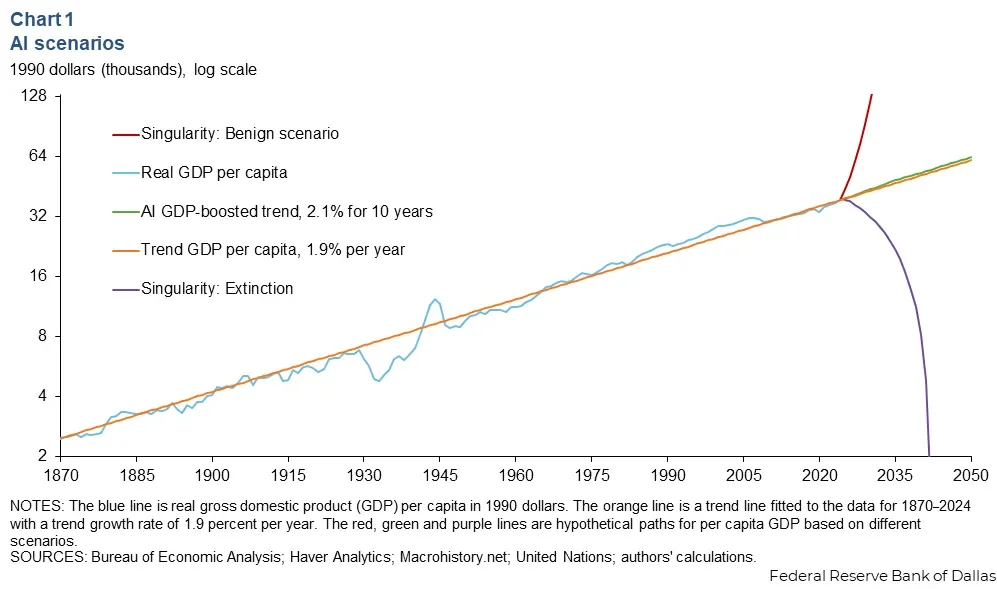
Before getting into the details of the five scenarios, there’s an important methodological point. People often believe that scenarios are attempts to predict the future — but that’s not true. Scenarios are a rigorous and methodical way to consider several imagined future situations which could come to pass, but they don’t have to happen in order to be useful. They’re designed to be different from one another, and their value lies in helping policymakers identify trends and useful courses of action across a wide range of potential outcomes. That’s to say, we should avoid the temptation to focus on the scenario we think is most likely because that’s not the purpose of such exercises. At the same time, they should still reflect plausible outcomes, otherwise you end up with AI scenarios like this unhelpful graph from the Federal Reserve Bank of Dallas.

How not to do AI scenarios (Source: Federal Reserve Bank of Dallas)

The scenarios outlined in the GO-Science report range from a ‘slow burn’, to ‘augmented growth’, to ‘take off’ — and provide a more nuanced picture than the graph above. The report looks at six ‘critical uncertainties’ for each scenario: capability, model access, security, adoption, labour displacement and global cooperation.

Across most scenarios, AI drives significant productivity gains, helps to transform public services and make them more accessible, and accelerates scientific breakthroughs in fields such as health and energy — which will likely become key drivers of Britain’s productivity growth.

At the same time, across all scenarios, even in the slowest, the nature of cognitive work changes significantly, with routine, execution-oriented tasks being automated. There’s also a risk that workers become overly reliant on AI and have trouble operating if it fails. Another finding that holds true across all scenarios is the uneven adoption of AI and the compounding effect that will have, with a bifurcation where some realise the tremendous potential of AI while others are left behind.

It may not be the most groundbreaking report, but should serve as a good tool to help policymakers think more systematically about the future of AI and its adoption.

Ian Ng, Researcher

The Trump administration placed Anthropic’s Fable 5 under export control last Friday, barring foreign nationals from accessing it. Anthropic responded by disabling the model for all customers. The ban came a day after the Europe 2031 essay imagined precisely a world in which Washington rations AI exports as a geopolitical lever. AI Minister Kanishka Narayan drew the obvious lesson: “access to AI capabilities is crucial.”

Europe’s dilemma is rooted in having no frontier model of its own. Adopt American models and you cede control of the access lever; adopt them slower than the US and the productivity gap only widens. If the past year has demonstrated anything, it’s the value of sovereignty and autonomy.

We live in an economy defined by chokepoints. Just as the Netherlands has ASML and Taiwan TSMC, Britain must think about the leverage we can build. We do have a seat at the table as a signatory of Pax Silica and the AI Security Institute being one of the few trusted to evaluate Mythos. However, it does not guarantee access to frontier AI models. The US has already floated a “trusted partner” scheme granting close allies privileged access. The tiers are being drawn now, and Britain cannot be sure if it will retain such access in future.

Leverage cannot be built overnight. The nature of a chokepoint is that once built, it cannot be easily replicated. ASML took four decades and an extraordinary accumulation of tacit knowledge across 5,000 suppliers. But that is precisely the argument for doubling down now. Britain, through our higher education sector, still holds an edge on talent. Our universities produced the researchers behind DeepMind and Arm. Without strategic chokepoints of our own, it matters all the more that we sharpen the edge that we still have and do everything to retain that talent.

Keeping talent is not solely about money because Britain will not win a bidding war with American labs. It is about whether there is anything here to work on. For frontier researchers that means compute, and the gap is stark: Isambard-AI, our most powerful machine, ranks eleventh in the world, while the top three are all American exascale systems.

We are not going to out-spend Washington. Government funding for British compute — £1 billion for AIRR, £750 million for Edinburgh — is barely a tenth of the £22 billion Microsoft alone is putting into the UK. Accepting American capital is unavoidable, and any honest plan builds most of its capacity that way. But some must sit on a sovereign core — publicly held compute backing British firms directly. AIRR is how Britain avoids having to 'rent its AI future from abroad’.

If the shelving of the Edinburgh supercomputer and the pausing of OpenAI’s Stargate UK were not wake-up calls enough, the export ban on Fable 5 should be. Certainty over the long term funding is crucial to attracting investment and retaining talent. That requires fiscal discipline from the government — both resisting borrowing for day-to-day spending as well as resisting the urge to axe capital projects when money is needed elsewhere.

None of this delivers leverage Britain can wield alone. But the fundamentals built at home are what give us something to bring to a table we cannot dominate.

Three Big Ideas #62

🏗️ Philip Salter, Founder

Since 1970, productivity across most of the American economy has roughly doubled. In construction, it has fallen by around 40%. A new VoxEU column by Dongkeun Choi and Munseob Lee unpacks why.

The fall in the price of equipment — computers, machines, instruments — has been one of the great engines of the post-war economy, adding around 1.3 percentage points a year to growth in output per person. But structures have moved the other way. The relative price of buildings in the US is now 80% higher than in 1970, and that rise claws back almost two-fifths of the gain from cheaper machines. The net contribution of falling capital-goods prices is therefore closer to 0.8 points than 1.3.

“About three-quarters of the drag runs through standard capital deepening. When structures are expensive, firms accumulate less of them, and production slows accordingly. The remainder operates through innovation. Laboratories, offices, and pilot plants are themselves structures. Stagnant productivity in construction raises the cost of doing science.”

This is not an American curiosity. Choi and Lee examine thirteen advanced economies, and all but Belgium sit in the same troubling quadrant: construction prices up, construction productivity down. Across the entire sample, the UK records both the largest fall in construction productivity and the steepest rise in the relative price of building.

Why has construction forgotten how to build? The leading suspect is regulation. Hilber and Vermeulen show that the restrictiveness of the UK’s planning system, more than any physical shortage of land, drives the long-run rise in house prices; D’Amico and co-authors tie America’s construction-productivity stagnation directly to land-use rules. A planning regime that makes every project bespoke, contested and slow has meant construction is one of the few industries that never industrialised — it never achieved the scale economies and standardisation that lifted output almost everywhere else.

This resembles Baumol’s cost disease. When productivity stalls in one sector but the rest of the economy still needs its output, the relative price rises and everyone else pays for it. What makes construction unusual is that there is no way to route around it: the economy cannot make do with fewer hospitals, fewer fabs or — increasingly — fewer data centres. The cost of standing still in construction shows up everywhere.

As is often argued, restrictive planning acts as a tax on housebuilding. But it has also held back innovation in the construction industry. Alongside planning reform, we need to look deeper at what’s made us less efficient at building.

🏹 Mann Virdee, Head of Science and Technology

When I was invited to give evidence before the Business and Trade Select Committee on industrial strategy, I emphasised three main points. First, a few outliers skew the statistics on British science. Once they’re removed, British science isn’t quite so ‘world-leading’. Second, the state can play an important role in procurement, such as through Advanced Market Commitments, and in de-risking the journey to market for entrepreneurs. Third, I offered some historical background on how Silicon Valley came to be the world’s pre-eminent hub for innovation and entrepreneurship.

But one question from the committee stumped me slightly: how effective is the Catapult Network? It’s a part of the UK’s R&D ecosystem I hadn’t really looked into in detail, although my overwhelming sense was that the Catapults were usually an afterthought in conversations about innovation and commercialisation I’d been part of. I thought it best to say nothing rather than pretending I had a more considered response.

The Catapult Network was created in 2011 after a report by Hermann Hauser that proposed an elite network of centres to help translate breakthrough scientific discoveries into commercial industries. It was modelled on 12 international comparators, including Germany’s Fraunhofer institutes.

There have been a series of reviews with mixed findings. A 2014 review called for doubling down on the approach, saying that it was mirroring international comparators, and recommended expansion. A 2017 review by Ernst & Young found that the centres were not being properly managed and that they had no common purpose statement. A 2021 government review recommended reviewing the Catapults less often, but it also found that the High Value Manufacturing Catapult alone had generated 75% of all the Catapults’ income the previous year, showing a highly uneven impact.

Against this background, there are reports that ministers are lining up another review of the Catapults to assess their value and impact after concerns that some have failed to support regional growth and help build national champions. It’s rumoured that streamlining and job cuts may be on the cards.

I recently wrote about an OECD report on the ‘valley of death’ between Britain’s strong support for research up to prototype and its thin support for demonstration, customer validation and early market entry. That report’s proposed solution was to expand the commercialisation role of the Catapults.

So the function clearly matters. The gap the Catapults were built to fill is, if anything, widening. The question remains whether these particular institutions are still the right vehicle for the job.

One approach is to keep tinkering and topping up funding, hoping that some future permutation works. The other is to know when to call it a day and build something new with a sharper remit, explicitly tied to growth and closing the demonstration-to-market gap. Founders I’ve spoken to lean towards the latter. But before we can choose well between these, we need an honest diagnosis of why the Catapults are underperforming — and what, concretely, we would do differently.

📈 Rafi Pollack-Joyce, Policy Analyst, Public First

Tony Blair’s intervention last week has put AI in the public sector at the heart of the fledgling Labour leadership debate. But is he right that governments can harness the technology to deliver more with less?

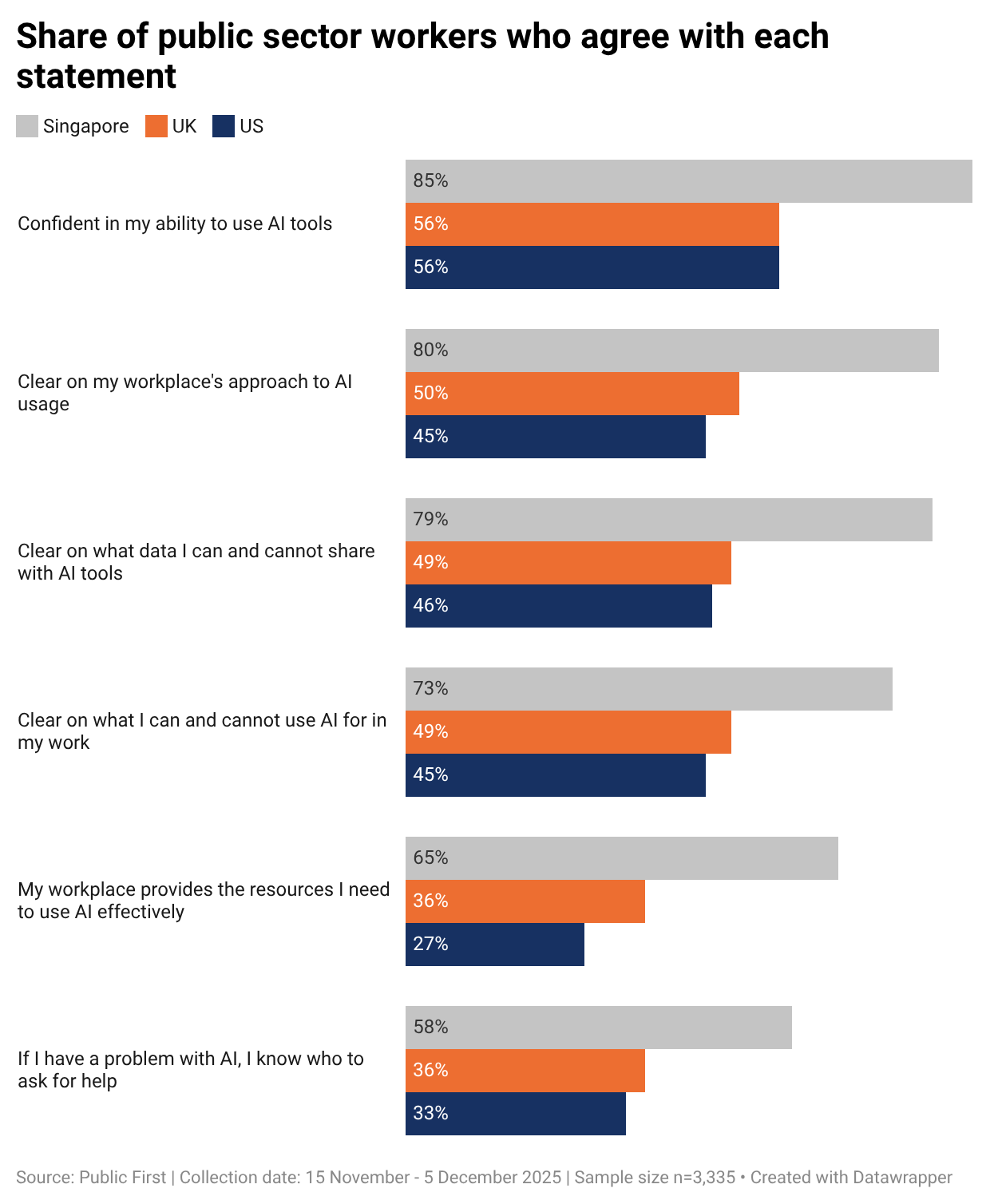
Earlier this year, Public First surveyed 3,335 public sector workers across ten countries. The headline finding is striking. AI is everywhere. Around three-quarters of public servants now use it, and most started in the past year. That probably makes AI the fastest-adopted technology the public sector has ever seen. But there’s a big difference between using a tool and changing how the government works.

The countries doing best aren’t simply the ones with the biggest AI sectors. They’re the ones that have made AI feel usable inside government. That means clear permission, decent training, approved tools, and a way for good experiments to become normal practice.

Singapore is the clearest example. Its advantage isn’t magic technology. It’s that public servants have more of the scaffolding around them: guidance, tools, training and institutional support. For example, Singapore is twice as likely as the UK or US to conduct mandatory training for employees. The results are clear: compared with the UK and US, Singaporean public sector workers are more than twice as likely to use AI daily, to be using it for complex tasks, and to think the public sector in their country overall is using it effectively.

The UK and US have a more awkward problem. Both are AI leaders in the obvious sense, with companies, researchers and policy attention. But inside government, use is patchier. People are interested, and often already experimenting, but many still don’t have clear guidance on what they’re allowed to do or how to move beyond low-risk tasks. While just over half of public servants in the UK and US feel confident using AI tools, that rises to 85% in Singapore.

That matters because unclear permission doesn’t necessarily stop AI use. It just makes it messier. People experiment on personal accounts, stick to shallow use cases, or run pilots that never really scale.

Ultimately, this is fixable. The hard part isn’t persuading public servants that AI matters, it’s building the basic machinery around it: procurement, guidance, training, data access and routes to scale.

Blair is right that AI could change the state. But the first test is more mundane: whether the government can manage the adoption that’s already happening

Three Big Ideas #61

🧑‍💼 Philip Salter, Founder

AI adoption is usually discussed in terms of cost and compute. In More Than Just Plug and Play, a working paper published this month, Diane Coyle and colleagues at the Bennett School use the ONS Management and Expectations Survey to show that UK firms with stronger management practices in 2020 were significantly more likely to go on to adopt AI by 2023.

Digging a bit deeper, it turns out different technologies call for different organisational capabilities. The same management practices that predict AI adoption show no relationship with the adoption of robotics, specialised software or specialised equipment.

We already know the UK has a management problem. Nick Bloom and John Van Reenen’s seminal 2007 paper introduced a structured way of measuring management practices across firms and countries, and the body of work that followed has consistently shown UK firms lagging US counterparts — with a particularly long tail of badly managed firms dragging down the productivity distribution. The policy response has tended to bundle this into general management improvement — training, peer learning and leadership development — rather than targeting the specific practices.

The new evidence narrows the target. As the paper notes, “it is specifically monitoring practices, such as use of KPIs and target-tracking, along with decentralised product development, that predict adoption.” Practices around continuous improvement and employment had weaker or insignificant effects.

Among multi-site firms, those where product development decisions sit closer to the frontline were more likely to adopt AI. The authors suggest “AI applications are more likely to be context-specific and require domain or technical knowledge to identify valuable use cases.” The combination of autonomy and measurement is the specific organisational structure that predicts AI adoption.

The policy implication is that management training interventions may be better targeted on capability-building around performance measurement and data architecture, combined with organisational design that empowers technical teams.

Policy aside, there’s a lesson here for founders bullish on AI. You don’t need a government programme to adopt the organisational shape this research describes. Building KPI infrastructure and pushing product decisions closer to the people who understand the work is something firms can do on their own. The companies that get this right won’t be waiting for policy to catch up. (Mann picks up the structural side of this problem below.)

💻 Mann Virdee, Head of Science and Technology

The OECD, in collaboration with the Department for Science, Innovation and Technology, recently released a report on technology adoption in the UK.

On the one hand, their findings indicate that British firms do well on mature digital technologies. The UK’s adoption of cloud computing, data analytics and basic process tools sits above EU and OECD averages, and SMEs have largely closed the gap with larger firms in using these foundational tools. On the other hand, for more advanced technologies, such as AI, robotics and automation, uptake is more limited than one would expect for a country with the UK’s income level (see Philip’s article above).

Take robotics, for example. The UK has a strong manufacturing legacy, particularly in the Midlands — yet adoption of robotics among manufacturing firms trails the EU average. The OECD attributes this to a mix of factors that compound in smaller manufacturers: high upfront costs, the average age of business owners, distrust of technology vendors, and a ‘wait-and-see’ approach whereby firms only adopt after peer validation. Each barrier is manageable in isolation, but together they create a structural drag on uptake in the sector in which the productivity dividend should be largest.

Geography compounds this problem. The OECD’s data on regional adoption finds that between 2018 and 2022, average SME adoption of AI and robotics technologies stood at around 15% in London and the South-East, but just 1.9% in the North-East. The concentration in the Golden Triangle is well-documented, but the within-region picture is just as stark. In the West Midlands, the Black Country trails most innovation indicators despite sitting next to one of the UK’s strongest industrial clusters.

The OECD’s overarching diagnosis is that Britain supports research well through to prototype (Technology Readiness Level (TRL) 6–7), but that support thins out at the stage of demonstration at scale, customer validation and early market entry (TRL 8–9). It’s at the later stage that firms package innovations into off-the-shelf products with the reliability and support that allow non-frontier SMEs to adopt them. Without that later stage of support, brilliant science struggles to become widely diffused technology.

The report’s proposed solution is to expand the commercialisation role of the Catapults, paired with the British Business Bank to crowd in private co-investment. For our part at The Entrepreneurs Network, we’ve been bringing together robotics founders with the Regulatory Innovation Office and the Health and Safety Executive to try to make their scaling journey smoother — exactly the kind of intermediary work the TRL 8–9 gap demands at scale.

🛡️ Harry Pitts, University of Exeter

Britain’s drive towards defence reindustrialisation and rearmament will depend on whether smaller, more agile firms can be integrated into the defence supply chain. In a new report for Babcock, The Next Line of Defence: Unlocking SME Potential in UK Defence from Policy to Practice, our team at the University of Exeter’s Defence, Security & Resilience Network found that the primary barriers relate to culture and process.

We interviewed 20 cutting-edge defence SMEs, both those well-established in the supply chain and those pivoting in from civilian sectors. The picture that emerged is of significant capability waiting to be unlocked, set against procurement systems that struggle to engage with it.

Ukraine’s high-tech resistance to Russia’s invasion has demonstrated what agile, software-led innovation can do on the modern battlefield. The UK has firms capable of producing similar capabilities at pace, but defence procurement, administrative systems and financing frameworks remain designed around large, established suppliers operating on multi-year cycles.

SMEs need credible demand signals to justify the investment and recruitment that scaling for defence requires. The forthcoming Defence Investment Plan is the obvious vehicle, and its credibility with the SME community will depend on how concretely it signals where money will flow and over what timeframe.

There is also a vital role for primes — the large, established contractors that sit between government and the SME base. Our interviews suggest that the most productive prime–SME relationships invert the usual power dynamic, with primes acting as supporting partners that help smaller companies articulate the value of their products to government, navigate procurement processes and bridge the gap between SME agility and government risk aversion. This is a markedly different role from the traditional one of subcontracting work down a tiered supply chain.

Babcock’s SME Engagement Charter, informed by our evidence, is an attempt to formalise this. Against a backdrop of rapid geopolitical change, primes have the power to realise in practice the promise of government policy in this domain.

Three Big Ideas #60

🧠 Mann Virdee, Head of Science and Technology

Google DeepMind is perhaps the most transformative startup Britain has produced. It’s now synonymous in the minds of many, myself included, with its protein structure prediction system, AlphaFold, and the 2024 Nobel Prize in Chemistry.

But did you know that to secure early funding, DeepMind’s CEO and co-founder Demis Hassabis once had to pitch investor David Gammon at his home — during which he was also required to win approval from Gammon’s wife and three teenage sons? It seems strange now that such a successful company could have been set back or derailed if just one of them hadn’t been convinced by his pitch.

It’s one of many stories in Sebastian Mallaby’s new book The Infinity Machine, which follows DeepMind’s rise from a startup in a Russell Square townhouse to the heart of Google’s operations. It’s well worth a read for those who want to understand what it takes to be a successful entrepreneur, as well as to explore broader questions about the future of scientific research, the nature of consciousness and the potential of artificial intelligence.

The family-veto story is important. In 2010, no British venture capitalist was set up to fund a company whose stated mission was to ‘solve intelligence’. That meant that Hassabis had to piece together funding from Peter Thiel, Elon Musk and others. By the start of 2014, the money had run out and the only viable option was to sell to Google.

Some mistakenly draw the conclusion DeepMind should not have sold to Google. But Google’s compute and resources were necessary for DeepMind to thrive. The lesson is a broader one. Britain still struggles to fund moonshots at the scale and time horizon they need.

It’s been said time and time again that our universities are world class. So too are our founders. But the patient, multi-billion-pound bets that turn blue-sky research into world-leading companies remain largely an American endowment. Closing that gap is partly about R&D and tax design, and partly about cultivating high-conviction angels and family offices willing to back unproven founders with audacious ideas.

That makes the recent news from David Silver, Hassabis’s old Cambridge friend and the man behind AlphaGo, feel like a test. Silver’s London startup Ineffable Intelligence has raised $1.1 billion at a $5.1 billion valuation, which is the largest seed round in European history, with the UK’s Sovereign AI Fund investing alongside Sequoia, Lightspeed, Nvidia and Google. The capital is still mostly from the US, but the company is British. It remains to be seen whether we can keep it that way as Ineffable scales — and whether we can grow and support more companies like it.

🐝 Philip Salter, Founder

Britain’s productivity problem is, in part, a problem of its big cities outside London underperforming. Manchester, Birmingham, Leeds, Glasgow — in most comparable countries, second-tier cities punch above the national average. In ours, they don’t. Closing that gap matters not just for the people who live there but for national prosperity.

A new CEP paper from Aadya Bahl and Henry Overman, Hive of Talent, uses Greater Manchester as a case study to ask what it would actually take to close one component of that gap: skills. The numbers are sobering. Manchester’s productivity sits 35% below London’s, against a 20% gap between, for example, Paris and Lyon. Even partly closing it would require — among other things — an additional 180,000 workers with degree or sub-degree qualifications.

The paper considers three pathways through which Manchester adds graduates: people who grow up there, people who move there to study, and people who move there for work. On the local cohort, even matching London on both attainment and retention, the GCSE pathway would generate only an extra 4,285 graduates a year. The local cohort is “just too small relative to the size of the workforce for even quite sizeable improvements in attainment or retention to generate the scale of changes needed.”

Manchester’s universities attract and retain around 11,400 graduates from outside the city region each year, but a meaningful slice of that depends on international students. The Government’s Immigration White Paper may dampen this significantly. And on non-education migration, the picture is similarly fragile. Manchester currently gains around 2,606 graduates a year through net international migration but loses 1,219 to the rest of the UK, for a net gain of about 1,387. Halve net international migration and the net gain shrinks to just 84 a year — a fall of roughly 1,300 graduates through this channel alone.

As the paper acknowledges, keeping more skilled workers in Manchester only helps if there are skilled jobs there for them to do:

“London benefits from a unique concentration of universities, high-skilled employment opportunities, and strong graduate labour markets that attract and retain graduates from across the UK and internationally… replicating these conditions in [Greater Manchester] would require changes that go well beyond skills policy alone, as factors such as labour market opportunities, wages, and supporting infrastructure all shape graduate location choices.”

The wider lesson is that no single lever moves the dial, and the supply-side levers don’t move it at all if the demand-side jobs aren’t there to absorb the workers. For founders and policymakers tempted by simple stories about either just fixing schools or visas — important as both are — this is a useful corrective. Manchester’s skills problem is a coordination problem, and one the rest of Britain’s big cities, with smaller cohorts and weaker universities, will face in even less forgiving forms.

💼 David Bharier, British Chambers of Commerce

By the late 1990s, most businesses had a website. While many firms simply replicated their brochures online, a smaller group — from Amazon to early digital-native retailers — built their operations around the technology entirely. It was that depth of adoption, not the speed of uptake, that ultimately separated the winners from the rest.

We may be seeing a similar pattern emerge with AI. Much of the current debate focuses on how quickly firms are adopting the technology. On that measure, the UK appears to be moving at pace. Analysis conducted with the University of Essex, using British Chambers of Commerce survey data from early 2026, finds that over half of SMEs are now using AI in some form, up sharply from around a third last year.

But this headline figure masks a more important reality: not all AI adoption is equal. For most firms, AI is not yet translating into meaningful workforce change. Around 95% of users report no impact on headcount, while 86% say job roles remain unchanged. This reflects the fact that most businesses are still using relatively light-touch, off-the-shelf tools — such as ChatGPT or Copilot — to support existing tasks rather than fundamentally redesign them.

The picture looks very different among the smaller group of firms embedding AI more deeply into their operations. Among these businesses, around one in five report staffing reductions attributable to AI, and they are more likely to have reorganised job roles. So it is not adoption itself that is driving change in the labour market, but the intensity of it. This distinction matters. Workforce restructuring may be concentrated among a relatively small but potentially growing segment of firms with adoption.

The key question now is whether this group remains niche or begins to grow. If it does, the lesson from the early internet era is clear: it will not be the firms that simply “use AI” that shape the future, but those that reorganise themselves around it.

In a labour market where wage floors have risen sharply and new firms are taking on fewer staff, the challenge for policymakers and businesses alike will be to ensure that this transition delivers productivity gains while bringing the workforce with it.

Three Big Ideas #59

🔬 Mann Virdee, Head of Science and Technology

It’s not new or insightful to note that Europe struggles when it comes to converting bright ideas and cutting-edge science into unicorns.

What is new, however, is a recently published comparative study in the Journal of European and International IP Law which seeks to explain why. The researchers looked at the legal frameworks of the United States, the United Kingdom and Italy and found a structural difference in how these countries deal with technology transfer (TT). In particular, they claim that the strictness of regulation is less important than the clarity of the regulation.

On one side you have the US model, rooted in the 1980 Bayh-Dole Act. This Act transformed TT by allowing universities, small businesses and non-profits to retain IP for inventions developed from federally funded research, as well as to license discoveries from that research to private-sector partners. That provided a big incentive for universities and researchers to turn discoveries into viable consumer products.

The authors of this study argue that the US model has succeeded because it has created a predictable and coherent regime which gave universities clear ownership of IP, and which also gave investors confidence to invest. The UK has tried to mirror the US model and has been moderately successful, resulting in what the authors call a ‘relatively mature environment’. Both the US and UK models benefit from having clear institutional ownership and Technology Transfer Offices (TTO).

On the other side, there’s Italy’s fragmented model. Italy produces lots of spin-outs but no unicorns (with the notable exception of Bending Spoons, a Milan-based tech conglomerate whose focus is on acquiring and managing products such as Evernote). In Italy, the lack of clear, universal legislation creates a network of ‘autonomous rules’ that leaves founders and investors in a state of constant uncertainty.

So while the US and UK have stricter regulations around academic-entrepreneurial roles than Italy, the authors of this research contend that the ‘coherence, accessibility, and institutional robustness of TT regulation are decisive factors for the emergence of university-born scale-ups’.

Or, to put it another way, clear regulations — even if stricter — are better than vague ones. When a founder knows exactly how many days they can consult (for example, around 13 days at Stanford) and who owns the IP, they can get on with the business of scaling.

Although the UK is in a strong position, there’s more work to be done to streamline TTO processes. Scientific excellence is only half the battle. The other half is ensuring our legal and institutional frameworks are configured to let that excellence evolve into global success.

📚Philip Salter, Founder

In 2008, Clayton Christensen’s Disrupting Class was published, arguing that schools were on the verge of being disrupted. Built around a factory model of standardised content, uniform pacing and batch processing of children, he argued that they were structurally incapable of personalising learning to individual needs. Technology, he contended, offered a way out — not by improving the existing model, but by routing around it entirely.

Christensen predicted that 50% of high school courses would be delivered online by 2019. They weren’t. Billions had been spent putting computers into schools, yet the technology has simply been co-opted into the existing model of instruction.

Last week’s government announcement, which invites EdTech companies to build AI tutoring tools for disadvantaged pupils in the UK, is encouraging. As the press release acknowledges, private tutoring can accelerate learning by up to five months, but it remains the preserve of those whose parents can afford it.

The ambition is right, but Christensen’s insights call into question the design: “Plugging a disruptive innovation into an existing business model never results in transformation of the model; instead, the existing model co-opts the innovation to sustain how it operates.” The Pioneer Group — eight companies, curriculum-aligned, teacher co-designed and DfE safety-approved — is structurally set up to do exactly that. Given the constraints any government programme operates under, it’s perhaps inevitable.

The Pioneer Group will co-design, pilot, evaluate and report, with national rollout targeted for 2027. While this is a relatively ambitious timeline for government, the technology is moving at breakneck speed. There is a real risk this programme institutionalises a version of AI the market has already moved two generations beyond.

In truth, the disruption Christensen predicted is already happening. A motivated 14-year-old with a capable AI can already access something closer to a genuine Socratic dialogue on any subject than most classrooms offer — without a Pioneer Group, without curriculum alignment and without waiting until 2027.

🎓Ayushma Maharjan, Centre for Policy Studies

The UK is one of the best places in the world to produce ideas. But few of those ideas are turned into commercial strength at home. Britain’s academic strength is hard to dispute. Ten of the world’s top 50 research universities are British. However, that scientific excellence has failed to proportionally translate into a dense network of R&D-active firms and the scale-up ecosystem needed to translate research into economic output.

The gap is clear in the data. Cambridge and Oxford rank only 69th and 77th globally as innovation clusters, a striking contrast to their top five standing in university rankings. A country can be brilliant at science and still underperform if little R&D happens inside businesses.

Analysis done by the Centre for Policy Studies suggests that the UK higher education sector performs a relatively high share of national R&D, at around 24%, compared with 11% in the United States. The UK business sector, by contrast, performs about 70% of total R&D, below the roughly 80% share seen in the United States. In leading innovation economies, every dollar invested in higher education R&D is matched by $7 to $9 in business R&D. In the UK, that ratio is less than $3.

One plausible explanation for the UK’s position is that Britain’s wider business environment is not attractive enough for firms to build, test and scale. This is clear from companies like AstraZeneca and OpenAI, which have chosen to halt investment or move activity elsewhere citing tax burden, regulatory complexity and high energy costs.

If Britain does not address this problem, the economic returns on British science will continue to be captured elsewhere. Evidence suggests 80% of UK university spin-out IPOs have taken place overseas since 2012. Likewise, despite ranking highly in AI research, the UK retains only 48% of its talent.

No amount of tax credits or industrial strategies can compensate for a hostile business environment. The UK needs a more innovation-friendly economy. For entrepreneurs, that means a simpler and predictable business environment, competitive taxation, and stronger incentives to stay and scale in Britain.

Three Big Ideas #58

🌍 Philip Salter, Founder

Is Europe losing its startups? That’s the question addressed in a new paper from the EU’s Joint Research Centre. The answer, of course, is yes: around 3.3–4.3% of European VC-backed startups relocate their headquarters abroad — roughly 10 times the rate of comparable non-VC-backed firms.

The United States dominates as a destination, accounting for around three quarters of moves, with San Francisco, Boston and New York the favoured landing spots. The picture is more nuanced than the headline suggests, though, as 97% of relocations are partial, meaning firms keep operations in their home country, and in a quarter of cases the CEO doesn’t move. Perhaps most concerning, relocation is concentrated in the earliest years. Nearly half of firms leave within their first three years, before they’ve had a chance to embed locally through hiring or R&D, and this is skewed towards asset-light sectors like IT — precisely the high-value, high-growth industries Europe most wants to keep.

The most ambitious firms are the most footloose, with other research cited finding relocation rates of around 13% among larger scaleups and nearly 30% among unicorns. The primary driver is that US investors frequently require — or at least prefer — a Delaware-incorporated parent as a precondition for funding.

Whether this amounts to a serious loss is genuinely unclear. On the one hand, a Delaware flip might allow a firm to raise the round that creates hundreds of jobs back home; or it might be the first step in a gradual shift of gravity westward. Research cited in the paper suggests that around 65% of the workforce ends up in the country of relocation among firms that eventually IPO, but without US funding there might never have been an avenue to scale.

For the UK, the picture cuts both ways. Britain is the second most popular destination for relocated European startups, capturing around 7% of moves — a reflection of genuine strengths in the UK’s entrepreneurial ecosystem. That shouldn’t be surprising: our own research finds that 54% of Britain’s 100 fastest-growing companies have a foreign-born founder or co-founder, drawn from 29 countries across every continent bar Antarctica.

Policymakers in the UK — and actors in our entrepreneurial ecosystem — might be best focused on competing for a larger share of the startups that are going to move anyway. To that end, the Migration Advisory Committee is currently reviewing the Global Talent and Innovator Founder visa routes. Ease of movement won’t solve everything — there are many building blocks we need to put in place — but getting the visa regime right is a necessary condition for the UK to make the most of its position as Europe’s most attractive destination for mobile entrepreneurial talent.

🚔 Eamonn Ives, Research Director

I’ve written previously for Three Big Ideas about evidence suggesting that the gig economy helps to both lower unemployment and boost entrepreneurship. This week, more data emerged that further buttresses the case for gig work. In a new paper, the authors show that the rollout of Deliveroo and Uber Eats in France between 2015 and 2019 caused a reduction in crime rates.

Overall recorded crime falls by 3% following a platform’s entry to a local labour market, but there is an especially steep decline in ‘low-skill property crime’ — such as shoplifting and street robberies. There is little impact on ‘high-skill property crime’ — such as burglary and vehicle theft — but that result, if anything, bolsters the theory the authors put forward. Gig work is disproportionately performed by young men with limited formal qualifications, or people who face labour market discrimination such as migrants. By offering these individuals an opportunity to earn an honest living, platforms reduce their ‘need’ to engage in acquisitive crime. This is standard rational choice model thinking, as first espoused by criminal economists like Gary Becker over 60 years ago, which states that when legal work becomes more accessible, the opportunity cost of offending rises.

Beyond this, the paper also shows how the spread of gig platforms correspond with a reduction in vandalism and drug crime, because, the authors explain, “[t]hese offences are disproportionately committed by adolescents and young adults and tend to be concentrated in the evening and weekend hours that delivery shifts occupy.”

As noted above, plenty of evidence now exists of the purely economic benefits of gig work, especially for marginalised people. What’s interesting about this study, however, is how it illustrates how gig work has positive, broader societal impacts too. It raises the question of what other virtuous effects such platforms might be having on society, and implores policymakers to weigh these accordingly when regulating them.

⚛️ Mann Virdee, Head of Science and Technology

There are some technologies that seem to be perpetually on the periphery of productive commercial use. The running joke for nuclear fusion is that it’s always 30 years away. For quantum, it’s usually 10 years away. I was thinking about this yesterday as I visited Oxford Quantum Circuits (OQC), a spinout from the University of Oxford’s Department of Physics that’s about to raise a Series C.

Earlier this decade, the quantum computing industry went through a bit of a crisis of confidence and there was frequent talk of a ‘Quantum Winter’. But that’s perhaps a natural response to the quantum hype and those labelling the technology ‘bigger than fire’.

At the time, the industry was focused on increasing the number of qubits (quantum bits) in a quantum computer without the need for full error correction (which protects quantum information from errors). But it soon became clear that tackling the source of those errors, noise, was critical to opening up productive applications of quantum computing.

To be clear, there are still sceptics who believe that quantum computing cannot deliver on its promises. But a pivot towards fault-tolerant quantum computing has led to a measured and widely-shared increase in confidence about its near-term utility and the need to prepare for a world with quantum computers.

A blog last week from Google Research suggests that quantum computers could break cryptocurrencies sooner than previously predicted. They argue that there is still time for blockchains to migrate to post-quantum cryptography to ensure they are resilient to quantum attacks, but that time window is shrinking.

The deadline to prepare for quantum computers and the capabilities they will begin to unlock has been brought forward to 2029. That’s not to say we will have fully productive quantum computers by then, but that firms should be prepared.

Some applications such as fraud prevention are likely to be the lowest hanging fruit for quantum computers and can be tackled in the coming few years in the range of millions of operations. As that progresses to billions and trillions, it should open up other applications such as drug discovery.

The UK is well placed to capitalise on this. The Government recently announced funding of up to £2 billion to support the development and commercialisation of quantum technologies, and help strengthen Britain’s quantum pipeline. With the creation of our new Science and Technology Forum, we’ll be doing our part to support founders in quantum and across all areas of science and technology in growing and scaling their businesses.

Three Big Ideas #57

🤖 Philip Salter, Founder

That vast tracts of our lives are now conducted in concert with and through digital technology is taken for granted by anyone growing up today. For the next generation, the same will be true of artificial intelligence. But, for those of us living through this paradigm shift, the uncertainty can be disconcerting.

Anthropic recently published findings from a large-scale qualitative study of more than 80,000 Claude users across 159 countries. As you might expect, the headline results are mixed: 28% cite economic empowerment as a benefit, while 18% fear displacement.

I will focus on the findings most relevant to entrepreneurship and the UK, though there are broader insights worth digging into.

Globally, 8.7% of users identify AI’s primary promise as helping them build and scale businesses. This is especially pronounced in Africa, South and Central Asia, the Middle East and Latin America, where AI is viewed as a capital bypass mechanism — in other words, a way to start businesses without traditional funding, hiring or infrastructure.

Independent workers and entrepreneurs appear to be the clearest economic beneficiaries. Nearly half report tangible gains from AI, compared with just 14% of institutional employees (47% vs 14%). Those running side projects benefit most, with 58% reporting economic gains.

While the report does not drill down specifically into the UK, it does reveal that Western European sentiment is slightly less positive than the global average (65% vs 67%). Concerns in the region centre on surveillance, privacy and governance. In developed economies like the UK, “life management” resonates more strongly than entrepreneurship, with users more likely to see AI as a tool for managing already complex lives.

This last point may come to matter a lot.

Nobody truly knows how quickly AI will come to dominate, but based on recent performance, those at the most bullish end shouldn’t be discounted out of hand. This will unlock economic growth, but also disrupt much of the status quo. Those with the skills and mindset to build with AI will flourish, as will the countries in which they live.

💊 Eamonn Ives, Research Director

In our latest UK AI Fieldbook interview, Murat Tunaboylu explained how artificial intelligence holds extraordinary promise for novel drug discovery.

One question I was particularly keen to get Murat’s thoughts on concerned whether or not our regulatory system was ready to handle a potential coming tidal wave of innovation. If AI does radically accelerate drug discovery, regulators could be inundated with approvals. In this world, innovation might be happening in one sense, but, in a more meaningful one, the benefits will lie dormant, waiting until a regulator gives groundbreaking drugs the green light.

As it happens, Murat was optimistic that we will avoid a backlog. But it nonetheless got me wondering about how we might be able to tweak regulatory approval systems to future-proof against sclerosis — in healthcare, and in other areas too.

One thing we discussed was the Medicines and Healthcare products Regulatory Agency’s pioneering approach to regulating the ‘processes’ involved in developing drugs, rather than individual drugs themselves. A not too far-fetched analogy here might be that if you asked a half-decent chef to cook you a meal from scratch, you’d probably trust them to make something edible simply by relying on tried and tested culinary techniques, rather than needing to forensically inspect whatever dish they eventually plate up for you.

An obvious riposte to this approach to regulation is that it could result in lower safeguards for things we consider extremely important. There may well be reasons why in some industries we very much do want to closely monitor final products and ensure they’re safe for their intended uses — be that drugs, or food, or anything else.

Perhaps we should therefore look to apply it in areas where there’s little to lose from a loosening of standards. In healthcare, this may be allowing companies working on hitherto ‘untreatable’ diseases to offer trials to patients who currently have no alternative. In logistics, it might be giving a longer leash to autonomous vehicles or drones operating in remote areas far from any human population centres. In education, it may be giving AI-powered teaching assistants to pupils for whom conventional teaching is unsuitable.

As more and more startups harness AI to advance innovation, an increasingly binding constraint on the good it could do will be our regulatory state. Now is the time to start thinking about how we can ensure it facilitates rather than frustrates modern miracles.

🧪 Mann Virdee, Head of Science and Technology

Some scientists are deeply committed to the idea of research as a good in and of itself — that is, simply to advance our understanding of the cosmos, even when its utility in our daily lives seems limited. For others, there is a strong societal dimension — they want their research to have a strong impact, such as in tackling climate change or in improving prosperity.

But that is a false dichotomy. Research can have spillover effects in all kinds of ways that may not initially be apparent.

So, how can we measure the spillovers from science into commercialised technologies? It’s an important question because quantifying spillovers helps us to understand the social returns from science and it’s useful for those designing policy.

That’s at the heart of a new discussion paper from the Centre for Economic Performance. The challenge is that the value scientific research generates in downstream technologies is diffused through chains of follow-on research.

The authors of this discussion paper propose a new measure called Science Rank, which uses combined patent and paper citations to assign a share of the private value of patented inventions to the scientific literature they directly (or indirectly) rely on.

The authors show that Science Rank outperforms other measures, such as patent-to-paper citation counts, in identifying influential scientific research. That’s because traditional metrics only count direct links from patents to papers. This is a bit like judging a tree by looking only at the trunk. It ignores the roots, the vast network of follow-on research that eventually leads to a breakthrough.

Science Rank is more effective at identifying the technological influence of foundational research than traditional metrics. For example, under conventional citation counts, nearly half of Nobel Prize-winning papers appear to have zero impact on technology. In contrast, Science Rank recognises the value of nearly all these prestigious papers, placing them in the top half of its distribution — with over 60% reaching the top 5%

The research also shows that the US remains the undisputed powerhouse not only in generating spillovers but also in keeping the commercial value domestic. The findings provide a more mixed picture for the UK; while we punch above our weight in generating global spillover value, a huge share of that value leaks out to foreign firms — as shown by the geography of beneficiaries.

Three Big Ideas #56

🤝 Philip Salter, Founder

Despite the performative antagonism of shows like The Apprentice and Dragons’ Den, anyone familiar with business knows that collaboration is critical for success. You only need to look at the concerns arising from Anthropic’s broken relationship with the United States Department of Defense to see the primacy of partnerships. And what’s true for one of the world’s fastest-growing companies is also true for Britain’s smallest — even more so.

In a new paper, researchers analysed over 17,500 UK firms from 2006 to 2018 across three government datasets, measuring innovation as the share of revenue from new-to-market products. They tracked whether firms collaborated with seven types of partners across four geographic levels and isolated how SMEs — 92% of the sample — benefited differently from partnerships compared with large firms.

The headline finding is that SMEs get the highest returns from collaboration with customers and suppliers compared with universities, consultants and government. On average, knowledge collaboration for innovation in SMEs is positively moderated by the regional proximity of collaboration partners — in other words, the closer the partner is, the greater the positive effects of knowledge collaboration. This matters most for university collaboration and exploration-oriented innovation; for customers and suppliers, however, the positive effects hold across geographic distances, including international.

University collaboration does positively affect SME innovation, but only when the university is nearby — regionally or nationally. The effect disappears or turns negative at international distances. Even then, the research suggests that the type of knowledge universities offer is harder for small firms to absorb and commercialise compared with the more applied, market-ready knowledge that flows from customers and suppliers.

Critically, government collaboration has essentially no measurable impact on SME innovation. This isn’t procurement but rather cooperation with government bodies or public research institutes specifically on innovation activities — joint R&D work or knowledge-sharing partnerships aimed at developing new products or processes.

The paper finds that homophilous partnerships — working with knowledge-similar, geographically close, supply-chain partners — produce the strongest measurable innovation outcomes for SMEs, at least when success is measured by new-to-market product revenue. The paper suggests that this can create echo chambers and might mean missing out on more transformative opportunities, but the data shows this is, on average, the best strategy.

So what are the policy implications? When it comes to SMEs, this paper suggests that government support should prioritise helping them deepen relationships with customers and suppliers — the partnerships that most reliably drive innovation. University–industry linkages — as currently delivered — may be overweighted, while international programmes requiring cross-border academic partnerships risk imposing costs on SMEs that outweigh the benefits. And, to be blunt, the data shows that entrepreneurs should think twice before working directly with government.

🪙 Eamonn Ives, Research Director

Plans to replace portraits of historical figures with pictures of quintessential British wildlife on bank notes will understandably be the one currency news story that gets all the attention today. Fun as it will no doubt be to see cuddly creatures adorn our legal tender, another altogether more important money-related media item also bubbles beneath the surface.

Today marks the last call for submissions to the Financial Services Regulation Committee’s inquiry on how stablecoins should be regulated in Britain. For the uninitiated, stablecoins are a form of digital currency, the value of which is tightly pegged to real-world assets — like cash or government bonds. This allows them to serve as a ‘stable’ unit of value, in the sense that one sterling-denominated stablecoin can always be redeemed at £1, a dollar-denominated one at $1, and so forth.

As Hugo Okada and Osian Guthrie note in our latest research paper, A Sterling Opportunity, stablecoins offer a host of potential benefits. For consumers, there’s the promise of greater financial inclusion. For businesses, cross-border transactions could become radically less expensive.

Where stablecoins could, however, pose more of a threat is to governments. If they continue on their meteoric rise — up tenfold in the last five years, with the market cap currently standing at around $300 billion — there’s always a risk that sovereign states will see their ability to regulate the money supply eroded. But, for a nation like the United Kingdom, there could also be significant upsides too.

Consider how stablecoins rely on high-quality assets — such as government bonds — to maintain their value. Simple economics tells us that this will drive bond prices up, and yields down. Servicing the national debt would in turn become cheaper. Public sector net debt is incrementally nudging down from the highs of the Covid-19 pandemic, but it still stands at 92.9% of GDP. In 2025-26, the Office for Budget Responsibility expects the UK to pay £114 billion simply to service that debt. Even in the best of times, that’s an awful lot of money that could otherwise be used for more productive ends.

Stablecoins won’t solve Britain’s debt problem entirely. But they might just help at the margin — through allowing cheaper borrowing, and by stimulating entrepreneurial activity in a clear growth sector. To seize their full potential, however, Britain needs a regulatory regime that’s fit for purpose. We should take heart from the fact that legislators are examining stablecoins closely — let’s hope their diagnosis and subsequent prescriptions are wise ones.

📝 Mann Virdee, Senior Researcher

On Sunday, our Adviser Sam Dumitriu highlighted a growing paradox in Britain’s approach to safeguarding nature: well-intentioned legislation designed to protect nature often has the opposite effect. By prioritising bureaucratic processes over purpose and outcomes, current laws offer the worst of all worlds. They fail to protect the environment and also prevent us from building the energy and transport infrastructure essential to decarbonisation.

This is part of a broader problem — the prioritisation of process over purpose leads to distorted outcomes. When we treat administrative compliance as the goal, we lose sight of the intended outcomes.

Legislation can also fail to serve its intended purpose because politicians are required to vote on complex regulations with limited time, information, and ability to stress-test. That’s not helped when the UK’s political system prioritises looking busy and constituency casework over the job of being a legislator. It’s worse for the entrepreneurial ecosystem because so few parliamentarians understand what it takes to be an entrepreneur or the competing pressures they face.

Take the example of the National Security and Investment Act. Its well-intentioned purpose is to allow government to scrutinise and intervene in business acquisitions, mergers, and investments that it believes will pose risks to national security. But its broad scope means that some startups and low-risk deals such as internal restructuring are unintended targets.

This all reflects an environment where the fear of making a wrong decision outweighs the benefit of trying a new approach. This “paralysis by analysis” leaves Britain with the highest energy costs in Europe and a regulatory regime that makes the investment environment more difficult for Britain’s entrepreneurs.

Addressing these failures requires better oversight as well as better regulation. That could include sunset clauses, formal review processes, and structured scrutiny from experts and practitioners after legislation has been passed. And there are many arguments for the reform of the House of Lords — not least its status as the world’s second-largest legislative body and the questionable expertise of some members — but the scrutiny and debate provided by the upper chamber should not be dismissed lightly; it remains a necessary, albeit imperfect, check on poorly drafted law.

Three Big Ideas #55

Eamonn Ives, Research Director

In the last few days alone, we’ve fielded a number of requests from journalists keen to know whether or not AI is having a discernible impact on Britain’s labour market. There’s certainly evidence to suggest that it might be, but the old adage of not confusing correlation with causation must be heeded. As I told both Bloomberg and The Telegraph, other factors — not least the increased tax burden of employing workers, plus new regulations that make it harder to fire underperformers — might hold more water for explaining the sustained rise in unemployment over recent months.

That being said, I think it’d be foolhardy to be too bearish on AI’s eventual impact on the world of work. A new working paper from Hemanth Asirvatham, Elliott Mokski and Andrei Shleifer gives credence to that hunch, and suggests change may occur quicker than we might expect. Their research studies how long it takes for various technologies to experience widespread adoption after being invented, and, crucially, how this has changed over time. What they find is striking — a tenfold decrease in ‘adoption lags’ since the start of the industrial age to today. Whereas it once took roughly 50 years for a technology to go from initial prototype to being diffused into the economy, it now takes only around five. While the authors do note AI has some properties that might somewhat slow its spread, they nonetheless believe there are reasons to believe its adoption will be rapid.

Source: Asirvatham, Mokski and Shleifer

Nobel-winning economist Robert Solow once famously quipped that “you can see the computer age everywhere but in the productivity statistics.” If Asirvatham, Mokski and Shleifer are right, we might not be able to say the same about AI for much longer.

🎓 Mann Virdee, Senior Researcher

Here’s something to think about: since the turn of the millennium, the number of doctoral students has more than doubled globally and is increasing each and every year. At the same time, there is room for less than 20% of them in permanent academic positions. In some fields, it can be as low as 3–5%.

That is not necessarily a problem. It depends what you think the purpose of a PhD is. A Doctor of Philosophy is, after all, about a love of wisdom. My own experience is that a PhD helps one think more deeply and ask more searching questions. That’s undoubtedly a good thing in and of itself.

But there are other ways to engage with knowledge — and it’s clear too many people are going down the same pathway that doesn’t equip them for careers outside of academia. Surely there are other ways to pursue a love of wisdom that doesn’t require a highly specific route of writing and defending an academic thesis for the vast majority of PhDs who will never be academics.

China is responding with an interesting innovation: the ‘practical PhD’. In this new model, engineering students graduate by defending a physical product instead of a written thesis. Students have two supervisors, one from a university and one from industry, and must prove their inventions would work at an industrial scale. It’s different from an Engineering Doctorate, which still relies on a traditional write-up.

Critics who argue that this isn’t a real PhD have a point, but they are also missing the point. Our current system trains vast numbers of people to write academic papers who will not need that skill after completing their doctorate. So while we shouldn’t stop people doing PhDs, experimenting with contributing to knowledge in forms other than a thesis seems like an excellent idea to me.

As the Financial Times recently noted, the graduate premium is collapsing in the UK. The problem is not that we have too many graduates, but rather that our economy is failing to create the high-skilled, professional jobs. Unlike the US or the Netherlands, the UK’s share of managerial and professional roles has stagnated. We have a skills mismatch because our PhDs are trained to write papers, while our economy desperately needs them to build companies and infrastructure. Perhaps shifting the dial slightly will help us turn our oversupply of graduates into an engine for growth.

🔋 Jessie May Green, Events and APPG for Entrepreneurship Coordinator

We rely on critical minerals, such as lithium, copper and cobalt, for everything from smartphones to wind turbines. Energy, communications, defence, transport and scientific research all depend on their ready supply. Yet being a globally traded commodity, critical minerals are acutely vulnerable to geopolitical shocks.

To mitigate risk, and to drive up standards in this notoriously harmful industry, the Government recently released its ‘Vision 2035’ Critical Minerals Strategy. The report emphasises three key focuses going forwards: collaborating with international partners, improving the ethics of international markets through enhanced ESG, and expanding our domestic capacity. The last point is an interesting one.

By 2035, the Government aims to be sourcing at least 10% of the UK’s critical minerals domestically (with a further 20% from recycling products that contain them). The fact that we have this much potential may surprise those living outside of industry hotspots like County Durham and Cornwall.

Currently, most may associate the sector with countries such as the Democratic Republic of Congo (cobalt), Brazil (ferro-niobium), and China (lithium and others). Fewer may be aware that Cornwall holds what is believed to be Europe’s largest lithium deposit, or that the largest tungsten deposit outside of China is in Plympton, Devon. Due to a lack of recycling facilities, the UK is a net exporter of copper, despite our domestic requirements for copper projected to double by 2035 to meet our climate targets. This highlights a need for enterprise and innovation if we are to increase our domestic resources and bring about circularity in the sector.

Nationwide, it’s all hands on deck. From the Scottish Government’s Draft Circular Economy Strategy and the Welsh Government’s Beyond Recycling, to the Critical Minerals Challenge Centre in Exeter and this pioneering magnet recycling plant in Belfast — Westminster is not alone in its desire to make the critical minerals supply chain more ethical, sustainable, diverse, and secure. Hopefully, ambition will only increase, and we will see a regeneration of local economies in the UK’s mineral-rich regions, as well as dignity and prosperity for our international partners.

Three Big Ideas #54

🧑‍💻 Eamonn Ives, Research Director

Nigel Farage has built his political career on making blunt, plain-spoken interventions. His latest — a promise to end Britain’s “work from home culture” if he becomes Prime Minister — certainly fits the mould. Speaking in Birmingham on Monday, Farage argued that people are more productive when labouring alongside one another. As someone who enjoys the routine of working among colleagues in my office, I have a vested interest in wanting to agree with him. But what do the hard data say?

Unfortunately, it’s a question that’s remarkably hard to answer conclusively. Much of the existing research suffers from weak methodologies (such as relying on self-reporting), small sample sizes, or findings applicable to only very specific industries. Even so, the balance of evidence suggests that the productivity impact of remote working is probably positive, or, at the very least, not meaningfully negative.

That should not come as a shock. As any student of Adam Smith will recall, the division of labour — a central driver of productivity growth — is limited by the extent of the market. By embracing remote working, firms effectively expand their potential labour pool from the local to the national (or even international). That gives employers access to a much wider range of talent, and a better chance of matching the right worker to the right task.

Other evidence suggests the declining importance of people working physically close to one another for economic growth. Writing for us in 2020, Matt Clancy pointed out how there has been a steady increase in the percentage of scientific articles published that are co-authored by academics from different institutions. In a similar vein, he also presented evidence of the growing geographic distance between inventors listed on the same patent. Insights like these suggest that physical proximity is becoming less central to collaboration than it once was — and that the ties which bind productive teams are increasingly intellectual rather than geographical.

Farage is right that Britain’s labour productivity is lower than it should be. The more our political elite focus on it as an economic indicator in need of improvement the better. But his diagnosis — and less so his prescription — misses the mark. Nostalgia for a pre-pandemic office culture may well win a few votes, but it won’t necessarily usher in a wave of productivity growth.

🏛️ Mann Virdee, Senior Researcher

There’s a simplicity to the principle ‘less is more’. Many organisations, however, gravitate towards the opposite.

Take, for example, the UK’s Office for Investment — a one-stop shop or ‘concierge service’ for dealing with Foreign Direct Investment. There’s a simplicity to that. It says to foreign investors: “if you want to engage with the UK on inward investment, just go to the Office for Investment.”

Well it might not surprise you to learn that the Government decided to put another layer on top of that with the creation of the Office for Investment: Financial Services. That seems like a good idea in principle — we obviously want to be attracting investment in Financial Services. But what about the life sciences, or quantum, or other frontier technologies? Why don’t they get their own entities in the Office for Investment? Perhaps in time they will — although then an investor looking to engage with the UK on, say, the life sciences will have to go through the trouble of figuring out whether they should be dealing with the Office for Life Sciences or the Office for Investment: Life Sciences, or one of many other bodies.

This chimes with a piece I read recently by Martha Dacombe. Government often lacks the imagination and politicians often lack the incentives to think beyond reorganisation. It’s as if the government is a carpenter with a single tool in their toolbox, and believes all problems can be solved with the same approach: the creation of a new entity, the publication of a new strategy, or a reshuffling of priorities. It confuses the means with the ends.

Incentives are a tricky problem to overcome. Which politician wants to spend time tackling tangled ecosystems when it’s far easier and politically beneficial to announce Another New Thing?

It’s time we re-evaluate how and why we set up new organisations, and work clearly with the outcome in mind. Organisations benefit from well-defined and focused missions. They should be frequently revisited to prevent unintended mission creep. Other organisations may benefit from sunset clauses requiring them to disband once they have achieved a clearly defined objective. Politicians should not underestimate the political rewards they could reap (and trust they could gain) by closing down entities that have achieved their goals instead of announcing the creation of new, poorly defined ones.

Jessie May Green, Events and APPG for Entrepreneurship Coordinator

Last month, the Government finally released its national security assessment on global biodiversity loss and ecosystem collapse, to a relatively hushed response from the national press. Indeed, how do you break the news that every critical ecosystem globally is on a pathway to collapse, posing a high risk to our national security and prosperity?

The assessment revealed that the UK could be left unable to feed itself if we don’t see major intervention to reverse current trends. Ecosystem degradation risks geopolitical competition for food, and with the UK reliant on imports for both food and fertiliser, that puts us in a precarious position.

To draw attention to this, some are calling on the Government to stage a prime-time televised emergency briefing across all the main channels à la the recent National Emergency Briefing, during which Lieutenant General Richard Edward Nugee said:

“If we do treat this [the climate and nature crisis] as the security challenge it is, the solutions make us stronger. We end up with more secure energy, more resilient infrastructure and a safer, more stable society. And important to me and, I hope, to you, a stronger democracy.”

This is a lesson in giving due weight to the challenge without being fatalistic. Humankind has shown its ability to invent its way out of problems before, and it can again. Now more than ever, we have the knowledge and tools available to restore our ecosystems and optimise our food systems. The assessment names some potential technological solutions — regenerative agriculture, lab-grown protein, insect protein, AI — but only time and experimentation will tell if these can be scaled to effect

Three Big Ideas #53

📜 Eamonn Ives, Research Director

One of the lazier tropes in political economy debates is that the United States is a free-market paragon, while in Europe it’s government bureaucrats who have their hands on the economic steering wheel.

New research, in which economists Jiandong Ju, Yuankun Li and Shang-Jin Wei review every Act of Congress and Presidential Order since the early 1970s, punctures this myth. They calculate that in an average year, 5.4 laws and 3.4 Presidential Orders are passed containing new industrial policies. Their finding that the US has long practised industrial policy holds true across parties, and they also show that the policies passed have meaningful economic impact — as evidenced in stock market reactions and changes in firms’ performance.

Of course, one easy retort is that without establishing how European governments compare, it’s hard to know whether passing 5.4 laws or 3.4 Presidential Orders a year is a little or a lot. To invoke the academic’s favourite turn of phrase: further research is required.

More interesting to my mind, however, is another part of the paper. The authors note that “many U.S. industrial policies incorporate design features that help mitigate potential drawbacks, such as explicit expiration dates and pilot programs for emerging technologies.” In other words, these measures are often time-bound, experimental, and contain built-in mechanisms that make them easier to reverse.

British policymakers should take note. Our statute books are littered with examples where well-meaning but outdated policies persist despite having limited — or even net negative — utility to wider society.

I don’t think the correct lesson to learn is that every new policy passed ought to be automatically subject to review, or only rolled out after small-scale trials have been completed. Predictability, after all, has a beauty of its own — allowing entrepreneurs and investors alike to plan effectively. Rapid adaptability matters too, especially if we’re trying to lock in a first-mover advantage in emerging industries.

Nonetheless, at the margin, when it comes to designing measures to support innovation, we should be minded to look across the Atlantic for inspiration. Intervene narrowly, experiment openly, and design off-ramps so that inertia doesn’t end up masquerading as strategy. Above all, ensure policies incentivise firms to build for the market, not for the subsidy.

♻️ Philip Salter, Founder

The Economist has written a necessary defence of London as an entrepreneurial hub, rightly describing it as “the rest of the world’s startup capital” (outside the US, of course).

The facts speak for themselves:

“It has produced more unicorns ($1bn-plus startups) than Berlin, Paris and Tokyo combined. Their alumni are now spawning a second generation of firms. London is the world’s fourth-largest venture hub, according to Dealroom, a data provider, and it is moving away from other capitals. In 2025 its startups raised $17.7bn, behind only the Bay Area, New York and Los Angeles.”

This is something many of us — particularly those deep in the weeds of trying to drive policy change — can sometimes take for granted.

Pleasingly, The Economist cites our finding that more than half of Britain’s fastest-growing startups were founded by immigrants, a result regular readers of our work will be familiar with. But today I want to focus on another theme of the article that is equally important: entrepreneurial recycling.

Entrepreneurial hubs develop through a self-reinforcing cycle in which successful startup employees use their experience, networks and wealth to become founders and investors themselves. Policymakers currently pay too little attention to this process. That is likely because, despite its disproportionate impact, entrepreneurial recycling operates at a relatively small scale: it depends on a small number of individuals exploiting tacit knowledge that is inaccessible to outsiders.

This matters for politicians and policymakers who should be focused on growth — in other words, all of them. In particular, spinouts from productive, larger firms tend to also start bigger and grow faster. At the extreme, this dynamic produces the so-called ‘Mafia effect’, most famously associated with PayPal and Skype. It is not a matter of chance that alumni from these two companies went on to found LinkedIn, YouTube, SpaceX, Palantir, Starship, Wise, and more.

We might be on the verge of our own Mafia here. As The Economist notes, former staff of Revolut and Wise have already founded more than 230 startups. It will be fascinating to see how this plays out over the coming years — and, crucially, how many choose to remain in the UK.

Mann Virdee, Senior Researcher

There is a common meme about entry level jobs requiring five years of work experience. That paradox, absurd as it is seemingly pervasive, also describes the way Britain decides which businesses to connect up to the grid.

Towards the end of last year, the National Energy System Operator changed its approach to connecting businesses to the grid from a “first-come, first serve” model to one better described as “first ready and needed, first connected.” While logical in theory to clear a huge backlog that had built up over years, it presents a new Catch-22 for founders.

Before securing a power connection, companies are now required to demonstrate their readiness by proving land and planning approvals. But for most ventures, land and planning requires investment – and that investment is dependent on securing a power connection.

As we discussed in a recent policy roundtable, some energy intensive companies are responding by exploring the potential of generating the power they need behind the meter, bypassing the grid altogether. This approach also allows firms to circumvent expensive long-haul wiring and rising energy costs.

While that may be good for those companies and their individual resilience, it makes balancing the energy system at a macro level much more difficult. That’s because it becomes a lot harder to forecast demand, and large amounts of capacity can disconnect or reconnect at short notice.

Britain’s grid is already in a parlous state. Unless the connection process is streamlined to account for the realities of early-stage investment, the ‘first ready’ concept may inadvertently push the country’s most promising industries off the grid entirely, turning things from bad to worse. This should give the government the wake up call it needs to act.

Three Big Ideas #52

☀️ Eamonn Ives, Research Director

In a recent blog post, the ever-reliable Hannah Ritchie makes an interesting observation — that many of us are “individually optimistic, but collectively pessimistic.” She draws on a range of data that show how wide gulfs can exist between how people perceive how they themselves are doing versus how they think life is going for their fellow compatriots.

While reading, it occurred to me that a similar divergence has repeatedly shown up in our own surveys of founders. Last time out, fully 59% told us they were optimistic about the year ahead for their own business, even though just 8% thought the same about the economy as a whole. I wouldn’t dare criticise our esteemed respondents, but with the best will in the world, I can’t help but think there will have been some wishful thinking behind those results.

Then I thought to myself, “so what?” Suppose the 84% of founders who are pessimistic about the next 12 months for Britain’s economy are right. Would we be better off if they perfectly mirrored that sentiment about their own businesses? I hardly think so. If you’re one of the brave individuals who has taken the risk to start a company and do something different, it helps to be positive — even if that also means being a little Pollyannaish.

This isn’t an ode to blissful ignorance and unwarranted bullishness. Successful entrepreneurs are those who know when to stick as well as twist. But there’s an ocean of difference between realism and fatalism. As Ritchie concludes:

“If we think that nothing can be done to improve things, we’re unlikely to try. This is one reason why I try to emphasise that there are things that each of us can do to make the world a better place. We don’t have to just sit on our hands. Without a sense of agency, we can become cynical and fatalistic that anything can change.”

🌱 Philip Salter, Founder

In December, a paper titled AI as “Co-founder”: GenAI for Entrepreneurship was released that deserved far more attention outside academia. It provides rare, large-scale evidence that generative AI is already reshaping entrepreneurship in ways that cut against many popular assumptions about AI and market power.

The authors exploit the sudden release of ChatGPT as a global shock, comparing firm creation before and after its launch across neighbouring locations within the same city in China that differed in pre-existing AI-specific human capital. They identify a large, causal increase in small-firm entry — amounting to roughly 400,000 additional firms over two years, or around 6% of all new firms created nationally in the post-ChatGPT period — driven by reduced experience, financing and managerial constraints.

This result was not a given. Many have predicted that AI would reinforce concentration, entrenching large incumbents and reducing competition. Instead, the evidence points in the opposite direction: AI appears to act as a pro-competitive technology, compressing the minimum viable scale of entry and allowing individuals and small teams to replicate capabilities that previously required significant capital and labour.

This brings to mind the predictions of James Wise, Partner at Balderton Capital and Chair of the government’s Sovereign AI Unit, in his book Start-Up Century. Wise argues that the 20th-century model of working for a single large firm for most of one’s career is breaking down. Just as automation once shifted workers from farms to factories, AI and digital tools are now automating layers of corporate middle management and administrative work, pushing more people toward independent and entrepreneurial paths.

While this shift raises real challenges for individuals and policymakers alike, it also creates an opportunity for more people to exercise agency, pursue their own interests and build livelihoods through entrepreneurship.

🏘️ James Howat, Chief Economist, Labour Together

The 100-mile corridor between Oxford and Cambridge is one of the most exciting stretches of land on the planet. It serves as a crucible for British innovation and prosperity, yet even here the usual horsemen of stagnation hold us back: local politics, planning regulations, and financing (or lack thereof).

A new report authored by Labour Together and the Centre for British Progress details how we could rid ourselves of this unholy trinity and triple the GDP of the ‘Ox-Cam Corridor’. We call our plan Project Hawking.

Project Hawking would create a single development corporation — Hawking DevCo — and grant it supreme planning authority within the Ox-Cam Corridor. This would allow it to overrule any decision by local authorities within its boundaries that it believes undermines its mission, enabling it to deliver new infrastructure at pace.

It should also be afforded powerful land value capture tools — such as levying taxes on undeveloped land or congestion charges — which we believe could make the entire project self-funding. By buying land cheaply and granting planning permission and selling it for 100x multiples, Hawking DevCo would become a low-risk money-printing machine.

Government after government has promised to turn the Ox-Cam Corridor into a British Silicon Valley. Yet none have matched their ambitious rhetoric with workable plans. Ministers should give their backing to Project Hawking, and allow this small corner of England to pay massive dividends for the entire United Kingdom.

Three Big Ideas #51

💬 Eamonn Ives, Research Director

There are some values we hold which appear so self-evidently worthwhile that it almost seems unnecessary to say so. Perhaps precisely because of that, they are also the ones most vulnerable to a determined challenger interrogating them.

In 2025, freedom of speech increasingly felt like one such value. High-profile cases abounded of people facing harsh consequences for harmlessly expressing their viewpoints. These were not just dramatic exceptions to the rule either – plenty of datasets show how freedom of expression in different guises has been in retreat across the world for decades.

Why this should matter for entrepreneurship might not be immediately obvious – but it does, and it should concern us all.

At its core, entrepreneurship is an act of discovery. It depends on founders questioning incumbents, testing unfashionable ideas, arguing against prevailing assumptions and persuading others to take risks with them. That takes more than just capital and skills. It requires a social environment where deviation from the status quo is not merely tolerated, but encouraged and indeed celebrated when it results in new, useful things.

History teaches us the value of toleration. It should be no surprise that many of the places that nurtured the Scientific Revolution during the 16th and 17th centuries went on to profit most from the Industrial Revolution that ensued. Similarly, we have repeatedly seen how émigrés fleeing persecution can transform the strength of their adopted nations’ economies – from industrial French Huguenots arriving in Britain, to Jewish scientists forced out of Central Europe contributing to the ongoing success of the United States.

Freedom of expression is therefore not only a civic concern, but an economic one as well. Though it’s patently true that exceptional founders can succeed even under illiberal regimes, I’d happily wager that the likelihood they will do so is lower. If we care about long-term dynamism in our economy, freedom of speech is something we ought to speak a lot more about.

🏅 Philip Salter, Founder

In the world of ideas, the big news of 2025 was the awarding of the Nobel Memorial Prize in Economic Sciences to Joel Mokyr, Philippe Aghion and Peter Howitt – three thinkers who, in different ways, helped explain how innovation becomes self-sustaining and why some places manage to turn new ideas into rising living standards.

Mokyr argues that lasting innovation depends on a steady flow of useful knowledge: both the scientific principles that explain how the world works and the practical know-how to turn those principles into working technologies. Britain, in the 18th century, offered an unusually fertile combination – a critical mass of skilled artisans, curious engineers and institutions flexible enough to let ideas spread and take root.

Aghion and Howitt’s breakthrough came in 1992, when they took Joseph Schumpeter’s insight about constant technological replacement and built the first growth model that properly captured it. Their article demonstrated mathematically how the incessant replacement – or Perennial Gale, if you will – of old technologies by new ones can yield sustained economic growth.

Before that, mainstream growth theory more or less ignored the churn of firms and the incentives that drive innovators. By embedding innovation into a realistic, dynamic economy, Aghion and Howitt opened the door to analysing everything from optimal R&D subsidies to the role of monopoly power – work that now underpins much of modern innovation policy.

This year’s prize should also remind us that entrepreneurs sit at the centre of this story. Entrepreneurship is not simply a route to personal or investor wealth; it is the mechanism through which societies discover better ways of doing things. Britain’s first innovation-driven growth era was powered by inventors, investors, engineers and tinkerers who embraced experimentation and were willing to break with convention.

Politics and policy played their part. While not perfect, our Parliament, as Mokyr shows, proved itself capable of brokering compromises and allowing policy shifts that prevented vested interests from blocking technologies that threatened them. That openness was a decisive advantage – and one of the reasons the Industrial Revolution took off here. Something to ponder upon as we head into 2026.

⚙️ Mann Virdee, Senior Researcher

What skills does it take to thrive in a modern economy? Many of us were taught to master the same types of skillsets in our careers – producing reports, spreadsheets and slide decks. We’re led to believe these will bring lifelong success and prosperity.

But it turns out that’s not true. AI can now do those tasks better than we can and it’s only going to improve. There are tough times ahead, particularly for those whose job is largely to read and write.

There’s an important aspect to this that’s not talked about enough. Focusing on such a narrow skillset means we’re losing other capabilities, such as the hands-on work of construction, manufacturing and DIY. That’s not just some feel-good zen philosophy about reconnecting with nature, it’s also a crucial part of how innovation works.

That idea has been at the heart of several pieces that have stayed in my mind this year, which collectively make a compelling case that there’s no substitute for hands-on learning-through-doing.

Dan Wang argues that process knowledge is being lost by offshoring supply chains, which in turn harms countries’ entrepreneurial ecosystems. The process of building, iterating, innovating, and improving manufacturing gets lost, and it’s just as important as the ‘Eureka’ moment in the lab. Libby Purves meanwhile makes the case that the decline in manual cars represents the loss of the ‘last necessary skills of physicality for the overeducated majority who don’t have a craft requiring routine dexterity’.

We’re fixated with removing friction and optimising our lives – but that very quest may inadvertently be eroding the competencies that make us creative, entrepreneurial and resilient. Without the friction of physical labour or complex coordination, our ability to iterate and problem-solve atrophies.

We don’t know what skills will be important in the future. In a rapidly changing world, conventional wisdom about the types of capabilities young people should focus on has been proven wrong time and time again. If we want to empower people to be entrepreneurial, we need to help them equip themselves with a broad foundation – including physical problem solving.

For a generation that experiences the present as an ‘anticipated memory’ and faces the challenge of increased automation, the best competitive advantage is re-engaging with the physical and the complex wherever and whenever we can.

Three Big Ideas #50

📈 Eamonn Ives, Research Director

One of our guiding beliefs here at The Entrepreneurs Network is that economic growth is something worth celebrating. In recent years, thanks in no small part to the widening reach of the progress studies movement, appreciation for the importance of economic growth has noticeably increased. The Prime Minister himself regularly preaches the gospel of why expanding the size of the economy matters. But we’d be kidding ourselves if we thought there weren’t still swathes of indifference among society to economic growth, not to mention stubborn pockets of resistance.

It’s not hard to see why we’re in the minority. Most of us ‘engage’ with economic growth by occasionally hearing about what’s happened to Gross Domestic Product in a given month – has it gone up by a tenth of a single percentage point, or down? Measly marginal updates one way or the other scarcely make for compelling news. As such, it’s understandable why many people place greater priority on other goals in their lives.

Moreover, it’s not as if GDP is a perfect measure. Famously, if I cleaned my apartment myself, Britain’s GDP figure wouldn’t budge an inch – but it would if I paid a professional to. Nor does GDP do a good job of encompassing things like the environment either. If I chop down a forest and sell the timber one year, economic growth on paper might rocket upward – even if we all know that rate won’t be sustained the following year.

Having said all this, GDP persists as one of the most important indicators we have. Why? In a recent article, Brian Albrecht eloquently explains that despite its fallibility, GDP is nonetheless a robust proxy for much of what we hold dear in life. Higher GDP per capita, he notes, correlates with longer life expectancy, lower infant mortality, higher educational attainment, reduced extreme poverty, and higher self-reported happiness.

When telling the story of economic growth, perhaps it’s incumbent on us to focus more on these outcomes rather than simply reeling off cold dry numbers on a spreadsheet.

🪞 Mann Virdee, Senior Researcher

Christmas is for many a natural time of reflection. As we come to the end of 2025, what can we tell future historians looking back about what life was like at this moment in time in the UK?

There are times when it’s hard not to get carried away by the negativity about Britain’s potential for prosperity. We learnt yesterday that unemployment has risen to a four-year high of 5.1%, and it’s hitting the youngest hardest. I think the weakening labour market is a sign that things might get a lot worse before they get better.

The disruption from AI is also increasingly visible. AI is making it harder for employers to identify strong candidates, and it is also being used to perform tasks new graduates would previously have done in the earliest stages of their career in a fraction of the time and to a higher standard. What does that mean for the prospects of young people and social dislocation? I think we’re about to find out.

But there are developments that suggest, even if faintly, that a burgeoning pro-growth consensus is finally taking hold.

Yesterday, the Housing Minister announced reforms to deliver more homes. That includes the addition of a default ‘yes’ for housing developments around train stations, which may be a key to unlocking productivity growth. Recently, the Prime Minister has committed to implementing all the excellent recommendations from the Nuclear Taskforce, which should help lower energy costs in the long term. The Home Secretary has said the best and brightest talent will be fast-tracked to help Britain regain lost ground in the global race for talent.

These are reasons to be optimistic. We’re starting to see, admittedly more in rhetoric than reality at the moment, that this Government is serious about unblocking the arteries of the economy – in planning, energy and the labour market.

If 2025 was the year the problem was diagnosed, let’s hope it’s also remembered as the year we started to address it too.

🛑 James Graham, Senior Researcher, Prosperity Institute

Anti-Money Laundering (AML) and Know Your Customer (KYC) regulations have exploded in scope in recent years, degrading our financial landscape.

Prior to 2002, responsibility for financial crime sat with the police. This changed with the passage of the Proceeds of Crime Act 2002, which represented a legal and philosophical shift. Banks and private businesses became responsible not only for providing financial services to their customers, but also for ensuring they were not criminals.

Since 2002, the burden placed upon banks has only expanded, with the most significant update being the Information on the Payer regulations in 2017. Neither the 2002 legislation nor subsequent regulations were at the behest of the British Parliament. Rather, they were required for us to abide by European Union directives.

In British common law, every individual is considered innocent until proven guilty, and their right to privacy is nearly absolute. The AML and KYC regime has turned this on its head. People are now treated with suspicion and presumed guilty – not just those in high finance, but ordinary people doing things such as purchasing a home. To prove their innocence and access basic financial services, customers must hand over vast amounts of private information to prove they are who they say they are.

This is not only wrong in principle, it has not been proven effective at preventing crime and it creates barriers for entrepreneurs who have to wait weeks rather than hours for new bank accounts, who pay higher fees to cover the £34 billion a year which banks must spend on complying with regulations, and who quite likely find themselves amongst the hundreds of thousands of accounts debanked every year. If that is you, please do let us know by completing our survey, which seeks to build and amplify a coalition of the debanked.

It is time to seriously rethink our financial crime architecture. The state should not require the private sector to enforce flawed regulations that stifle enterprise and undermine the British common law tradition.