
🔑 Philip Salter, Founder
When Stripe Economics reported a surge in American solopreneurs last month, it raised the question: is the same thing happening in the UK? According to the official numbers, no. The ONS says business creations fell 8% in the first quarter, and registrations have been flat for two years. Britain, apparently, isn’t starting up.
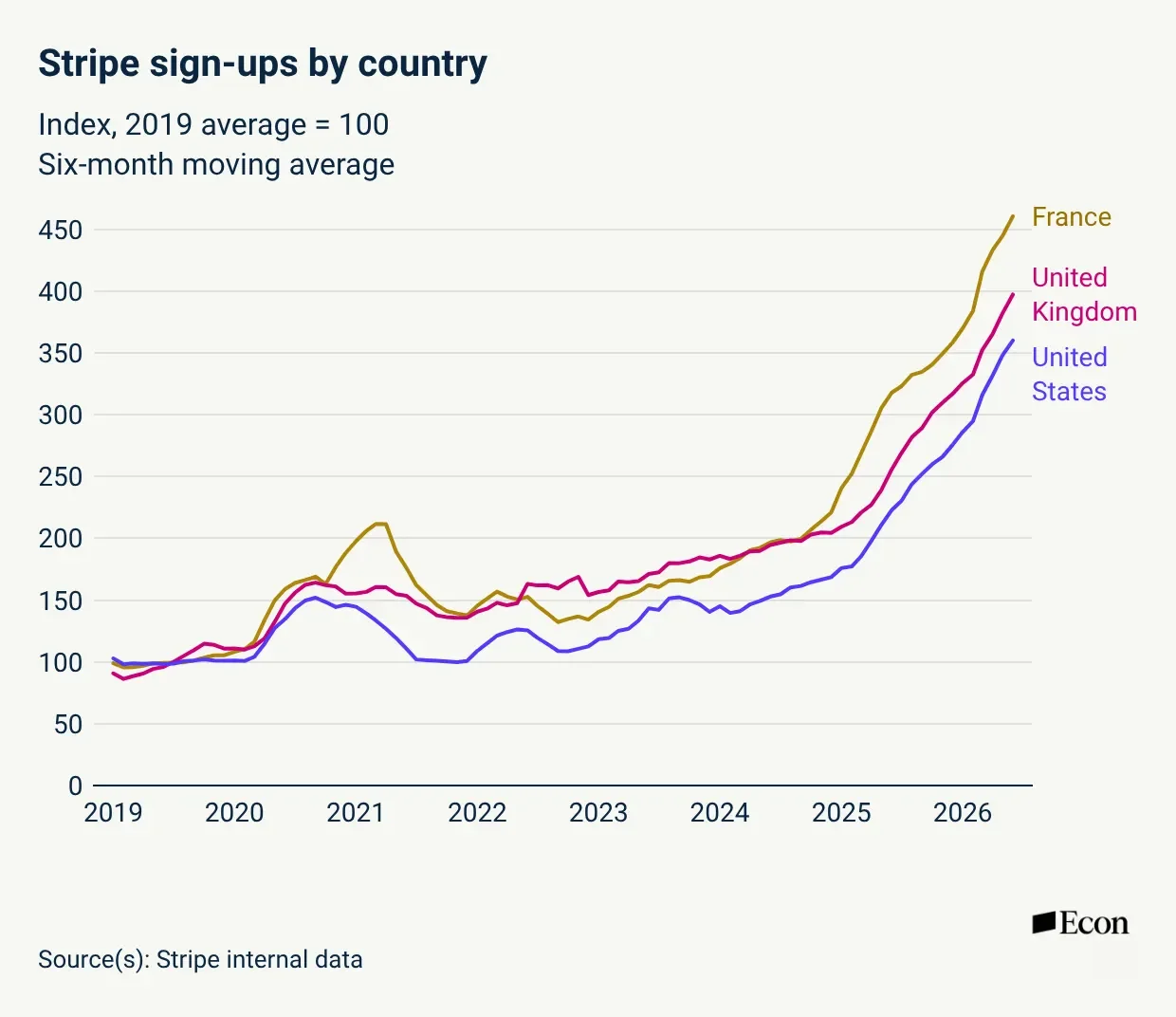
However, Stripe dug into the UK data and concluded the boom is almost certainly happening here too. Its UK sign-ups have doubled in two years, tracking the US and France almost exactly, and since 2024 they have pulled sharply away from Companies House incorporations.
We already know Britain is bad at counting this kind of activity. And what it does count doesn’t join up. Companies House doesn’t count sole traders, the ONS only counts businesses registered for VAT or PAYE, you don’t need to register with HMRC at all until you’re turning over £1,000 a year, and the Labour Force Survey — the survey meant to pick up everyone else — has lost roughly half its effective sample since the pandemic, was suspended in 2023 and returned as a shadow of its former self.
France and the US can see their versions of this shift because both keep dedicated statistics on solo and micro-businesses. France’s are the cleanest, because registration there is near-universal from the first euro of activity and the records join up.
We recently set out a fix for this in The Master Key, with Xero and Enterprise Nation. It proposes a Unique Business Identifier paired with reusable, verified digital credentials — one key a business carries across HMRC, Companies House, banks and local authorities. Its main purpose is to cut admin and fraud, but it would also let departments join up records they currently hold separately. It wouldn’t capture everyone, unless we required or incentivised the smallest side-traders to do what France does, but it would get us most of the way there.
Policy is built on data, and this gap calls into question a big part of the story we tell ourselves about declining business dynamism. The claim that entrepreneurship is in decline in Britain, creating fewer firms, with less churn and an ageing business base, rests almost entirely on data that counts employers and registered companies.
A country that can’t count its founders doesn’t know how to support them. Right now, Britain can’t count.
📈 Ian Ng, Researcher
High taxes, red tape, gaps in late-stage funding, and a Westminster that doesn’t understand entrepreneurship have become common complaints from founders since we started surveying them a year ago. We published our fourth edition of the Entrepreneurs Survey this morning, and the results tell the same story again.
Most founders continue to find it difficult to scale a business in the UK. Our survey also found that nearly 80% of founders think the government does not understand their needs, and when asked which of the political parties they trust most to understand their needs, the most popular option goes to “none of the above”. Most say it is difficult to raise investment and hold a negative view of the level of taxation and regulation in the UK. You can see the full results here.
In spite of all the hurdles, entrepreneurship in the UK continues to be alive and kicking. Entrepreneurs remain optimistic about the year ahead for their business, and many would still encourage others to start a business of their own. More than 40% of founders expect to increase their headcount over the next 12 months.
As Keir Starmer bid farewell with his final PMQs today, his successor will inherit a mixed bag of policies impacting entrepreneurship: a higher rate for employer National Insurance, of course, but also AI growth zones, legislation for regulatory sandboxes and the Industrial Strategy.
What founders are asking for has stayed consistent, and so have the answers they gave in our surveys. They look for certainty, not months of flirting with key taxes ahead of the Autumn Budget, and for less bureaucracy. None of this requires reinventing the state, just a government willing to act on what founders have been telling us for a year. The next Prime Minister can be the one who finally listens, or the one who gives us the same results to report again.
🔬 Dr Florence Young, Senior Public Opinion and Policy Officer, Campaign for Science and Engineering
The pioneering Research and Development (R&D) occurring across Scotland and Wales is expanding our understanding of the world, tackling society’s biggest challenges and bringing benefits to local communities. But this work, and the organisations doing it, are not well recognised.
Campaign for Science and Engineering (CaSE) works to champion R&D as a political and societal priority, including by exploring how the public think and feel about R&D, to help the sector make R&D matter to more people.
Our latest public opinion study – Public Attitudes to R&D in Scotland and Wales 2026 – confirms a consistent dilemma we see across the UK, that public support for R&D is broad but shallow. If our sector continues to feel distant and intangible to voters, it risks being deprioritised by politicians.
On the one hand, the vast majority of people value public investment into R&D and like the idea of R&D being present in their communities. Around three quarters think it is important for their devolved government to invest in R&D in their nation (77% in Scotland and 72% in Wales) and most people (66% in Scotland; 59% in Wales) would feel proud if their area were to become well known as an important hub for R&D.
But despite this, Scottish and Welsh R&D suffers from very low levels of awareness, and its benefits feel vague and hard to articulate for many.
Some 87% feel they don’t know much or anything about the R&D being done in Scotland, with an even higher proportion in Wales (91%). And people struggle to immediately identify the benefits of R&D, whether for themselves, their local area, or Scotland or Wales as a whole.
The sector cannot be complacent and must act now to deepen connections.
Our Advocacy Toolkit points to place, purpose and participation as powerful connection points. The R&D sector has a positive story to tell and CaSE is working closely with our members and the wider sector to make R&D more visible in communities, convey how it is contributing to the public’s priorities and highlight how the public can get involved.