📈 Philip Salter, Founder
We all know that slow growth means lower material living standards than would otherwise be the case, but what are the other consequences? Matt Clancy digs into the evidence on non-material consequences over at What’s New Under the Sun.
The work of Besley, Dann and Dray shows that faster growth goes with more trust in government and less perceived corruption, with larger effects in democracies. Slower growth explains somewhere between a quarter and two-thirds of the trust gap between American millennials and boomers. And as Acemoglu et al. show, living in a democracy only builds support for democracy when that democracy delivers.
The bigger risk for entrepreneurs is zero-sum thinking. Chinoy, Nunn, Sequeira and Stantcheva find that those who grew up in slow-growth years lean towards the view that people can only get rich at the expense of others. This isn’t confined to the left or the right: zero-sum thinkers back both more redistribution and tighter immigration, which might help explain the politics of the past decade.
Worse, this mindset sticks. Trust in government rises and falls with recent growth, but zero-sum thinking sets in early: it’s the growth you experience in your first 20 years that counts. By surveying 20,400 Americans about four generations of family history, the authors trace zero-sum thinking back through ancestors’ experiences too, including how much upward mobility they had and whether they were immigrants. A slump today can shape the outlook of voters not yet born.
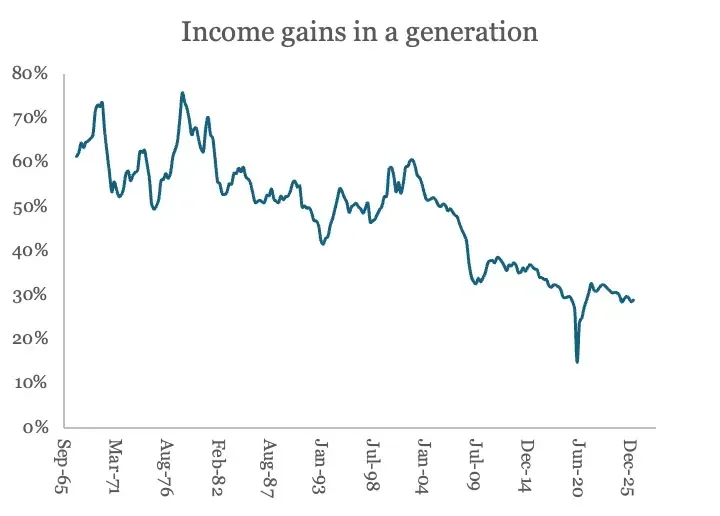
That should worry Britain, where GDP per person is 29% below where it would have been had the 1955–2008 trend continued. The British 18-year-olds reading this have lived their whole lives in this economic quagmire.
For those of us who have lived a bit longer, it isn’t just rose-tinted nostalgia. Up until the financial crisis, it was reasonable to conclude that things could only get better.
Not everything shows up in the numbers, but as Eamonn Ives has argued here previously, GDP correlates with longer life expectancy, lower infant mortality, higher educational attainment, reduced extreme poverty, and many other things that matter.
Growth also keeps alive the belief that one person’s success need not be another’s loss, and without that belief, it’s hard to win the argument for rewarding the people who take risks.
🌾 Mann Virdee, Head of Science and Technology
Maris Piper, for decades Britain’s most widely grown potato, was bred by the state at the Plant Breeding Institute in Cambridge to resist potato cyst nematode. That’s also the case for much of Britain’s wheat. In fact, the institute’s wheat varieties accounted for 90% of the UK market when the government sold the Plant Breeding Institute to Unilever in 1987. The sale reflected a belief that industry, not the state, should pay for this type of near-market research.
However, private breeders find it hard to make money from wheat. As the wheat flower has both male and female parts, it pollinates itself. And because wheat seed grows into the same crop year after year, farmers can sow seeds saved from last year’s harvest. By contrast, maize has separate male and female flowers and is easy to hybridise, but seed saved from a hybrid won't grow into the same crop, so farmers have to buy fresh seeds every season. You could say hybrid maize seed is like a subscription, whereas wheat seed is a one-off sale and customers can grow their own. Without some other way to get paid, breeders have less reason to invest and innovate in non-hybrid crops such as wheat.
In 1985, the US Patent and Trademark Office ruled in Ex parte Hibberd that seeds and plants could be patented. This is the context for a new NBER working paper, Flowers of Invention, by MIT’s Jacob Moscona, who treats the ruling as a natural experiment. He compares crops such as wheat and barley (where patents in effect turned the seeds into a subscription) with crops such as maize (where hybrids had long done that naturally).
The paper finds that in the decade that followed this ruling, new variety releases for the newly protected crops more than doubled (up 119%) compared with hybrid crops, and yields rose 11%. The increase was driven by private R&D rather than public spending. Tellingly, it came from crops replanted every year or two, where a patent turns farmers into repeat customers. Farmers in counties suited to those crops spent more on seed but their land values and profits rose, meaning the better seed more than paid for itself. On the most conservative estimate, patent rights added 7.5% (roughly $80 billion) to the value of US farmland by 2002, though larger farms benefited disproportionately.
The paper’s findings now have a British test case. In July, Defra confirmed that PiperPlus, a new disease-resistant Maris Piper developed at the Sainsbury Laboratory in Norwich, qualifies as precision bred. BioPotatoes, a startup part-owned by the lab, plans to take it to market. But potatoes, like wheat, have little natural moat. Farmers can keep back tubers from one harvest to plant the next.
In the UK, new varieties are protected by plant breeders’ rights rather than patents, and these are deliberately weaker. Farmers who replant their own tubers pay only a reduced royalty and rival breeders can use protected varieties to develop new ones. That keeps seed cheaper and lets breeders build on each other’s work, but Moscona’s findings suggest the price may be less invention.
⤴️ Ian Ng, Researcher
OpenAI reportedly expects to burn through $280 billion by 2030. It is an extreme case of a familiar pattern in the startup world, where high-growth companies endure periods of losses before breaking even. Investment in equipment and talent drags cash flow down before revenue catches up, forming a J-curve if the company manages to scale.
New research by Hellmann, Montag and Tåg examines whether differences in financing capacity affect the cash flow and growth trajectories of startups. Studying the Swedish startup scene, they find that those backed by American VCs experience substantially deeper operating losses after investment, followed by higher sales from around the third year. These startups also receive more capital than their non-US VC-backed counterparts. The authors link this to US VCs having deeper pockets, as they manage on average SEK 37.3 billion more than non-US syndicates. Nationality of the VCs alone does not explain the difference in the performance of startups. The authors find that startups receiving investment from a large non-US VC show a similar combination of deeper losses, higher sales and more funding.
The authors then turn to the EU’s Scaleup Europe Fund, from which Britain is reportedly being blocked. However, we don’t start from a bad position among European countries. According to an EIB study cited in the paper, the US had 137 VC funds larger than $1 billion between 2013 and 2023, compared with 11 across the European Union and 10 in the UK alone. And some of the largest UK pension funds are considering to commit capital to a new £1 billion UK Scale-up Fund with the British Business Bank. As the research suggests, funds with sufficiently deep pockets are needed to sustain losses in the early stages.
There are pitfalls to avoid. The fund should be run on commercial terms, with the single objective of returns from scaling the best companies, rather than being loaded with the objectives that littered the government’s announcement: good growth in every postcode, reindustrialisation and so on. As with public procurement, ‘Everythingism’ tends to achieve little. There should also be no pressure to deploy the £1 billion quickly. The Centre for British Progress cites evidence that the best UK VC funds are already oversubscribed, so rushing to spend would push money down the quality ladder.
Hellmann, Montag and Tåg warn against confusing continuity of financing through years of losses with unconditional continuation. Continued financing must remain conditional on credible growth milestones, and political objectives risk muddying the waters.