
⚗️ Mann Virdee, Head of Science and Technology
In 1662, the newly chartered Royal Society of London appointed the natural philosopher Robert Hooke its first Curator of Experiments. Its Fellows had no shortage of questions about the natural world. What the Society lacked was someone whose job it was to test them.
Hooke was expected to bring three or four experiments to every meeting and to try out those the Fellows proposed. He was extraordinarily productive. He built the air pump for Robert Boyle’s experiments on the ‘spring of the air’, the work that led to Boyle’s law. He coined the word ‘cell’ after seeing them through a microscope of his own design. But even Hooke could not keep up with the Fellows’ ideas.
More than 350 years later, AI may be recreating Hooke’s problem.
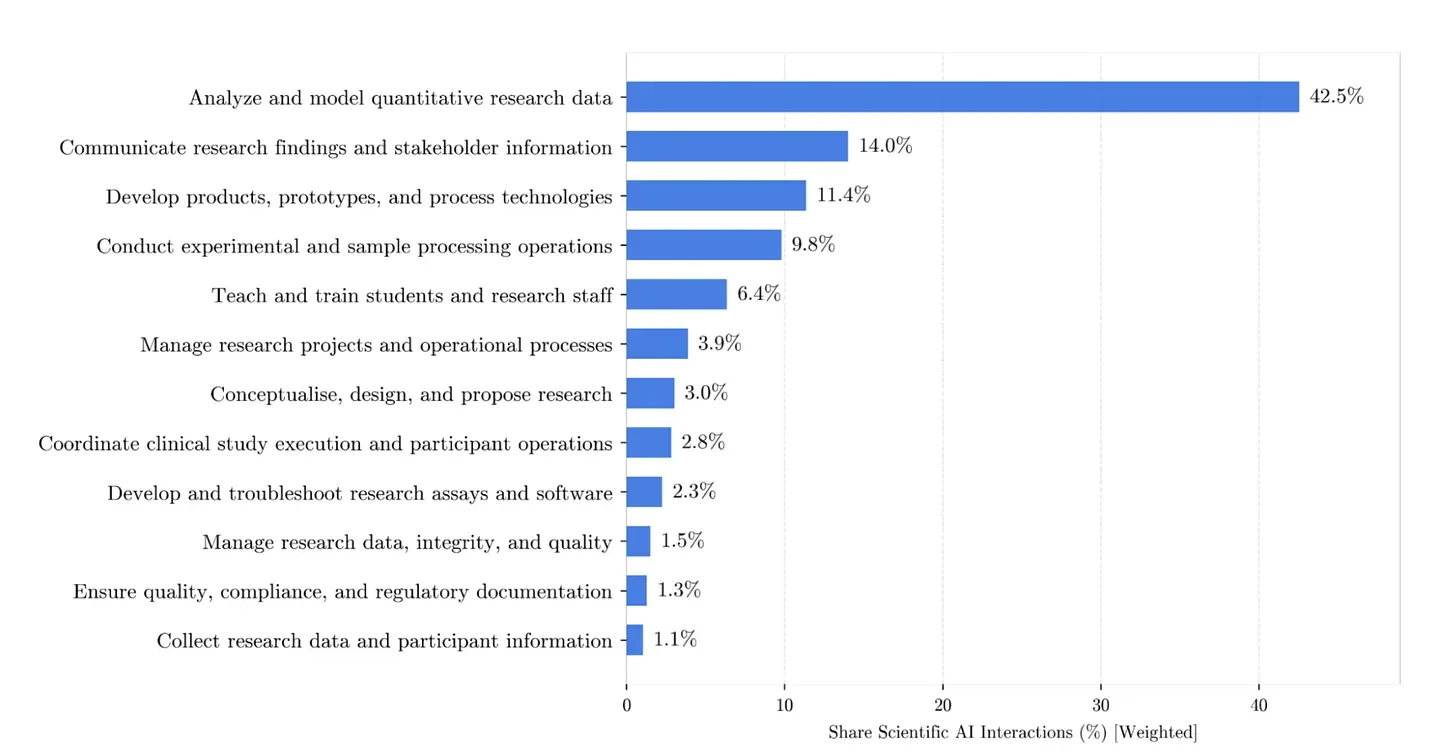
That’s the implication of AI in Science: Early Insights, a new study by researchers at Google, Google DeepMind and MIT FutureTech. It draws on around 15 million Gemini interactions, more than 2,600 specialised scientific models and a survey of 637 researchers in the US and UK.
Scientists are big users of AI. In the US, science occupations turn up in Gemini conversations about 2.7 times as often as their share of employment would suggest. Nearly half of those surveyed use AI daily, and the average respondent saves almost seven hours a week.
But the bottleneck in scientists’ workflow hasn’t so much disappeared as shifted: 44% say their main constraint has shifted downstream over the past two years, into lab work, clinical validation and field data collection. This research finds that physical experimentation and data collection is now the most commonly cited constraint, named by 24%. And 41% report a growing backlog of untested hypotheses, against a quarter whose backlog has shrunk.
The survey isn’t necessarily representative, and the authors rightly point out that AI enthusiasts may be more likely to respond. But both the downstream shift and the growing backlog are strongly correlated with how intensively respondents use AI. As the authors put it, AI may have increased the number of viable hypotheses, but not necessarily the means to test them.
Perhaps a more interesting finding is about the direction rather than speed of scientific research. Almost half (49%) say AI is steering them towards safer, more incremental projects, against 28% who say it lets them take on riskier questions. The authors suggest a possible ‘streetlight effect’. AI lowers the cost of tractable, data-rich problems the most, so riskier questions, where data is scarce and validation is physical and expensive, get crowded out.
We might assume the scarce ingredient in science is ideas. This paper suggests this is becoming less true. What’s scarce now is the modern Curator of Experiments. That is, the labs, instruments, technicians and automated facilities that test hypotheses. As AI makes the easy-to-test questions cheaper first, it also shapes which questions get asked.
🔍 Philip Salter, Founder
In March, Innovate UK published a new prospectus that reorients it towards deep tech in priority sectors, as those who came to our Audience with Tom Adeyoola, Executive Chair of Innovate UK, will know (better than most). Central to the pitch is for Innovate UK to become a “trusted due diligence engine” for the UK’s deep tech ecosystem.
Last month, the Innovation and Research Caucus published Science as Substrate. Written by Nesta’s Innovation Growth Lab, it links 29,262 Innovate UK projects to a global corpus of over 40 million papers and classifies each research topic as niche, emerging, active or mature. Since 2020, 90% of the AI funding it could classify has gone to projects built on slow-growing niche or mature topics, while the fastest-growing parts of the AI literature attract almost no funding.
Several of the “AI” topics are broad catch-alls, and the authors note that Innovate UK has rarely said what research maturity it is aiming for. Even so, the finding shows why a sharper deep tech strategy matters.
Science as Substrate also points to a deeper problem. Innovate UK doesn’t publish what happens to the companies it funds, so outcomes have to be reconstructed after the fact by outside researchers from company filings and commercial databases.
When an earlier Caucus study tried this, 13,500 of its 59,048 grants couldn’t be traced to a company at all, because the registration numbers were missing or wrong. The same report found a mixed picture on impact: Innovate UK-funded firms grew faster in employment and turnover and patented more, but there was no clear effect on productivity, and funded firms were more likely to go insolvent, which the authors suggest may reflect riskier ventures.
Innovate UK knows how to fix this. In 2018 it committed to tracking outputs and expected outcomes for every project it funds. Its own evaluation framework calls randomised trials the most robust method, and it has allocated innovation vouchers by lottery, with an evaluation designed alongside the Innovation Growth Lab, the team behind Science as Substrate.
We made a similar case last year in Full Speed Ahead, our report on Britain’s 500-plus accelerators and incubators. We called for a dual-track assessment that follows both how companies perform and how founders develop. The same applies to Innovate UK: it should track outcomes for every company it backs under the new strategy. It should also avoid turning any single number, such as follow-on investment, into a target.
The prospectus has the logic right. Deep tech is hard to invest in because the risk is technical, and Innovate UK can call on technical assessors most investors can’t. Its endorsement could end up worth more to a company than the grant itself. For that to happen, Innovate UK needs the data to show how its picks have done, and Science as Substrate shows how far it has to go.
🗺️ Ian Ng, Researcher
Successive governments have banged the drum about regional inequality, from Boris Johnson’s levelling up to Andy Burnham’s “good growth in every postcode”. That ambition now runs through every corner of government, including public procurement and innovation policy.
The 2025 Industrial Strategy called itself “unashamedly place-based”. In the same year’s Spending Review, Keir Starmer’s Government committed £86 billion to R&D over four years, rising from £20.4 billion in 2025-26 to £22.6 billion by 2029-30. So it is tempting for the Government to kill two birds with one stone: why not focus innovation funding on left-behind places?
New research by Johan P Larsson and Johan Grip suggests the two goals pull against each other: mission-oriented innovation policy may inherently exacerbate regional imbalances. Missions concentrate resources where a breakthrough is most likely, which tends to mean cities and established hubs. Cities benefit from the agglomeration of talent, capital and institutions such as universities, hospitals and major firms.
The cycle is self-reinforcing: early concentrations attract further investment, talent and institutions. And because missions are, at their core, about accelerating progress, money flows most easily to places that can absorb it quickly and show visible results within short timeframes; most lagging regions lack that absorptive capacity. The researchers conclude that if missions succeed, their benefits concentrate in hubs and cities; if they fail, the money will still have acted as an expensive stimulus for those same places.
UK funding already follows this pattern. UKRI, the UK’s largest public research funder, spent only half of its money outside the Greater South East in 2023-24, while ARIA concentrated two-thirds of its funding in London, the South East and the East of England.
I have written about the dangers of ‘everythingism’ in the previous edition and the edition before last, so I won’t repeat it here. As former Science Minister Lord Vallance put it, curiosity-driven research must be funded purely on excellence, excellence will always cluster, and funding should “absolutely not” be spread evenly.
To argue otherwise is cakeism: it abandons funding on excellence and undermines the value-for-money case for spending public money on research. I fully accept that the Treasury could spend money to support left-behind places, but the Government should be honest that innovation funding is the wrong tool for it.
There is one caveat. When Britain’s cities were built through decades of agglomeration of talent, institutions and capital, demand for clean energy on the scale AI requires had not yet appeared on the horizon. This is the logic behind AI Growth Zones, which use faster planning and grid access, rather than research grants, to steer data centres towards places with abundant clean energy.
The North Wales AI Growth Zone is the prime example. Anglesey is not known for attracting talent or capital, but its geography could give it new life. Wylfa will host Britain’s first three Rolls-Royce small modular reactors, due to supply the grid from the mid-2030s. Off Holy Island to the west, the Morlais tidal scheme is preparing to put its first devices in the water. Offshore wind farms in the Irish Sea off the North Wales coast add further capacity, and the Growth Zone’s Prosperity Parc site on Anglesey is earmarked for data centres. This is the reindustrialisation of the 21st century.
But geography alone won’t do the job. In July 2025, the Government rejected zonal pricing and kept a single national wholesale electricity price, so a data centre next to Wylfa pays the same wholesale price as one on the outskirts of London. The Government addressed the problem with electricity discounts for data centres in AI Growth Zones. Rather than ministers deciding region by region who gets cheap power, locational pricing would let abundant clean energy pull investment towards it. The Government should be clear-eyed that innovation funding in itself cannot level up left-behind places, but the factors that determine a growth hub may have changed.