





Three Big Ideas #50

📈 Eamonn Ives, Research Director

One of our guiding beliefs here at The Entrepreneurs Network is that economic growth is something worth celebrating. In recent years, thanks in no small part to the widening reach of the progress studies movement, appreciation for the importance of economic growth has noticeably increased. The Prime Minister himself regularly preaches the gospel of why expanding the size of the economy matters. But we’d be kidding ourselves if we thought there weren’t still swathes of indifference among society to economic growth, not to mention stubborn pockets of resistance.

It’s not hard to see why we’re in the minority. Most of us ‘engage’ with economic growth by occasionally hearing about what’s happened to Gross Domestic Product in a given month – has it gone up by a tenth of a single percentage point, or down? Measly marginal updates one way or the other scarcely make for compelling news. As such, it’s understandable why many people place greater priority on other goals in their lives.

Moreover, it’s not as if GDP is a perfect measure. Famously, if I cleaned my apartment myself, Britain’s GDP figure wouldn’t budge an inch – but it would if I paid a professional to. Nor does GDP do a good job of encompassing things like the environment either. If I chop down a forest and sell the timber one year, economic growth on paper might rocket upward – even if we all know that rate won’t be sustained the following year.

Having said all this, GDP persists as one of the most important indicators we have. Why? In a recent article, Brian Albrecht eloquently explains that despite its fallibility, GDP is nonetheless a robust proxy for much of what we hold dear in life. Higher GDP per capita, he notes, correlates with longer life expectancy, lower infant mortality, higher educational attainment, reduced extreme poverty, and higher self-reported happiness.

When telling the story of economic growth, perhaps it’s incumbent on us to focus more on these outcomes rather than simply reeling off cold dry numbers on a spreadsheet.

🪞 Mann Virdee, Senior Researcher

Christmas is for many a natural time of reflection. As we come to the end of 2025, what can we tell future historians looking back about what life was like at this moment in time in the UK?

There are times when it’s hard not to get carried away by the negativity about Britain’s potential for prosperity. We learnt yesterday that unemployment has risen to a four-year high of 5.1%, and it’s hitting the youngest hardest. I think the weakening labour market is a sign that things might get a lot worse before they get better.

The disruption from AI is also increasingly visible. AI is making it harder for employers to identify strong candidates, and it is also being used to perform tasks new graduates would previously have done in the earliest stages of their career in a fraction of the time and to a higher standard. What does that mean for the prospects of young people and social dislocation? I think we’re about to find out.

But there are developments that suggest, even if faintly, that a burgeoning pro-growth consensus is finally taking hold.

Yesterday, the Housing Minister announced reforms to deliver more homes. That includes the addition of a default ‘yes’ for housing developments around train stations, which may be a key to unlocking productivity growth. Recently, the Prime Minister has committed to implementing all the excellent recommendations from the Nuclear Taskforce, which should help lower energy costs in the long term. The Home Secretary has said the best and brightest talent will be fast-tracked to help Britain regain lost ground in the global race for talent.

These are reasons to be optimistic. We’re starting to see, admittedly more in rhetoric than reality at the moment, that this Government is serious about unblocking the arteries of the economy – in planning, energy and the labour market.

If 2025 was the year the problem was diagnosed, let’s hope it’s also remembered as the year we started to address it too.

🛑 James Graham, Senior Researcher, Prosperity Institute

Anti-Money Laundering (AML) and Know Your Customer (KYC) regulations have exploded in scope in recent years, degrading our financial landscape.

Prior to 2002, responsibility for financial crime sat with the police. This changed with the passage of the Proceeds of Crime Act 2002, which represented a legal and philosophical shift. Banks and private businesses became responsible not only for providing financial services to their customers, but also for ensuring they were not criminals.

Since 2002, the burden placed upon banks has only expanded, with the most significant update being the Information on the Payer regulations in 2017. Neither the 2002 legislation nor subsequent regulations were at the behest of the British Parliament. Rather, they were required for us to abide by European Union directives.

In British common law, every individual is considered innocent until proven guilty, and their right to privacy is nearly absolute. The AML and KYC regime has turned this on its head. People are now treated with suspicion and presumed guilty – not just those in high finance, but ordinary people doing things such as purchasing a home. To prove their innocence and access basic financial services, customers must hand over vast amounts of private information to prove they are who they say they are.

This is not only wrong in principle, it has not been proven effective at preventing crime and it creates barriers for entrepreneurs who have to wait weeks rather than hours for new bank accounts, who pay higher fees to cover the £34 billion a year which banks must spend on complying with regulations, and who quite likely find themselves amongst the hundreds of thousands of accounts debanked every year. If that is you, please do let us know by completing our survey, which seeks to build and amplify a coalition of the debanked.

It is time to seriously rethink our financial crime architecture. The state should not require the private sector to enforce flawed regulations that stifle enterprise and undermine the British common law tradition.
No Country for Young Workers

Unemployment is back in the news. As John Burn-Murdoch has written in the Financial Times, the proportion of young people in the UK who are neither working, seeking work, in education nor raising children has doubled over the past decade. In The Telegraph, Tim Wallace shows that Britain has experienced the sharpest rise in youth unemployment across the G7. Rachel Wolf, meanwhile, describes how the lives of those on the margins of the labour market are being hollowed out.

Putting any pretence of false modesty aside for a moment, I predicted this would happen back in May.

All unemployment is bad, but youth unemployment is uniquely pernicious. Early-career joblessness leads to persistent earnings losses, skill depreciation and weaker attachment to the labour market that can last for decades. These scarring dynamics do not just harm individuals; they reduce business formation, slow productivity growth and raise the economy’s long-run unemployment rate. Youth unemployment is not just a cyclical inconvenience but a structural drag on entrepreneurial dynamism and growth.

This is partly why the Government has committed £820 million with the aim of supporting nearly one million young people into work. The plan is to create 350,000 workplace opportunities, expand Youth Hubs, and introduce a “Jobs Guarantee” offering fully funded, six-month placements for long-term unemployed 18-to-21-year-olds in high-need areas. For eligible businesses, the attraction is straightforward: taxpayers cover 100% of wages and training costs for these placements.

The Government will also spend a further £725 million to try to generate 50,000 new apprenticeships over the next three years. Here too, the incentives for eligible businesses are significant, with taxpayers covering 100% of training costs for apprentices under 25, removing the previous co-investment requirement.

Success in both cases will depend on employer take-up, whether placements resemble real jobs rather than holding patterns, and whether there is clear progression into unsubsidised employment.

The Government, however, is not doing itself any favours. Since coming to power, the Employer National Insurance Contribution changes announced at Labour’s first Budget are likely to fall largely on employees — through lower wages — and hardest on the young, who are more exposed to job losses and more likely to be priced out of low-productivity roles altogether.

In addition, from 1 April 2026 the National Living Wage (for those aged 21 and over) will rise to £12.71 an hour, while the minimum wage for 18-to-20-year-olds will jump to around £10.85 — an increase of roughly 8.5%. Rates for under-18s and apprentices will also rise to around £8 an hour. It is possible to strike a balance on minimum wages without causing excessive unemployment, but when the Labour-aligned Resolution Foundation is warning that the increase for 18-to-20-year-olds is “unnecessarily big”, and risks making it harder for them to find work, alarm bells should be ringing.

Then there is the Employment Rights Bill, which remains far from settled. While the shift away from day-one unfair dismissal rights toward a six-month qualifying period is welcome, it still risks making employers more cautious about taking on new staff — particularly young and inexperienced workers.

And there is still plenty more to be concerned about in the Bill. Under current law, compensation for unfair dismissal is capped at the lower of 52 weeks’ pay or a statutory maximum (around £118,000). The original proposal was to remove this cap entirely – a move rejected this week by the House of Lords. Unlimited awards would significantly increase the tail risk of hiring, especially in sectors like tech, where startups must compete on pay with large firms but lack the HR capacity to manage legal risk. For some of our most innovative firms, this risk would be existential.

Alongside this sit expanded union ballot and recognition rules, enhanced protections around industrial action and a range of other changes that, taken together, would make many business owners markedly more reluctant to hire if passed in their current form.

This is not to dismiss the importance of worker protections — but there is a balance to be struck. Our latest Entrepreneurs Survey provides one of the clearest signals yet of how the UK’s most ambitious founders view the Employment Rights Bill. Among those aware of the legislation, 80% believe it will have a negative impact on the economy, with more than 40% expecting the impact to be “very negative”. Just 4% believe it will have a positive effect.

The Government can’t say they weren’t warned.

Reckoned With

The Invest in Women Taskforce has published its annual report, and the headline is that the fund has now reached £635 million in commitments from institutions including Barclays, M&G, BGF, Aviva, Morgan Stanley, Nationwide and the British Business Bank.

The funding is designed to work on two fronts. Around £270 million will support the pipeline of female fund managers, enabling them to invest in female and mixed-gender founding teams. The remaining £365 million will be deployed directly by institutional investors into those companies.

The Entrepreneurs Network also gets a mention in the report for our work on angel investment, highlighting both regional disparities and the growing – though still limited – participation of women angels.

Read it in full here.

Humanity’s Hallmark

If you haven’t yet signed our Mission Statement, you can do so here. We’ll publish the first set of names in the new year, and continue adding to it over the months, years and decades ahead. Our mission is Sisyphean — and that is precisely why it matters.

On Your Marks

I’m delighted to share that Mark McCormack, Founder and co-CEO of Talking Tables, has joined us as an Adviser. Mark brings over 25 years of experience growing Talking Tables to a £20m+ turnover international business.

Mark is already providing a wealth of knowledge on policies around exporting and trade tariffs. He believes, like us, that entrepreneurs are the lifeblood of the UK economy, and that we help facilitate getting entrepreneurs heard by Westminster. Get in touch if you’re keen to find out more about becoming an Adviser in 2026.

What We Believe

This week, prompted by a rather contentious LinkedIn post from Johann Nordhus Westarp, Sifted’s Martin Coulter asks the question: Can you be left-wing and an ‘elite founder’?

In his article, Coulter quotes our latest Entrepreneurs Survey, which revealed that founders have shifted their political allegiances slightly in the last few months towards the Conservatives and Reform (although it’s worth pointing out that the margins are still very tight).

I’ve managed to hold myself back from writing a diatribe on political economy — for today at least — because I figured it would be more constructive to set out what we as an organisation fundamentally believe.

This idea came from a discussion with our newest Adviser, Richard Browning, who launched the world’s first human jet suit, and who is the first signatory to our mission statement. This is a public pronouncement, which we’re encouraging all of our supporters to put their names to. You don’t need to be an entrepreneur to sign this — just someone who shares our worldview. So, are you with us?

A hallmark of humanity is our desire to solve problems. When we do that through markets — by creating new goods, services and ways of doing things — we call it entrepreneurship.

Entrepreneurship is one of the most powerful engines of productivity and progress. Throughout history, entrepreneurial ventures have transformed societies, lifting people from subsistence to prosperity.

Entrepreneurs pioneer new ideas, create jobs and drive the breakthroughs that raise living standards — not only today, but for generations to come. Supporting and nurturing entrepreneurship is essential if we are to live healthier, happier and more meaningful lives.

But progress doesn’t happen by accident. It is shaped by the choices made every day by entrepreneurs and by those who support them — their teams, mentors, investors, and the wider ecosystem.

And while the entrepreneurial impulse may be innate, its success depends on the environment around it. Entrepreneurs need the right laws, regulations, institutions, incentives, infrastructure, talent, capital and culture to thrive.

We believe the United Kingdom can and should be the best place in the world to start and grow a business.

Out of Focus

Most people — including, and perhaps most importantly, most politicians — have never run a business. That’s why the way journalists cover entrepreneurship really matters.

With support from Pathos Communications, we surveyed founders across our network to understand how they view the media’s portrayal of Britain’s startup ecosystem.

In Out of Focus, we found that five times as many founders disagree (60%) as agree (12%) that journalists do a good job of covering entrepreneurship. Most also said they had seen no improvement in the quantity or quality of coverage in recent years. And nearly three quarters feel that the issues that matter most to them get too little attention, compared with just 6% who feel they receive enough.

Alongside the quantitative data, founders shared their views in their own words. Many want the media to look beyond London-based, high-valuation tech stories and pay more attention to the everyday — and often unglamorous — realities of building a business. Others feel the tone around success and wealth creation could be fairer, and that journalists would benefit from a deeper understanding of entrepreneurship. There is also strong appetite for broader representation: across sectors, regions, backgrounds and stages of growth.

This isn’t intended as a broadside against the broadsheets. Founders were conscious of their own shortcomings too: while 30% feel entrepreneurs present themselves well in the media, 36% do not. And if you’re a journalist reading this, you’re already demonstrating a deep interest in entrepreneurship. Perhaps the main takeaway is that entrepreneurs still believe the media matters. Journalists continue to shape how policymakers, investors and the public understand risk-taking, innovation and economic dynamism.

The report — and its launch in the House of Lords — has already generated productive discussion on LinkedIn. We’re now speaking with several journalists about how we can help constructively bridge the gap between entrepreneurs and the media. Those in our WhatsApp community will know we’re already doing this by sharing live opportunities from journalists – so if you haven’t joined yet, now’s the time to do so.

Three Big Ideas #49

📰 Philip Salter, Founder

Our latest briefing paper, Out of Focus, is different from most of our reports. Rather than our usual wide-ranging analysis or deep dive into technical policy, we used our latest Quarterly Survey to ask a simple but vital question: What do entrepreneurs think about the UK’s media landscape?

The verdict is clear: founders are dissatisfied. Sixty percent of founders disagree with the idea that journalists are covering the sector well, while only 12% agree. Yet there is also introspection. Founders are critical of their own efforts, with more believing they represent themselves poorly than those who think they get it right.

The data also points to stagnation. Around 40% of respondents have seen no improvement in either the quality or quantity of coverage in recent years. Even more concerning is the misalignment of priorities: 74% of founders feel the media ignores the issues that matter to them most, compared to only 6% who feel the press is focusing on the right topics.

This matters because our mission goes beyond policy – we also want to shift culture. Championing entrepreneurs in the public debate is a core pillar of our work. This drive for cultural change is why we are calling for initiatives such as a modern successor to the Great Exhibition of 1851 and a new order of chivalry to elevate the status of British innovators.

To be clear, we are not suggesting any interventions are required to our relatively free press. Nor are we ignoring the shift to digital – we know that 75% of young adults rely on social media for news. Yet, the reality remains that the country’s decision-makers still rely on mainstream media to form their views.

As a former journalist, I know the pressures of the job. This is not a critique of the trade, but a challenge to everyone across the ecosystem. We need to think more entrepreneurially about how we tell the story of British business, both to the influential elite and the wider public.

In our small way, we are taking practical steps to fix this. We have launched an interview series here on Network Effects to highlight leadership voices, and created a free WhatsApp Community where we share occasional media opportunities to help democratise access to the press.

🪟 Eamonn Ives, Research Director

Anyone who’s visited Washington, DC will know vehicle licence plates are emblazoned with the words “End Taxation Without Representation.” A new law passed by President Trump – the IRS MATH Act – takes the principle a step further. It compels America’s tax agency to explain precisely what it is changing on a return when it believes a taxpayer has made an error, and grants individuals 60 days to challenge any decisions before they’re made final.

The logic is straightforward, but the consequences could be profound. Most obviously, taxpayers should over time learn how to file returns more accurately – helping to shrink the tax gap, and also allowing the IRS to spend more time rooting out genuine tax evasion rather than punishing innocent mistakes. Further, if it helps to build trust with taxpayers, we might see more people decide to file by themselves, without shelling out on expensive accountants for peace of mind. Finally, someone who takes a more cynical view of the IRS may also think that by requiring them to categorically prove a mistake, it will reduce the likelihood of ‘over-taxation’.

HM Revenue and Customs should take inspiration. To its credit, earlier this year it consulted on its approach to dispute resolution. A large portion of the consultation focused on ‘Revenue Correction Notices’ (RCNs), which allow HMRC to amend a taxpayer’s return where it has reason to believe an error has been made. When considering responses to the consultation, HMRC acknowledged that “[a]lmost all respondents supported the idea that there should be a requirement for HMRC to provide an explanation for a revenue correction,” and that “[m]any respondents considered providing clear explanations should already be standard practice and expressed concern that HMRC’s explanations in revenue correction notices are often vague and inadequate.” They should heed this feedback, and accelerate reforms to increase transparency accordingly.

So much commentary on taxation understandably centres on headline rates, thresholds and allowances. But we shouldn’t lose sight of the administrative mechanics involved in actually paying what’s owed. Changes that make that process more straightforward should be championed. Of course, reducing overall tax complexity must be the priority, but greater clarity should be a close second. An end to taxation without explanation would be a nice reprieve to Britain’s beleaguered businesses.

📝 Mann Virdee, Senior Researcher

Last month, I read with interest that 995 people had applied for a single public affairs role at the London School of Economics.

Was this perhaps a particularly desirable role, a sign of a tough job market, or might AI have a role to play by making it easier to write cover letters? I suspect it’s a combination of all three.

Then, last week, I came across Andrew Orlowski’s op-ed. In this article, Andrew argues that generative AI is primarily a tool to fabricate, used by those pretending to be something they are not. I think that’s a little harsh and overly simplistic. But there may be more than a grain of truth in his conclusion: AI disproportionately rewards the lazy and dishonest, and that those who decline to use it are punished.

In support of his argument, Andrew cites a recent economics paper which focuses on how AI disrupts markets that have traditionally relied on writing as a signal of quality, and specifically the impact of applicants using AI to produce cover letters. The paper finds that:

“employers are less able to identify high-ability workers, causing the market to become significantly less meritocratic.”

As a result, employers hired fewer high-quality candidates and more low-quality candidates.

Now back to that job at the LSE. The hiring manager for that role would disagree with that paper. He claims that generative AI is actually a hindrance to applicants because it provides bland and easy-to-spot responses. He added that the LSE does not use AI to filter applications, and that each response is read by a recruiting panel member.

That’s all well and good for a large institution, but what does it mean for entrepreneurs?

It’s time to question the way we go about assessing applicants’ suitability for a role. For entrepreneurs in small teams, recruiting a good candidate can be the difference between success and failure. They don’t have the time to read through 995 applications. The real takeaway for entrepreneurs is that they are not recruiting to find the best writer, but the best problem solver. It’s more productive to test and filter applicants on how they would approach a problem rather than assess them on how well they write a cover letter.

Three Big Ideas #49

Three Big Ideas is our fortnightly roundup of ideas (and our takes on them) in entrepreneurship, innovation, science and technology, handpicked by the team.

This week, Philip Salter discusses our latest research on how founders think about national media, Eamonn Ives urges HMRC to follow America’s lead when it comes to tax transparency, and Mann Virdee ponders how AI is altering the hiring landscape.

Speculative Bubbles

We’re all stuck in our own bubbles. Try as we might, we’re naturally drawn to people who share our views, backgrounds or interests. So when the Budget landed this week, I realised that I sit roundly in two bubbles that saw it very differently: the entrepreneurship ecosystem bubble and the economics bubble.

First, the entrepreneurial ecosystem bubble. Viewed through this lens (to mix my metaphors), the Chancellor – advised by the incisive and indomitable Alex Depledge, the Treasury’s first Entrepreneurship Adviser – absolutely delivered. Depledge’s Entrepreneurship in the UK prospectus closely reflects many of the priorities of high-growth founders. As I wrote in our snap response: “The doubling of Enterprise Management Incentive allowances and the expansion of the Enterprise Investment Scheme stand out as a clear response from the Government to calls from entrepreneurs.”

We were also pleased to see some movement on the Stamp Duty Reserve Tax. As our Research Director Eamonn Ives explains: “[It] is an international outlier and a relic of a bygone age. It depresses share prices, increases the cost of capital and adds friction to our beleaguered markets.” In the next Budget, as argued in Backing Breakthrough Businesses, the Government should just scrap the whole tax.

Arguably the most underappreciated announcement was around procurement. Public procurement makes up around 15% of UK GDP, which makes it one of the largest single levers the state controls. It should be driving innovation – but it isn’t.

Announcements to expand Advance Market Commitments, the creation of an Innovation Marketplace to fast-track innovative solutions, and the appointment of Procurement Innovation Champions across all departments, all sound encouraging. It’s about time a government started thinking creatively about how to harness procurement’s power.

But we – including many reading this – really need to come together to understand why public procurement is so bureaucratic and how to unpick it. We aren’t the only country to suffer from this, though many countries do procurement better. Fundamentally, it can’t just be about layering the above on top of the current system; we need a genuine reset.

Finally, the Call for Evidence on Tax Support for Entrepreneurs, which launched alongside the Budget, is a welcome way to keep the conversation and momentum going. As well as looking at current schemes, you’ll have the chance to contribute ideas on things like how the government can strengthen the investment pipeline, why exited founders do or do not reinvest, and whether Business Asset Disposal Relief (BADR) is effective. I expect we’ll be integrating some of these questions into our Entrepreneurs Survey, so do let us know if you’re keen to partner on this work.

Now to the second bubble: the economics bubble. As a think tank, we’re grounded in and by economics, and it’s fair to say that most economists weren’t overly enamoured with the Chancellor’s Budget.

The Economist was eloquently blunt (paywall): “The tax-and-spend party has taxed and spent,” and “The state has never been so expensively funded, yet seemed so tired.” Paul Johnson, formerly of the IFS, spoke for many in the profession (paywall). I would summarise him and others as criticising big tax rises without reform, debt still rising, a barely better-than-even chance of meeting the fiscal target, repeated U-turns on tax and welfare, and an overall sense of a government lacking strategy and direction.

I won’t try to thread the needle here. It’s possible for a Budget to contain strong micro-level reforms that help entrepreneurs while still falling short on the foundational reforms that underpin growth. As we argued in Building Blocks:

“While remedying small issues can be important, there’s a danger that too much attention in policymaking is afforded to them, while more fundamental problems go unchecked. We contend that even marginal policy improvements in any of these bigger areas – from simplifying our country’s planning rules, to rationalising the tax code, to modernising the visa system – will do more to ensure we are genuinely offering the best possible platform from which to unleash the full potential of entrepreneurship and innovation in Britain.”

Finally, these lenses ignore others. As Enterprise Nation reveals in the reaction from some of the more than 150,000 small business owners they support, there are concerns about rising costs, squeezed margins, frozen thresholds, tax pressures, wage pressures and a lack of growth measures. Similarly, in his weekly must-read newsletter (sign up here), Beauhurst’s Henry Whorwood states:

“[I]f you’re starting a business that doesn’t fit the equity and grant funding model, you’re left out in the cold. Indeed, you are clobbered with onerous employee rights, minimum wage increases, and record employer NI contributions. Instead of ever more fine-grained interventions, we need to make it easier and cheaper to create jobs in every sector.”

I managed to avoid the tired framing of this being “the good, the bad and the ugly” Budget. Nor did I call it “a tale of two Budgets.” But there’s a reason these idioms are as hackneyed as they are.

It’s up to you to decide which bubble you’re in, and which lens matters most.
Rights Call

I’ll keep this brief. It’s good to see the government scrap the plan to give workers the right to claim unfair dismissal from their first day in a job. Reducing the qualifying period from the current two years to six months is a compromise employers can live with. But while this was the worst part of the draft bill, there’s a lot more they’ll need to unpick. Drop me a message if you’d like to be involved.

Cometh the Hour

I’m delighted to share that Dr Mann Virdee has joined us as a Senior Researcher. Before joining The Entrepreneurs Network, Mann led the Council on Geostrategy’s work exploring how the United Kingdom can build a more competitive and resilient science and technology base. He previously worked at RAND Europe, the UK Parliament, and the Parliamentary Network on the World Bank and IMF.

Mann’s research has covered areas such as AI, energy, infrastructure, quantum computing, R&D, 5G, space, the life sciences, civil service reform and Foreign Direct Investment. Drop him an email here, follow him on X here, and connect with him on LinkedIn here.

Autumn Budget 2025 – Our snap reaction

This afternoon, Chancellor of the Exchequer Rachel Reeves gave the 2025 Autumn Budget. Read below for our team’s snap reaction to some of the main points concerning economic growth, innovation and entrepreneurship.

We’ll be digging into things in more depth later in the week — so stay tuned by subscribing to our Friday newsletter, Perennial Gale, if you haven’t already.


On the Autumn Budget in general 

Philip Salter, Founder of The Entrepreneurs Network said:

“Despite a challenging economic environment of sluggish growth, stagnant productivity and rising taxes, and a failure to deliver the fundamental tax reform the system desperately needs, this Budget includes targeted measures to support the UK’s entrepreneurial ecosystem that ambitious founders will welcome.

“Unlike the Chancellor’s first Budget, there were no significant unwelcome surprises, with a number of measures directly addressing founders’ priorities. The doubling of Enterprise Management Incentive allowances and the expansion of the Enterprise Investment Scheme stand out as a clear response from the Government to calls from entrepreneurs.

“Entrepreneurs will also welcome the Call for Evidence on supporting companies to start, scale and stay in the UK. But with our latest survey showing that more than a quarter of ambitious entrepreneurs are considering leaving the UK in the next 12 months, this focus couldn’t come soon enough.”

On the new UK Listing Relief 

Eamonn Ives, Research Director at The Entrepreneurs Network said:

“Britain’s 0.5% Stamp Duty Reserve Tax that is paid when anyone buys shares in a UK-listed company is an international outlier and a relic of a bygone age. It depresses share prices, increases the cost of capital and adds friction to our beleaguered markets. 

“A three-year SDRT holiday is therefore welcome, but given that most firms and investors operate on far longer time horizons than that, its overall effect will be muted. If the Government accepts the logic that SDRT is not fit for purpose, it should chart a course to abolish it entirely.”

On changes to EMI

Mann Virdee, Senior Researcher at The Entrepreneurs Network said:

“It’s encouraging to see that the Enterprise Management Incentive (EMI) is being expanded. Currently, a company can offer EMIs if it has both assets of £30 million or less, and fewer than 250 full-time employees. The Chancellor announced that the gross asset test is being quadrupled to £120 million, and the employee limit is being doubled to 500 employees. Doing so allows startups to attract and retain talent from larger companies when they don’t have the resources to compete on salaries.”

On public sector procurement driving innovation

Philip Salter, Founder of The Entrepreneurs Network said:

“Public sector procurement accounts for 15% of GDP – a massive economic lever that should be driving innovation. But it isn’t.

“The recent Procurement Act didn’t go nearly far enough to unlock this potential. That’s why it’s encouraging to see the Government revisit procurement reform in the Budget.

“While the devil will be in the detail and implementation, three initiatives show promise: expanding Advance Market Commitments to drive innovation, creating an Innovation Marketplace to fast-track innovative solutions, and appointing Procurement Innovation Champions across all departments.

“These measures suggest the government is starting to think creatively about how to harness procurement’s power.”

On the Nuclear Regulatory Review 2025

Eamonn Ives, Research Director at The Entrepreneurs Network said:

“Access to cheap, reliable energy is critical to future economic growth. Nuclear power should sit at the heart of Britain’s decarbonisation mission, but presently we have some of the highest construction costs in the world.

“Reforms set out this week by John Fingleton in the Nuclear Regulatory Review 2025 could slash costs and expedite gigawatts of additional clean power to the grid. If the Government is as serious about delivering growth and halting climate change as it says it is, it must accept the Review’s recommendations in full.”  

On attracting and retaining talent

Mann Virdee, Senior Researcher at The Entrepreneurs Network said:

“As we recently revealed, 54% of the UK’s fastest-growing businesses have at least one founder – and often multiple – who was born overseas. High visa costs, together with slow processing times, are making Britain uncompetitive in the race for the world’s best and brightest researchers and entrepreneurs. As such, we are pleased to see the Government acknowledge the value of high-skilled immigration to the economy. 

“The Budget reiterated that the Home Office will introduce reforms to the High Potential Individual, Innovator Founder, and Global Talent visas. We hope that these changes streamline access to top-tier talent in support of the UK’s modern Industrial Strategy.”

R&D Tax Relief Delays and Silence are Stalling UK Innovation

We recently convened a roundtable of founders and business advisers to talk candidly about R&D tax relief. Following the event, we put out a call for further evidence, which has been fed into this policy brief. What emerged was a plea for predictability, clarity and the kind of practical engagement that lets companies plan, hire and build.

Half the Battlers

To those outside the entrepreneurial ecosystem, the fact that more than half of the UK’s fastest-growing businesses have a foreign-born founder often comes as a surprise.

This outsized contribution certainly surprised me when I first dipped my toe in the entrepreneurial waters while interviewing entrepreneurs at City A.M. Not that it was a ‘fact’ back then. To put a number on the phenomenon, we had to team up with one of our longest-serving Advisers, Beauhurst’s Henry Whorwood. Combining their proprietary fundraising data with Eamonn Ives’ methodical desk research meant that this week, in partnership with Kingsley Napley, we were able to reveal in Job Creators 2025 that 54% of the UK’s fastest-growing businesses have at least one founder – and often multiple – who was born overseas.

Among the 219 founders behind this year’s fastest-growing companies, 42% came from abroad – remarkable given immigrants make up less than half that in the population at large. Of the 54 immigrant-founded firms, almost half were created entirely by foreign-born teams, while the rest were built by mixed founding teams. This shows how international founders typically complement, rather than compete with, domestic talent. Put simply, this cohort of immigrant founders is more than twice as entrepreneurial as their population share would predict.

There are plenty of theories for why immigrants are more entrepreneurial – from immigration self-selecting for risk-takers, to blocked mobility in traditional labour markets, to the fact that immigrants are more likely to cluster in cities where agglomeration effects are strongest. Whatever the mix, the UK has clearly tapped into an extraordinary resource that we must protect.

The case studies in the report reveal the kind of frontier-level innovation immigrant founders bring to Britain. Teru Adachi is building cyber-intelligence tools that expose hidden threats in global supply chains. Dimitri Masin is developing AI systems for high-stakes financial environments. Kevin Lester is revolutionising how financial institutions manage risk. And in the NHS, Jing Ouyang is reinventing hospital workforce planning with technology that frees up time and improves care.

To get more Terus, Dimitris, Kevins and Jings, we set out several straightforward tweaks that could be made to the immigration system: 1) reforming the Global Talent visa so it welcomes world-class operators and experienced tech executives; 2) making the Innovator Founder visa functional by trusting endorsers and aligning settlement criteria with real startup timelines; 3) creating a selective Spinout visa for graduates and academics linked to high-quality incubators; and 4) reducing the cost and admin burden on early-stage firms by freezing fees and allowing staggered payments.

The numbers involved – whether in people or cost to the Exchequer – are tiny. But if we attract more incredible entrepreneurs as a result, the returns to the country would be enormous.

Of course, visas aren’t the whole story. One thing I’ve learned from talking with Britain’s most ambitious founders – including many on this list who have raised millions – is that they’re acutely aware of incentives and disincentives. Unlike some ministers I’ve met over the years (who will remain nameless), they all know their EIS from their EMI, and what other countries are offering. They also, like everyone else, want to feel welcome in the country to which they’re offering up blood, sweat and tears to realise their bold visions.

We know – because you told us so – that more than a quarter of entrepreneurs are considering leaving the UK in the next 12 months. I don’t want to get doomy and gloomy, but a lot hangs in the balance ahead of next week’s Budget. Over to you, Rachel.

Policy Fix

Patron – and friend of The Entrepreneurs Network – Steve Rigby has launched a new podcast: The Policy Fix. His first guest is the inimitable Rupert Soames, Chair of the CBI, and it’s available on Apple, YouTube, Spotify. Do give it a listen.

You Dropped This

Another week, another new Adviser: Peter King, Director of Business Banking at OakNorth. He’ll draw on his experience to highlight how the UK’s “missing middle” of scaleups is underserved, how regulation slows responsive lending, and how better data infrastructure could unlock faster, more flexible finance. As he put it: “The Entrepreneurs Network brings together ambitious business leaders, ecosystem players and advisors so that we all raise our game.”

If you want to join Peter and others in our mission to make the UK the best place in the world to start and grow a business, find out more about becoming an Adviser here.

True to

We’ve updated our Membership sign-up form. It’s free to join, and by doing so you’ll stay updated on our work, be invited to the events and opportunities most relevant to you, and help us prioritise what matters most to entrepreneurs.

Three Big Ideas #48

Three Big Ideas is our fortnightly roundup of ideas (and our takes on them) in entrepreneurship, innovation, science and technology, handpicked by the team.

This week, Philip Salter explains how Europe can grow again, Eamonn Ives defends university rankings, and Rebecca Hill from the Campaign for Science and Engineering reveals what the public think about R&D.

Three Big Ideas #48

🇪🇺 Philip Salter, Founder

Stagnation now threatens Europe’s ability to fund its welfare states, stay globally competitive and defend its values. (Those values, I should add, are also ours in the UK – despite Brexit.)

As The Constitution of Innovation argues, Europe’s original project — free trade, an internal market and peace through economic interdependence — has gradually been crowded out by an ever-expanding regulatory agenda. This bureaucratic accretion is holding the continent back, helped along by acts of self-sabotage such as the General Data Protection Regulation (GDPR) and the Artificial Intelligence Act.

Economists Luis Garicano, Bengt Holmström and Nicolas Petit call for Europe to refocus on the fundamentals of innovation, market integration and economic dynamism. Instead of constant mission creep, they propose limiting the Union to its essential economic competences. Central to their argument is the need for vigorous enforcement of the internal market and removing barriers to entry and exit for firms so innovation can thrive.

Their recommendations include sharply reducing the use of directives in favour of directly applicable regulations; creating specialised EU-level commercial courts to enforce internal market rules swiftly; and establishing a truly supranational “28th regime” to give Europe-wide companies a workable legal infrastructure, instead of forcing them to navigate dozens of national systems.

By trying to take on everything, Europe has undermined its ability to do the things that matter most. That institutional drift is one key reason many free-market supporters in the UK lost faith in the European project, giving the Brexit campaign more legitimacy – and more votes – than it deserved.

But the Old World shouldn’t be counted out. As the authors note, European institutions have twice delivered extraordinary growth: first in the three decades after the Second World War, and again in Eastern Europe in recent decades. Few institutions can claim not one but two of the great economic catch-up stories of the past century. It’s time for a third.

🥇 Eamonn Ives, Research Director

British politicians simply can’t resist giving a speech on higher education without boasting about the global pre-eminence of our universities. Institutions like Oxford, Cambridge and Imperial College routinely occupy top spots in world rankings, and attract thousands of gifted students a year – no doubt partly because of those accolades. But what if their claims were built on flawed evidence? What if the system of ranking universities is fundamentally unfit for purpose? That’s a challenge laid down by Elizabeth Gadd, who argues in a recent Nature article:

“[R]eliance on rankings means that universities are shaped not by the needs of society or by innovations driven from inside the international higher-education community, but by unappointed third-party ranking agencies.”

I’m not entirely unsympathetic. Indeed, previous research by The Entrepreneurs Network has highlighted the flaws in using university rankings to inform public policy making. A recent graduate’s eligibility for Britain’s innovative High Potential Individual visa depends not on their own talents, but on how well their alma mater performs on university rankings. (Incidentally, we proposed an alternative system which would be based on real-world market data, and would open up the eligibility pathway for many more colleges.)

Yet at the same time, I can only extend my support so far. In the messy reality of the world we live in, quantifying anything like what the world’s best university is will always be fraught with challenges. Methodologies will always need to be somewhat arbitrary. Gadd’s suggestion to band universities instead into clusters of ‘high’, ‘medium’ and ‘low’ will still ultimately entail sharp lines and judgement calls.

Moreover, even if current ranking systems are not impeccable, we should consider the long-run effect they might have in terms of driving up standards. If I can go on a small tangent, I draw a parallel here with football. Manchester City won the Premier League by a whisker in 2012, with Sergio Agüero’s late strike famously denying their cross-city rivals a 20th title. The next season, Manchester United invested in a prize striker of their own, whose haul of goals enabled them to romp to victory. Competition, even when based on fine margins, incentivises improvement.

Of course, we should be discerning when public policy is based on partial proxies. But, equally, we should not let the perfect become the enemy of the good. If we still get net beneficial outcomes as a result, we might just need to make our peace with things. The answer isn’t to abandon measurement, but to use it more intelligently.

🔎 Rebecca Hill, Public Opinion and Involvement Manager, Campaign for Science and Engineering

Research and development can transform lives and livelihoods; it tackles major societal challenges, helps grow our economy and creates jobs and opportunities for people of all ages.

Despite this, support for it from both policymakers and the public can’t be taken for granted. Campaign for Science and Engineering (CaSE) works to champion R&D as a political and societal priority, including by exploring how the public think and feel about R&D, to help the sector make R&D matter to more people.

Our latest landmark opinion study – Public Attitudes to R&D 2025 – clearly shows the opportunity and the challenge our sector faces.

The research, which took in the views of a nationally representative sample of more than 8,000 adults in the UK, found broad awareness and support for R&D – but suggests that this support is shallow, and fragile.

On the positive side, a majority say they have heard of “research and development,” 88% think it is important for the Government to invest in R&D, and 71% agree that the private sector has an important role to play in UK R&D.

However, the people, processes and places linked to R&D are opaque, and the public feels disconnected from R&D and its benefits. Just 29% said they felt a connection or personal interest in R&D, and its benefits feel vague and hard to articulate, especially on a personal level.

Nor do the public necessarily see R&D’s role in their highest priority issues. Although 94% said reducing the cost of living should be a priority for the UK, only 58% said that R&D had an essential or important role to play in addressing it.

Such weak connections pose a risk. British R&D has benefited from support spanning successive governments, but if this political backing fractures, we will need more than shallow public support to see our sector through.

We must act now to strengthen the foundations. Our research emphasises that place, purpose and involvement are powerful connection points with the public. CaSE is working closely with our members and the wider sector to make R&D more local, and more human.

Ban the Budget

Here’s a bold idea. Let’s ban the Budget.

When entrepreneurs are turning to me for business advice – specifically, asking whether they should sell up or move out of the country – you know that something has gone very, very wrong.

Today’s flip-flopping on hiking income tax rates is just the latest twist in a month or more of deep uncertainty for British businesses.

It’s no doubt partly why, as reported by John Thornhill in Sifted, we found in our latest poll that just 3% of founders thought the government understood the needs of entrepreneurs. As Thornhill reports, this lack of confidence has political consequences:

“Such has been the disappointment with the government that more respondents said they would vote for the populist Reform party (15%) than for the ruling Labour party (10%) if an election were held tomorrow. Even more unnervingly, 27% of entrepreneurs said they were intending to leave Britain over the next year.”

If Keir Starmer and Rachel Reeves are serious about, well, so-called “serious government,” ending the political chaos of the Budget would be the “grown-up” thing to do.

As I’ve argued in the past, periods of high political uncertainty typically coincide with measurable drops in new business formation, investment, and innovation. When founders anticipate shifts in tax policy, regulation, trade arrangements, or public spending, the resulting volatility makes it difficult to project returns and encourages firms to defer launches, pause expansion, rethink hiring, and put R&D on ice.

Academic studies illustrate these effects clearly. Following the unexpected policy regime shift after President Trump’s first term, researchers found a decline in patenting and VC funding among high-growth startups, especially those denied H-1B workers despite winning the visa lottery. As Nicholas Bloom’s latest paper shows, Brexit uncertainty produced similar outcomes in the UK, adding further weight to evidence that our withdrawal from the European Union reduced equity investment and lowered employment growth.

This is a long-winded way of backing Hugo Gye in The i Paper and Andrew Marr on LBC in calling for the Budget to be scrapped.

It wouldn’t be easy. Abolishing the Budget would require strict safeguards: regular Office for Budget Responsibility assessments to ensure borrowing rules are being met, and a transparent year-round balance sheet capturing all tax and spending changes. Continuous transparency and independent oversight would be essential to keep the public finances disciplined.

Nevertheless, the alternative is demonstrably worse. Annual Budget theatrics freeze investment, delay hiring, and distort economic decision-making across both the private and public sectors. Concentrating all major tax and spending signals into a single annual event amplifies volatility, creates avoidable information gaps, and ties business planning to an arbitrary political timetable.

Is this wishful thinking? Of course it is. But to steal the quip from Dr Madsen Pirie, who knows a thing or two about economic revolutions: “We propose things which people regard as being on the edge of lunacy. The next thing you know, they’re on the edge of policy.”

Share

Rocketing Ahead

I’m delighted to share that Richard Browning, Founder and CEO of Gravity Industries, has joined us this week as an Adviser. You’ll recognise him as the man who “has turned the impossible dream of human flight into a ground-breaking $80m+ business.” In his own words:

“Entrepreneurship and innovation are the true engines of economic growth, and we need to keep that spirit alive by empowering the next generation of business owners to think boldly and act fearlessly. Every single business starts with individuals willing to take risks, challenge convention and build something new, and I’m looking forward to supporting The Entrepreneurs Network as they continue to play a crucial role in supporting these risk takers, and ensuring that innovation and entrepreneurship remain at the heart of Britain’s future.”

If that doesn’t inspire you to become an Adviser too, perhaps nothing will.

Firm Footing

Forsters LLP is the latest on our growing stable of Corporate Partners. Joining us as Advisers, we’re delighted to welcome Daniel Bryan, Counsel in the Corporate team, and Oliver Claridge, Senior Associate.

Daniel advises founders and investors across the full lifecycle of growth, giving him a sharp view of the legal and commercial frictions that slow fundraising, deals and exits. He will help shape our policy agenda around obstacles in UK company law and investment processes, ensuring our recommendations reflect the real challenges scaling businesses face.

Oliver is a recognised expert on founder-facing tax issues – from investment reliefs and employment taxation to cross-border and crypto tax – and will help guide our policy work by pinpointing the tax barriers that most constrain entrepreneurs and where targeted reform would have the biggest impact.

Get in touch to find out more about becoming a Corporate Partner.

Leaps and Bounds

A fast-growing London community of immigrant founders and investors is currently looking for a new home to expand. Founded by a highly respected early-stage venture group, this community runs more than 60 high-quality gatherings each year, bringing together founders, investors, operators, universities, and international delegations. Their focus is on helping ambitious entrepreneurs accelerate fundraising, go-to-market progress, and network-building within the UK tech ecosystem.

They’re now exploring partnership opportunities with organisations that share their mission or see a strategic fit in hosting a vibrant, high-growth founder community. If you know a venue, organisation, or partner that may be interested, I’d be very happy to make an introduction. Just let me know.

Steer the Agenda

I’m delighted to share that I’ve joined the Steering Group of the Enterprise Research Centre (ERC). Funded by the Economic and Social Research Council, the ERC has been delivering independent research to inform policy and practice on small- and medium-sized enterprises since 2013. Sign up to their newsletter here (scroll down).

Exit, Voice, and Loyalty

This week, we launched our pre-Budget Entrepreneurs Survey. I won’t sugarcoat things: the findings make for brutal reading. (Though do read on for a silver lining.)

To be clear from the start, this survey reflects the views of some of the UK’s most ambitious founders – not freelancers, CEOs parachuted into existing firms, or survey-panel participants posing as entrepreneurs. These are the people building significant companies from the ground up. This is where innovation, jobs and productivity come from, so their views matter.

Eighty-five per cent of respondents think the Government doesn’t understand the needs of entrepreneurs, while only 3% think it does. Seventy-nine per cent say life as an entrepreneur has become harder since they started; just 6% say it has become easier.

Following the first Labour Budget, we know that over half of entrepreneurs surveyed reduced their growth expectations and nearly as many paused hiring. A third cut headcount, and a third reduced investment in R&D.

Even more concerning, six in ten founders know at least one entrepreneur who has sold their business or left the UK because of changes made to capital gains taxes. Seven in ten know at least one who is planning to leave due to the current or expected tax regime. A striking 88% of founders view current UK taxation negatively, and 72% say the same about regulation – both an increase on June’s survey.

With the next Budget less than a few weeks away, 88% expect taxes to rise, and 82% expect the Budget to be bad for the entrepreneurial community at large. A fifth of founders surveyed plan to sell their business, and over a quarter plan to leave the UK. Something has to give. As our Research Director and number-cruncher Eamonn Ives was quoted by City A.M. as saying:

“Our polling shows that years of repeated tax hikes are now taking their toll. The UK can’t hope to outcompete tax havens, but we can be smarter about how we raise money to fund public services.”

“None of the Above” remains the most common answer to the question of which political party founders told us best understands entrepreneurs, though the Conservatives and Reform have made modest gains at the expense of Labour and the Liberal Democrats since our last survey. Among those expressing a preference, if a General Election were held tomorrow, 18% would vote Conservative, 16% Liberal Democrat, 15% Reform and 10% Labour.

I promised you a silver lining.

First, despite everything above, many of these same founders plan to increase headcount, R&D spending, exporting, expand internationally and seek new investment over the next 12 months.

Second, founders who would still encourage someone to start a business in the UK outnumber those who would not by a ratio of two to one.

And finally, we can only run this survey because there are founders who are as ambitious for the UK as they are for their own businesses (thank you to those of you who took part).

We don’t underestimate the challenge of balancing the books. Entrepreneurs aren’t asking for miracles – just a sense that things are moving in the right direction. It’s time to turn a corner.

If you want to join us in dissecting the next Budget, request a place to join us on 10 December at Home Grown for a panel discussion with Partners Wealth Management (PWM).

On the Uptake

Here’s another dose of optimism. Three quarters of entrepreneurs are positive about the impact AI will have on their business, with just 3% pessimistic. The main things holding them back from increasing their use of AI in their businesses are security or privacy concerns and accuracy or mistakes, although nearly a third haven’t found any barriers.

And while it’s leading to fewer hires for some, it is far from clear that it’s going to cause a spike in unemployment. For that, look at our findings on the much-maligned Employment Rights Bill. Among those aware of its implications, most think it will have a negative impact on the economy.

Coining it in

We’re delving into the policy details of stablecoins and would welcome input from experts – particularly in finance, law or Parliament. If you or your organisation has insights to share, get in touch.

Laid Plans

Fidelity International is launching major research on the retirement savings crisis facing UK entrepreneurs. They’re looking for founders willing to be case studies for the national press – offering a short quote for the media release and, if comfortable, speaking with a national journalist. You can reach out to Fidelity via email here.

Three Big Ideas #47

📈 Eamonn Ives, Research Director

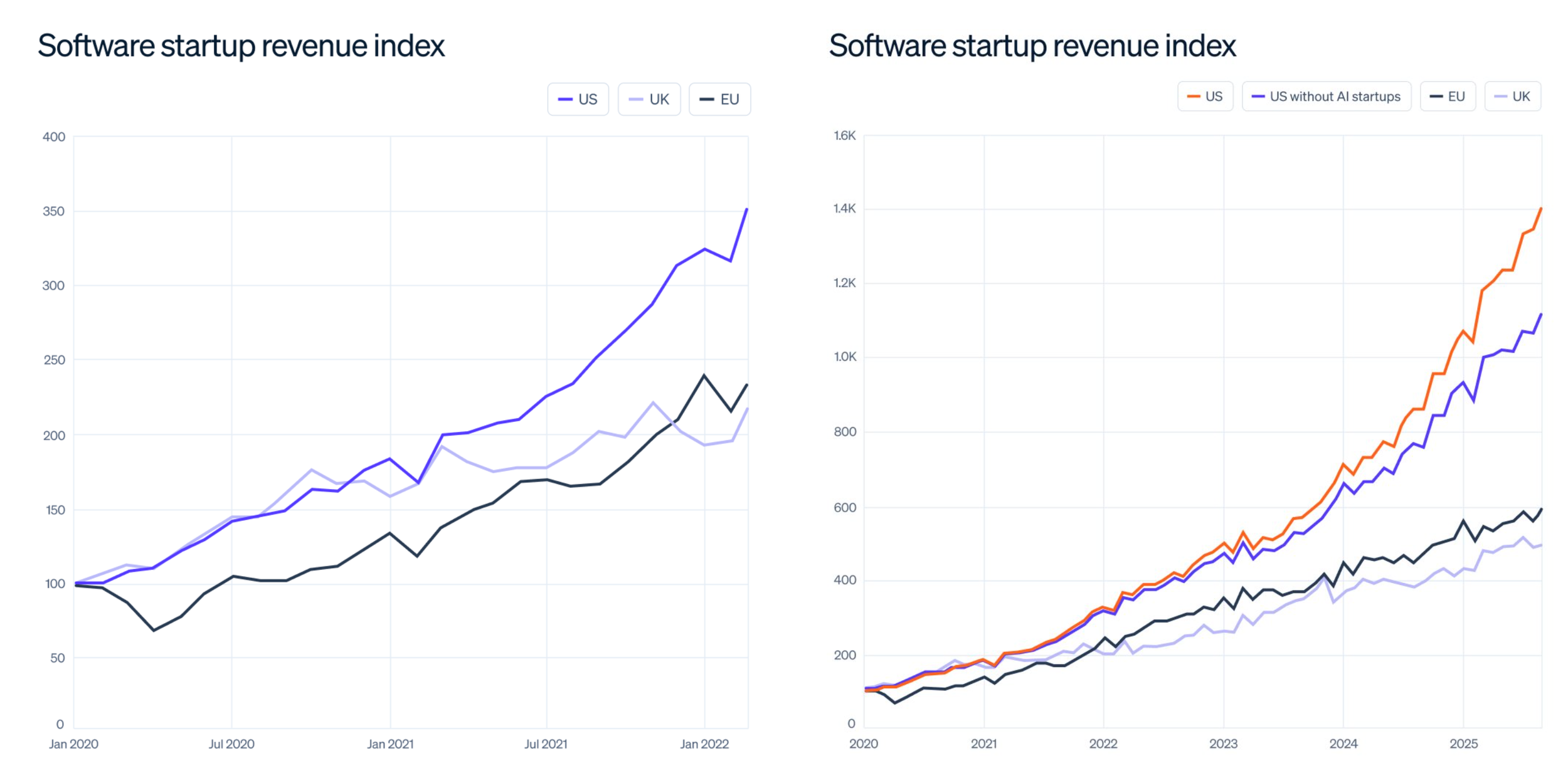
I’ve alluded to before in these pages about how Patrick Collison is almost as good an economic commentator as he is an entrepreneur (and I’m sure the two are mutually reinforcing, too). Alongside running Stripe, Collison regularly finds time to publicly weigh in on trends and their implications for the world around us. Last Sunday, he shared a pair of charts – reproduced below – which clearly show how American startups have raced ahead of their British and European counterparts on revenue growth since the beginning of the decade.

Source: Patrick Collison

One explanation for this would be that the gains are accruing only to AI companies. Not only do I think this line of reasoning offers false comfort (why shouldn’t those AI companies be this side of the Atlantic?) but as Collison notes, while partly true, it can only explain a small share of the widening gulf. Even if you remove American AI startups from the mix, things still look a lot rosier stateside.

A better theory, Collison suggests, is that Americans are quicker off the mark when it comes to adopting new tech – including AI, but also other innovations like stablecoins. Certainly, this vibes true to me, and it doesn’t require much mental gymnastics to see why. American startups are physically closer to many of the world’s key software suppliers, and plenty will have been started by founders who once worked for them too. Technological diffusion becomes so much easier as a result.

There’s also more business dynamism in the US – meaning that those firms which don’t embrace cutting-edge technologies will invariably find themselves competed away by those which do. In Britain and Europe, laggards may be able to scrape by, in turn mechanically pulling down the revenue growth data.

It’s not as if our own Government is unaware of this. In recent years, we’ve seen a litany of strategies, working groups, and sometimes even real policies passed to try to increase tech adoption by businesses. This summer, the SME Digital Adoption Taskforce produced its final report, in which it recommended common e-invoicing standards, the rollout of digital ID, tax digitisation, and a targeted awareness programme for digital and AI adoption support. Time will tell whether these prescriptions will be medicine enough to heal our ailing economy.

📊 Pedro Serodio, Chief Economist, Centre for British Progress

The emergence of deep learning as a source for commercially viable AI technology has highlighted the economic value of high-quality data. At the same time, the UK’s public data infrastructure is quietly degrading. Both research and policy critically depend on the availability and reliability of key economic data. However, the methods used to generate it are increasingly fallible.

Much of the data produced by the UK’s main statistical body, the Office for National Statistics, relies on survey data. Many other datasets feeding key statistics or playing prominent roles in research and policy evaluation also depend on securing high response rates and high-quality responses to questionnaires distributed to key demographics. Surveys of individuals across disparate but connected economic indicators enable researchers to generate data on the labour market, company and sectoral activity, income and wealth, innovation activity, or even economic output. As long as the sample remains representative of the population as a whole, it can be used to infer important information about statistical aggregates.

But conducting surveys is becoming more difficult and expensive. Labour costs, data storage and handling, and regulatory requirements on data protection, have made surveys significantly more expensive and difficult to run. Beyond costs, persuading people and companies to provide information is getting harder, and offering compensation carries a large risk of selecting away from representative samples that can stand in for population-wide data.

On the other hand, administrative data has never been so abundant. Many different services, both public and private, now collect vast quantities of data that exist largely in isolation. There is a growing risk that public authorities have made a large and costly strategic error by not prioritising the integration and availability of different sources of administrative data across different parts of the public sector.

Administrative data owned by specific units, departments and organisations is increasingly walled off from government officials – often even within the very departments they work in. It also has several drawbacks relative to survey data. Beyond the technical complexity of matching records across sources, data protection regulations, inadequate technical infrastructure, and entrenched departmental silos create fundamental barriers to integration. But as surveys become less feasible, a failure to leverage administrative data will result in a concerning degradation of the quality of our public data. There is a deep irony that just as the private sector begins to leverage data into billion-pound valuations, we risk eroding the value of our public data by failing to reform how we collect and handle it.

🤝 Philip Salter, Founder

President Harry S. Truman was wrong. Specifically, when he said: “Give me a one-handed economist. All my economists say ‘on one hand...’, then ‘but on the other...’.” It’s a catchy quip, but in reality there are quite a few things that most reasonable economists agree on.

That’s why it’s so significant to see CenTax, the Centre for Policy Studies, the Adam Smith Institute, Labour Together, the Institute for Public Policy Research, the New Economics Foundation, the Joseph Rowntree Foundation, Bright Blue, and Dan Neidle team up today to propose a package of reforms that would move the UK towards a fairer, more effective, and more pro-growth tax system.

For those less familiar with these organisations, this collaboration is remarkable – it bridges a genuine political divide. On one side, the Centre for Policy Studies, co-founded by Margaret Thatcher and Sir Keith Joseph; on the other, the New Economics Foundation, which advocates wealth redistribution, stronger unions, shorter working weeks, and public ownership of key sectors.

The resulting package is a strong one, and includes several reforms we’ve long championed – such as basing Business Rates on site values, removing empty property relief, and merging employer and employee National Insurance contributions with Income Tax. Although not everything proposed in the report is economic consensus. Many are rightly raising questions about the report’s call for an exit tax, which could discourage top entrepreneurial talent from coming or staying in the UK.

The best way to run the country isn’t simply a negotiation between economists from the left and right. We should heed Dr Madsen Pirie’s caution against the logical fallacy of argumentum ad temperantiam. Yet, there are areas of tax policy where the status quo is so bad, that you can even bring together Thatcher’s own think tank with unabashed degrowthers. The Chancellor should take note.

Three Big Ideas #47

Three Big Ideas is our fortnightly roundup of ideas (and our takes on them) in entrepreneurship, innovation, science and technology, handpicked by the team.

This week, Eamonn Ives dwells on why American startups are pulling ahead of their European counterparts, Philip Salter salutes a significant tax consensus, and Pedro Serodio warns that public data is slowly degrading.

Burning Ambition

On Wednesday we launched Ambition Unlimited, the inaugural report of our Young Entrepreneurs Forum.

Speaking at the launch in the House of Lords were Callum Anderson MP, Sean Kohli, Chair of the Young Entrepreneurs Forum, Dana Denis-Smith OBE, Founder of Obelisk Support, and our Research Director, Eamonn Ives, who all set out a positive case for why we need to back the next generation.

As I wrote in Forbes, Eamonn delivers a compelling suite of policies which would deliver a platform upon which entrepreneurs can flourish:

“The UK must double down on openness, dynamism and stability. That means ensuring tax and investment incentives stay internationally competitive, designing regulation that adapts quickly to new technologies, and keeping visa routes navigable and attractive so that founders like Lin continue to choose Britain as their base. Above all, government should give entrepreneurs the confidence to plan for the decade ahead, not just the next fiscal statement.”

I would, as you would expect, encourage you all to dig into the report, but I want to take a slightly different tack today and share one lesson I’ve learned from the events we’ve undertaken with the Young Entrepreneurs Forum project: that Britain has no shortage of talent nor ambition to take on the world.

We’re not alone. Matt Clifford CBE expressed similar sentiments in a speech at the recent LFG conference, arguing that, as the birthplace of modern science, democracy, industry, medicine, computing, and even sport and literature, Britain can be so once again.

It goes without saying that we believe in the importance of policy change to drive change. But it’s also worth acknowledging that much can still be achieved despite these constraints.

To that end, it’s worth sharing a list of organisations that support the next generation of entrepreneurs that our Adviser and the Small Business Commissioner, Emma Jones CBE, put together following our event, including Young Enterprise, Founders for Schools, Kickstarter and LaunchIt. Emma encourages you to share other organisations that support young entrepreneurs, which you can do so here.

It’s vital to attack the challenge of renewal on both fronts. Policy change and practical efforts reinforce each other – not least because launching a report with over 100 of the most ambitious young entrepreneurs in the country gives you the inspiration to keep up the policy work to support them.

500 Smiles

Without much of a push, our WhatsApp community has now grown steadily to over 500 people. We still have some work to do in thinking about how we can make the most of the groups (answers on a postcard, please), but it’s proving a useful avenue to share our latest work, events and opportunities. Join our community here.

Express Yourself

To coincide with some polling they’ve commissioned on the importance of networking for small businesses, American Express is looking for case studies of entrepreneurs with positive stories to tell.

Perhaps networking helped you to land a big client, navigate a rocky period, or make connections necessary for international expansion. Whatever it was, if you have benefited from networking in the past and want to be considered for a case study, let us know by emailing us with a few sentences about yourself and how networking helped your business.

Trading Places

The Department for Business and Trade has asked us to share that next week is the fifth edition of International Trade Week (ITW) – five days of free online and in-person events designed to help businesses grow through exporting. Find out more here.

Think Inside the Box

Some policy ideas take a while to bear fruit. Take this week’s announcement of the AI Growth Lab, a regulatory sandbox in which innovators can safely test their AI products under adjusted or temporarily relaxed regulations.

This announcement puts a bit more meat on the bones of the AI Opportunities Action Plan, which, among many other things, called on the Government to “work with regulators to accelerate AI in priority sectors and implement pro-innovation initiatives like regulatory sandboxes.” However, this is an idea with a long history.

Success, of course, has many mothers and fathers, but it’s worth looking into the work of John Fingleton CBE, who, over the years, has created the conceptual framework and supplied the intellectual ballast for those making the case for the sort of pro-innovation regulation the UK needs. His advocacy for bounded regulatory discretion and competition-driven innovation not only influenced the creation of the FCA’s sandbox, but also this week’s announcement.

The most compelling aspect of the policy is the option to regulate across the economy, rather than relying on the coordination of existing regulators. This chimes with Fingleton’s idea for an ‘n+1 regulator’, which he explained in an interview I conducted with him earlier this year:

“The idea of the n+1 regulator goes back to about 2012, when I worked in the Cabinet Office and was advising on supply-side reforms. The essential idea was that new business models come along, and the existing regulatory framework doesn’t suit them. That could be because incumbents have captured it, or it could be because what they’re doing is just more risky or has a different profile of risk.”

The point here isn’t to write the history, but to shape the future. The Department for Science, Innovation and Technology has opened a consultation and would like to hear from individuals and organisations who are interested in using the AI Growth Lab; who are going to be affected by it; or who have expert views on implementing sandboxes.

Having spoken to the officials working on this policy, we highly recommend relevant entrepreneurs in our network consider responding. If you’d like to get in touch with us beforehand about that, my email is always open. We may also host a roundtable discussion with the government on this topic, so please get in touch to show early interest.

Anasta–see ya!

After a highly productive year and a half with us, our Head of Science and Technology, Anastasia Bektimirova, has left to join the Royal Academy of Engineering. Anastasia achieved a lot during her time at The Entrepreneurs Network, including authoring Governing in the Age of AI: Building Britain’s National Data Library, Towards a More Special Relationship and Full Speed Ahead, but perhaps her greatest legacy will be in moving our newsletter here – to Substack – which is proving to be a brilliant decision as our content and numbers continue to grow. Anastasia will be staying on as an Adviser – nobody ever really leaves The Entrepreneurs Network.

Network Intelligence

Anastasia also helped launch our new UK AI Fieldbook series, with her interview with Paul Patras, founder of Net AI, which looks into how AI is transforming mobile networks to prevent communications blackouts and optimise energy consumption.

It’s a cracking read with a lot of lessons for policymakers, including the need to design funding and policy around real startup experience, not top-down assumptions; to fix cash-flow pain by paying grants upfront rather than in arrears; to emulate ARIA’s speed, flexibility and minimal paperwork; and to bridge gaps between early-stage schemes like ICURe and follow-on support.

There’s also a clear case for modernising grant rules to suit globally distributed teams, tailoring evaluation criteria to company maturity, and, coincidentally enough, investing in AI sandboxes and better public compute tools so startups can safely develop and deploy innovations in critical sectors.

The UK AI Fieldbook series is kindly sponsored by OpenAI. This gives us the time and resources to really uncover the policy lessons from entrepreneurs at the cutting edge. We want to replicate this sort of deep policy dive with entrepreneurs across other areas of the ecosystem, so if you’re keen to partner with us on this, get in touch.

Three Big Ideas #46

🚙 Eamonn Ives, Research Director

Last week, Waymo formally announced that from 2026 it would be offering Londoners the opportunity to be whisked around the capital in one of their autonomous vehicles. As someone who made a point of hailing a Waymo as soon as I possibly could when I last visited San Francisco, I could not be happier with this news.

In our very first instalment of Three Big Ideas, I explained how autonomous vehicles represent a much safer form of driving – “[t]he computers that control them don’t get aggressive, tired or drunk” – and how they could also pave the way to a radically more efficient transport network. But the recent announcement also gives me hope in another dimension.

When innovation goes right it doesn’t just bestow society with snazzy new goods and services. It also instils in people a technophilic mindset that a better world is possible. When things that were once impossible become an ordinary part of daily life, it forces us to wonder what other unimaginable advances stand to be made. In short, innovation – like entrepreneurship – is contagious.

With that in mind, the next logical question is what can be done to increase innovation’s virality. Of course, there are the obvious things – like governments ensuring regulations allow experimentation, or enabling immigrants who likely have novel perspectives to move easily to new countries.

Then there are the more overlooked things. In our report Blueprint for a New Great Exhibition, we made the case for reviving the 1851 Great Exhibition, which showcased the latest inventions from around the world, facilitating learning – and stimulating competition among nations to raise their respective games. A revamped Great Exhibition might be a chance for innovators to convene and demonstrate the latest in lab-grown foods, breakthrough materials, medical nanobots, and, yes, autonomous vehicles.

If innovation is a cycle that feeds on belief, then just making it more visible is one of the best forms of progress policy we have. Simply put, the future feels closer when it drives past you.

💫 Bella Rhodes, Policy Lead, Startup Coalition

Over at Startup Coalition, we have just launched a report looking at the Enterprise Management Incentive (EMI) scheme. EMI offers tax-advantaged share options to help startups compete with corporate giants for top talent. When you can’t match Big Tech salaries, equity is essential.

Our report found that EMI works brilliantly – until it doesn’t. Ninety-two per cent of employers say it meaningfully motivates employees, 82% say it helps attract talent they’d otherwise struggle to hire, and 85% believe staff motivation would suffer if options became less attractive. But the scheme is breaking at precisely the wrong moments.

Companies raising funding rounds – averaging £23 million for growth-stage deals and £31.5 million for AI firms – routinely breach EMI’s outdated £30 million asset cap in a single go. This creates a brutal tax cliff: they don’t graduate to another scheme, they’re simply locked out. While alternatives like a Company Share Option Plan exist, they’re not always suitable substitutes, leaving successful scaleups in a policy no-man’s land: too large for EMI, but not yet at scale to rely purely on cash compensation.

Meanwhile, with companies staying private longer (now 10-12 years to IPO), early employees are forced to either lose their options or face punitive tax treatment when the 10-year exercise window expires. Changes to HMRC guidance applied retroactively now prevent boards from extending opportunities for employees to access liquidity through secondary transactions. Long-serving employees are forced to choose between exercising early (paying huge upfront tax bills) or leaving the company. Their employers can’t help without jeopardising the entire scheme.

One of our key recommendations is an EMI Growth scheme. Rather than leaving successful companies stranded when they outgrow EMI, we should create a smooth graduation path – an ‘EMI Growth’ tier with higher thresholds (we suggest £500 million assets and 2,500 employees) that maintains tax advantages for scaling firms. This prevents companies scrambling to restructure equity compensation while closing critical hires, keeping Britain competitive when it matters most.

🔌 Ed Hezlet, Head of Energy, Centre for British Progress

Energy policy in the UK is facing a conundrum. Decarbonisation efforts to date have largely focused on cleaning up electricity generation, which accounted for nearly a quarter of Britain’s territorial emissions in 2004. Fast forward to 2024, and absolute emissions from the electricity sector had fallen by 78%, to just 10% of total emissions.

Unfortunately, the UK now has some of the highest electricity prices in the world. In 2024, the UK had the second-highest domestic electricity prices in the IEA and topped the charts with respect to industrial electricity costs. This is not only a barrier to growth in the UK but also stands in the way of consumers and businesses adopting decarbonising technologies like heat pumps and electric vehicles.

There is no silver bullet for solving this problem – electricity bills have become a complex array of different policy costs that have been layered up over time. Whilst some of these costs could be moved to general taxation, scope is limited with the UK’s already tight fiscal position.

One small lever to help the situation would be removing the Carbon Price Support (CPS), the UK’s second carbon cost for electricity generators, which sits alongside the UK Emissions Trading Scheme.

The CPS adds a carbon tax of £18 per tonne of carbon dioxide, which increases wholesale electricity prices by around £6.60 per megawatt-hour whenever a gas power station is the marginal generator in the wholesale electricity market.

Our research indicates that this tax increased electricity costs by around £1.6 billion in 2024, whilst only raising around £440 million in tax receipts for the government.

Whilst it is a small start, the UK needs to focus on reducing its electricity costs to more competitive levels – for the sake of households, businesses and the environment.

Three Big Ideas #46

Three Big Ideas is our fortnightly roundup of ideas (and our takes on them) in entrepreneurship, innovation, science and technology, handpicked by the team.

This week, Eamonn Ives asks whether Waymo can inspire an uptick in innovation, Bella Rhodes explains how to turbocharge EMI, and Ed Hezlet makes the environmental case for reducing taxes on electricity.

Network Intelligence

In our latest interview for our UK AI Fieldbook series, Anastasia Bektimirova speaks to Paul Patras on how AI is transforming mobile networks to prevent communications blackouts and optimise energy consumption.