

📈 Eamonn Ives, Research Director
I’ve alluded to before in these pages about how Patrick Collison is almost as good an economic commentator as he is an entrepreneur (and I’m sure the two are mutually reinforcing, too). Alongside running Stripe, Collison regularly finds time to publicly weigh in on trends and their implications for the world around us. Last Sunday, he shared a pair of charts – reproduced below – which clearly show how American startups have raced ahead of their British and European counterparts on revenue growth since the beginning of the decade.
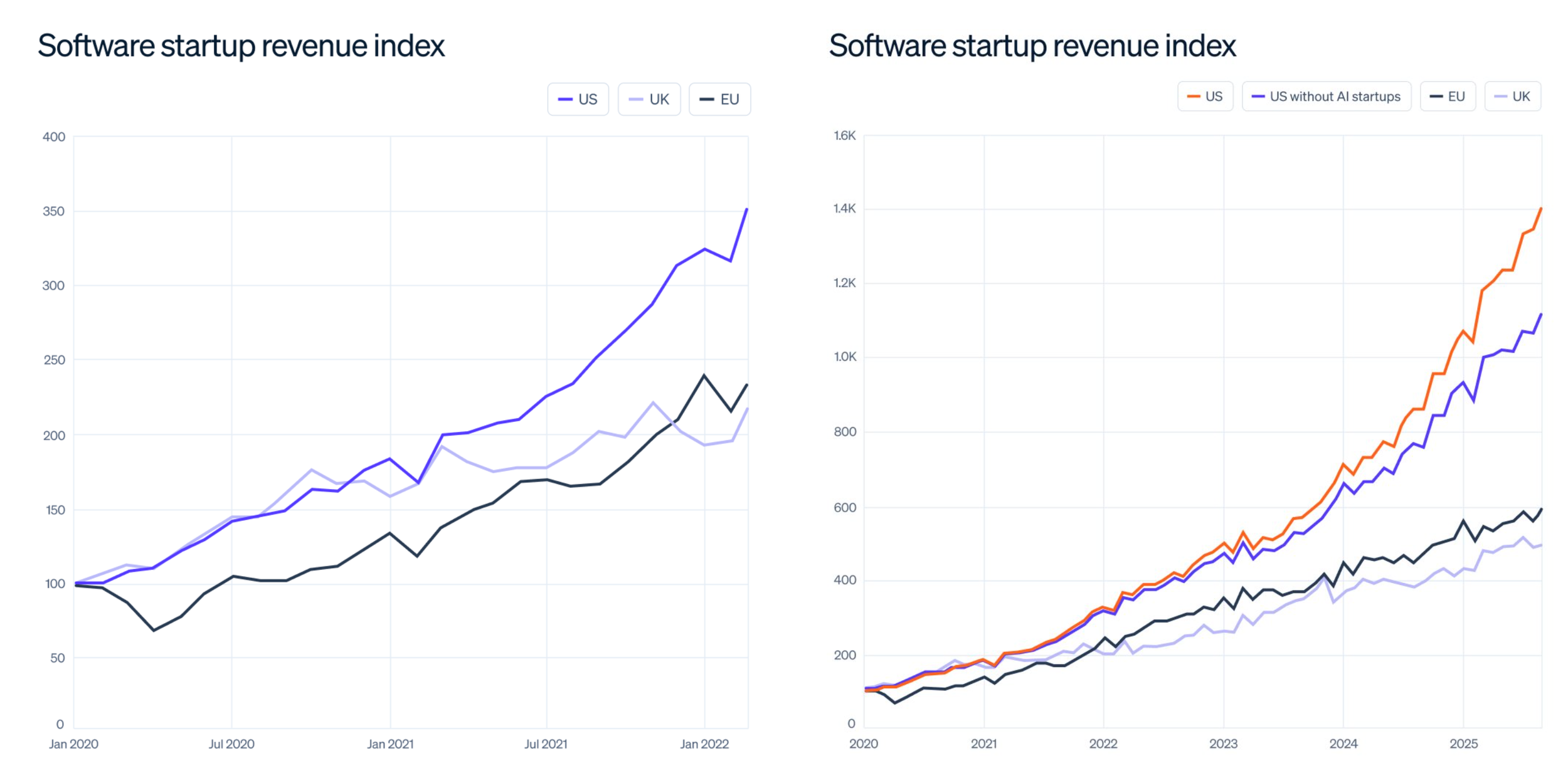
Source: Patrick Collison
One explanation for this would be that the gains are accruing only to AI companies. Not only do I think this line of reasoning offers false comfort (why shouldn’t those AI companies be this side of the Atlantic?) but as Collison notes, while partly true, it can only explain a small share of the widening gulf. Even if you remove American AI startups from the mix, things still look a lot rosier stateside.
A better theory, Collison suggests, is that Americans are quicker off the mark when it comes to adopting new tech – including AI, but also other innovations like stablecoins. Certainly, this vibes true to me, and it doesn’t require much mental gymnastics to see why. American startups are physically closer to many of the world’s key software suppliers, and plenty will have been started by founders who once worked for them too. Technological diffusion becomes so much easier as a result.
There’s also more business dynamism in the US – meaning that those firms which don’t embrace cutting-edge technologies will invariably find themselves competed away by those which do. In Britain and Europe, laggards may be able to scrape by, in turn mechanically pulling down the revenue growth data.
It’s not as if our own Government is unaware of this. In recent years, we’ve seen a litany of strategies, working groups, and sometimes even real policies passed to try to increase tech adoption by businesses. This summer, the SME Digital Adoption Taskforce produced its final report, in which it recommended common e-invoicing standards, the rollout of digital ID, tax digitisation, and a targeted awareness programme for digital and AI adoption support. Time will tell whether these prescriptions will be medicine enough to heal our ailing economy.
📊 Pedro Serodio, Chief Economist, Centre for British Progress
The emergence of deep learning as a source for commercially viable AI technology has highlighted the economic value of high-quality data. At the same time, the UK’s public data infrastructure is quietly degrading. Both research and policy critically depend on the availability and reliability of key economic data. However, the methods used to generate it are increasingly fallible.
Much of the data produced by the UK’s main statistical body, the Office for National Statistics, relies on survey data. Many other datasets feeding key statistics or playing prominent roles in research and policy evaluation also depend on securing high response rates and high-quality responses to questionnaires distributed to key demographics. Surveys of individuals across disparate but connected economic indicators enable researchers to generate data on the labour market, company and sectoral activity, income and wealth, innovation activity, or even economic output. As long as the sample remains representative of the population as a whole, it can be used to infer important information about statistical aggregates.
But conducting surveys is becoming more difficult and expensive. Labour costs, data storage and handling, and regulatory requirements on data protection, have made surveys significantly more expensive and difficult to run. Beyond costs, persuading people and companies to provide information is getting harder, and offering compensation carries a large risk of selecting away from representative samples that can stand in for population-wide data.
On the other hand, administrative data has never been so abundant. Many different services, both public and private, now collect vast quantities of data that exist largely in isolation. There is a growing risk that public authorities have made a large and costly strategic error by not prioritising the integration and availability of different sources of administrative data across different parts of the public sector.
Administrative data owned by specific units, departments and organisations is increasingly walled off from government officials – often even within the very departments they work in. It also has several drawbacks relative to survey data. Beyond the technical complexity of matching records across sources, data protection regulations, inadequate technical infrastructure, and entrenched departmental silos create fundamental barriers to integration. But as surveys become less feasible, a failure to leverage administrative data will result in a concerning degradation of the quality of our public data. There is a deep irony that just as the private sector begins to leverage data into billion-pound valuations, we risk eroding the value of our public data by failing to reform how we collect and handle it.
🤝 Philip Salter, Founder
President Harry S. Truman was wrong. Specifically, when he said: “Give me a one-handed economist. All my economists say ‘on one hand...’, then ‘but on the other...’.” It’s a catchy quip, but in reality there are quite a few things that most reasonable economists agree on.
That’s why it’s so significant to see CenTax, the Centre for Policy Studies, the Adam Smith Institute, Labour Together, the Institute for Public Policy Research, the New Economics Foundation, the Joseph Rowntree Foundation, Bright Blue, and Dan Neidle team up today to propose a package of reforms that would move the UK towards a fairer, more effective, and more pro-growth tax system.
For those less familiar with these organisations, this collaboration is remarkable – it bridges a genuine political divide. On one side, the Centre for Policy Studies, co-founded by Margaret Thatcher and Sir Keith Joseph; on the other, the New Economics Foundation, which advocates wealth redistribution, stronger unions, shorter working weeks, and public ownership of key sectors.
The resulting package is a strong one, and includes several reforms we’ve long championed – such as basing Business Rates on site values, removing empty property relief, and merging employer and employee National Insurance contributions with Income Tax. Although not everything proposed in the report is economic consensus. Many are rightly raising questions about the report’s call for an exit tax, which could discourage top entrepreneurial talent from coming or staying in the UK.
The best way to run the country isn’t simply a negotiation between economists from the left and right. We should heed Dr Madsen Pirie’s caution against the logical fallacy of argumentum ad temperantiam. Yet, there are areas of tax policy where the status quo is so bad, that you can even bring together Thatcher’s own think tank with unabashed degrowthers. The Chancellor should take note.