





Three Big Ideas #56

🤝 Philip Salter, Founder

Despite the performative antagonism of shows like The Apprentice and Dragons’ Den, anyone familiar with business knows that collaboration is critical for success. You only need to look at the concerns arising from Anthropic’s broken relationship with the United States Department of Defense to see the primacy of partnerships. And what’s true for one of the world’s fastest-growing companies is also true for Britain’s smallest — even more so.

In a new paper, researchers analysed over 17,500 UK firms from 2006 to 2018 across three government datasets, measuring innovation as the share of revenue from new-to-market products. They tracked whether firms collaborated with seven types of partners across four geographic levels and isolated how SMEs — 92% of the sample — benefited differently from partnerships compared with large firms.

The headline finding is that SMEs get the highest returns from collaboration with customers and suppliers compared with universities, consultants and government. On average, knowledge collaboration for innovation in SMEs is positively moderated by the regional proximity of collaboration partners — in other words, the closer the partner is, the greater the positive effects of knowledge collaboration. This matters most for university collaboration and exploration-oriented innovation; for customers and suppliers, however, the positive effects hold across geographic distances, including international.

University collaboration does positively affect SME innovation, but only when the university is nearby — regionally or nationally. The effect disappears or turns negative at international distances. Even then, the research suggests that the type of knowledge universities offer is harder for small firms to absorb and commercialise compared with the more applied, market-ready knowledge that flows from customers and suppliers.

Critically, government collaboration has essentially no measurable impact on SME innovation. This isn’t procurement but rather cooperation with government bodies or public research institutes specifically on innovation activities — joint R&D work or knowledge-sharing partnerships aimed at developing new products or processes.

The paper finds that homophilous partnerships — working with knowledge-similar, geographically close, supply-chain partners — produce the strongest measurable innovation outcomes for SMEs, at least when success is measured by new-to-market product revenue. The paper suggests that this can create echo chambers and might mean missing out on more transformative opportunities, but the data shows this is, on average, the best strategy.

So what are the policy implications? When it comes to SMEs, this paper suggests that government support should prioritise helping them deepen relationships with customers and suppliers — the partnerships that most reliably drive innovation. University–industry linkages — as currently delivered — may be overweighted, while international programmes requiring cross-border academic partnerships risk imposing costs on SMEs that outweigh the benefits. And, to be blunt, the data shows that entrepreneurs should think twice before working directly with government.

🪙 Eamonn Ives, Research Director

Plans to replace portraits of historical figures with pictures of quintessential British wildlife on bank notes will understandably be the one currency news story that gets all the attention today. Fun as it will no doubt be to see cuddly creatures adorn our legal tender, another altogether more important money-related media item also bubbles beneath the surface.

Today marks the last call for submissions to the Financial Services Regulation Committee’s inquiry on how stablecoins should be regulated in Britain. For the uninitiated, stablecoins are a form of digital currency, the value of which is tightly pegged to real-world assets — like cash or government bonds. This allows them to serve as a ‘stable’ unit of value, in the sense that one sterling-denominated stablecoin can always be redeemed at £1, a dollar-denominated one at $1, and so forth.

As Hugo Okada and Osian Guthrie note in our latest research paper, A Sterling Opportunity, stablecoins offer a host of potential benefits. For consumers, there’s the promise of greater financial inclusion. For businesses, cross-border transactions could become radically less expensive.

Where stablecoins could, however, pose more of a threat is to governments. If they continue on their meteoric rise — up tenfold in the last five years, with the market cap currently standing at around $300 billion — there’s always a risk that sovereign states will see their ability to regulate the money supply eroded. But, for a nation like the United Kingdom, there could also be significant upsides too.

Consider how stablecoins rely on high-quality assets — such as government bonds — to maintain their value. Simple economics tells us that this will drive bond prices up, and yields down. Servicing the national debt would in turn become cheaper. Public sector net debt is incrementally nudging down from the highs of the Covid-19 pandemic, but it still stands at 92.9% of GDP. In 2025-26, the Office for Budget Responsibility expects the UK to pay £114 billion simply to service that debt. Even in the best of times, that’s an awful lot of money that could otherwise be used for more productive ends.

Stablecoins won’t solve Britain’s debt problem entirely. But they might just help at the margin — through allowing cheaper borrowing, and by stimulating entrepreneurial activity in a clear growth sector. To seize their full potential, however, Britain needs a regulatory regime that’s fit for purpose. We should take heart from the fact that legislators are examining stablecoins closely — let’s hope their diagnosis and subsequent prescriptions are wise ones.

📝 Mann Virdee, Senior Researcher

On Sunday, our Adviser Sam Dumitriu highlighted a growing paradox in Britain’s approach to safeguarding nature: well-intentioned legislation designed to protect nature often has the opposite effect. By prioritising bureaucratic processes over purpose and outcomes, current laws offer the worst of all worlds. They fail to protect the environment and also prevent us from building the energy and transport infrastructure essential to decarbonisation.

This is part of a broader problem — the prioritisation of process over purpose leads to distorted outcomes. When we treat administrative compliance as the goal, we lose sight of the intended outcomes.

Legislation can also fail to serve its intended purpose because politicians are required to vote on complex regulations with limited time, information, and ability to stress-test. That’s not helped when the UK’s political system prioritises looking busy and constituency casework over the job of being a legislator. It’s worse for the entrepreneurial ecosystem because so few parliamentarians understand what it takes to be an entrepreneur or the competing pressures they face.

Take the example of the National Security and Investment Act. Its well-intentioned purpose is to allow government to scrutinise and intervene in business acquisitions, mergers, and investments that it believes will pose risks to national security. But its broad scope means that some startups and low-risk deals such as internal restructuring are unintended targets.

This all reflects an environment where the fear of making a wrong decision outweighs the benefit of trying a new approach. This “paralysis by analysis” leaves Britain with the highest energy costs in Europe and a regulatory regime that makes the investment environment more difficult for Britain’s entrepreneurs.

Addressing these failures requires better oversight as well as better regulation. That could include sunset clauses, formal review processes, and structured scrutiny from experts and practitioners after legislation has been passed. And there are many arguments for the reform of the House of Lords — not least its status as the world’s second-largest legislative body and the questionable expertise of some members — but the scrutiny and debate provided by the upper chamber should not be dismissed lightly; it remains a necessary, albeit imperfect, check on poorly drafted law.
Total Recall

In our latest interview for our UK AI Fieldbook series, Mann Virdee speaks to Hanna Celina about how combining learning science with generative AI can overcome the cognitive forgetting curve to optimise human memory

Stiffed Competition

Ambitious entrepreneurs face a panoply of risks between ideation and exit, some of which can stop them in their tracks. One such risk that gets overlooked all too often is the web of regulations that constitute our approach to competition policy. As we argued in Better Together, these rules can have a chilling effect on investment, and thus entrepreneurial activity overall.

On this note, busy founders will be easily forgiven for not digging deep into the recesses of GOV.UK to find the Department for Business and Trade’s paper Refining Our Competition Regime.

It covers a lot, but let me highlight one proposal. Specifically, the paper proposes giving the Competition and Markets Authority (CMA) the power to compel companies to hand over the source code behind their algorithms. It would also be able to intervene in how products operate during an investigation — for example, by altering how content is displayed or how a pricing engine behaves — before any wrongdoing has been proven. The CMA could even run its own tests on an algorithm under conditions it specifies, with its in-house experts observing how the system behaves.

These are investigative powers rather than penalties. In practice, that means they could be deployed during a review — most likely a merger investigation — prior to any conclusion being reached. These powers would expand the surface area of regulatory risk, increase the burden on businesses subject to them, and send an unwelcome signal about the UK’s regulatory culture that investors around the world will notice.

The Department for Business and Trade’s call for evidence on these proposed changes to the CMA closes at the end of the month. You may wish to respond. And please feel free to reach out directly to me with your thoughts on this.

Easy As

This week, the All-Party Parliamentary Group (APPG) for Entrepreneurship released the A to Z of Entrepreneurship. I appreciate that many of you will have heard about this via the APPG’s newsletter or my email, so I’ll keep it brief.

In short, through the APPG, we’ve helped to create an evergreen resource for politicians, policymakers, researchers and anyone looking to better understand the landscape of entrepreneurship policy.

If you have any feedback — including suggestions for new entries — let us know.

Local to Global

International Women’s Day is on Sunday. You’ll already know about all the work we undertake with Barclays through our Female Founders Forum — including most recently Ideas to Impact, in which we looked at the experiences of female academic entrepreneurs in Britain’s spinout ecosystem — so today I want to draw your attention to two separate endeavours supporting female founders I found out about this week.

First, we hosted our latest Ecosystem Builders event in Birmingham with Tara Attfield-Tomes. Among other things, Tara is the founder of The 51% Club, which is building hubs across the country. Second, this week the equally wonderful Pip Jamieson announced the launch of the UN Women UK community app. Both come highly recommended.

Relatedly, do get in touch with recommendations for resources or organisations which have supported your business growth. We may add them to our Support for UK Entrepreneurs page.

Inside a Deal

On the morning of Tuesday 24 March, Buzzacott will be hosting a deep dive into the sale of Cadcorp, a leading geospatial software provider, to NEC Software. The live panel discussion will take you behind the scenes of the journey. You can request a place here.

For the Trees

I’m delighted and honoured to have joined the board of The Cedar Review, a national, independent review exploring how to better support refugee entrepreneurs to start, sustain and grow successful businesses in the UK.

As part of this work, refugee entrepreneurs are being asked to take part in paid research to share their experiences, the opportunities, the challenges, and what would make the biggest difference.

Find out more here, and sign up to take part in the research here.

Message from our Partner

At Fora, we create flexible workspaces that empower ambitious businesses to thrive. With over 70 locations across London, the UK and Germany, our spaces are designed to fuel productivity, creativity and growth.

Now, we’re bringing that vision to The Jellicoe at King’s Cross a dedicated hub for founders and fast-growing companies. Here, flexibility meets opportunity: scale at speed with agile workspace solutions, connect with a curated community of entrepreneurs and investors, and enjoy all the perks of a Fora membership, from wellness spaces and hospitality-grade service to events that open doors.

Surround yourself with innovators and global tech giants in one of London’s most exciting neighbourhoods.

If you’re building the next big thing, this is where you want to be.

Discover Fora with a free Day Pass

Permission Control

Today’s newsletter comes from our Research Director, Eamonn Ives. Normal service with Philip resumes next week!

While I’m hardly the world’s most sentimental person, there are a handful of things I routinely look forward to each year: that first sunny day of spring, the return of Premier League football, and Patrick and John Collison publishing Stripe’s annual company letter.

If you think you have better things to do with your time than read some corporate musings, think again. Far from the inane platitudes that give ‘corporatese’ its deservedly bad name, their annual stocktake is always worth your full attention.

In their latest letter, the pair examine several trends that should interest each and every entrepreneur. Among other things, they show how income concentration among top firms is approaching record levels, how stablecoins are already reshaping B2B payments, and how agentic commerce might transform both professional and personal life.

Like all good writers, the Collisons save the best for last. Invoking the work of Joel Mokyr, one of the winners of last year’s Nobel Prize in Economic Sciences, they note:

“In The Political Economy of Technological Change, Mokyr also observed that new technologies have in the past often failed, despite their economic superiority, because technological decision-making implicates not only suppliers and customers, but also a broad variety of nonmarket “aggregators” (regulators, committees, courts) that influence what is adopted. As AI and the internet expand the scope of what’s possible, synthetic impediments to adoption and adaptation will become increasingly costly. Our bifurcating economy shows that growth is contingent on the application of useful knowledge and not some preordained result of its abstract availability.”

The point is worth dwelling on. It’s not enough to invent something better. Whether it actually gets used — at scale, and quickly enough to matter — depends just as much on permission from regulators as it does on consumer demand and entrepreneurial guile. We’ve seen this play out already with nuclear energy and drones — and we’re watching it unfold again with advances like AI and GLP-1 agonists. An increasingly pertinent question for innovation policy now is not whether we can invent miraculous new technologies, but whether institutional environments will give them the oxygen they require to breathe.

Here at The Entrepreneurs Network, we can’t promise to crack cold fusion, engineer room-temperature superconductors, or invent any other technological marvels. What we can try to do, however, is to ensure that when society’s innovators make progress, the policy landscape stands ready to facilitate rather than frustrate them.

After decades of relative stagnation, it’s patently clear that we are now at a juncture in human history. Readers of my Big Idea this week will know that new technologies appear to be diffusing into the economy at an ever-quickening pace. It is incumbent on policymakers to ensure that regulatory barriers to socially useful innovation do not put that trend into reverse. Before us awaits an abundant society — if we can permit it.

On the Hunt

On Tuesday, we hosted Sir Jeremy Hunt MP for a fireside chat, adeptly chaired by our Patron, Steve Rigby. In the audience were around 50 entrepreneurs, all armed with incisive questions to pose to the former Chancellor.

As it was held under Chatham House Rule, I can’t divulge exactly what was discussed, but we covered a lot of ground. I mentioned on LinkedIn how one of the most interesting parts of the evening was Sir Jeremy’s reflection on the similarities between being a top politician and leading entrepreneur.

Since then, I’ve also spent more time thinking about his observation of how we need to get better at embracing risk — both in business, and, perhaps more importantly, in politics. This wasn’t a paean for recklessness, but to acknowledge that too often our political system rewards ‘not doing wrong’ far more so than it rewards ‘actively doing good’.

Many of Britain’s thorniest problems have festered for decades. Rather than always trying to stave off the worst-case scenario, perhaps civil servants should be empowered to experiment more boldly with novel solutions. When venture capitalists allocate investment, they do so in the hope that a handful of winning bets cover many multiples more losing ones. Gains may stand to be made if we could develop a similarly healthy tolerance for failure in policymaking too.

We’ll be organising more fireside chats with other political leaders in the near future. To receive invitations directly, you can join as a Member for free here. If you’re in a position to support us financially, you can use the same link to join us as a Supporter or Adviser (for those who already do — thank you).

Last Call

If you haven’t got around to it yet, there’s still time to respond to our latest Entrepreneurs Survey. Whether you’re optimistic, pessimistic, or somewhere in between — we want to know what founders really think about Britain’s current state of affairs. It only takes 10 minutes to complete, and you’ll be joining hundreds of fellow founders who have made their voices count.

Three Big Ideas #55

Eamonn Ives, Research Director

In the last few days alone, we’ve fielded a number of requests from journalists keen to know whether or not AI is having a discernible impact on Britain’s labour market. There’s certainly evidence to suggest that it might be, but the old adage of not confusing correlation with causation must be heeded. As I told both Bloomberg and The Telegraph, other factors — not least the increased tax burden of employing workers, plus new regulations that make it harder to fire underperformers — might hold more water for explaining the sustained rise in unemployment over recent months.

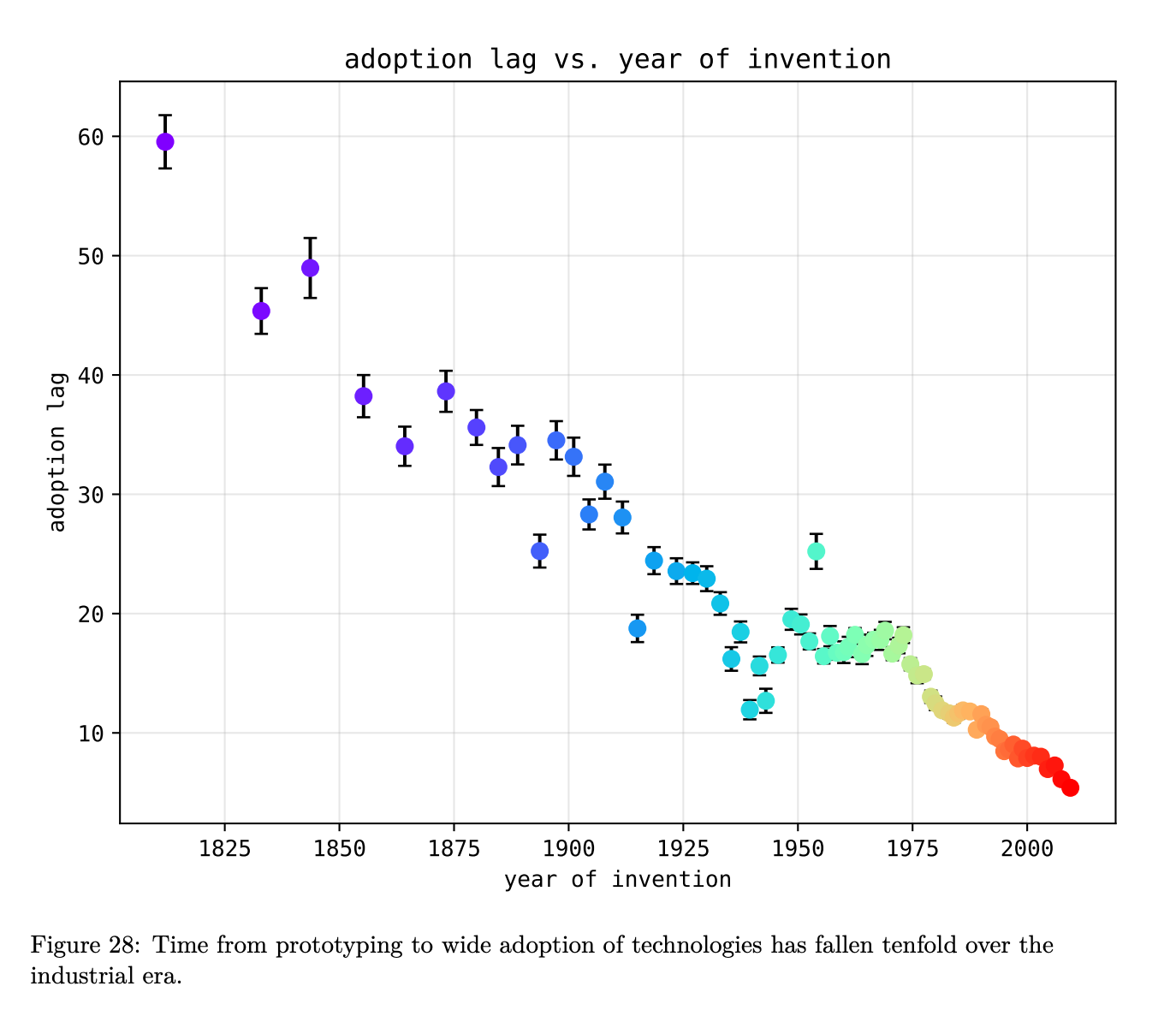
That being said, I think it’d be foolhardy to be too bearish on AI’s eventual impact on the world of work. A new working paper from Hemanth Asirvatham, Elliott Mokski and Andrei Shleifer gives credence to that hunch, and suggests change may occur quicker than we might expect. Their research studies how long it takes for various technologies to experience widespread adoption after being invented, and, crucially, how this has changed over time. What they find is striking — a tenfold decrease in ‘adoption lags’ since the start of the industrial age to today. Whereas it once took roughly 50 years for a technology to go from initial prototype to being diffused into the economy, it now takes only around five. While the authors do note AI has some properties that might somewhat slow its spread, they nonetheless believe there are reasons to believe its adoption will be rapid.

Source: Asirvatham, Mokski and Shleifer

Nobel-winning economist Robert Solow once famously quipped that “you can see the computer age everywhere but in the productivity statistics.” If Asirvatham, Mokski and Shleifer are right, we might not be able to say the same about AI for much longer.

🎓 Mann Virdee, Senior Researcher

Here’s something to think about: since the turn of the millennium, the number of doctoral students has more than doubled globally and is increasing each and every year. At the same time, there is room for less than 20% of them in permanent academic positions. In some fields, it can be as low as 3–5%.

That is not necessarily a problem. It depends what you think the purpose of a PhD is. A Doctor of Philosophy is, after all, about a love of wisdom. My own experience is that a PhD helps one think more deeply and ask more searching questions. That’s undoubtedly a good thing in and of itself.

But there are other ways to engage with knowledge — and it’s clear too many people are going down the same pathway that doesn’t equip them for careers outside of academia. Surely there are other ways to pursue a love of wisdom that doesn’t require a highly specific route of writing and defending an academic thesis for the vast majority of PhDs who will never be academics.

China is responding with an interesting innovation: the ‘practical PhD’. In this new model, engineering students graduate by defending a physical product instead of a written thesis. Students have two supervisors, one from a university and one from industry, and must prove their inventions would work at an industrial scale. It’s different from an Engineering Doctorate, which still relies on a traditional write-up.

Critics who argue that this isn’t a real PhD have a point, but they are also missing the point. Our current system trains vast numbers of people to write academic papers who will not need that skill after completing their doctorate. So while we shouldn’t stop people doing PhDs, experimenting with contributing to knowledge in forms other than a thesis seems like an excellent idea to me.

As the Financial Times recently noted, the graduate premium is collapsing in the UK. The problem is not that we have too many graduates, but rather that our economy is failing to create the high-skilled, professional jobs. Unlike the US or the Netherlands, the UK’s share of managerial and professional roles has stagnated. We have a skills mismatch because our PhDs are trained to write papers, while our economy desperately needs them to build companies and infrastructure. Perhaps shifting the dial slightly will help us turn our oversupply of graduates into an engine for growth.

🔋 Jessie May Green, Events and APPG for Entrepreneurship Coordinator

We rely on critical minerals, such as lithium, copper and cobalt, for everything from smartphones to wind turbines. Energy, communications, defence, transport and scientific research all depend on their ready supply. Yet being a globally traded commodity, critical minerals are acutely vulnerable to geopolitical shocks.

To mitigate risk, and to drive up standards in this notoriously harmful industry, the Government recently released its ‘Vision 2035’ Critical Minerals Strategy. The report emphasises three key focuses going forwards: collaborating with international partners, improving the ethics of international markets through enhanced ESG, and expanding our domestic capacity. The last point is an interesting one.

By 2035, the Government aims to be sourcing at least 10% of the UK’s critical minerals domestically (with a further 20% from recycling products that contain them). The fact that we have this much potential may surprise those living outside of industry hotspots like County Durham and Cornwall.

Currently, most may associate the sector with countries such as the Democratic Republic of Congo (cobalt), Brazil (ferro-niobium), and China (lithium and others). Fewer may be aware that Cornwall holds what is believed to be Europe’s largest lithium deposit, or that the largest tungsten deposit outside of China is in Plympton, Devon. Due to a lack of recycling facilities, the UK is a net exporter of copper, despite our domestic requirements for copper projected to double by 2035 to meet our climate targets. This highlights a need for enterprise and innovation if we are to increase our domestic resources and bring about circularity in the sector.

Nationwide, it’s all hands on deck. From the Scottish Government’s Draft Circular Economy Strategy and the Welsh Government’s Beyond Recycling, to the Critical Minerals Challenge Centre in Exeter and this pioneering magnet recycling plant in Belfast — Westminster is not alone in its desire to make the critical minerals supply chain more ethical, sustainable, diverse, and secure. Hopefully, ambition will only increase, and we will see a regeneration of local economies in the UK’s mineral-rich regions, as well as dignity and prosperity for our international partners.

Three Big Ideas #55

Three Big Ideas is our fortnightly roundup of ideas (and our takes on them) in entrepreneurship, innovation, science and technology, handpicked by the team.

This week, Eamonn Ives discusses new research that suggests the pace at which novel technologies diffuse into the economy is accelerating, Mann Virdee ponders whether we should copy the Chinese when training new engineers, and Jessie May Green takes stock of Britain’s approach to critical minerals.

Work Out

This week we learned that the UK’s unemployment rate hit a near five-year high in the last quarter of 2025, climbing to 5.2%. Among 16 to 24-year-olds, unemployment rose to 16.1%, the highest in more than a decade — and above the EU average for the first time since records began in 2000. Ouch!

Entrepreneurs in our network knew this was happening in real time. As reported by Bloomberg:

“One in four founders have made fewer administrative hires, and 19% recruited fewer juniors in response to AI technological advancements, according to a survey conducted by The Entrepreneurs Network in November. Only 2% said they increased headcount.”

(Incidentally, this is one reason you should complete our latest Entrepreneurs Survey. Your views on tax breaks will be submitted to the Government’s call for evidence, and you may like to know that strategists in all political parties are on tenterhooks to find out which outfit — or none, if you prefer — entrepreneurs say best understands their needs.)

Friend of the network Rachael Twumasi-Corson identifies the dual challenge in the same Bloomberg article:

“It’s scary to hire people, the minimum wage is so high and there’s so many additional protections”...“I would much rather have a team, celebrate wins and figure out ways to solve problems together, but at the moment, my team is ChatGPT and Gemini.”

It’s not just the minimum wage though. While the Government thankfully ditched its pledge to give day-one protection from unfair dismissal, the impact of the Employment Rights Act will still be brutal — here are no fewer than 55 reasons why. As our Research Director Eamonn Ives told Bloomberg:

“Before, the mindset might have been: we’ve got this idea and we’re going to quickly recruit as many people as possible to pursue it.”...“Now startups are thinking twice about taking on new hires who they might not be able to keep on if things don’t pan out.”

The cost of this direction of travel is clear. In a brilliant article for Works in Progress, Pieter Garicano argues — convincingly — that labour laws go a long way to explaining the innovation divide between the US and Europe.

This is seen most obviously when companies like Bird, Grammarly and Hugging Face move explicitly for this reason. But most of the damage is done below the surface. Relative to income, it costs large companies four times more to lay off workers in Germany and France than in the US — a difference arising entirely from regulation. As Pieter writes:

“If it is expensive to lay people off, employers avoid creating jobs that they might subsequently discontinue. Innovation involves experimentation and risk, so jobs in innovative areas of the economy are more likely to be discontinued than jobs elsewhere. High severance costs create a fundamental incentive for European businesses to avoid innovative areas and concentrate on safe, unchanging ones. In the long run, this is a recipe for decline.”

It’s not all doom and gloom, though. Pieter argues that Europe doesn’t need to choose between innovation and worker protection — it can have both, as Denmark and Austria show.

Denmark’s ‘flexicurity’ model lets employers fire almost at will, while the government catches workers with generous unemployment insurance (up to 90% of prior income for two years) and heavy spending on retraining. Austria uses portable severance accounts funded by employers, so workers keep their safety net when they change jobs.

Britain doesn’t have to choose between a safety net and a dynamic economy. But right now, we’re getting the worst of both worlds.

Our Adviser Anton Howes has created an employment cost calculator, which you may find useful. We’ve also compiled some useful links on our Support for UK Entrepreneurs page, including the Government’s new Employment Changes guidance on workplace rights reforms.

Value Judgement

This week, we joined 18 other business organisations in calling on the Government to consult on extending VAT liability rules for online marketplaces. As things stand, some overseas sellers exploit gaps in the current system to avoid charging VAT, giving them an automatic 20% price advantage over British businesses who play by the rules. For entrepreneurs who rely on marketplaces to grow, this is a serious competitive threat.

As well as levelling the playing field, reform could recover an estimated £700 million a year for the Exchequer. What’s not to like?

Leading Light

I’m delighted to share that Gaurav Chawla has joined us as an Adviser. Gaurav is a deep-tech founder, angel investor and university mentor focused on strengthening the UK’s science-to-scale pipeline.

As well as leading Lumirithmic, an Imperial College London spinout, he invests in and mentors early-stage founders emerging from Cambridge, Oxford, Imperial and UCL.

Gaurav is bullish on the UK:

“The UK combines world-class universities with global capital markets and a strong legal framework. The opportunity lies in strengthening risk appetite and improving the pathways between research institutions and commercial markets. With better alignment between policy, capital, and execution, the UK is well positioned to lead in deep-tech commercialisation.”

He also describes our quarterly Entrepreneurs Survey as “invaluable”:

“Policy debates often rely on theory; those surveys surface the lived experience of founders navigating tax policy, capital constraints, hiring, and regulation in real time. If we want to fix the commercialisation gap in UK deep tech, we need to listen to operators and study where companies stall, not just celebrate research output.”

Hear, hear! Now is your chance to do something invaluable (in under 10 minutes).

XOX

Our new buddies at SXSW London have asked us to share two opportunities I think will interest many of you.

First, the London Venture Spotlight: a university-affiliated pitch competition designed to platform emerging startups developing technologies that felt like science fiction just a few years ago. First prize is £100,000 in investment and an on-stage slot at SXSW Pitch in Austin. Find out more here.

Second, SXSW London is also looking for mentors to deliver pre-booked 1:1 sessions with festival attendees, matched by industry expertise. Mentors contribute 100 minutes in total — five focused 20-minute conversations. They’re also seeking roundtable leads for intimate, facilitated group discussions of 10–15 delegates, lasting one hour. Register your interest here.

Anne-Laure Le Cunff's Speech at the Launch of Job Creators

Anne-Laure Le Cunff — neuroscientist, Founder of Ness Labs and Adviser to The Entrepreneurs Network — spoke at the launch of our latest Job Creators report:

I'm the founder of Ness Labs, a science-based platform helping knowledge workers be more productive and creative without sacrificing their mental health. It's work that grew directly out of my research as a neuroscientist at King's College, London where I study curiosity, among other things. And I think curiosity is actually the right word for tonight.

When I read the report, the finding that jumped out at me wasn't just that more than half of the fastest growing companies in the UK have a foreign-born founder. It was the list of countries those founders come from. Twenty-nine nations, six continents. And the most common country of origin? France.

As a French-Algerian person born in Paris, I feel a certain personal pride in that statistic. But more than pride, I feel gratitude. Because the UK gave me something I'm not sure I would have found anywhere else.

I first moved here in 2013. I left for the US in 2015, came back in 2017, and it's now been almost a decade that I call this country home. In that time, I've gone from working in tech, to doing a PhD, to building a company. And the reason I could do all of that here is precisely what makes the UK special: this is a country where you can wear many hats. Where reinventing yourself isn't just tolerated — it's encouraged.

The UK is cosmopolitan, diverse, and creative, combining world-class research institutions with a thriving startup culture — which, for someone building a science-based business, is the perfect combination. Our proximity to Europe also matters to me; I consider myself European at heart and I deeply value the exposure to different perspectives and talent. The UK has a long tradition of intellectual curiosity and exploration, and given that I study curiosity for a living, I can't think of a better place to be.

Now, I want to be honest. I've been fortunate. I moved here before Brexit, which meant I didn't face the visa hurdles that many brilliant people face today. But increasingly, when I meet talented researchers and founders from abroad — people who would be extraordinary additions to our economy — I hear the same story. The processing delays are unpredictable. The costs are steep, especially for early-stage companies. And too often, as a result, these people decide it's simply easier to go somewhere else. That's real talent, real companies, and real jobs that the UK will never see.

So I want to highlight two recommendations from tonight's report that I think deserve real attention.

First: protect fast-track settlement for exceptional talent. When someone already has a proven track record, forcing them onto a ten-year settlement track sends the wrong signal.

Second: design a selective Spinout visa for graduates and academics. I've seen firsthand, at King's College, London and across UK universities, how much world-class research never contributes to the economy, sometimes simply because the researcher doesn't have the right to stay and build a business.

The UK has something genuinely rare: a combination of intellectual curiosity and entrepreneurial energy that draws people from all over the world. Let's make sure we don't close the door on the very people who help make this country exceptional.

Divide Intervention

I hope you’ll forgive another push, but our Entrepreneurs Survey is now open. If you’ve already completed it — thank you. If not, we’d value any founders who are reading to give just ten minutes of their time to do so.

We know your time is precious, so we wouldn’t ask you to spend it on us if we didn’t think it was worth it. Your responses will form the basis of our submission to the Treasury’s call for evidence on tax support for entrepreneurs, which closes soon. And while I can’t promise that the Government will do everything necessary to make the tax system perfect for entrepreneurs, this really is an opportunity to make a meaningful difference.

I’ve used Margaret Mead’s quote before and will do so again: “Never doubt that a small group of thoughtful, committed citizens can change the world; indeed, it’s the only thing that ever has.”

Have your say

If you’re not a founder, you can help us by forwarding this to entrepreneurs in your network and reposting this LinkedIn post (also feel free to connect with me while you’re there).

It’s Not Me

The Liberal Democrats have proposed breaking up the Treasury and replacing it with a new Department for Growth based in Birmingham if they were to enter government.

The proposed department would set taxes, design growth strategy, oversee major infrastructure decisions and shape spending rules. The Department for Business and Trade would be merged into it, while a separate Department for Public Expenditure would oversee spending.

All the way back in 2014, Giles Wilkes and Stian Westlake (an Adviser to us) argued for a similar idea. As with many Nesta papers from that period, it is still worth reading — not least because it explains how the reform could fail if poorly implemented.

The main risks are weaker fiscal discipline, the loss of the Treasury as an internal challenger to departmental spending demands, and coordination problems between tax, spending and growth policy. It would also shift power toward the Prime Minister and would rely on a politically strong growth department — without that, the old behaviour likely re-emerges informally.

Nevertheless, it’s a bold idea worthy of serious consideration from all parties. It also shows the long arm of influence that top quality research can have.

Still Believe

This week, Tim Shipman claimed in The Spectator (paywall) that even loyalists think Keir Starmer lacks a ‘philosophical worldview’. If the Prime Minister is on the hunt for one, we have one ready and waiting. The clearest articulation is in our statement of What We Believe, namely that:

“Entrepreneurship is one of the most powerful engines of productivity and progress. Throughout history, entrepreneurial ventures have transformed societies, lifting people from subsistence to prosperity.”

Our first signatory was Adviser Richard Browning — Founder, CEO and Chief Test Pilot of Gravity Industries. But the idea isn’t limited to entrepreneurs (or Prime Ministers). If you share our worldview, add your name to our website here.

Rise Up

Barclays is working with Female Founders Rise on The Rise Report of Female Entrepreneurship 2026. You can sign up here to receive a copy in your inbox. Women’s Health Horizons is inviting female healthtech founders and senior leaders to apply to speak at its conference on 10 March.

Rally Round

Bradley Jones, Founder of ThatRound, has joined us as an Adviser. A serial entrepreneur and angel investor, Bradley is focused on improving how UK-based startups raise capital.

Bradley sees the UK as one of Europe’s strongest places to build a company: deep financial services, strong early-stage incentives, leading universities and growing regional hubs. He believes founders need a stronger policy voice — “entrepreneurs on the front line should help shape the rules of the game” — and values our role translating founder experience into reform.

You can learn more about joining our growing ambitious band of Advisers here.

Message from our Partner

At Fora, we create flexible workspaces that empower ambitious businesses to thrive. With over 70 locations across London, the UK and Germany, our spaces are designed to fuel productivity, creativity and growth.

Now, we’re bringing that vision to The Jellicoe at King’s Cross a dedicated hub for founders and fast-growing companies. Here, flexibility meets opportunity: scale at speed with agile workspace solutions, connect with a curated community of entrepreneurs and investors, and enjoy all the perks of a Fora membership, from wellness spaces and hospitality-grade service to events that open doors.

Surround yourself with innovators and global tech giants in one of London’s most exciting neighbourhoods.

If you’re building the next big thing, this is where you want to be.

Three Big Ideas #54

🧑‍💻 Eamonn Ives, Research Director

Nigel Farage has built his political career on making blunt, plain-spoken interventions. His latest — a promise to end Britain’s “work from home culture” if he becomes Prime Minister — certainly fits the mould. Speaking in Birmingham on Monday, Farage argued that people are more productive when labouring alongside one another. As someone who enjoys the routine of working among colleagues in my office, I have a vested interest in wanting to agree with him. But what do the hard data say?

Unfortunately, it’s a question that’s remarkably hard to answer conclusively. Much of the existing research suffers from weak methodologies (such as relying on self-reporting), small sample sizes, or findings applicable to only very specific industries. Even so, the balance of evidence suggests that the productivity impact of remote working is probably positive, or, at the very least, not meaningfully negative.

That should not come as a shock. As any student of Adam Smith will recall, the division of labour — a central driver of productivity growth — is limited by the extent of the market. By embracing remote working, firms effectively expand their potential labour pool from the local to the national (or even international). That gives employers access to a much wider range of talent, and a better chance of matching the right worker to the right task.

Other evidence suggests the declining importance of people working physically close to one another for economic growth. Writing for us in 2020, Matt Clancy pointed out how there has been a steady increase in the percentage of scientific articles published that are co-authored by academics from different institutions. In a similar vein, he also presented evidence of the growing geographic distance between inventors listed on the same patent. Insights like these suggest that physical proximity is becoming less central to collaboration than it once was — and that the ties which bind productive teams are increasingly intellectual rather than geographical.

Farage is right that Britain’s labour productivity is lower than it should be. The more our political elite focus on it as an economic indicator in need of improvement the better. But his diagnosis — and less so his prescription — misses the mark. Nostalgia for a pre-pandemic office culture may well win a few votes, but it won’t necessarily usher in a wave of productivity growth.

🏛️ Mann Virdee, Senior Researcher

There’s a simplicity to the principle ‘less is more’. Many organisations, however, gravitate towards the opposite.

Take, for example, the UK’s Office for Investment — a one-stop shop or ‘concierge service’ for dealing with Foreign Direct Investment. There’s a simplicity to that. It says to foreign investors: “if you want to engage with the UK on inward investment, just go to the Office for Investment.”

Well it might not surprise you to learn that the Government decided to put another layer on top of that with the creation of the Office for Investment: Financial Services. That seems like a good idea in principle — we obviously want to be attracting investment in Financial Services. But what about the life sciences, or quantum, or other frontier technologies? Why don’t they get their own entities in the Office for Investment? Perhaps in time they will — although then an investor looking to engage with the UK on, say, the life sciences will have to go through the trouble of figuring out whether they should be dealing with the Office for Life Sciences or the Office for Investment: Life Sciences, or one of many other bodies.

This chimes with a piece I read recently by Martha Dacombe. Government often lacks the imagination and politicians often lack the incentives to think beyond reorganisation. It’s as if the government is a carpenter with a single tool in their toolbox, and believes all problems can be solved with the same approach: the creation of a new entity, the publication of a new strategy, or a reshuffling of priorities. It confuses the means with the ends.

Incentives are a tricky problem to overcome. Which politician wants to spend time tackling tangled ecosystems when it’s far easier and politically beneficial to announce Another New Thing?

It’s time we re-evaluate how and why we set up new organisations, and work clearly with the outcome in mind. Organisations benefit from well-defined and focused missions. They should be frequently revisited to prevent unintended mission creep. Other organisations may benefit from sunset clauses requiring them to disband once they have achieved a clearly defined objective. Politicians should not underestimate the political rewards they could reap (and trust they could gain) by closing down entities that have achieved their goals instead of announcing the creation of new, poorly defined ones.

Jessie May Green, Events and APPG for Entrepreneurship Coordinator

Last month, the Government finally released its national security assessment on global biodiversity loss and ecosystem collapse, to a relatively hushed response from the national press. Indeed, how do you break the news that every critical ecosystem globally is on a pathway to collapse, posing a high risk to our national security and prosperity?

The assessment revealed that the UK could be left unable to feed itself if we don’t see major intervention to reverse current trends. Ecosystem degradation risks geopolitical competition for food, and with the UK reliant on imports for both food and fertiliser, that puts us in a precarious position.

To draw attention to this, some are calling on the Government to stage a prime-time televised emergency briefing across all the main channels à la the recent National Emergency Briefing, during which Lieutenant General Richard Edward Nugee said:

“If we do treat this [the climate and nature crisis] as the security challenge it is, the solutions make us stronger. We end up with more secure energy, more resilient infrastructure and a safer, more stable society. And important to me and, I hope, to you, a stronger democracy.”

This is a lesson in giving due weight to the challenge without being fatalistic. Humankind has shown its ability to invent its way out of problems before, and it can again. Now more than ever, we have the knowledge and tools available to restore our ecosystems and optimise our food systems. The assessment names some potential technological solutions — regenerative agriculture, lab-grown protein, insect protein, AI — but only time and experimentation will tell if these can be scaled to effect

Three Big Ideas #54

Three Big Ideas is our fortnightly roundup of ideas (and our takes on them) in entrepreneurship, innovation, science and technology, handpicked by the team.

This week, Eamonn Ives ponders the productivity impacts of a pledge to end working from home, Mann Virdee discusses how and when institutional reform is required, and Jessie May Green argues innovation will be essential if Britain is to strengthen its defences against ecosystem degradation.

Power of Ten

The Government needs you. Specifically, they want your views as part of a call for evidence into the future of tax for entrepreneurs, which closes soon. This is your chance to influence it by completing our latest Entrepreneurs Survey.

Investment tax reliefs, employee share schemes, and the tax treatment of founder exits are all under consideration. Your responses will directly shape the evidence we submit.

Beyond this, your answer will inform how the Government, political parties and the media understand entrepreneurs. Your views will also set the agenda for what we work and campaign on.

It only takes around 10 minutes to complete, but will be felt in the policies that impact you and your business for years to come.

Master Stroke

Time entrepreneurs spend on administrative compliance is time they don’t spend growing their companies. Fragmented and opaque processes also enable fraud and slow down access to finance. There is a solution: The Master Key.

In our latest paper, published with Enterprise Nation and Xero, we make the case for a Unique Business Identifier combined with Verified Credentials — a “Master Key” that puts entrepreneurs in control.

Countries like Singapore, Australia and New Zealand already use this model, and the UK has laid much of the legislative groundwork. The final steps could deliver a productivity boost for Britain’s 5.7 million SMEs.

It’s time for Britain to beat bureaucracy.

Cool Operator

Our latest UK AI Fieldbook interview (supported by OpenAI) features our formidable Adviser Rodolfo Rosini of Vaire Computing.

As well as explaining Rodolfo’s audacious aim of near-zero energy computing, Mann Virdee draws out policy lessons from the frontline of building a foundational hardware company: use the state as an early customer rather than grants, fund measurable outcomes not academic approaches, and fix the UK’s scaling gap by improving capital markets and easing entry for top technical talent.

Read, like and subscribe here (especially if you need a clear explainer on reversible computing).

STEM the Flow

The Government is considering a Migration Advisory Committee recommendation to remove the PhD salary discount under the Skilled Worker visa. Today, firms can hire immigrant STEM PhDs from £33,400, but this would rise to £41,700 absent the discount. If you’ve hired — or are considering hiring — STEM PhDs via this route, please complete this short form.

Stamp it Out

As every economist (worthy of the name) knows, Stamp Duty Land Tax acts as a major barrier to mobility, discouraging moves for work, limiting firms’ ability to recruit across regions and reducing labour-market flexibility. That’s why we’re backing our Adviser Andrew Dixon OBE’s petition calling for a full Independent Review of Stamp Duty. You might want to as well.

Good Advice

As our WhatsApp Community already knows, we’ve soft-launched a website page directing founders to support. Support for UK Entrepreneurs (SEO rules everything around me) does exactly what it says on the tin — but it’s still a work in progress, and we’d like your help building it out.

We’d especially welcome suggestions from: entrepreneurs who’ve benefited from great advice, investors who share useful resources, public sector teams running overlooked support, operators who see recurring founder problems, advisers who help navigate complexity, ecosystem builders who connect people to the right help, and providers offering something special to our community.

Onyertrain

Are you plugged into Birmingham’s or Exeter’s entrepreneurial ecosystem? If not, here’s your chance to meet (nearly) everyone who matters locally — and others like you.

Our Ecosystem Builders events are deliberately light-touch but designed for deep connections. If you’re travelling in, you can also work from the space for the day, so it won’t interrupt your workflow (and you get to spend the day with us).

Birmingham is on 5 March (find out more here), and Exeter is on 24 April (find out more here).

Cool Runnings

In our latest interview for our UK AI Fieldbook series, Mann Virdee speaks to Rodolfo Rosini about how reversible computing can overcome the energy bottleneck to power the next generation of AI

Ideas to Impact

One of the best things about running The Entrepreneurs Network is meeting genuinely extraordinary people at our events each week — people building incredible businesses that restore my faith in human ingenuity and our ability to tackle the world’s most pressing problems. It’s a privilege to spend time among people like this.

That was certainly true on Tuesday, when we hosted the launch of our latest Female Founders Forum report, Ideas to Impact, in partnership with Barclays. To pick just three examples from a room of 150 phenomenal female founders: Wenmiao Yu of Quantum Dice is building cryptographic infrastructure for a post-quantum world, using quantum mechanics to secure everything from financial networks to national systems. Di Gilpin of Smart Green Shipping is cutting emissions from global shipping through wind-assisted propulsion. Magdalene Ho of Traxion Biotech is developing breakthrough therapeutics for neurological conditions. I could go on (over one hundred more times).

Victoria Collins MP, Science, Innovation and Technology Spokesperson for the Liberal Democrats, speaking at the launch

Policymakers would do well to tap into that ambition. On current trends, women may not reach parity with men in founding university spinouts until 2060. I won’t rehearse all ten recommendations here, but I will briefly summarise the three I set out today in Forbes.

First, the report argues that time — not talent — is the binding constraint, and that universities need to grant academics credible ways to de-risk career pauses. We propose Commercialisation Fellowships: time-limited buy-outs that allow academics to build companies without jeopardising publications, promotions or REF outputs. With no formal mechanism to pause an academic career, entrepreneurship can feel like a one-way door — particularly for women, who even today still shoulder the majority of caring responsibilities. A recognised, reversible pathway would make spinning out feel less risky.

Second, we argue for scaling what already works instead of endlessly piloting new schemes. Programmes such as Innovate UK’s ICURe show that salary-supported time and structured market discovery increase both spinout success and female participation. ICURe replaces informal, network-driven entrepreneurship with evidence-based customer discovery, yet remains heavily oversubscribed. Expanding proven programmes would do far more for access than creating a proliferation of small initiatives.

Third, the report calls for better data to expose hidden barriers. Current spinout statistics are patchy and over-aggregated, masking where women drop out. Requiring universities to publish gender-disaggregated data on equity, leadership and survival rates would allow much sharper diagnosis. The HESA Spinout Register is a step forward, but without demographic detail it cannot show who truly benefits.

As Juliet Gouldman, Director at Barclays Business Banking and a member of the Invest in Women Taskforce, wrote in her foreword:

“If we get this right, the UK wins: more world-class research translates into businesses, more high-quality jobs across the regions, and a stronger pipeline of diverse founders building solutions the world needs.”

I’ll end with a quote from the foreword of Seema Malhotra MP, Minister for Equalities: “If we are to deliver on our Mission for Growth, we cannot afford to leave any talent sitting on the sidelines.” Hear, hear!

Data Intelligence

James Titcomb at The Telegraph has given the Government’s £4.1 million AI Skills Hub a fairly robust kicking (paywall). You can make up your own mind by signing up here, but after having a look myself, I’m left wondering what exactly that £4.1 million was spent on.

By contrast, the Department for Science, Innovation and Technology, working with Number 10 Data Science, has just released an excellent public tracker for delivery of the AI Opportunities Action Plan. It clearly breaks down each commitment and shows which have been met — with progress currently standing at 76%. The Government should do this as standard for every major policy announcement.

Crossed Wires

Subscribers to our Policy Updates received a briefing on the back of a private roundtable dinner with the Rt Hon Claire Coutinho MP, Shadow Secretary of State for Energy Security and Net Zero, which we hosted with Mishcon de Reya.

The overwhelming feeling around the table was not hostility to decarbonisation, but frustration with a system that has lost sight of cost, speed and integration. Britain has ended up with some of the cleanest electricity in the world, but also some of the most expensive — and that cost is increasingly incompatible with building and scaling companies here.

Expect more insights from these events. I think it’s the least we can do given that demand for these events often outstrips supply by a factor of fifteen.

Three Big Ideas #53

📜 Eamonn Ives, Research Director

One of the lazier tropes in political economy debates is that the United States is a free-market paragon, while in Europe it’s government bureaucrats who have their hands on the economic steering wheel.

New research, in which economists Jiandong Ju, Yuankun Li and Shang-Jin Wei review every Act of Congress and Presidential Order since the early 1970s, punctures this myth. They calculate that in an average year, 5.4 laws and 3.4 Presidential Orders are passed containing new industrial policies. Their finding that the US has long practised industrial policy holds true across parties, and they also show that the policies passed have meaningful economic impact — as evidenced in stock market reactions and changes in firms’ performance.

Of course, one easy retort is that without establishing how European governments compare, it’s hard to know whether passing 5.4 laws or 3.4 Presidential Orders a year is a little or a lot. To invoke the academic’s favourite turn of phrase: further research is required.

More interesting to my mind, however, is another part of the paper. The authors note that “many U.S. industrial policies incorporate design features that help mitigate potential drawbacks, such as explicit expiration dates and pilot programs for emerging technologies.” In other words, these measures are often time-bound, experimental, and contain built-in mechanisms that make them easier to reverse.

British policymakers should take note. Our statute books are littered with examples where well-meaning but outdated policies persist despite having limited — or even net negative — utility to wider society.

I don’t think the correct lesson to learn is that every new policy passed ought to be automatically subject to review, or only rolled out after small-scale trials have been completed. Predictability, after all, has a beauty of its own — allowing entrepreneurs and investors alike to plan effectively. Rapid adaptability matters too, especially if we’re trying to lock in a first-mover advantage in emerging industries.

Nonetheless, at the margin, when it comes to designing measures to support innovation, we should be minded to look across the Atlantic for inspiration. Intervene narrowly, experiment openly, and design off-ramps so that inertia doesn’t end up masquerading as strategy. Above all, ensure policies incentivise firms to build for the market, not for the subsidy.

♻️ Philip Salter, Founder

The Economist has written a necessary defence of London as an entrepreneurial hub, rightly describing it as “the rest of the world’s startup capital” (outside the US, of course).

The facts speak for themselves:

“It has produced more unicorns ($1bn-plus startups) than Berlin, Paris and Tokyo combined. Their alumni are now spawning a second generation of firms. London is the world’s fourth-largest venture hub, according to Dealroom, a data provider, and it is moving away from other capitals. In 2025 its startups raised $17.7bn, behind only the Bay Area, New York and Los Angeles.”

This is something many of us — particularly those deep in the weeds of trying to drive policy change — can sometimes take for granted.

Pleasingly, The Economist cites our finding that more than half of Britain’s fastest-growing startups were founded by immigrants, a result regular readers of our work will be familiar with. But today I want to focus on another theme of the article that is equally important: entrepreneurial recycling.

Entrepreneurial hubs develop through a self-reinforcing cycle in which successful startup employees use their experience, networks and wealth to become founders and investors themselves. Policymakers currently pay too little attention to this process. That is likely because, despite its disproportionate impact, entrepreneurial recycling operates at a relatively small scale: it depends on a small number of individuals exploiting tacit knowledge that is inaccessible to outsiders.

This matters for politicians and policymakers who should be focused on growth — in other words, all of them. In particular, spinouts from productive, larger firms tend to also start bigger and grow faster. At the extreme, this dynamic produces the so-called ‘Mafia effect’, most famously associated with PayPal and Skype. It is not a matter of chance that alumni from these two companies went on to found LinkedIn, YouTube, SpaceX, Palantir, Starship, Wise, and more.

We might be on the verge of our own Mafia here. As The Economist notes, former staff of Revolut and Wise have already founded more than 230 startups. It will be fascinating to see how this plays out over the coming years — and, crucially, how many choose to remain in the UK.

Mann Virdee, Senior Researcher

There is a common meme about entry level jobs requiring five years of work experience. That paradox, absurd as it is seemingly pervasive, also describes the way Britain decides which businesses to connect up to the grid.

Towards the end of last year, the National Energy System Operator changed its approach to connecting businesses to the grid from a “first-come, first serve” model to one better described as “first ready and needed, first connected.” While logical in theory to clear a huge backlog that had built up over years, it presents a new Catch-22 for founders.

Before securing a power connection, companies are now required to demonstrate their readiness by proving land and planning approvals. But for most ventures, land and planning requires investment – and that investment is dependent on securing a power connection.

As we discussed in a recent policy roundtable, some energy intensive companies are responding by exploring the potential of generating the power they need behind the meter, bypassing the grid altogether. This approach also allows firms to circumvent expensive long-haul wiring and rising energy costs.

While that may be good for those companies and their individual resilience, it makes balancing the energy system at a macro level much more difficult. That’s because it becomes a lot harder to forecast demand, and large amounts of capacity can disconnect or reconnect at short notice.

Britain’s grid is already in a parlous state. Unless the connection process is streamlined to account for the realities of early-stage investment, the ‘first ready’ concept may inadvertently push the country’s most promising industries off the grid entirely, turning things from bad to worse. This should give the government the wake up call it needs to act.

Three Big Ideas #53

Three Big Ideas is our fortnightly roundup of ideas (and our takes on them) in entrepreneurship, innovation, science and technology, handpicked by the team.

This week, Eamonn Ives unpacks a new economics paper on doing industrial policy better, Philip Salter discusses the economic impacts of entrepreneur mafias, and Mann Virdee argues that policymakers need to think hard about Britain’s grid connection conundra.

Re-Energising British Businesses

At our roundtable with Rt Hon Claire Coutinho MP, Shadow Secretary of State for Energy Security and Net Zero, founders warn that high costs, slow institutions and a fragmented grid are undermining Britain’s ability to build and scale energy-intensive businesses

Fee Movement

Year after year after year — report after report after report — we have made the case that Britain’s exorbitant visa fees are a false economy: raising little compared to the economic damage caused by deterring talented individuals who would otherwise be contributing to the country’s coffers.

It was therefore pleasing to hear Rachel Reeves announce in Davos this week that the Government is planning to “reimburse visa fees for select trailblazers in deep tech sectors and those joining the most promising UK companies in priority sectors.” Some like to quote the line that “insanity is doing the same thing over and over again and expecting different results,” but in the battle of ideas, persistence can pay off.

At our last count, we found it costs nearly seven times as much for a skilled worker to come to the UK for five years with a spouse and a dependant compared to Australia, more than 12 times as much as Canada, and over eighty-six times — yes! Eighty-six — as much as Germany.

As friend of the network Lauren Gilbert explained in a brilliant article last month, Britain’s visa fees reduce welfare and revenue because they are misaligned with the elasticity of migrant supply across income groups. Put simply, high-skilled workers have a lot more choice on where to move to, so fees matter more to them. This means the current system raises little revenue, fails to deter the migrants policymakers claim to worry about, all while discouraging those who generate the largest fiscal surplus.

For those paying attention, this has been trailed for months. While there is always an element of playing to the crowd, Rachel Reeves has repeatedly stated that she understands that access to talent is a big deal for entrepreneurs when addressing them.

The Chancellor, of course, is right to trade in a little income on fees so the best and brightest aren’t put off coming to the UK. It can’t be said enough that 54% of the UK’s fastest-growing companies have at least one foreign-born founder or co-founder.

Now there’s just the small matter of the four other policy recommendations from our most recent Job Creators report. Namely: protecting fast-track settlement for exceptional talent; reforming the Global Talent visa to attract world-class operators; making the Innovator Founder visa more functional; and designing a selective Spinout visa for graduates and academics.

Simons Says

It was recently revealed that the Government dropped its plans for mandatory digital ID in the UK. Regular readers will be all too familiar with my views on the potential of Britain as a digital state (the uninitiated might want to read this).

To be clear, a digital identity system doesn’t need to be mandatory to succeed. Instead, we just need to make it so useful and compelling that only those with particularly strong ideological objections choose to opt out. That strikes the right balance for the UK between being both a liberal society with an efficient state that actually works for people. (Critically, for those with fundamental concerns, a well-designed system offers stronger protections, clearer oversight and greater control over personal data than the status quo.)

This week I discussed this directly with Josh Simons MP, Minister for Digital Government and Data, and have since been approached by several people who have followed our work on this. This is a policy area we will now return to in earnest. If you are an expert, entrepreneur, or simply have a serious interest in digital identity, please do get in touch.

Get on Board

Over the next month we’ll be adding some new names to the Advisory Board of the All-Party Parliamentary Group (APPG) for Entrepreneurship. This is made up of business groups, trade bodies, advocacy groups, ecosystem bodies and research institutes. If that’s you and you want to get involved, drop Eamonn Ives an email.

Votes in Confidence

This week, Xero published a paper as part of their Financial Confidence Taskforce, which I was delighted to chair. It argues that Britain is missing out on a generation of startups because many would-be entrepreneurs lack financial literacy. The paper is intended to feed directly into the Government’s Maple Review.

As was reported by the Daily Mail, nearly two in five small business owners say they do not know whether they were profitable last month, with more than half struggling with cash flow management. Younger entrepreneurs were most doubtful of their financial management skills and knowledge, with 35% of 18–34 year-olds agreeing that they lack the financial skills needed to manage their business.

The report reflects the collective views of the expert Taskforce and is well worth reading in full, but I want to focus on a couple of themes close to my heart.

The first is bureaucracy. As the paper makes clear, complexity does not just impose administrative costs; it actively erodes confidence. Simplifying tax and regulation should therefore be seen not only as a deregulatory exercise, but as a confidence-building intervention for Britain’s entrepreneurs.

If I were in a position of power in a Government looking for a way to make a meaningful difference — while also winning the sizeable small business vote — I would promise to go some way to dismantling the bureaucratic state. As I’ve written before, this is possible.

That said, the paper also makes clear that there are ways to support business owners even within the current levels of bureaucracy.

Crucially, confidence is not a function of information alone; it is built through repeated practice in realistic settings. This brings us back to education. Our What Applied Learning Really Looks Like report with Young Enterprise argues that abstract teaching disengages pupils when they cannot see real-world relevance, and that confidence and capability emerge only when learning is applied in realistic contexts. There is a clear through-line from applied learning in childhood to entrepreneurial confidence in adulthood. Schools should embed financial and commercial reasoning early, before attitudes towards money, risk and work become fixed.

However, there will always be those for whom schooling does not provide these skills, which means we need to ensure that support is available later on. Xero’s Unlock Your Numbers programme is one example. But I would be keen to hear about other resources you think are essential. We will soon launch a carefully curated hub of places and people where entrepreneurs in our network can get help, and so might end up recommending your suggested resources to thousands of founders. Do drop me an email.

Every Ounce

In the latest instalment of our UK AI Fieldbook series, our Research Director Eamonn Ives spoke with Benedikt Thüngen, Co-Founder of Sanome, about how AI is helping clinicians avert medical crises before they arise.

In An Ounce of Prediction, which I recommend reading in full, the pair explore how AI could enable clinicians to identify serious health deterioration earlier — shifting healthcare from reactive treatment to preventative intervention — while also unpacking the practical, regulatory and policy challenges of scaling this kind of innovation within the NHS.

These interviews matter because they sit at the intersection of policy and entrepreneurial experience. They give founders space to explain their innovations in a level of detail rarely afforded elsewhere, while also surfacing the real-world constraints they face to help policymakers understand what is actually happening on the ground.

We are grateful to OpenAI for their support of the UK AI Fieldbook series. We are keen to expand it into other sectors and themes, so if you work for an organisation interested in supporting in-depth interviews of this kind, please get in touch.

Right Place

We believe in experimentation, which is why we are trialling two new event formats.

First, on 29 January, we will host a day of co-working for around 20 tech entrepreneurs at Fora: The Jellicoe. The day will begin with a 10am meetup, coffee and short introductions, but the intention is to allow serendipity to take the lead as participants work there for the day.

While this pilot is focused on tech entrepreneurs with employees, we plan to run similar sessions with different cohorts over the course of the year. Request a place here.

Second, on 24 February we’ll host an audience with the Rt Hon Jeremy Hunt MP. There will be space for around 40 of our Patrons, Advisers and Supporters (join us here). Unlike a fireside chat where the chair gets to dominate, the bulk of the questions here will come directly from the great and the good in attendance.

You can submit your questions for Jeremy when you apply. Given he’s a successfully exited entrepreneur, I expect a few to cover business as well as politics. Request a place here.

Three Big Ideas #52

Three Big Ideas is our fortnightly roundup of ideas (and our takes on them) in entrepreneurship, innovation, science and technology, handpicked by the team.

This week, Eamonn Ives makes the case for slightly deluded optimism, Philip Salter discusses how AI could challenge monopolists, and Labour Together’s James Howat sets out a plan to build Britain’s answer to Silicon Valley.