





Exit, Voice, and Loyalty

This week, we launched our pre-Budget Entrepreneurs Survey. I won’t sugarcoat things: the findings make for brutal reading. (Though do read on for a silver lining.)

To be clear from the start, this survey reflects the views of some of the UK’s most ambitious founders – not freelancers, CEOs parachuted into existing firms, or survey-panel participants posing as entrepreneurs. These are the people building significant companies from the ground up. This is where innovation, jobs and productivity come from, so their views matter.

Eighty-five per cent of respondents think the Government doesn’t understand the needs of entrepreneurs, while only 3% think it does. Seventy-nine per cent say life as an entrepreneur has become harder since they started; just 6% say it has become easier.

Following the first Labour Budget, we know that over half of entrepreneurs surveyed reduced their growth expectations and nearly as many paused hiring. A third cut headcount, and a third reduced investment in R&D.

Even more concerning, six in ten founders know at least one entrepreneur who has sold their business or left the UK because of changes made to capital gains taxes. Seven in ten know at least one who is planning to leave due to the current or expected tax regime. A striking 88% of founders view current UK taxation negatively, and 72% say the same about regulation – both an increase on June’s survey.

With the next Budget less than a few weeks away, 88% expect taxes to rise, and 82% expect the Budget to be bad for the entrepreneurial community at large. A fifth of founders surveyed plan to sell their business, and over a quarter plan to leave the UK. Something has to give. As our Research Director and number-cruncher Eamonn Ives was quoted by City A.M. as saying:

“Our polling shows that years of repeated tax hikes are now taking their toll. The UK can’t hope to outcompete tax havens, but we can be smarter about how we raise money to fund public services.”

“None of the Above” remains the most common answer to the question of which political party founders told us best understands entrepreneurs, though the Conservatives and Reform have made modest gains at the expense of Labour and the Liberal Democrats since our last survey. Among those expressing a preference, if a General Election were held tomorrow, 18% would vote Conservative, 16% Liberal Democrat, 15% Reform and 10% Labour.

I promised you a silver lining.

First, despite everything above, many of these same founders plan to increase headcount, R&D spending, exporting, expand internationally and seek new investment over the next 12 months.

Second, founders who would still encourage someone to start a business in the UK outnumber those who would not by a ratio of two to one.

And finally, we can only run this survey because there are founders who are as ambitious for the UK as they are for their own businesses (thank you to those of you who took part).

We don’t underestimate the challenge of balancing the books. Entrepreneurs aren’t asking for miracles – just a sense that things are moving in the right direction. It’s time to turn a corner.

If you want to join us in dissecting the next Budget, request a place to join us on 10 December at Home Grown for a panel discussion with Partners Wealth Management (PWM).

On the Uptake

Here’s another dose of optimism. Three quarters of entrepreneurs are positive about the impact AI will have on their business, with just 3% pessimistic. The main things holding them back from increasing their use of AI in their businesses are security or privacy concerns and accuracy or mistakes, although nearly a third haven’t found any barriers.

And while it’s leading to fewer hires for some, it is far from clear that it’s going to cause a spike in unemployment. For that, look at our findings on the much-maligned Employment Rights Bill. Among those aware of its implications, most think it will have a negative impact on the economy.

Coining it in

We’re delving into the policy details of stablecoins and would welcome input from experts – particularly in finance, law or Parliament. If you or your organisation has insights to share, get in touch.

Laid Plans

Fidelity International is launching major research on the retirement savings crisis facing UK entrepreneurs. They’re looking for founders willing to be case studies for the national press – offering a short quote for the media release and, if comfortable, speaking with a national journalist. You can reach out to Fidelity via email here.

Three Big Ideas #47

📈 Eamonn Ives, Research Director

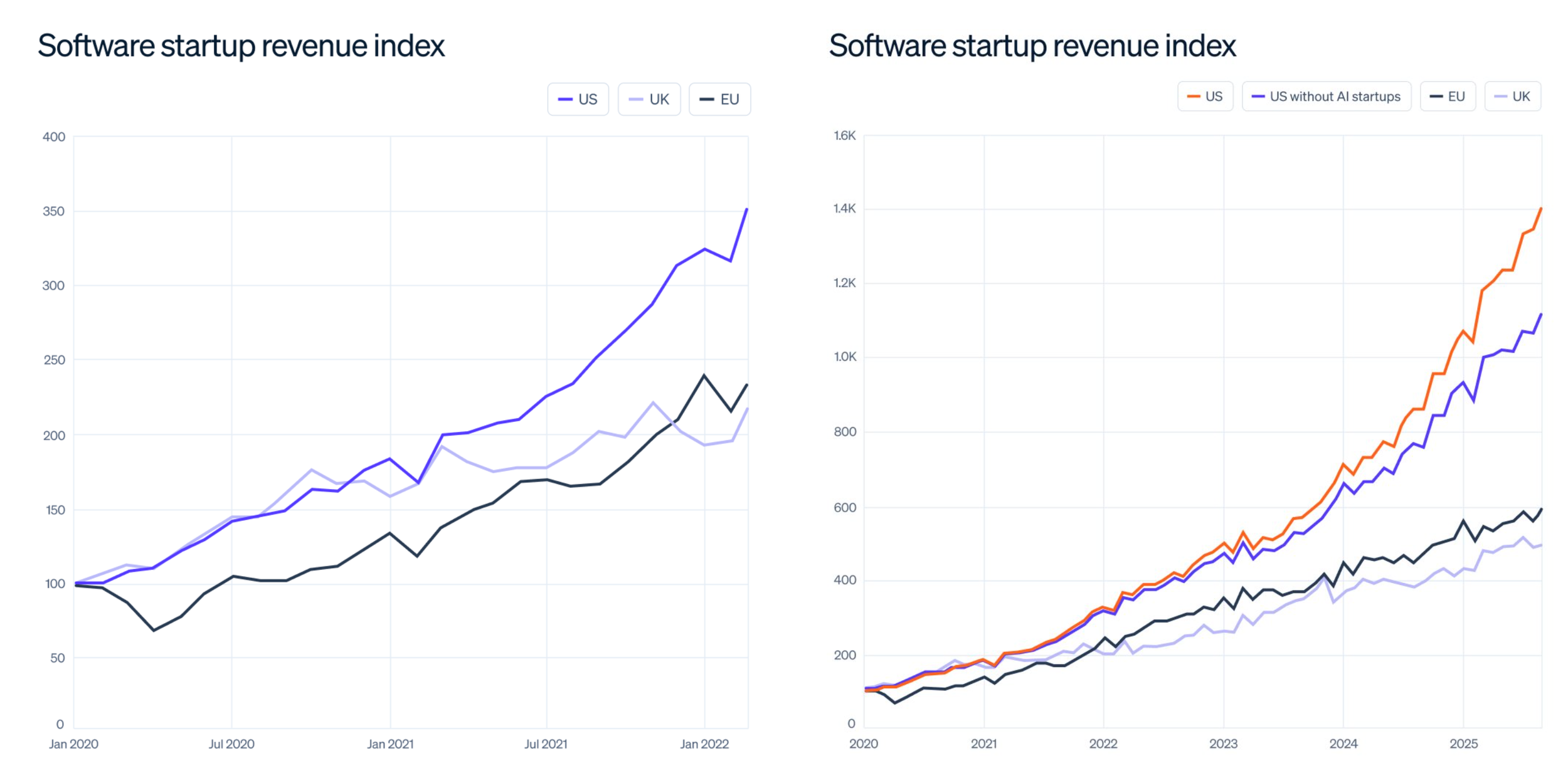
I’ve alluded to before in these pages about how Patrick Collison is almost as good an economic commentator as he is an entrepreneur (and I’m sure the two are mutually reinforcing, too). Alongside running Stripe, Collison regularly finds time to publicly weigh in on trends and their implications for the world around us. Last Sunday, he shared a pair of charts – reproduced below – which clearly show how American startups have raced ahead of their British and European counterparts on revenue growth since the beginning of the decade.

Source: Patrick Collison

One explanation for this would be that the gains are accruing only to AI companies. Not only do I think this line of reasoning offers false comfort (why shouldn’t those AI companies be this side of the Atlantic?) but as Collison notes, while partly true, it can only explain a small share of the widening gulf. Even if you remove American AI startups from the mix, things still look a lot rosier stateside.

A better theory, Collison suggests, is that Americans are quicker off the mark when it comes to adopting new tech – including AI, but also other innovations like stablecoins. Certainly, this vibes true to me, and it doesn’t require much mental gymnastics to see why. American startups are physically closer to many of the world’s key software suppliers, and plenty will have been started by founders who once worked for them too. Technological diffusion becomes so much easier as a result.

There’s also more business dynamism in the US – meaning that those firms which don’t embrace cutting-edge technologies will invariably find themselves competed away by those which do. In Britain and Europe, laggards may be able to scrape by, in turn mechanically pulling down the revenue growth data.

It’s not as if our own Government is unaware of this. In recent years, we’ve seen a litany of strategies, working groups, and sometimes even real policies passed to try to increase tech adoption by businesses. This summer, the SME Digital Adoption Taskforce produced its final report, in which it recommended common e-invoicing standards, the rollout of digital ID, tax digitisation, and a targeted awareness programme for digital and AI adoption support. Time will tell whether these prescriptions will be medicine enough to heal our ailing economy.

📊 Pedro Serodio, Chief Economist, Centre for British Progress

The emergence of deep learning as a source for commercially viable AI technology has highlighted the economic value of high-quality data. At the same time, the UK’s public data infrastructure is quietly degrading. Both research and policy critically depend on the availability and reliability of key economic data. However, the methods used to generate it are increasingly fallible.

Much of the data produced by the UK’s main statistical body, the Office for National Statistics, relies on survey data. Many other datasets feeding key statistics or playing prominent roles in research and policy evaluation also depend on securing high response rates and high-quality responses to questionnaires distributed to key demographics. Surveys of individuals across disparate but connected economic indicators enable researchers to generate data on the labour market, company and sectoral activity, income and wealth, innovation activity, or even economic output. As long as the sample remains representative of the population as a whole, it can be used to infer important information about statistical aggregates.

But conducting surveys is becoming more difficult and expensive. Labour costs, data storage and handling, and regulatory requirements on data protection, have made surveys significantly more expensive and difficult to run. Beyond costs, persuading people and companies to provide information is getting harder, and offering compensation carries a large risk of selecting away from representative samples that can stand in for population-wide data.

On the other hand, administrative data has never been so abundant. Many different services, both public and private, now collect vast quantities of data that exist largely in isolation. There is a growing risk that public authorities have made a large and costly strategic error by not prioritising the integration and availability of different sources of administrative data across different parts of the public sector.

Administrative data owned by specific units, departments and organisations is increasingly walled off from government officials – often even within the very departments they work in. It also has several drawbacks relative to survey data. Beyond the technical complexity of matching records across sources, data protection regulations, inadequate technical infrastructure, and entrenched departmental silos create fundamental barriers to integration. But as surveys become less feasible, a failure to leverage administrative data will result in a concerning degradation of the quality of our public data. There is a deep irony that just as the private sector begins to leverage data into billion-pound valuations, we risk eroding the value of our public data by failing to reform how we collect and handle it.

🤝 Philip Salter, Founder

President Harry S. Truman was wrong. Specifically, when he said: “Give me a one-handed economist. All my economists say ‘on one hand...’, then ‘but on the other...’.” It’s a catchy quip, but in reality there are quite a few things that most reasonable economists agree on.

That’s why it’s so significant to see CenTax, the Centre for Policy Studies, the Adam Smith Institute, Labour Together, the Institute for Public Policy Research, the New Economics Foundation, the Joseph Rowntree Foundation, Bright Blue, and Dan Neidle team up today to propose a package of reforms that would move the UK towards a fairer, more effective, and more pro-growth tax system.

For those less familiar with these organisations, this collaboration is remarkable – it bridges a genuine political divide. On one side, the Centre for Policy Studies, co-founded by Margaret Thatcher and Sir Keith Joseph; on the other, the New Economics Foundation, which advocates wealth redistribution, stronger unions, shorter working weeks, and public ownership of key sectors.

The resulting package is a strong one, and includes several reforms we’ve long championed – such as basing Business Rates on site values, removing empty property relief, and merging employer and employee National Insurance contributions with Income Tax. Although not everything proposed in the report is economic consensus. Many are rightly raising questions about the report’s call for an exit tax, which could discourage top entrepreneurial talent from coming or staying in the UK.

The best way to run the country isn’t simply a negotiation between economists from the left and right. We should heed Dr Madsen Pirie’s caution against the logical fallacy of argumentum ad temperantiam. Yet, there are areas of tax policy where the status quo is so bad, that you can even bring together Thatcher’s own think tank with unabashed degrowthers. The Chancellor should take note.

Three Big Ideas #47

Three Big Ideas is our fortnightly roundup of ideas (and our takes on them) in entrepreneurship, innovation, science and technology, handpicked by the team.

This week, Eamonn Ives dwells on why American startups are pulling ahead of their European counterparts, Philip Salter salutes a significant tax consensus, and Pedro Serodio warns that public data is slowly degrading.

Burning Ambition

On Wednesday we launched Ambition Unlimited, the inaugural report of our Young Entrepreneurs Forum.

Speaking at the launch in the House of Lords were Callum Anderson MP, Sean Kohli, Chair of the Young Entrepreneurs Forum, Dana Denis-Smith OBE, Founder of Obelisk Support, and our Research Director, Eamonn Ives, who all set out a positive case for why we need to back the next generation.

As I wrote in Forbes, Eamonn delivers a compelling suite of policies which would deliver a platform upon which entrepreneurs can flourish:

“The UK must double down on openness, dynamism and stability. That means ensuring tax and investment incentives stay internationally competitive, designing regulation that adapts quickly to new technologies, and keeping visa routes navigable and attractive so that founders like Lin continue to choose Britain as their base. Above all, government should give entrepreneurs the confidence to plan for the decade ahead, not just the next fiscal statement.”

I would, as you would expect, encourage you all to dig into the report, but I want to take a slightly different tack today and share one lesson I’ve learned from the events we’ve undertaken with the Young Entrepreneurs Forum project: that Britain has no shortage of talent nor ambition to take on the world.

We’re not alone. Matt Clifford CBE expressed similar sentiments in a speech at the recent LFG conference, arguing that, as the birthplace of modern science, democracy, industry, medicine, computing, and even sport and literature, Britain can be so once again.

It goes without saying that we believe in the importance of policy change to drive change. But it’s also worth acknowledging that much can still be achieved despite these constraints.

To that end, it’s worth sharing a list of organisations that support the next generation of entrepreneurs that our Adviser and the Small Business Commissioner, Emma Jones CBE, put together following our event, including Young Enterprise, Founders for Schools, Kickstarter and LaunchIt. Emma encourages you to share other organisations that support young entrepreneurs, which you can do so here.

It’s vital to attack the challenge of renewal on both fronts. Policy change and practical efforts reinforce each other – not least because launching a report with over 100 of the most ambitious young entrepreneurs in the country gives you the inspiration to keep up the policy work to support them.

500 Smiles

Without much of a push, our WhatsApp community has now grown steadily to over 500 people. We still have some work to do in thinking about how we can make the most of the groups (answers on a postcard, please), but it’s proving a useful avenue to share our latest work, events and opportunities. Join our community here.

Express Yourself

To coincide with some polling they’ve commissioned on the importance of networking for small businesses, American Express is looking for case studies of entrepreneurs with positive stories to tell.

Perhaps networking helped you to land a big client, navigate a rocky period, or make connections necessary for international expansion. Whatever it was, if you have benefited from networking in the past and want to be considered for a case study, let us know by emailing us with a few sentences about yourself and how networking helped your business.

Trading Places

The Department for Business and Trade has asked us to share that next week is the fifth edition of International Trade Week (ITW) – five days of free online and in-person events designed to help businesses grow through exporting. Find out more here.

Think Inside the Box

Some policy ideas take a while to bear fruit. Take this week’s announcement of the AI Growth Lab, a regulatory sandbox in which innovators can safely test their AI products under adjusted or temporarily relaxed regulations.

This announcement puts a bit more meat on the bones of the AI Opportunities Action Plan, which, among many other things, called on the Government to “work with regulators to accelerate AI in priority sectors and implement pro-innovation initiatives like regulatory sandboxes.” However, this is an idea with a long history.

Success, of course, has many mothers and fathers, but it’s worth looking into the work of John Fingleton CBE, who, over the years, has created the conceptual framework and supplied the intellectual ballast for those making the case for the sort of pro-innovation regulation the UK needs. His advocacy for bounded regulatory discretion and competition-driven innovation not only influenced the creation of the FCA’s sandbox, but also this week’s announcement.

The most compelling aspect of the policy is the option to regulate across the economy, rather than relying on the coordination of existing regulators. This chimes with Fingleton’s idea for an ‘n+1 regulator’, which he explained in an interview I conducted with him earlier this year:

“The idea of the n+1 regulator goes back to about 2012, when I worked in the Cabinet Office and was advising on supply-side reforms. The essential idea was that new business models come along, and the existing regulatory framework doesn’t suit them. That could be because incumbents have captured it, or it could be because what they’re doing is just more risky or has a different profile of risk.”

The point here isn’t to write the history, but to shape the future. The Department for Science, Innovation and Technology has opened a consultation and would like to hear from individuals and organisations who are interested in using the AI Growth Lab; who are going to be affected by it; or who have expert views on implementing sandboxes.

Having spoken to the officials working on this policy, we highly recommend relevant entrepreneurs in our network consider responding. If you’d like to get in touch with us beforehand about that, my email is always open. We may also host a roundtable discussion with the government on this topic, so please get in touch to show early interest.

Anasta–see ya!

After a highly productive year and a half with us, our Head of Science and Technology, Anastasia Bektimirova, has left to join the Royal Academy of Engineering. Anastasia achieved a lot during her time at The Entrepreneurs Network, including authoring Governing in the Age of AI: Building Britain’s National Data Library, Towards a More Special Relationship and Full Speed Ahead, but perhaps her greatest legacy will be in moving our newsletter here – to Substack – which is proving to be a brilliant decision as our content and numbers continue to grow. Anastasia will be staying on as an Adviser – nobody ever really leaves The Entrepreneurs Network.

Network Intelligence

Anastasia also helped launch our new UK AI Fieldbook series, with her interview with Paul Patras, founder of Net AI, which looks into how AI is transforming mobile networks to prevent communications blackouts and optimise energy consumption.

It’s a cracking read with a lot of lessons for policymakers, including the need to design funding and policy around real startup experience, not top-down assumptions; to fix cash-flow pain by paying grants upfront rather than in arrears; to emulate ARIA’s speed, flexibility and minimal paperwork; and to bridge gaps between early-stage schemes like ICURe and follow-on support.

There’s also a clear case for modernising grant rules to suit globally distributed teams, tailoring evaluation criteria to company maturity, and, coincidentally enough, investing in AI sandboxes and better public compute tools so startups can safely develop and deploy innovations in critical sectors.

The UK AI Fieldbook series is kindly sponsored by OpenAI. This gives us the time and resources to really uncover the policy lessons from entrepreneurs at the cutting edge. We want to replicate this sort of deep policy dive with entrepreneurs across other areas of the ecosystem, so if you’re keen to partner with us on this, get in touch.

Three Big Ideas #46

🚙 Eamonn Ives, Research Director

Last week, Waymo formally announced that from 2026 it would be offering Londoners the opportunity to be whisked around the capital in one of their autonomous vehicles. As someone who made a point of hailing a Waymo as soon as I possibly could when I last visited San Francisco, I could not be happier with this news.

In our very first instalment of Three Big Ideas, I explained how autonomous vehicles represent a much safer form of driving – “[t]he computers that control them don’t get aggressive, tired or drunk” – and how they could also pave the way to a radically more efficient transport network. But the recent announcement also gives me hope in another dimension.

When innovation goes right it doesn’t just bestow society with snazzy new goods and services. It also instils in people a technophilic mindset that a better world is possible. When things that were once impossible become an ordinary part of daily life, it forces us to wonder what other unimaginable advances stand to be made. In short, innovation – like entrepreneurship – is contagious.

With that in mind, the next logical question is what can be done to increase innovation’s virality. Of course, there are the obvious things – like governments ensuring regulations allow experimentation, or enabling immigrants who likely have novel perspectives to move easily to new countries.

Then there are the more overlooked things. In our report Blueprint for a New Great Exhibition, we made the case for reviving the 1851 Great Exhibition, which showcased the latest inventions from around the world, facilitating learning – and stimulating competition among nations to raise their respective games. A revamped Great Exhibition might be a chance for innovators to convene and demonstrate the latest in lab-grown foods, breakthrough materials, medical nanobots, and, yes, autonomous vehicles.

If innovation is a cycle that feeds on belief, then just making it more visible is one of the best forms of progress policy we have. Simply put, the future feels closer when it drives past you.

💫 Bella Rhodes, Policy Lead, Startup Coalition

Over at Startup Coalition, we have just launched a report looking at the Enterprise Management Incentive (EMI) scheme. EMI offers tax-advantaged share options to help startups compete with corporate giants for top talent. When you can’t match Big Tech salaries, equity is essential.

Our report found that EMI works brilliantly – until it doesn’t. Ninety-two per cent of employers say it meaningfully motivates employees, 82% say it helps attract talent they’d otherwise struggle to hire, and 85% believe staff motivation would suffer if options became less attractive. But the scheme is breaking at precisely the wrong moments.

Companies raising funding rounds – averaging £23 million for growth-stage deals and £31.5 million for AI firms – routinely breach EMI’s outdated £30 million asset cap in a single go. This creates a brutal tax cliff: they don’t graduate to another scheme, they’re simply locked out. While alternatives like a Company Share Option Plan exist, they’re not always suitable substitutes, leaving successful scaleups in a policy no-man’s land: too large for EMI, but not yet at scale to rely purely on cash compensation.

Meanwhile, with companies staying private longer (now 10-12 years to IPO), early employees are forced to either lose their options or face punitive tax treatment when the 10-year exercise window expires. Changes to HMRC guidance applied retroactively now prevent boards from extending opportunities for employees to access liquidity through secondary transactions. Long-serving employees are forced to choose between exercising early (paying huge upfront tax bills) or leaving the company. Their employers can’t help without jeopardising the entire scheme.

One of our key recommendations is an EMI Growth scheme. Rather than leaving successful companies stranded when they outgrow EMI, we should create a smooth graduation path – an ‘EMI Growth’ tier with higher thresholds (we suggest £500 million assets and 2,500 employees) that maintains tax advantages for scaling firms. This prevents companies scrambling to restructure equity compensation while closing critical hires, keeping Britain competitive when it matters most.

🔌 Ed Hezlet, Head of Energy, Centre for British Progress

Energy policy in the UK is facing a conundrum. Decarbonisation efforts to date have largely focused on cleaning up electricity generation, which accounted for nearly a quarter of Britain’s territorial emissions in 2004. Fast forward to 2024, and absolute emissions from the electricity sector had fallen by 78%, to just 10% of total emissions.

Unfortunately, the UK now has some of the highest electricity prices in the world. In 2024, the UK had the second-highest domestic electricity prices in the IEA and topped the charts with respect to industrial electricity costs. This is not only a barrier to growth in the UK but also stands in the way of consumers and businesses adopting decarbonising technologies like heat pumps and electric vehicles.

There is no silver bullet for solving this problem – electricity bills have become a complex array of different policy costs that have been layered up over time. Whilst some of these costs could be moved to general taxation, scope is limited with the UK’s already tight fiscal position.

One small lever to help the situation would be removing the Carbon Price Support (CPS), the UK’s second carbon cost for electricity generators, which sits alongside the UK Emissions Trading Scheme.

The CPS adds a carbon tax of £18 per tonne of carbon dioxide, which increases wholesale electricity prices by around £6.60 per megawatt-hour whenever a gas power station is the marginal generator in the wholesale electricity market.

Our research indicates that this tax increased electricity costs by around £1.6 billion in 2024, whilst only raising around £440 million in tax receipts for the government.

Whilst it is a small start, the UK needs to focus on reducing its electricity costs to more competitive levels – for the sake of households, businesses and the environment.

Three Big Ideas #46

Three Big Ideas is our fortnightly roundup of ideas (and our takes on them) in entrepreneurship, innovation, science and technology, handpicked by the team.

This week, Eamonn Ives asks whether Waymo can inspire an uptick in innovation, Bella Rhodes explains how to turbocharge EMI, and Ed Hezlet makes the environmental case for reducing taxes on electricity.

Network Intelligence

In our latest interview for our UK AI Fieldbook series, Anastasia Bektimirova speaks to Paul Patras on how AI is transforming mobile networks to prevent communications blackouts and optimise energy consumption.

Creative Thinking

This year’s winners of the Nobel Memorial Prize in Economic Sciences are a win for entrepreneurship, with Joel Mokyr awarded it for showing how the Industrial Enlightenment made growth possible through ideas and openness, and Philippe Aghion and Peter Howitt recognised for their explanation of how creative destruction keeps economies advancing.

On Mokyr, Dr Anton Howes, author of many of our reports, wrote the definitive reaction post following his win. As Anton notes, Mokyr put entrepreneurs and innovation at the heart of the story of how our species went from near-universal poverty to relative prosperity:

“Whereas most of the public, and even many historians, think of the causes of modern economic growth – the beginnings of the Industrial Revolution – as being rooted in material factors, like conquest, colonialism, or coal, Mokyr tirelessly argued that it was rooted in ideas, in the intellectual entrepreneurship of figures like Francis Bacon and Isaac Newton, and in the uniquely precocious accumulation in eighteenth-century Britain of useful, often mechanically actionable knowledge. Britain, he argued, through its scientific and literary societies, and its penchant for publications and sharing ideas, was the site of a world-changing Industrial Enlightenment – the place where progress was thought possible, and then became real.”

This worldview aligns with one of our core tenets: to elevate the status and champion the role of entrepreneurs across society. From our reports, it shows itself most clearly in Anton’s Blueprint for a New Great Exhibition, which makes the case for why we need to recreate the Great Exhibition of 1851, to both inspire innovation and foster a culture of improvement among frontier entrepreneurs and the general population. More broadly, it’s the reason behind every meeting and every event we host.

Turning to Aghion and Howitt, the name of this very Substack, Perennial Gale, isn’t a reference to Britain’s inclement weather, but a quote from Joseph Schumpeter’s description of capitalism as “the perennial gale of creative destruction.” His observation in 1942 was that our economic system is neither stable nor static, but constantly shaped by innovation, entrepreneurship and change. Entrepreneurs are central to this, driving forward economic progress by disrupting existing systems.

Aghion and Howitt put some numbers on the theory. As the Royal Swedish Academy of Sciences stated in its press release:

“In an article from 1992, they constructed a mathematical model for what is called creative destruction: when a new and better product enters the market, the companies selling the older products lose out. The innovation represents something new and is thus creative. However, it is also destructive, as the company whose technology becomes passé is outcompeted. In different ways, the laureates show how creative destruction creates conflicts that must be managed in a constructive manner. Otherwise, innovation will be blocked by established companies and interest groups that risk being put at a disadvantage.”

As backers of upstarts over incumbents, you can see why we’re so keen on the winners.

Aghion and Howitt’s work also highlights an emerging challenge: the growing productivity gap between frontier firms and laggards. The best business models and innovations aren’t diffusing as rapidly as they once did. This raises familiar, but no less urgent, questions like: What barriers prevent promising startups from scaling? Why aren’t successful innovations spreading to more firms? How can policy accelerate knowledge transfer while preserving the competitive dynamics that reward innovation?

We exist to answer these questions, but we also need insights from the frontline of entrepreneurship. Answers on a postcard (or email).

Table Matters

On Wednesday, we will host a roundtable lunch with Alex Depledge MBE, Entrepreneurship Adviser to the Chancellor of the Exchequer.

This one will be focused on scaling businesses with either £10 million in annual revenue or that have raised over £10 million in venture capital funding. If that’s you, we might still be able to squeeze you in – please request a place here.

I know Alex has been tirelessly hosting roundtables like this with businesses at various sizes and stages up and down the country, but if you haven’t had the chance to chat with her, please get in touch with me before Wednesday with what you think the Chancellor needs to know going into the Budget, and I’ll pass it on directly to her.

Oxford Come ’ere

Since our very first Ecosystem Builders event, the positive feedback has been supplemented with a fair critique: what about the rest of the country? Well, we’ve listened, so I’m delighted to announce that we’re going to Oxford, courtesy of our co-hosts Dr Fabio Bianchi (Oxentia) and Meric Sevgi Eren.

Oxford Edge has a workspace you’ll be able to work from, so we’re encouraging people to make a day of it. Find out more here.

Our sights are also set on Birmingham, Leeds, Cardiff, Manchester, Cambridge and Edinburgh, so watch this space for more information. And get in touch if you’re happy to host a bunch of energetic ecosystem builders in your city.

Know Your Limits

The Enterprise Investment Scheme (EIS) and Venture Capital Trusts (VCTs) are the backbone of Britain’s innovation economy, fuelling thousands of startups up and down the country. Yet the annual and lifetime investment limits for these schemes have been frozen for nearly a decade. In that time, inflation has eroded their real value, meaning their impact is now roughly three-quarters of what it once was, and could soon fall to half of their 2016 strength if nothing changes.

That’s why we’re backing Growth Beyond Limits, a new campaign calling on the Chancellor to raise the lifetime company investment limit to £30 million, or £40 million for Knowledge-Intensive Companies (KICs), and the annual limit to £15 million, or £25 million for KICs, alongside a commitment to review them every three years. If you believe Britain should back its most innovative businesses with funding that keeps pace with the times, you can read the letter here and sign it alongside me and many others here.

State of AI

Yesterday, Nathan Benaich released his annual State of AI Report 2025. While coming in at over 300 slides, as always, Air Street Capital’s General Partner delivers. There is a lot to unpack, but I’ll focus on one aspect that matters to everyone reading this.

The report covers OpenAI’s new GDPval benchmark, an evaluation launched in September that measures model performance on economically valuable, real-world tasks across 44 occupations. The results are clear: models now rival human experts across many professions.

As many of you will know first-hand, general-purpose models are proving effective as professional assistants, and companies like Lufthansa are forecasting thousands of administrative job cuts by 2030 on the back of AI.

Entry-level jobs are being hit hardest. Hiring for junior software and support roles has stagnated since 2022, even as overall employment rises. Law school applications are up 21% as graduates hedge their bets, while seasoned professionals appear more insulated – for now, at least.

Not everyone agrees this signals an imminent crisis. A Yale–Brookings study suggests AI’s long-term disruption may take decades. Yet both OpenAI and Anthropic report growing use of their models for workplace tasks.

This is largely a good thing – after all, this is what increasing productivity and growth looks like. But if this is the way of the future, entrepreneurial skills will be at a premium. It’s a strange world where being an entrepreneur is a safer bet than some established professions, but that may be where we’re heading.

(I recommend reading it in full. For the futurism-enjoyers, flip to the predictions on slide 11 and then to slide 305. The deck starts with a scorecard on last year’s calls, such as an open-source alternative surpassing OpenAI’s o1 (“YES,” with DeepSeek-R1), and challengers failing to dent NVIDIA’s dominance (“YES”), then lays out ten bold bets for the next 12 months. Highlights include the prediction that a major retailer will get over 5% of online sales from agentic checkout as agent-ad spend hits $5 billion.)

Still Stock-Still?

Last Friday, I discussed Britain’s downturn in listings. What a difference a week makes. Since then, the Manchester-based The Beauty Tech Group listed on the London Stock Exchange with an initial market cap of £300 million, while the pipeline for the first half of 2026 looks promising.

A lot of my job revolves around pointing out how things could be better. But that shouldn’t be mistaken for thinking Britain is the basket case that some seem to think it is. We have cracked, or inherited, many of the hard things that make a country a great place to be an entrepreneur – from world-class universities and a strong rule of law to a global financial centre, a global language, and a culture that prizes creativity and fairness.

Too often, we make the easy things harder than they need to be – through complex taxes, clunky regulation, and slow-moving policymaking. But I like to think these are problems to be fixed, rather than insurmountable barriers to crash up against.

This is why, at The Entrepreneurs Network, we’re optimistic.

Message from our Partner

Zestic AI has announced a new partnership with Proteus, the UK’s leader in strategic change management, to help organisations move from AI pilots to measurable performance. By combining Proteus’ $100 billion transformation dataset and change-management expertise with Zestic AI’s AI-first architecture, the partnership enables companies to embed AI directly into live and new transformation programmes – without disruption. Together, the two firms aim to help Boards and C-suites turn AI from experiment into enterprise capability, accelerating productivity, innovation, and growth. Read the full announcement to learn how the partnership is redefining what intelligent transformation looks like in practice.

Three Big Ideas #45

Three Big Ideas is our fortnightly roundup of ideas (and our takes on them) in entrepreneurship, innovation, science and technology, handpicked by the team.

This week, Philip Salter hails the work of the Global Entrepreneurship Monitor, Eamonn Ives looks at why startups are taking longer to go public, and Anastasia Bektimirova discusses whether agentic AI could spell the end of the line for transaction costs.

Three Big Ideas #45

Philip Salter, Founder

Back in 1999, a small group of British and American academics launched what would become one of the most enduring studies of its kind: the Global Entrepreneurship Monitor (GEM). A quarter of a century on, its 150,000-plus interviews each year across more than 120 economies give us a rare window into trends driving entrepreneurship across the world.

A couple of weeks ago, the Global Entrepreneurship Monitor UK National Report 2024/25 was launched. Despite the many challenges over the years, the UK is a far more entrepreneurial country than it was at the turn of the millennium. At last count, 36% of working-age adults are either running a new business or intend to start one within the next three years – the highest level since 1999. There has also been remarkable progress in who is starting businesses. Early-stage entrepreneurial activity by women has more than tripled since 2002, rising from just over 3.5% to 10% in 2024, while immigrants and ethnic minorities remain consistently among the most entrepreneurial groups in the UK.

It’s worth adding a note of caution. Entrepreneurship isn’t – or at least shouldn’t – be an end in itself. What matters is whether it leads to better outcomes – for founders and for society at large. Still, for policymakers (and for “policy recommenders” like us), it’s vital to have a firm grasp of the facts. Longitudinal studies like GEM are gold dust.

That’s why it was encouraging to see last month’s announcement that the Economic and Social Research Council (ESRC) will fund the Generation New Era study — a landmark project that will follow the lives of more than 30,000 babies born in 2026 through their early years, and potentially well beyond.

Britain’s landmark 1946, 1958 and 1970 cohort studies show how early life conditions shape later health and attainment, and how childhood poverty leaves lasting marks. They also reveal that intergenerational income mobility declined for those born in 1970 compared with 1958.

Internationally, landmark longitudinal studies have transformed our understanding of health and human development. The Framingham Heart Study, launched in 1948, was the first to show that heart disease isn’t an inevitable part of ageing but is driven by modifiable risk factors such as high blood pressure, cholesterol, smoking and obesity – insights that revolutionised preventive medicine. Likewise, Harvard’s Nurses’ Health Studies, which have followed more than 230,000 women across several cohorts since 1976, have demonstrated how lifestyle and diet shape long-term wellbeing.

If there’s a lesson for entrepreneurship policy, it’s that we still lack this kind of long-term evidence about the people who start businesses – who they are, what shapes their choices, and how their ventures affect both their lives and the wider economy. Perhaps it’s time to invest in longitudinal research that tracks entrepreneurs from the very start of their journeys – capturing not just whether they start businesses, but how those ventures evolve, what drives success or failure, and what lasting impact entrepreneurship has on individuals and communities.

🗓️ Eamonn Ives, Research Director

Across much of the world, the age at which companies decide to go public is trending steadily upwards. Few have done more to catalogue this than University of Florida’s Jay F. Ritter, whose carefully organised data on American IPOs over recent decades show that in the 1980s the median age of a company listing was just eight years old, while last year it had grown to 14. A similar trend can be seen in the United Kingdom, which partly explains why it now boasts one of the ‘oldest’ exchanges in the world – with centenarian companies responsible for a sizeable portion of the London Stock Exchange’s combined market cap.

Much ink has been spilled about the reasons for this increase. Fingers are quick to be pointed at the challenges involved in the process of listing, and then existing as a public company. The dulling effect of the Stamp Duty Reserve Tax, which levies a 0.5% tax on the purchase of shares, has also been singled out for criticism. Certainly, there is merit in these accusations, and the Government would do well to ease these burdens – as reports suggest they might be.

A more positive potential explanation, however, is that privately-held companies nowadays have a wider range of options for raising capital. From family offices, to more established VC firms, to sovereign wealth funds and private equity, promising startups are finding that they don’t necessarily have to turn to public markets to get the capital they need to grow. This will have other consequences for the economy that warrant consideration, but from the perspective of the individual entrepreneur, greater choice can only be a good thing.

In the past week, Beauty Tech Group joined the LSE with a £300 million IPO, while Princes Group and Shawbrook also announced plans to list there. This was enough for Bloomberg to declare that London had broken its ‘IPO drought’. While one swallow does not make a summer, three in quick succession should give ground for optimism that sunnier days are ahead. Whether that will be enough to reverse long-term trends, and help determined founders realise their IPO ambitions sooner rather than later remains to be seen; after all, Princes Group was originally founded all the way back in 1880.

♟️ Anastasia Bektimirova, Head of Science and Technology

Here’s a claim I keep coming back to: discovery is among the most important phases of any complex project. It’s also the one we struggle to give the right shape to, often ritualising it into paperwork that turns discovery into something defensive rather than inquisitive. By discovery I mean the process of figuring out what problem we’re actually solving, who is affected, which constraints are real, what trade-offs people will accept in practice, and what failure modes we should avoid. In policymaking, discovery is how you turn unknowns into choices. It’s also how you avoid designing for a world that doesn’t exist.

You’ll be familiar with how this often plays out in infrastructure projects. Dan Davies offers a good illustration of how our quasi-judicial system invites “the problem factory”: since a project can be derailed late on a narrow point, teams try to pre-empt every hypothetical, amplifying every perceived hazard, which can narrow options to solutions shaped by imagined vetoes. This looks more like optimising for surviving scrutiny rather than uncovering a workable bargain. Pre-emptive risk-aversion is discovery done backwards, which is also why it can underdeliver.

Here’s a thought experiment on what discovery might look like instead. Seb Krier’s new essay imagines that competent, personally aligned AI agents could lower the transaction costs that make early-stage bargaining so hard, such as finding affected parties, eliciting preferences, drafting options, stress-testing trade-offs and tracking commitments. It’s hard for people to reveal what they actually want and what they’d trade for it, so we end up with one-size-fits-all rules.

If agentic AI could lower those costs, more problems could be handled through bottom-up bargains rather than top-down approximations. Take a high-street resurfacing. What if instead of running a generic consultation, every household and shop would get a civic agent to express bounded choices (night works versus weekend closures, access windows, tolerable noise levels). The contractor would publish several concrete schedules with mitigations, agents would then aggregate responses and negotiate towards a feasible package – for example, trading later start times for guaranteed delivery windows. The few obligations that actually change behaviour, such as quiet machinery, acoustic screening or automatic compensation if access is breached would be escrowed, and a public compliance log would make monitoring straightforward. Instead of pre-emptiveness, we’d get early evidence about what people are happy to accept before decisions are made.

The essay is clear-eyed about the boundaries: default rights still matter, bad alignments would do harm, and none of this makes politics vanish. But the core claim that better, cheaper discovery through faster and broader participation could expand and improve the feasible set of options is worth noting. If tools like this can reliably lower the cost of discovery, we might spend less time defending paper universes and more time building in the real one.

Stock-Still

First, the good news. This is the last time I’m going to harass you (at least via the newsletter) to fill in our latest survey. We’re on the cusp of our target number of responses, so if you’re an entrepreneur, you could be the one to make our day. If you’re part of any other network of founders, sharing it would be incredibly helpful.

Now, the bad news. London has dropped to twenty-third place globally for IPOs. Twenty-third. Behind Oman, Mexico and Croatia. According to Bloomberg, volume this year dropped 69% to $248 million, the weakest haul in more than 35 years. In 2013, UK IPOs accounted for more than half of the European fundraising total – this year it’s just 3%. Ouch!

No wonder the Treasury is reported to be considering giving a stamp duty holiday to new London Stock Exchange (LSE) listings. The measure would exempt investors from the 0.5% tax on buying the shares of newly listed companies in the UK, applying for a period of two to three years after the company’s stock market flotation.

While the current state of public finances might not allow it in November’s budget, the Government should really scrap stamp duty entirely. As we argued in Backing Breakthrough Businesses through our Private Business Commission:

“Stamp Duty Reserve Tax (SDRT) is highly distortive, affecting decisions about share turnover, suppressing share prices, and biasing investors against UK-listed equities at a moment when we need the exact opposite – something that also biases entrepreneurs against listing in, or indeed setting up in the UK. It disproportionately punishes marginal investments too. Whereas Corporation Tax taxes the return on investments and relieves the cost of investing through allowances, SDRT has no such allowances and effectively taxes both the investment itself and the return on it, even when those returns are negative.”

It’s not just a matter of tax, though. The exchange remains more highly regulated than many of its competitors. Victor Riparbelli, founder of UK-based $2 billion AI unicorn Synthesia, recently tore into the LSE, describing it as “more like a hospice than a stock exchange,” lamenting the City’s preference for rent-seeking over innovation. Riparbelli isn’t threatening to leave, but he is articulating what many founders quietly think but often won’t say – at least, not publicly.

To be fair, there are pockets of understanding in the current Government (as there were in the previous one) about the scope of the challenge. As the Science Minister Lord Vallance said only yesterday:

“We are streamlining listing and prospectus rules, removing outdated restrictions on follow-on capital, and have launched PISCES – a new stock-exchange model to help private companies scale and provide a stepping-stone to public markets”...“We are pushing better regulation, including through the work of the Regulatory Innovation Office which has cleared away barriers in four technology areas and will expand its work over the next year.”

The stakes couldn’t be higher. Britain excels at creating startups – we raised over £8 billion in the first half of 2025, more than France and Germany combined. But we’re losing companies at the scale-up stage. If we want to remain a globally significant economy of the future, we need to fix that – pronto.

Now, I’m afraid, the ugly – and it’s connected.

In the same week London slumped in the IPO rankings, a debate erupted about the economic contribution immigrants make to the UK. On Sunday, Hannah Prevett, Associate Business Editor of The Sunday Times, made the business case for immigration and shared her personal story on LinkedIn, which is worth reading if you missed it.

But here’s why it matters for our capital markets crisis: you can’t fix the IPO drought without securing the fundamental building blocks of growth, which include, among other things, having the talent pipeline to create IPO-ready companies in the first place.

According to The Economist, Synthesia only exists in London because Victor Riparbelli wanted to move to California but the US denied him a visa. Our latest Job Creators data makes this concrete. Hannah shared the numbers in her column:

“Analysis of Britain’s fastest-growing companies from The Entrepreneurs Network in 2024 showed that 39% have at least one foreign-born founder or co-founder. That is far out of proportion to the roughly 14.5% of the general population born overseas, and early indications suggest the figure will be higher still for 2025.”

Somehow it looks like I managed to end on a positive note. Let’s double down on this. And if you need another dose of optimism, watch Jensen Huang talk up Britain in an interview with Faisal Islam.

Blick 101

Our Corporate Partner Blick Rothenberg is hosting a breakfast roundtable with the esteemed Centre for the Analysis of Taxation on how our tax system should evolve to meet the needs of a modern, competitive economy. Our Patron, Chris Hulatt, co-founder of Octopus Group, will be on the panel. It would be great to see you there. Find out more here.

Connect 10

Our friends at Enterprise Nation reached out following the launch of Supply Connect, a free national programme supported by JPMorgan Chase. It provides practical support for small and micro businesses to get them fit to supply and win public sector contracts.

I hope it’s useful. Relatedly, on the back of a chat with Number 10, I’m collating a list of all the useful, free resources that are out there which support entrepreneurs. I know not all the best things in life are free, but it’s a good place to start. Drop me a message if you have anything to recommend.

Three Big Ideas #44

Three Big Ideas is our fortnightly roundup of ideas (and our takes on them) in entrepreneurship, innovation, science and technology, handpicked by the team.

This week, Eamonn Ives suggests raising the cost caps that incentivise spurious legal claims against infrastructure projects, Philip Salter argues that hikes to H-1B visa fees present an opportunity for Britain to attract priced-out talent, and Anastasia Bektimirova reflects on an evening of technology vibes.

Three Big Ideas #44

🧑‍⚖️ Eamonn Ives, Research Director

As our Adviser Sam Dumitriu details in his most recent report, legal obstacles represent a serious impediment to the development of new nuclear reactors in Britain. Anti-nuclear activists have weaponised lawsuits as a means to delay building, not only slowing down construction timelines, but also raising the risk premium nuclear developers face. Both of these facts increase overall costs – leaving consumers and businesses on the hook for higher electricity prices.

Of course, few would argue that developers should have carte blanche to steamroll through whichever projects they like. In a liberal democracy, it’s only right that there are opportunities for stakeholders to have their say. The operative question, therefore, is how to strike the right balance.

Since 1998, Britain has been a signatory to the Aarhus Convention – an international agreement which seeks to mediate disputes concerning environmental matters, such as those that may arise from the construction of new infrastructure. Article 9, Paragraph 4 of the Convention asserts that access to justice cannot be “prohibitively expensive,” though it does not explicitly state how signatories should enforce this. In Britain, we use cost caps, which limit the amount litigants have to pay if their challenge fails (contrary to the standard ‘loser pays’ rule in court, whereby successful defendants can claim their legal costs back from claimants). Since 2013, these cost caps have been set at £5,000 for individuals, and £10,000 for organisations (such as environmental groups).

Sam argues that we should raise the limits of these cost caps, or remove them altogether for repeatedly unsuccessful litigants. I’m minded to agree. While some grievances are doubtlessly valid, the trend of well-funded, organised groups lodging spurious objections to new developments simply to throw sand in the gears – safe in the knowledge that there’s a fixed upper limit on the cost of doing so – warrants a reappraisal of the current situation.

Where then should new cost caps be set? Well, linking them to inflation seems to me like a reasonable minimum starting point. This would bring individual caps up to just over £7,000, and organisation cost caps up to just over £14,000. Alternatively, a more common sense approach might be to follow the lead of almost all other signatories and simply afford judges the discretion to take each case as they come.

As we and many, many others have explained before, building more stuff is a quickfire way to grow the economy. But whether it’s new homes, new roads, new railways or new power stations, all kinds of infrastructure in Britain comes in over budget and over schedule – if it even gets built at all. There are plenty of levers the Government could pull on to help rectify this situation – and rethinking how it meets its Aarhus obligations ought to be one of them.

🎟️ Philip Salter, Founder

Donald Trump’s recent announcement on H-1B visas caused chaos in Silicon Valley. If his proposed $100,000 H-1B visa fee actually sticks, this will be just the beginning.

As David J. Bier argues, this hike would be prohibitively expensive for many companies hiring skilled foreign workers, driving tech out of the US, reducing innovation, lowering demand for American workers, and harming the broader economy by shrinking the supply of goods and services across many sectors. Lauren Gilbert agrees, highlighting the important point that universities and non-profits, which are exempt from the cap but operate on tight budgets, would be hit particularly hard.

Even if it gets struck down, the uncertainty presents an opportunity for the UK to capture some talent. That’s why it’s great to see our friends at Startup Coalition have published a letter calling on the government to seize the moment. It quotes our research, stating:

“Data from the Entrepreneurs Network shows that 39% of the UK’s 100 fastest-growing companies have foreign-born founders or co-founders. Companies like Wayve and Synthesia, which recently received recognition from NVIDIA’s founder Jensen Huang during his visit to London, demonstrate the transformative impact of international talent on our ecosystem.”

The letter calls for an immediate expansion of the Global Talent Fund, expedited processing for H-1B holders, one-on-one casework support from the Home Office, and updates to the Enterprise Management Incentive (EMI) scheme, all of which we back.

I would add another policy idea for public debate. As we set out in our report Passport to Progress, Canada offers work visas for migrants with H-1B visas in the US, piggybacking on American bureaucracy by interpreting their approval as a good enough indicator of talent. Like Canada, if we brought this in, the Government would want to cap it (to maintain control), but also bear in mind that not everyone accepted will move, which was the case for Canada.

Given that we know that high-skilled immigrants are drivers of innovation, and that H-1B holders consistently pay more in taxes than they receive in public benefits, if we can draw just a few thousand to the UK, it will be worth it.

💽 Anastasia Bektimirova, Head of Science and Technology

After the UK-US Tech Prosperity Deal was signed last Thursday, part of the innovation ecosystem gathered at the NVIDIA UK AI Celebration. The lights were bright and the numbers were big. NVIDIA CEO Jensen Huang had an Oprah Winfrey moment, announcing a £2 billion investment into AI startups by pointing to specific founders in the room, by name, and declaring he was investing in their next funding rounds.

You’ll be familiar with the sentiment that nights like this are all theatre. It’s true that you don’t build capacity with vibes alone, but you also can’t build it without them. The NVIDIA evening understood that and used theatre to do something policy can struggle to do on paper: place researchers, entrepreneurs and officials inside the same narrative and shift what feels possible. The Prime Minister and two Secretaries of State joining Huang on stage felt less like government “loving startups” in some generic sense, and more like a re-understanding of the strategic importance of having the capacity to build technologies, companies and innovation, with builders being placed inside the national story. This kind of theatre recruits talent, attracts capital and inspires confidence.

There was, inevitably, a degree of scepticism in the audience chatter after the speeches. Questions about economic stability and tax changes, about whether policy across departments will join up quickly enough to convert headlines into action, about energy costs, grid connections and skills on the ground, about who, exactly, will use all this compute infrastructure. It’s also true that some of what was said from that and other stages last week will materialise faster than other things. Those are fair points. In large part, domestic benefit will depend on adoption.

Against that backdrop, the Tony Blair Institute’s new report with Ipsos on public attitudes towards AI finds that while over half of the surveyed Britons report having used generative AI in the past year, 38% cite a lack of trust in AI-generated content as the biggest barrier to wider use. People are also more likely to see AI as a risk to the economy (39%) than an opportunity (20%).

Among other things, the report recommends government focus on demonstrating real-world benefits of AI and building public engagement. I agree with the thrust, and I’d add that government communications teams are already doing it reasonably well: most ministerial speeches and press releases frame AI through benefits people can feel – appointments booked faster, public services accessed easier, the planning system transformed to build more homes quicker – rather than technical capability metrics.

What the report perhaps underplays is that not every challenge requires a government intervention. While it’s fantastic that the Prime Minister is personally engaging with this agenda, the ecosystem itself needs to step up. When innovators can effectively articulate what their work delivers, they create the conditions for their own success. The theatre matters too – vibes are also part of the enabling infrastructure for everything else that follows.

Following Suit

Before I share my thoughts on policy, I want to hear yours!

Specifically, if you’re an entrepreneur and you haven’t completed our latest survey, now’s the time. This really is one of the best ways to get your voice heard. Last time around we secured strong press coverage, and all the main parties reached out to find out what they can do to appeal to founders.

If you’re not a founder or have already filled it in, I’d encourage you to share it with your network. A quick post in a WhatsApp or Slack group really does help.

On the Cards

The big news today is that the Government will be bringing in digital IDs. Like Tony Blair, the last Prime Minister to try to bring a version of them in, Keir Starmer is framing the policy around illegal migration, which given the political climate isn’t surprising, but overlooks its wider benefits.

First things first, digital IDs would not plunge Britain into a totalitarian state. There has been much talk about Estonia in the announcement, whose experience has shown to many liberals (with a small “l”) across the political spectrum, including Lib Dem leader Ed Davey, that this isn’t to be feared.

In fact, a digital identity could offer greater liberty than the current system, where data sits across numerous databases with varying degrees of security and can be accessed without record. In advanced digital states, by contrast, you can see exactly who has accessed your data and why. (Even so, I don’t think it’s absolutely required that they’re mandatory for them to be a success in the UK.)

It would also make life easier. As I argued back in 2020:

“The relationship between the state and business owners in the UK and Estonia is starkly different. For example, in the UK the National Audit Office (NAO) has found that there are more than 20 ways of identifying individuals and businesses across 10 departments and agencies, with no standard format for recording data such as name, address and date of birth. This wastes business owners’ time, and leads to delays and errors. It also means that the government doesn’t understand the UK business population as well as it could.”

In Estonia, digital reforms built on digital ID save business owners around 12 million hours every year. Matching this in the UK would equate to about 430 million hours annually. And it’s not just about bureaucracy. Digital states also allow efficiencies and innovation in healthcare, welfare, justice, education, and civic engagement more effectively. The lessons of how digital states coped with lockdowns compared with others shouldn’t be forgotten.

But things get really exciting when you consider what’s around the corner. As the newly minted Special Adviser for Britain’s Science Department Kirsty Innes and I argued years ago, we could soon see a proactive, one-stop-shop for government services that anticipate citizens’ needs – whether renewing a passport, filing taxes, or receiving tailored healthcare – rather than forcing people to navigate dozens of disconnected systems.

We wrote that in an essay collection that included a foreword from Tony Blair, who, of course, failed to bring in ID cards (for both technical and messaging reasons). While most discussion today in Westminster has focused on the negative case for not bringing them in, we shouldn’t forget the positive argument: this is the first step to ending bureaucracy.

Way to Make a Living

In case you missed it, we’re hiring a new Researcher or Senior Researcher to join the team. The deadline is this Sunday. Find out more here.

Wise Words

On Thursday we hosted a small roundtable with our Adviser Iain Butler, Head of Innovation Incentives at Buzzacott, to dissect the R&D Tax Credits. We’re going to produce a short briefing off the back of the roundtable, with lessons for policymakers. If you’re keen to share your experiences and insights with us anonymously – whether good, bad or somewhere in between – drop me an email with your thoughts.

Subscribers to our Policy Updates newsletter will receive the briefing in their inboxes. If you’d like to host a similar deep dive on a policy area relevant to entrepreneurs, just let me know.

Message from our Partner

Corporate Partners Blick Rothenberg and the Centre for the Analysis of Taxation (CenTax) are hosting a high-impact breakfast debate bringing together successful entrepreneurs, ultra-high-net-worth individuals, and heads of tax and finance to have a discussion around how our tax system should evolve to meet the needs of a modern, competitive economy. Taking place on Wednesday 15 October, this will be a unique opportunity to help shape the conversation and contribute to meaningful reform. Please note, places are limited.

In the Limelight

It’s been a miserable week for commuters in the capital, and even though strikes on the London Underground are now winding down, the disruption is forecast to have cost the UK economy £230 million in lost productivity.

Whether or not the actual figure hits almost a quarter of a billion pounds, one thing is certain, the final amount will have been markedly reduced by an unlikely saviour from Silicon Valley: Neutron Holdings, Inc – or, Lime.

During the strikes, the number of Lime bike trips rocketed by 74%, with a 40% increase in trip duration and a 35% increase in distance covered. While by no means a perfect substitute for the Tube, it’s proof that choice and competition are an unalloyed good for consumers.

Whether the next disruption comes from strikes or something else, we know that e-bikes make transport systems more robust – antifragile, even. This also points towards the benefits of the UK becoming a testbed nation for more technologies from around the world. As we argued in The Way of the Future:

“[F]or the UK to become the most attractive place for innovative investments, it needs to do all it can to support domestic demand. This means making the political decisions that enable the adoption of new technologies.”

At this point, I’m acutely aware that readers based outside the M25 may only have so much sympathy for Londoners’ week of transport woe. Leodensians, (in)famously, go without a mass-transit system 365 days a year. Indeed, perhaps the biggest lesson for policymakers is therefore that the temporary hit to productivity from reduced agglomeration facing Londoners this week is anything but for those in our nation’s other cities. As Tom Forth wrote back in 2019, the lack of public transport effectively makes Birmingham an economically small city.

This doesn’t necessarily need to come at a huge cost to the public purse. Through an innovative programme of finance, funding and value capture, London’s businesses and future passenger revenues contributed around two-thirds of the cost of building the Elizabeth Line. The Government is already exploring a privately funded Birmingham-Manchester rail link. Full steam ahead, please!

For more food for thought, check out The Economist’s Mike Bird’s discussion of Hong Kong’s Mass Transit Railway (MTR) rail and property model for building transport infrastructure by capturing land value.

(New)sletter

This week, Callum Anderson, the Parliamentary Private Secretary at the Department for Science, Innovation and Technology, launched a newsletter on LinkedIn. Commons & Capital will offer a regular look at the overlap of markets, policy and politics – through a centre-left Labour lens, which is exactly what we’ll be discussing with him and a room full of entrepreneurs and investors on Tuesday.

It got me thinking about other Members of Parliament who produce policy-rich newsletters. The Shadow Minister for Policy Renewal and Development, Neil O’Brien’s Substack, immediately springs to mind. But so too do Liam Byrne’s Fixing Inequality and Jeevun Sandher’s Winning Formulas.

If we zoom out to the Lords, at opposite ends of the economic spectrum, we also have Robert Skidelsky’s Substack and Matt Ridley’s Rational Optimist.

Who did I miss?

Good Graces

I’m delighted to share that Grace Almendras-Castillo – Founder and CEO of Gifftid – has joined us as an Adviser. She is building an AI intelligence and analytics platform that mobilises capital, data, and partnerships to scale underserved SMEs and impact-driven enterprises, which aligns perfectly with our mission.

Grace has been recognised as one of Canada’s Top 50 Women in STEM, a Springboard Enterprises Alum, an EY Entrepreneur of the Year nominee, and a fellow of JLabs and MaRS Discovery District in Toronto.

Grace praises the UK for its highly educated, intelligent community: “Overall, it fits the environment where I can participate in innovation, creation and make a contribution to society.”

Why don’t you join us as an Adviser? Drop me an email if you have any questions.

Message from our Partner

On 8 October, leaders from across finance, defence, technology, and government will gather in the City of London for the Fifth Anniversary of The City Quantum & AI Summit. With its rule of “plain English only”, the Summit is designed to cut through the noise and focus on what matters: the practical business outcomes driven by frontier technologies.

The event will bring together decision-makers shaping the future of finance, security, and technology adoption, to listen to discussions with CEOs from the likes of AWS, Palantir, and Multiverse Computing. Panels will be chaired by senior figures such as Sir Edward Braham (M&G and NED to the UK Treasury), Ian Stuart (CEO of HSBC UK), and General Sir Patrick Sanders (former Chief of the General Staff).

For entrepreneurs and the wider ecosystem, this is a chance to hear directly from board-level leaders on how Quantum and AI are already reshaping industries – and where opportunities lie.

Three Big Ideas #43

Three Big Ideas is our fortnightly roundup of ideas (and our takes on them) in entrepreneurship, innovation, science and technology, handpicked by the team.

This week, Eamonn Ives examines the new Defence Industrial Strategy, Anastasia Bektimirova mulls over a new book contrasting China and the United States, and Philip Salter discusses navigating the politics of immigration.

Three Big Ideas #43

🌐 Philip Salter, Founder

As I write this, we are taking part in our annual trawl through Beauhurst’s proprietary data to work out the percentage of the UK’s fastest-growing companies that have a foreign-born founder, as part of our multi-year Job Creators project.

This year we’re teaming up with Kinglsey Napley, our longtime partners on immigration policy advocacy, and building out a set of policy recommendations to ensure that we have the visa routes to capture more of this small but incredible cohort of founders.

It’s no exaggeration to state that Britain’s entrepreneurial ecosystem has been built on the backs of these individuals who have actively chosen to make the UK their home. Foreign-born founders have been instrumental in innovating in everything from artificial intelligence (Synthesia) to avocados (Oddbox).

While immigration is an increasingly controversial issue, this sort of immigration isn’t. It’s why everyone from Prime Ministers downwards loves to cite our 2019 finding that half the fastest-growing companies in the UK have a foreign-born founder. I wouldn’t even be surprised to see Reform back it.

But as important as this tiny section of immigrants is, we shouldn’t fall into the trap of believing that Britain’s economy just needs entrepreneurs. Writing about the US – but with application here too – Jerusalem Demsas digs into this on her Substack, arguing that immigrants are also needed to build houses and infrastructure, which are critical for delivering economic growth.

To make this happen politically, Demsas makes the case for transfers to communities absorbing immigrants, building greater state capacity around immigration administration and funding assimilation projects. Whatever you think of her specific policy ideas, she is asking an important question: “will liberals confine ourselves to merely defending the Katalin Karikós of the world?”

⚙️ Anastasia Bektimirova, Head of Science and Technology

You know when a book suddenly becomes the conversation? That’s Dan Wang’s Breakneck: China's Quest to Engineer the Future right now. In my circle at least, it seems like every third person is reading it. To get a taste, there is a good Works in Progress interview with the author.

Wang’s central image of China as an “engineering state” that builds faster and bigger and the US as a “lawyerly society” mired in litigation and caution is an interesting framing. The contrast between Chinese and American infrastructure delivery is unquestionable, and his broader point that the US needs to rebuild industrial capability is right. Wang also doesn’t shy away from showing the costs of authoritarian control and bureaucratic paralysis. The book is well worth a read, especially for those less familiar with China’s modern history.

But the framing also risks flattening things. In his review of the book, Jonathon Sine notes the slipperiness of defining “engineering”. Many top Chinese leaders aren’t technical hands-on engineers but part of a “Leninist developmental state” class trained in ideology and party management, with all its features of centralised control, campaign-style governance and ideology-driven mobilisation. Michael Hill also argues that this better explains many of the policies Wang uses to typify the “engineering mindset,” such as the One Child Policy and Zero COVID. In fact, the share of Politburo members with undergraduate engineering degrees has fluctuated significantly: peaking at 70% in 2002, falling to 20% in 2017, and rising again to 33% by 2022. Ironically, as Sine points out, Xi Jinping’s PhD is actually in law. Similarly, the notion of a lawyer‑driven US may headline well, but doesn’t capture the democratic and institutional contexts where rights are the point, rather than procedure.

I also don’t buy that lawyers are quite the bottlenecks Wang makes them out to be. I know lawyers who are imaginative futurists or deeply involved in building with amazing foresight and contagious ambition. I doubt it’s really about credentials. Sometimes slowing things down to pressure-test risk and ask “What could go wrong here, and how hard is it to unwind?“ is what keeps a state governable. And to be clear, it’s not just lawyers who are qualified to do that.

The “engineers versus lawyers” frame prompts a broader question of how to build a government that combines capacity and expertise with pluralism. The challenge as I see it is how to regain our ability to build without opening the door to over‑engineered social control. This is less a matter of getting a specific quota of engineers or lawyers into government and more about the kinds of institutions that allow different strands of expertise to combine into action while enabling governing with care.

🛡️ Eamonn Ives, Research Director

If there’s one thing we’ve all had to learn – or perhaps re-learn – over the last few years, it’s that the first duty of a government is to protect its citizens. Following Russia’s full-scale invasion of Ukraine in 2022, virtually all European countries have doubled down on bolstering their nations’ defences – in rhetoric, spending, and other reforms. This week, the Ministry of Defence (MoD) published its new Defence Industrial Strategy, which sets out a series of changes to improve the relationship between the Armed Forces and Britain’s defence sector, and put us on a surer military footing.

As the Strategy notes, one area holding back innovation in the defence sector is our “Cold War-era procurement cycles,” which are characterised by “a ‘feast and famine’ approach to investment” that conspires against smaller and potentially more technologically innovative players. Aside from simply increasing the overall spending envelope that will be afforded to defence contractors – which will doubtlessly help plug gaps – the Strategy also notes how the recently established UK Defence Innovation (UKDI) will be empowered to accelerate cutting-edge capabilities.

If the language used to describe the new unit is anything to go by, defence tech entrepreneurs should be heartened. UKDI will be granted operational autonomy from the MoD, be encouraged to take risks and not be afraid of failing fast, and be headed up by a strong figurehead with the ability to coordinate with a range of Whitehall departments where necessary. Alongside this, the MoD itself will commit to “targeted regulatory sprints” in priority areas, to review where red tape is suffocating startups that are pioneering promising technologies. While, of course, the results remain to be seen, it’s hard to fault any of these pledges.

Entrepreneurs outside of the defence tech space would be forgiven for thinking that they are, at best, an indirect beneficiary of the new Strategy. But a theme running through the 112-page blueprint is the importance of developing dual-use technologies – and specifically, how more will be done to leverage military innovation for civilian applications. Many of us will be familiar with how the Internet, GPS, jet engines, drones – even canned food – can trace their origins back to times of warfare. Should all go to plan with the new Defence Industrial Strategy, we might just be adding to that list of useful everyday inventions.

Shaken, not stirred

With the Deputy Prime Minister’s demise precipitating a full Cabinet reshuffle, it would be easy to focus on the negatives. But this is also an opportunity for the Government to strike out in a new direction. As every founder learns through experience: never let a good crisis go to waste.

Tony Blair articulated this opportunity well with his famous “kaleidoscope speech” in Chicago on 22 April 1999:

"This is a moment to seize. The kaleidoscope has been shaken. The pieces are in flux. Soon they will settle again. Before they do, let us reorder this world around us."

The Prime Minister must already get this. After all, it’s all too easy to forget that he inherited a Labour Party in crisis. When Jeremy Corbyn was their leader, Labour was polling only in the 20s. Keir Starmer rebranded the party, purged the antisemitism, rebuilt its credibility with business, and decisively won the 2024 election.

While the last 14 months haven’t gone swimmingly, all is not lost. Now’s the time to ditch what isn’t working and lean into what we know will – specifically when it comes to spurring economic growth.

First things first: do no (or at least less) harm. With Angela Rayner gone, it’s time to ditch the worst parts of her Employment Rights Bill. As I wrote back in February, the Government’s own analysis projects its annual cost to businesses to be in the billions. Founders have told us repeatedly that they’re really concerned about the mooted changes. Of course, workers need protection; but they also need jobs in the first place. (Next month, Lord Leigh is chairing a virtual roundtable to discuss the implications of the Government’s Employment Rights Bill on businesses – sign up here.)

Second, we need to get more of the basics right. As we argued in Building Blocks, even marginal policy improvements in a few large areas – such as simplifying our country’s planning rules, rationalising the tax code, or modernising the visa system – would do more to ensure we are genuinely offering the best possible platform from which to unleash the full potential of entrepreneurship and innovation in Britain.

These aren’t only things that the Government could (or should) do, but if I were Starmer I would apply the advice of Steve Jobs to the rest of his term: “Deciding what not to do is as important as deciding what to do.”

In truth, you can count the real and lasting achievements of even our most radical Prime Ministers on one hand.

Clement Attlee created the NHS, built the welfare state, co-founded NATO, initiated Britain’s nuclear deterrent and granted independence to India.

Margaret Thatcher privatised major industries, curbed trade union power, deregulated the City and introduced Right to Buy.

Tony Blair secured the Good Friday Agreement, gave the Bank of England independence, introduced the National Minimum Wage and devolved power to the nations.

Starmer’s second phase of this Government should be unapologetically focused on the big things.

To that end, I would point people towards the latest newsletter from the APPG for Entrepreneurship. Penned by my colleague Eamonn Ives, it flags what will definitely be one of the less discussed job moves this week, but that doesn’t make it any less important. John van Reenen, the Chair of the Chancellor’s Council of Economic Advisers will now report directly to Rachel Reeves as an expert adviser. As Eamonn writes:

“One piece of research that has stuck with me over the years is his 2019 paper A Toolkit of Policies to Promote Innovation. Written with the equally distinguished Nicholas Bloom and Heidi Williams, this paper quickly yet comprehensively makes the case for why governments should support endeavours to promote innovation, before evaluating some of the most common ways they try to do so. Specifically, they examine tax policies to favour research and development, government research grants, policies aimed at increasing the supply of human capital focused on innovation, intellectual property policies, and pro-competitive policies.”

Research the Role

We are looking to hire either a new Researcher or Senior Researcher, depending on experience. The successful candidate will be a core member of the team – primarily producing original policy reports and other written outputs, but also contributing on other fronts, such as supporting our events programme and expanding our presence in the policymaking ecosystem.

The ideal candidate will be highly self-motivated with a strong interest in public policy. They will not simply wait to be assigned tasks, but proactively identify new opportunities to drive the policy agenda. We expect applicants to be recent graduates, or to be working in a similar role, or to have already demonstrated the core competencies we’re looking for in another role.

Strong applicants will have shown an active interest in policies and issues that impact entrepreneurs. Most importantly, their values will be in strong alignment with those of The Entrepreneurs Network.