

🧑⚖️ Eamonn Ives, Research Director
As our Adviser Sam Dumitriu details in his most recent report, legal obstacles represent a serious impediment to the development of new nuclear reactors in Britain. Anti-nuclear activists have weaponised lawsuits as a means to delay building, not only slowing down construction timelines, but also raising the risk premium nuclear developers face. Both of these facts increase overall costs – leaving consumers and businesses on the hook for higher electricity prices.
Of course, few would argue that developers should have carte blanche to steamroll through whichever projects they like. In a liberal democracy, it’s only right that there are opportunities for stakeholders to have their say. The operative question, therefore, is how to strike the right balance.
Since 1998, Britain has been a signatory to the Aarhus Convention – an international agreement which seeks to mediate disputes concerning environmental matters, such as those that may arise from the construction of new infrastructure. Article 9, Paragraph 4 of the Convention asserts that access to justice cannot be “prohibitively expensive,” though it does not explicitly state how signatories should enforce this. In Britain, we use cost caps, which limit the amount litigants have to pay if their challenge fails (contrary to the standard ‘loser pays’ rule in court, whereby successful defendants can claim their legal costs back from claimants). Since 2013, these cost caps have been set at £5,000 for individuals, and £10,000 for organisations (such as environmental groups).
Sam argues that we should raise the limits of these cost caps, or remove them altogether for repeatedly unsuccessful litigants. I’m minded to agree. While some grievances are doubtlessly valid, the trend of well-funded, organised groups lodging spurious objections to new developments simply to throw sand in the gears – safe in the knowledge that there’s a fixed upper limit on the cost of doing so – warrants a reappraisal of the current situation.
Where then should new cost caps be set? Well, linking them to inflation seems to me like a reasonable minimum starting point. This would bring individual caps up to just over £7,000, and organisation cost caps up to just over £14,000. Alternatively, a more common sense approach might be to follow the lead of almost all other signatories and simply afford judges the discretion to take each case as they come.
As we and many, many others have explained before, building more stuff is a quickfire way to grow the economy. But whether it’s new homes, new roads, new railways or new power stations, all kinds of infrastructure in Britain comes in over budget and over schedule – if it even gets built at all. There are plenty of levers the Government could pull on to help rectify this situation – and rethinking how it meets its Aarhus obligations ought to be one of them.
🎟️ Philip Salter, Founder
Donald Trump’s recent announcement on H-1B visas caused chaos in Silicon Valley. If his proposed $100,000 H-1B visa fee actually sticks, this will be just the beginning.
As David J. Bier argues, this hike would be prohibitively expensive for many companies hiring skilled foreign workers, driving tech out of the US, reducing innovation, lowering demand for American workers, and harming the broader economy by shrinking the supply of goods and services across many sectors. Lauren Gilbert agrees, highlighting the important point that universities and non-profits, which are exempt from the cap but operate on tight budgets, would be hit particularly hard.
Even if it gets struck down, the uncertainty presents an opportunity for the UK to capture some talent. That’s why it’s great to see our friends at Startup Coalition have published a letter calling on the government to seize the moment. It quotes our research, stating:
“Data from the Entrepreneurs Network shows that 39% of the UK’s 100 fastest-growing companies have foreign-born founders or co-founders. Companies like Wayve and Synthesia, which recently received recognition from NVIDIA’s founder Jensen Huang during his visit to London, demonstrate the transformative impact of international talent on our ecosystem.”
The letter calls for an immediate expansion of the Global Talent Fund, expedited processing for H-1B holders, one-on-one casework support from the Home Office, and updates to the Enterprise Management Incentive (EMI) scheme, all of which we back.
I would add another policy idea for public debate. As we set out in our report Passport to Progress, Canada offers work visas for migrants with H-1B visas in the US, piggybacking on American bureaucracy by interpreting their approval as a good enough indicator of talent. Like Canada, if we brought this in, the Government would want to cap it (to maintain control), but also bear in mind that not everyone accepted will move, which was the case for Canada.
Given that we know that high-skilled immigrants are drivers of innovation, and that H-1B holders consistently pay more in taxes than they receive in public benefits, if we can draw just a few thousand to the UK, it will be worth it.
💽 Anastasia Bektimirova, Head of Science and Technology
After the UK-US Tech Prosperity Deal was signed last Thursday, part of the innovation ecosystem gathered at the NVIDIA UK AI Celebration. The lights were bright and the numbers were big. NVIDIA CEO Jensen Huang had an Oprah Winfrey moment, announcing a £2 billion investment into AI startups by pointing to specific founders in the room, by name, and declaring he was investing in their next funding rounds.
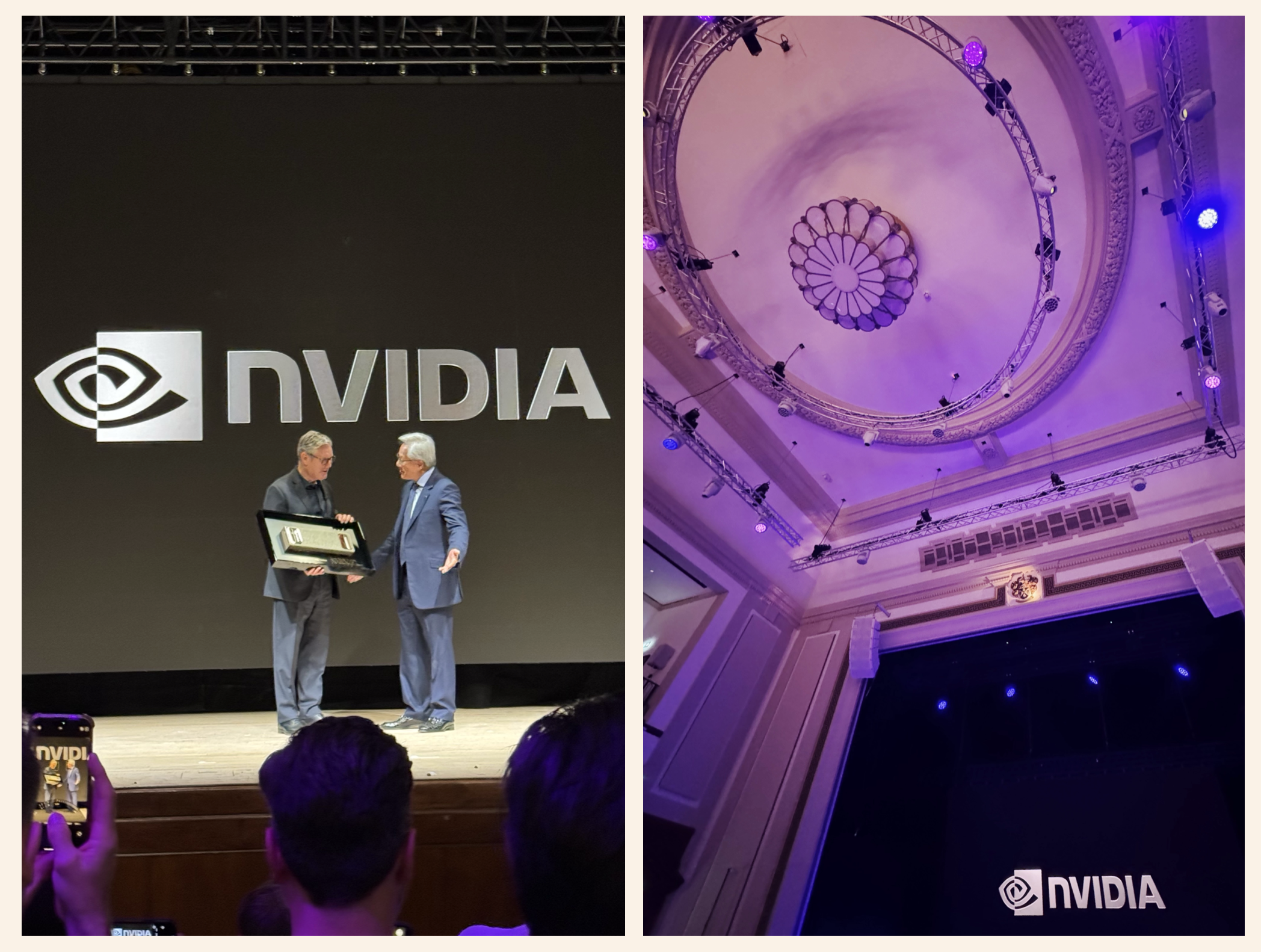
You’ll be familiar with the sentiment that nights like this are all theatre. It’s true that you don’t build capacity with vibes alone, but you also can’t build it without them. The NVIDIA evening understood that and used theatre to do something policy can struggle to do on paper: place researchers, entrepreneurs and officials inside the same narrative and shift what feels possible. The Prime Minister and two Secretaries of State joining Huang on stage felt less like government “loving startups” in some generic sense, and more like a re-understanding of the strategic importance of having the capacity to build technologies, companies and innovation, with builders being placed inside the national story. This kind of theatre recruits talent, attracts capital and inspires confidence.
There was, inevitably, a degree of scepticism in the audience chatter after the speeches. Questions about economic stability and tax changes, about whether policy across departments will join up quickly enough to convert headlines into action, about energy costs, grid connections and skills on the ground, about who, exactly, will use all this compute infrastructure. It’s also true that some of what was said from that and other stages last week will materialise faster than other things. Those are fair points. In large part, domestic benefit will depend on adoption.
Against that backdrop, the Tony Blair Institute’s new report with Ipsos on public attitudes towards AI finds that while over half of the surveyed Britons report having used generative AI in the past year, 38% cite a lack of trust in AI-generated content as the biggest barrier to wider use. People are also more likely to see AI as a risk to the economy (39%) than an opportunity (20%).
Among other things, the report recommends government focus on demonstrating real-world benefits of AI and building public engagement. I agree with the thrust, and I’d add that government communications teams are already doing it reasonably well: most ministerial speeches and press releases frame AI through benefits people can feel – appointments booked faster, public services accessed easier, the planning system transformed to build more homes quicker – rather than technical capability metrics.
What the report perhaps underplays is that not every challenge requires a government intervention. While it’s fantastic that the Prime Minister is personally engaging with this agenda, the ecosystem itself needs to step up. When innovators can effectively articulate what their work delivers, they create the conditions for their own success. The theatre matters too – vibes are also part of the enabling infrastructure for everything else that follows.