
🚢 Mann Virdee, Head of Science and Technology
In 1882, a teenager from Slonim (in what is now Belarus) arrived in Leeds fleeing antisemitism. His name was Michael Marks and he had heard that Leeds needed tailors. The story has it that the only word of English he knew was ‘Barrans’, referring to John Barran & Sons, a clothing manufacturer known to employ Jewish immigrants.
Soon after, a local wholesaler, Isaac Dewhirst, offered to lend Marks £5. Marks used the money to buy stock from Dewhirst’s warehouse and sold it door to door as a pedlar. By 1884 he had a stall at Kirkgate Market, and it soon carried the slogan ‘Don’t ask the price, it’s a penny’. Ten years later, in 1894, Dewhirst’s cashier, Tom Spencer, put in £300 for a half share, and Marks & Spencer was born.
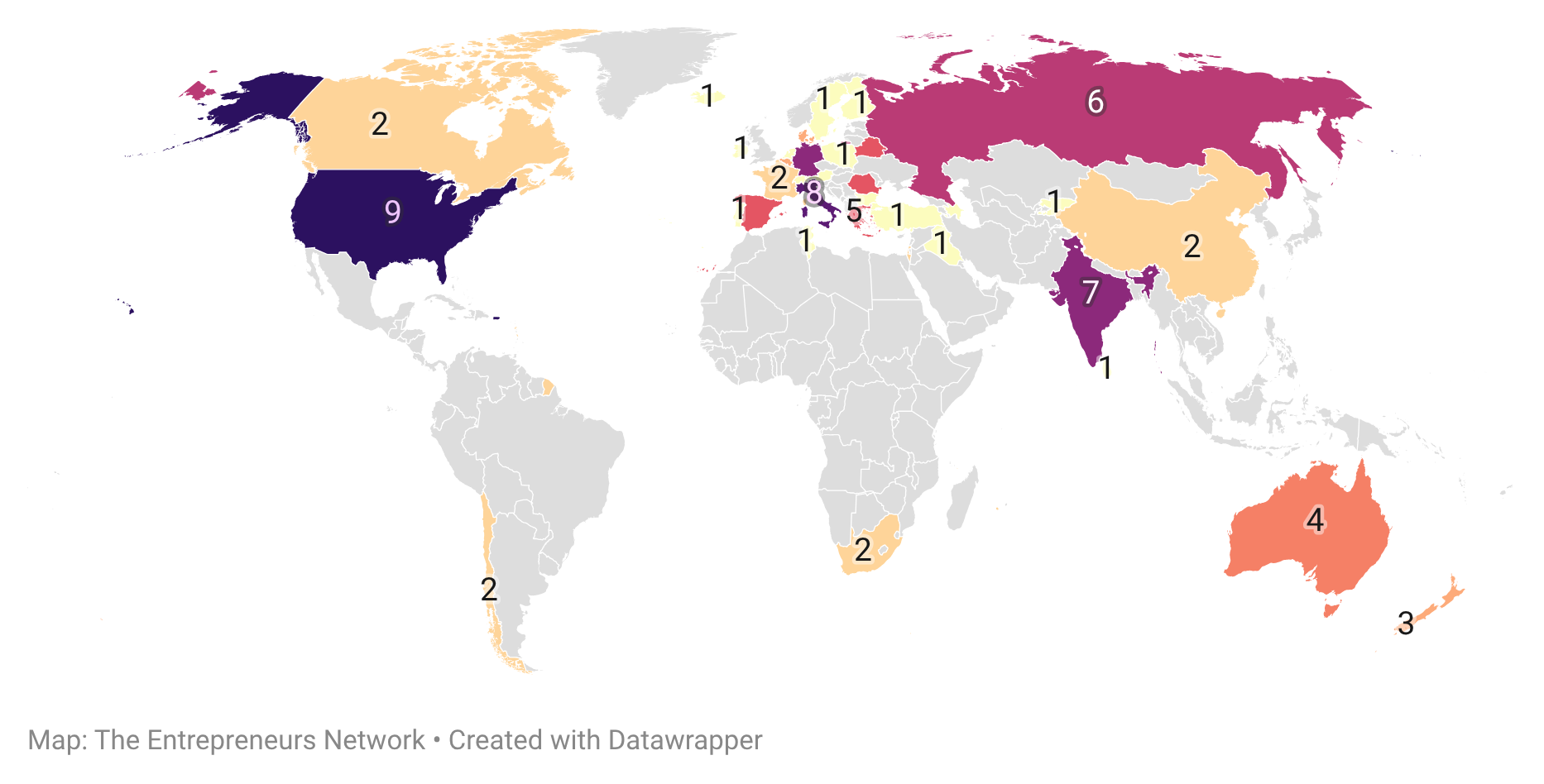
Marks’s story is unusual in some respects, but it also echoes those of many foreign-born founders today. Our Job Creators report, which was sponsored by Penningtons Manches Cooper, counts how many of Britain’s 100 fastest-growing companies have at least one foreign-born founder. In this year’s edition, 54 did, matching last year’s record. But a headcount can’t settle the obvious question: are migrant founders more likely to succeed, or simply more numerous?
A new NBER working paper by Harvard researchers Paul Gompers and Henry Woo tracks 913,226 founder-firm pairs across 213 countries, comparing ‘expats’ (those who build companies abroad) and ‘returnees’ (those who come home after time abroad) with comparable local founders.
The paper finds that both expats and returnees raise early funding more often than local founders.
But where success means an IPO or a sizeable acquisition, the expat premium is concentrated in two countries: the US, where expat founders are 18% more likely to succeed, and the UK, where they are 26% more likely. Returnees rarely show a premium under this measure of success.
These are relative figures on low base rates: fewer than 3% of UK startups in the sample succeed. But where returns come from a few big exits, being a quarter more likely to reach one matters. In Britain, at least, migrant founders aren’t just more numerous.
The paper’s breakdown by entry route shows where the premium comes from. In the US, expats who first came for graduate study, for work or to found directly all show premiums of around 30%, while those who arrived as undergraduates show none. In the UK, the premium is concentrated among direct founders — people who, like Marks, started a business as their first step in their new country. Neither of the student routes shows a significant premium in Britain.
Much of Britain’s high-skilled migration debate centres on students and the Graduate route. This paper suggests that in Britain, the migrants most likely to outperform local founders are those who arrive ready to found. Few of the successful ones in the data can have used the Innovator Founder visa, which only opened in 2023, but now that it’s the route built for them, it needs to work.
🪧 Ian Ng, Researcher
When the Government published its AI Opportunities Action Plan in 2025, it named Culham, home to the UK Atomic Energy Authority’s fusion campus, as Britain’s first AI Growth Zone. Almost two years on, Culham still has no investment partner and no planning application, and its investment page is still inviting expressions of interest.
Since 2025, high-profile AI projects have been pulled or shelved in the UK, from OpenAI’s Stargate UK to Microsoft’s deal at Nscale’s Loughton site. Science Works’ new pipeline report finds that hyperscalers account for only 19% of Britain’s data centre pipeline. The rest is being built by land promoters and colocation providers, who typically build only once a tenant signs. The UK’s 19% stands in contrast to 30% in both the US and the EU. The report also finds that an alarming 42% of the capacity due by 2030 is being developed by land promoters without disclosed tenants, compared with 33% in the US and just 16% in the EU.
Some investors walk away over grid delays, others over energy costs. The legal challenge that forced the Government to concede that its planning permission for the Iver data centre was flawed has added further uncertainty. Together, these result in a chicken-and-egg problem, where tenants hesitate when power and planning are not guaranteed, but land promoters need a signed tenant to sell or finance a site. As argued in a recent edition, locational pricing could partially fix the energy cost problem, but the UK’s compute build-out still faces other problems.
The Science Works report rightly points out that the government’s demand forecasts measure UK demand for compute, not demand for compute located in the UK. Some sites simply struggle to find takers. In Didcot, cloudHQ’s campus obtained full planning consent in 2019 and has an existing grid connection and fibre link. Its website still lists all 101MW as available. Fixing the supply-side fundamentals remains important, but Didcot shows that it may not be sufficient.
The Government has pledged to use procurement to back innovative businesses. It could also act as an anchor tenant, signing long-term leases up front for workloads that require sovereign data to be hosted and kept in the UK. In last week’s Budget, the Chancellor said he wants NHS and armed forces AI data to stay in the UK. The state should consider securing the capacity to host it. Signing market-rate leases up front for an expanded AI Research Resource, defence’s sovereign compute and NHS AI could also give developers revenue they can borrow against. The Data Centre Covenant already asks strategic data centres to provide access to compute for public services, but leasing capacity could provide revenue certainty for land promoters as well as host public data securely.
The government’s own modelling puts public-sector demand at just 0.2GW by 2030, a small fraction of the pipeline. Anchor commitments should be capped at genuine need, as the government should not be expected to underwrite all of the market demand. Ultimately, success rests on making the UK an attractive place to lease compute capacity.
🧠 Philip Salter, Founder
Last week, writing in The Argument, Zachary Liscow listed high-skilled immigration among the few growth policies cheap enough to shrink the US deficit. The research behind that claim points to a big idea worth pondering upon.
Marta Prato’s work, in the Quarterly Journal of Economics, followed inventors moving between Europe and the US. Inventors who left the EU for the US increased their patenting by 33% a year after the move. More surprisingly, the co-inventors they left behind in Europe also gained, increasing their own patenting by around 16% a year once their collaborator had gone.
Prato also modelled an EU tax break for foreign and returning inventors, designed to keep European inventors at home and tempt back those in America. With more inventors at home, Europe produces more ideas, and its productivity growth rate rises by about 3% over the first 25 years. But fewer Europeans in the US means fewer ideas produced there and fewer collaborations carrying them back. In the long run, Europe’s productivity growth rate ends up about 3% lower than if it had done nothing.
The UK sits on both sides of this. Gabriele Pellegrino and colleagues show that between 1990 and 2011 the UK was the third-largest source of migrant inventors, after China and India, and one of the five largest destinations. When a British inventor moves from London to San Francisco and produces more there, the UK keeps part of the gain through the people they still work with here.
Prato estimates that doubling the number of US H-1B visas for skilled workers raises the long-run growth rate by 4% in both the US and the EU, because inventors end up where they produce most. The same logic applies when the UK is the destination. Inventors who would be more productive here gain by coming, and so, through their collaborators, do the countries they leave.
Inventors are not the same as founders. And while we know that startups relocating to Silicon Valley go on to perform significantly better than similar firms that stay put, nobody has yet measured how the ecosystem founders leave behind fares. The big idea is that what holds for inventors might well hold for founders too.
If it does, the policy points towards admitting more talent, charging little for it, not penalising people for leaving with measures such as an exit tax, and making it easy to collaborate across borders. Other priorities might override it — most obviously national security and strategic capability — and those are the arguments opponents would need to make.