

By Philip Salter (Founder, The Entrepreneurs Network), Ian Ng (Researcher, The Entrepreneurs Network), Sophya Mashkoor (Intern, The Entrepreneurs Network) and Mann Virdee (Head of Science and Technology, The Entrepreneurs Network)
Executive Summary
For the second year running, 54 of the UK’s 100 fastest-growing companies have at least one foreign-born founder, equalling the highest proportion we have recorded since this research began in 2019. These companies have a combined pre-money valuation of £15.84 billion, 70% of the total for the top 100.
Of the 225 founders behind this year’s companies, 98 (44%) were born overseas. That is up from 42% last year and more than twice the foreign-born share of the UK population, which stood at around 19% in 2024. They come from 35 countries across six continents, with the United States the most common birthplace. More than half of the 54 companies were founded by British-born and foreign-born co-founders together: immigrant founders complement British-born entrepreneurs rather than crowd them out.
Net migration has fallen from a peak of 944,000 in the year ending March 2023 to 171,000 in 2025, the lowest level since 2012, excluding the pandemic. Having delivered that reduction, the Government has less reason than at any point in the past five years to pursue sweeping restrictions that catch the small number of people who start and scale the companies Britain needs. In 2025, while two thirds of the public thought immigration was too high, 56% supported making it easier for skilled people to move to the UK and just 16% were opposed. Concern about immigration levels should not be mistaken for opposition to high-skilled immigration.
Yet the rules that matter most to founders remain unresolved. The consultation on raising the baseline qualifying period for settlement from five years to ten closed in February 2026, and no response has been published. Founders, investors and the people they hope to recruit are being asked to make ten-year decisions against a rule that does not yet exist. Meanwhile the Graduate route will fall to 18 months from January 2027, fees have risen again and the Innovator Founder route, the only one designed specifically for founders, remains slow and uncertain. At Ankar AI, one of the companies profiled in this report, sponsored hires received their visas faster than one of its co-founders did. In our Entrepreneurs Survey, 65% of founders agree the UK is an easy country to start a business in, but just 14% say the same of scaling one; 55% find it difficult to recruit.
Our recommendations focus on what is needed for more of the world’s most innovative people to come to the UK, stay and build their businesses here. None would materially increase net migration, and almost all could be delivered through a Statement of Changes to the Immigration Rules or amendments to the fees regulations, without primary legislation.
End the uncertainty over settlement. Publish the consultation response with a firm implementation date. Confirm that the seven-year reduction for Global Talent applies to exceptional promise, taking it from five years to three. Match the qualifying period across the household, so a founder’s spouse does not wait ten years while the founder settles in three. Let those already on a route to settlement keep the qualifying period that applied when they arrived, or settle sooner where the new rules allow.
Keep the founders we educate. Give Graduate route holders a further 12 months – 30 in total – where an endorsing body has agreed to assess their business.
Broaden the High Potential Individual route. Add two further tests for the Global Universities List: a top-50 place in the Financial Times or QS Global MBA rankings, or in any of the five broad faculty areas of the QS subject rankings. This would add around twenty institutions, including INSEAD, HEC Paris and IIT Delhi, within the existing cap of 8,000 applications. Promote the route directly to graduating cohorts at qualifying institutions.
Cut the cost of coming and hiring. Extend visa fee reimbursement, now limited to scaleups, to companies with fewer than ten employees for their first three sponsored hires, at £5,000 each. Freeze fees on the founder and high-talent routes for the rest of this Parliament.
Fix the Innovator Founder route. Once an approved body has endorsed an application, restrict caseworkers to identity, security, provenance of funds and fraud. If the Home Office keeps the commercial assessment, resolve doubts in an interview rather than through months of document requests. Make processing standards binding and publish the criteria for treating a case as complex. Replace the novelty test with a viability test.
Red-team new routes before they launch. Appoint a standing red team of practitioners – endorsing bodies, immigration solicitors and founders – to stress-test every new or substantially amended route, publishing its assessment alongside the Statement of Changes.
Foreword
The UK has long benefited from its ability to draw entrepreneurial talent from around the world. Our universities, research institutions, financial markets and vibrant startup ecosystem continue to make Britain an attractive destination for founders looking to turn innovative ideas into successful companies.
Moreover, as data and stories featured in this report demonstrate, foreign-born founders are more than individual beneficiaries of the opportunities the UK offers; they play a key role in helping to strengthen the wider economy and create opportunities for others through innovation and job creation.
That reality is brought to life through the experiences of the entrepreneurs who have kindly shared their stories. Having worked with hundreds of founders and high-growth businesses over the course of my career, the qualities and attitudes are familiar: a willingness to take risks, a desire to use their skills in a meaningful way, and a belief that the UK is a country in which their businesses can grow and succeed.
I also see how a complex and uncertain immigration system can affect decisions. For founders, immigration is rarely a stand-alone administrative issue. Hiring plans, investment decisions, family life and long-term business strategy are all tightly connected to an individual’s chosen visa route and current immigration status.
When uncertainty persists, it becomes harder for entrepreneurs to commit fully to building their future in the UK. That’s why many of the recommendations in this report are so important. Clarity around settlement leads our policy recommendations for a reason; businesses are built over years, sometimes decades, and founders need confidence that the rules governing their future will not remain unresolved indefinitely.
Equally important is ensuring that we retain the talented individuals we educate. Every year, UK universities attract exceptional students with the potential to become future founders, innovators and employers. Too often, however, barriers within the system make it difficult for them to remain and build businesses here. How many ideas will we end up losing to competitors?
The report also highlights positive developments: the introduction of the Scale-up visa reimbursement scheme is a step in the right direction and welcome recognition that immigration costs can act as a genuine barrier to growth and international recruitment. At the same time, there remains a strong case for reform of the Innovator Founder route. A visa specifically designed for entrepreneurs should be accessible and efficient. At present, too many founders encounter delays and unnecessary complexity.
I strongly believe that the UK wishes to remain a leading destination for entrepreneurial talent, we must therefore offer not only opportunity, but certainty. It’s vital that we ensure our immigration framework rewards ambition, supports innovators and enables founders to put down roots if we want the next generation of job creators to build their future here. Penningtons Manches Cooper is proud to support this report and evidence-based reform promoting that goal.
Pat Saini
Head of Immigration, Penningtons Manches Cooper
Introduction
Britain’s national conversation on immigration has become detached from the data. Net migration peaked at a historic high of 944,000 in the year ending March 2023. [1] In 2025 it fell to 171,000 – the lowest level since 2012, excluding the pandemic. [2] Yet 56% think immigration increased last year. Given that this is the context in which policy is being made, it is hardly surprising that in July 2026, 43% of the British public named immigration as an important issue facing the UK, putting it ahead of any other topic. [3]
For years, we at The Entrepreneurs Network have sought to put hard data behind the anecdotes we repeatedly hear from founders about the importance of immigration to Britain’s startup economy and national prosperity. Through our Job Creators series, we have documented the disproportionate contribution that foreign-born founders make to starting and scaling some of Britain’s fastest-growing businesses. And more broadly, we hear from British founders every day about their need to bring in overseas talent to compete internationally.
The political landscape has changed since we last published Job Creators 2025. [4] In July 2026, Andy Burnham succeeded Keir Starmer as Prime Minister and reappointed Shabana Mahmood as Home Secretary, a clear signal that the programme set out in the May 2025 Immigration White Paper will proceed broadly as planned.
Since its publication, the White Paper has gone from a prospectus to a partially built system. The minimum skill threshold for Skilled Worker visas rose to degree level in July 2025, and overseas recruitment of care workers closed the same month. The Immigration Skills Charge has risen by 32%. Since January 2026, applicants to the Skilled Worker, Scale-up and High Potential Individual routes have had to demonstrate B2 English rather than B1. From January 2027, the Graduate visa falls from two years to 18 months.
However, the single most consequential proposal for founders remains unresolved. The Government’s consultation on settlement proposed extending the qualifying period for Indefinite Leave to Remain from five years to a baseline of ten for most work routes. It closed in February 2026 having attracted more than 200,000 responses. No government response has been published, and nothing on qualifying periods has been laid before Parliament since. [5] Founders, investors and the people they are trying to recruit are therefore being asked to make ten-year decisions against a rule that does not yet exist.
Reforms over the last year have not been uniformly restrictive. The Global Talent route was expanded to the design industry, the Global Business Mobility routes were made more flexible, and there was a call for evidence on the Innovator Founder visa – a route we have long argued underperforms relative to its potential.
Across four waves of our Entrepreneurs Survey, founders have told us consistently that Britain is a straightforward country in which to start a company and a difficult one in which to grow one. A clear majority, 65%, agree the UK is an easy country to start a business in, against just 14% who say the same of scaling one. [6] Hiring is a persistent part of that gap: 55% of founders find it difficult to recruit new staff and only 23% find it easy, a picture that has not meaningfully improved in any wave since May 2025.
The Government has already delivered a substantial reduction in net migration. Our argument is narrower and, we think, harder to dismiss. Having achieved that reduction, there is now less reason than at any point in the past five years to pursue further sweeping restrictions that catch the small number of people who start and scale the companies Britain needs. Other factors, not least changes to the tax regime, are weighing on the UK’s appeal to internationally mobile founders; the immigration system should not give them another reason to build elsewhere.
Where policies are introduced to reduce immigration, they should be targeted and carry a clear justification. One-size-fits-all rules seldom work well for anyone; invariably they deny international talent the chance to flourish and the British public the benefits of their success, whether in jobs created, tax receipts generated, investment made or innovations supplied.
What follows is our evidence. As in previous years, we have identified every founder behind the UK’s 100 fastest-growing companies and established where each of them was born. The picture that emerges is, once again, difficult to reconcile with the direction of policy.
Key Findings
Our latest analysis reveals that 54 of the UK’s 100 fastest-growing companies have a foreign-born founder or co-founder. This matches last year’s figure, equalling the highest proportion we have recorded since we first started carrying out this research in 2019. The combined pre-money valuation of these companies is £15.84 billion, representing 70% of the combined valuation of the UK’s 100 fastest-growing companies.
Chart 1. More than half of Britain’s fastest-growing companies have a foreign-born founder or co-founder
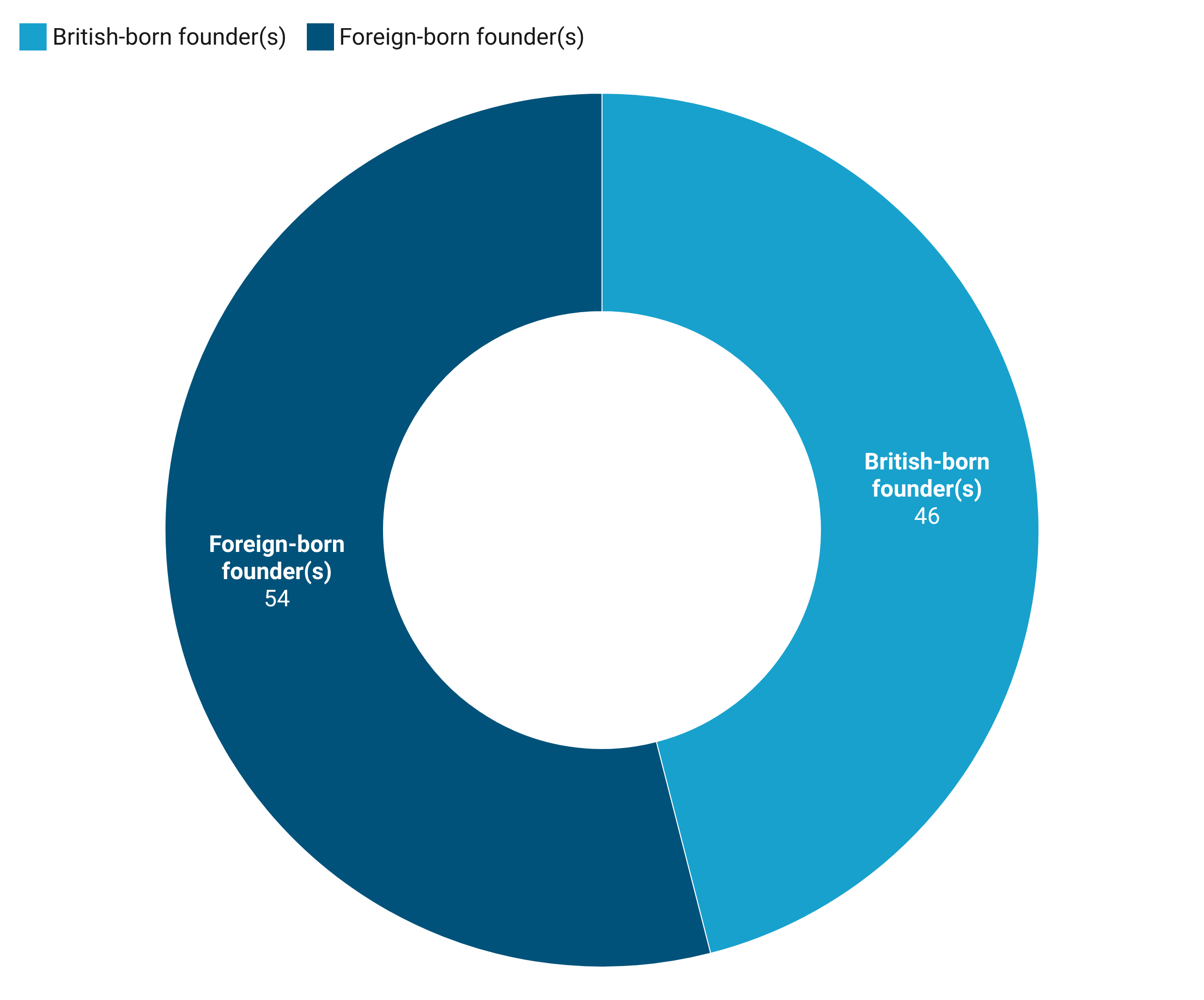
Among the 225 founders and co-founders behind this year’s companies, 98 (or 44%) were born overseas, up from 42% last year. These statistics underscore the significant contribution that immigrants make to the UK’s entrepreneurial landscape. Of the 54 immigrant-founded or co-founded companies, 25 were established entirely by foreign-born founders, while the other 29 were joint efforts between British-born and immigrant co-founders, emphasising how immigrant founders often come to the country and complement, rather than crowd out, British-born entrepreneurs.
It is surprisingly difficult to calculate immigrants as a proportion of the total population, at least in a timely fashion. Nevertheless, the Migration Observatory’s analysis of the latest census and Annual Population Survey data shows that the foreign-born population of the United Kingdom stood at around 19% in 2024. In the years since, net immigration will have pushed this figure higher, as it far outweighs what is referred to as ‘natural population change’ – all live births minus deaths.
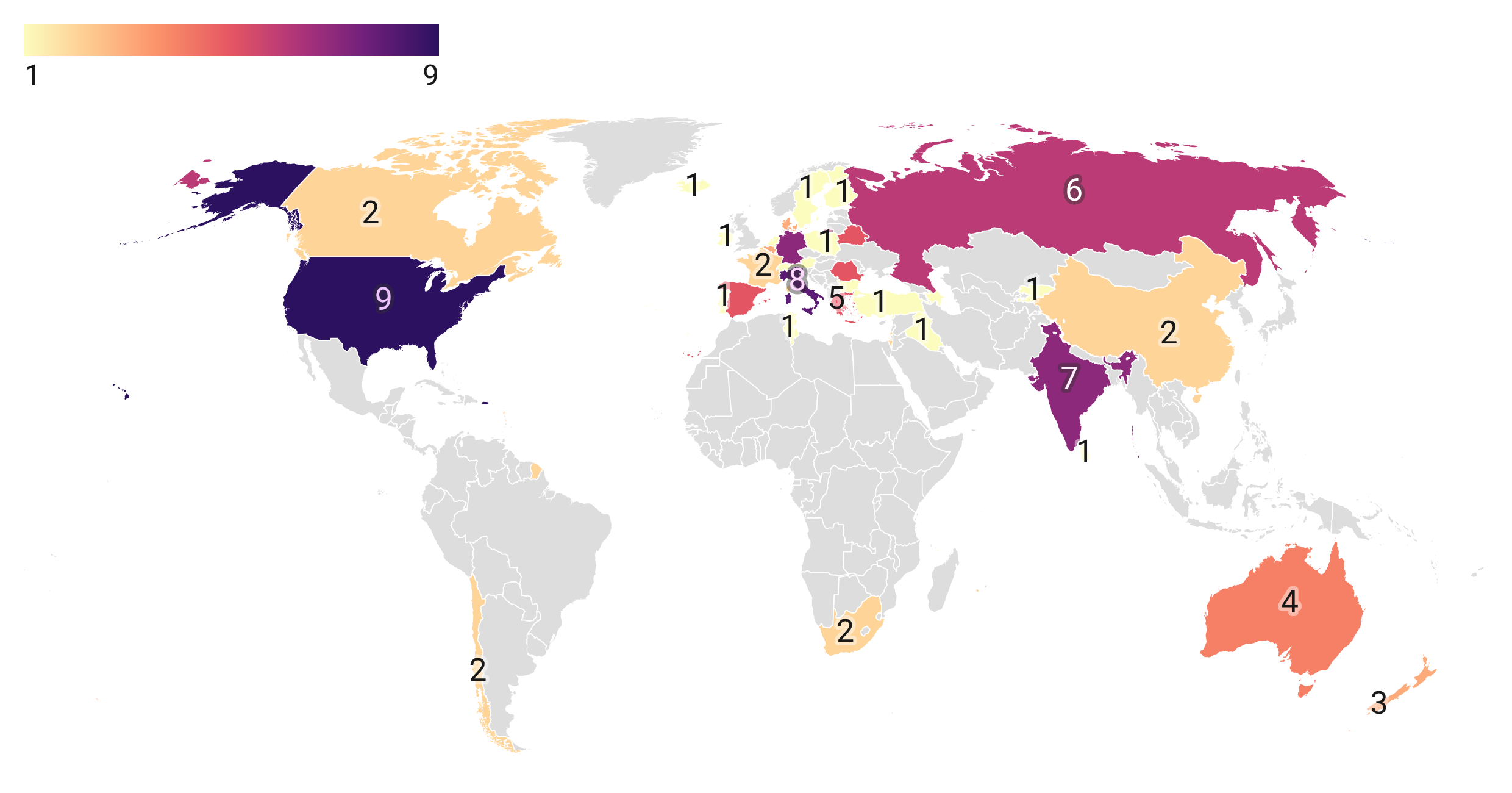
The foreign-born founders in this year’s sample hail from 35 unique countries across six continents – a rise in the spread from last year’s 29. The United States was the most common birthplace, with nine founders born there. That was followed by Italy with eight, Germany and India with seven, Russia with six, Belarus, Greece, Romania and Spain with five, Australia with four, Belgium, Denmark and New Zealand with three, Canada, Chile, China, France, Israel and South Africa with two, and one each from Austria, Azerbaijan, Bulgaria, Finland, Iceland, Iraq, Ireland, Kyrgyzstan, the Netherlands, Poland, Portugal, Sri Lanka, Sweden, Switzerland, Tunisia and Turkey. No single country accounts for more than a tenth of the foreign-born cohort – a notably more dispersed picture than last year, when France alone accounted for 12.
Chart 2. Foreign-born founders behind Britain’s 100 fastest-growing companies come from 35 different countries
Once again, this data shows that foreign-born founders make an integral and outsized contribution to Britain’s entrepreneurial scene – starting and growing innovative companies which advance the economy. Our findings only serve to emphasise the importance of crafting an immigration system, and overall environment, that is navigable for and attractive to high-skilled immigrants. As we set out in the Policy Recommendations, there are a number of ways in which the Government can thread the needle of retaining control of the immigration system while still enabling international talent to easily move to Britain and begin building incredible companies here rather than elsewhere.
Case Study: Tim Chong, Co-Founder, Yonder

Tim Chong (right), with co-founders Harry Jell (left) and Theso Jivajirajah (middle)
Source: Yonder
While working for Accenture in Nairobi at the intersection of management consultancy and international development, Tim Chong watched buyers and sellers in a village market pay each other with the mobile money platform M-PESA on basic phones, instead of cash. That experience left him with a deep conviction. “I realised that building a tech startup could make a real difference to people’s lives,” Tim says. That belief stayed with him through a career advising clients in the technology, media and telecommunications sector, but it only found a specific target once he joined ClearScore in London and met his two future co-founders.
The target came from his own experience of arriving in Britain. Moving from Australia to London in 2018, Tim found himself spoiled for choice when it came to opening a current account. Credit was a different story: “It didn’t feel like there was a modern product experience for credit cards like the one that Monzo has built for debit. I was being offered credit card options that felt old and stuffy, with rewards that felt underwhelming and irrelevant to my life.”
Getting approved at all was harder still. “The fact I didn’t have a UK credit report seemed to make me an undesirable customer, despite having a good job and a great credit score back home.” Founded in 2021, Yonder set out to address both problems at once: a rewards card that looks beyond the credit report when assessing eligibility, and one with rewards that, as Tim puts it, “actually fit and complement people’s lives.”
Tim’s route to London was a winding one. “I’ve worked all over the place; I love to travel and I really wanted to experience as much as possible in my twenties,” he explains. After leaving Australia he worked in Phnom Penh and Nairobi before settling in London, which has been home for the past eight years.
The decision to build the business in Britain was deliberate. Tim rates Shenzhen, New York and London as the leading global fintech hubs, and London won on its outward-facing character. “For me, London stood out for its international outlook, unlike New York which tends to be US-centric. For a fintech with global ambitions, London felt like the best fit. It’s home to some of the best fintech companies in the world and has an incredibly strong startup ecosystem.”
Asked how being foreign-born has shaped him as an entrepreneur, Tim is careful to distinguish his own move from those of the generation before him. His parents moved from Malaysia to Australia; his in-laws arrived there as refugees from Cambodia. “I would say it’s the influence of my parents and in-laws who essentially started from scratch in a very different country that taught me a lot about hard work and perseverance over a long period of time. Their work ethic, even when work wasn’t always easy or rewarding, has taught me a lot.”
Access to talent defined Yonder’s early months. “As a founder, there was a point in the early days where my full-time job was a recruiter, finding the right talent myself to help us figure out how to scale what we’d built. It was a lot of scouring LinkedIn and my network to find the best of the best, with no limits to where the talent is based.” Most of the team is now UK-based, with colleagues dotted across Europe and beyond who join the company’s annual offsites. “Being able to access borderless talent is really important to us, and is one of the many blessings of today’s connected world.”
Tim’s own encounter with the immigration system was resolved, but only with intervention. Processing delays on his Indefinite Leave to Remain application arrived at a point when he needed to travel for business during a critical phase of growth. The Government’s Global Talent Taskforce case-managed the situation and preserved continuity for him and his family. “Without their help, the uncertainty would have significantly impacted the business.”
Ask Tim what Britain should change, though, and his answer moves beyond visas. “We need capital markets that encourage risk-taking, especially at the growth and IPO stage. The UK invests far less in its own market than many other G7 countries and it means that we continue to lose great companies to US capital markets.”
Case Study: Alexandra Birch-Mayne, Co-Founder, Aveni
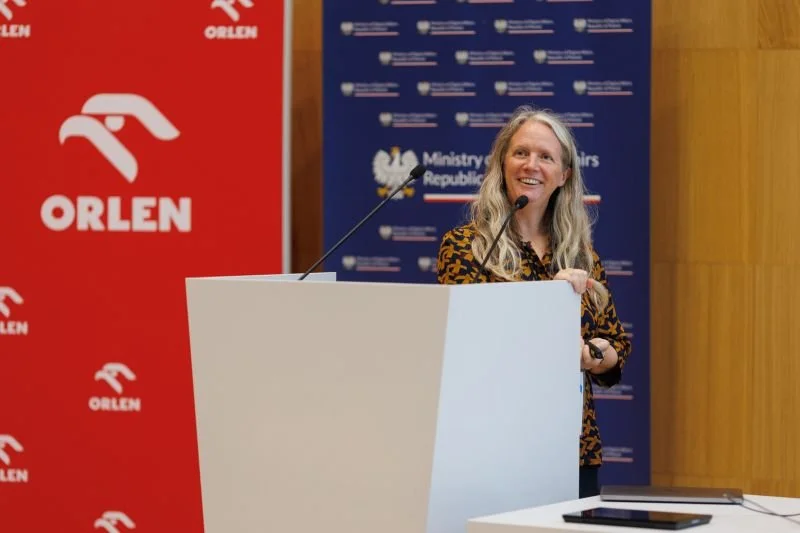
Alexandra Birch-Mayne
Source: ELLIS Unit Warsaw
The book that set the direction was Anthony Burgess’s A Mouthful of Air, a broad survey of the history of language which Alexandra Birch-Mayne had adored for all its quirks and delights. It was 2004, she had a computer science degree and she was looking for a specialism, ideally one that would matter to the companies then defining the frontier of the field. “I felt that natural language processing perfectly combined my interests and skills,” Alexandra says. The conclusion took her to Edinburgh, where she went on to complete an MSc, a PhD and a postdoc in statistical machine translation.
The timing proved fortunate. “This meant I had a front row seat at the start of the AI revolution,” she says. In 2016 she co-authored a paper on byte pair encoding, a method of splitting words into smaller subword units so that translation systems could handle vocabulary they had never seen before. Variants of that technique are now used in most large language models.
The company came later, and from a straightforward observation. “There was clearly a huge opportunity to deploy NLP in society,” Alexandra says. Financial services was the obvious place to start. Her co-founder Joseph Twigg had the contacts, the sector’s working practices were ripe for modernisation and there was money available to fund the development work. Aveni, founded in Edinburgh in 2018, builds AI products for the industry.
Alexandra’s own path to Britain had nothing to do with any of this. Her husband was offered a job in Edinburgh and she came with him, choosing the University of Edinburgh to study because of its reputation for work in natural language processing and AI. The choice of where to build the business, more than a decade later, followed from where she had already put down roots. “I moved here 14 years before I started the company because of the universities and the cultural link with my family who were all British, even though I am South African.”
Asked how being foreign-born has shaped her as an entrepreneur, Alexandra describes a frontier mentality. “I don't trust that I will be OK. I pursue opportunities vigorously because I do not have extended family or resources to back me up, and culturally in South Africa that kind of behaviour is common.” She offers a striking illustration of how common. Of her 1996 computer science class at the University of Cape Town, she estimates around 90% have gone on to start their own businesses.
That outlook carries into how Aveni hires. Access to international talent has been, in Alexandra’s assessment, very important to the company, and her continuing links to the University of Edinburgh have been central to attracting the right people to it.
Her verdict on the system that governs that access is blunt. “It has been very expensive and unfriendly to people who are high value and can bring a lot of money to the UK.”
Her message to the Government follows directly. “Make it cheaper and easier for people who have created businesses and employed people to get visas and nationality.”
Case Study: Tamar Gomez, Co-Founder, Ankar AI

Tamar Gomez
Source: Anker AI
Tamar Gomez started her working life on oil and gas platforms. From there she went to Imperial College London for a PhD, spent a period in the French military and then joined the American software company Palantir, which is where, as she puts it, she really zeroed in on tech and software. It is an unusual route into a London AI startup, and an instructive one.
What she took from Palantir was a view of where the technology mattered most. “I was kind of at the forefront of the start of LLMs, deploying AI platforms, and it was very clear to me that the most important place to deploy AI was in innovation and research and development,” Tamar says. “That’s where I think this technology can make the biggest difference and have the biggest positive impact for humanity.” Ankar, which she co-founded in London, is the result: an AI-native platform for research and development, aimed at the people working on new technologies and at the patent and intellectual property work that follows.
Her arrival in Britain preceded any of this. Tamar is French, born and raised there and educated there to master’s level, and she came to the UK for the PhD rather than for the business. “When I did my PhD, I didn’t really know I was going to start a company, so I just wanted to go to the best university I could.” A short stint back in France followed, but from the doctorate onwards she has been largely UK-based.
The decision about where to put the company was a more deliberate one. By then Tamar was living in London and her co-founder was in Zurich, and as two French founders they could plausibly have chosen Paris. London won on four counts. The engineering talent pool was simply larger. Capital was more accessible, with most investment funds either based in the city or maintaining an office there. It was the better stepping stone into the US market. And the administrative burden was no worse than in France and lighter than in Zurich.
Being foreign-born has shaped the company more than the founder, on Tamar’s account. “I guess it means we’ve had a very international company from the get-go. Half of the company are foreign-born, and we have a lot of customers in Europe.”
Her own experience of the immigration system was uneventful, because by the time Ankar existed she had been in the UK long enough to have settled status. Her co-founder’s was not. Moving from Zurich meant being endorsed by a third-party body, at considerable cost, and then justifying the company’s progress to it at regular intervals. “Every year we have to explain how the company is still growing – which it is, by the way – but they have no clue what a VC-backed company is, or what the economics of a VC-backed company are. So it’s been a bit of a pain, frankly.”
The comparison that follows is the sharpest part of her evidence. “It’s easier for us as a company to sponsor skilled workers than it was for my co-founder to get a visa. Our skilled workers get a visa way quicker than my co-founder did, which is a bit counterintuitive when you think about it.”
Her recommendation is to strip out the intermediary. “It would be great if you could just apply for that visa directly, without having to use a third party, with some very simple criteria. If you have a good education, a great professional track record, a company with some form of investment already – in the millions of pounds – it should be easier.”
Policy Recommendations
No government starts with a clean slate on immigration. This one inherits an unfinished settlement reform and a set of routes that need fixing.
Top of the new Government’s in-tray is the consultation on earned settlement. But like any government serious about re-election, the new Cabinet is working within a narrow window of what the electorate will accept.
We recognise the political constraints, which is why these recommendations would not materially increase net migration and almost everything can be delivered through a Statement of Changes to the Immigration Rules or amendments to the fees regulations, without primary legislation.
While there are more tweaks to the immigration system that would help support economic growth, for the purposes of this report we are focused on a subset of these – what’s needed to ensure more of the world’s most innovative individuals come, stay and build their businesses in the UK.
1. End the uncertainty over settlement
The leading recommendation of last year’s Job Creators report was that the Government preserve accelerated settlement for high-value visa categories and exempt them from the ten-year track set out in the Immigration White Paper.
The Government’s policy statement on earned settlement, published in November 2025, set out how the ten-year baseline would work and the reductions to be earned against it. Under those proposals Global Talent and Innovator Founder holders would receive a seven-year reduction after three years’ continuous residence. The statement referred to Global Talent at route level and did not address its sub-routes. The consultation closed in February 2026 and no final decision has been published.
1a. Publish the consultation response, with a firm implementation date
More than a year on from the White Paper, and with the consultation closed since February 2026, nothing on settlement has been implemented. This uncertainty is deterring talented people from choosing the UK. The new Government must make it a priority to respond, with a firm implementation date.
1b. Confirm the seven-year reduction applies to exceptional promise
Global Talent has two sub-routes. Exceptional talent visa holders settle at three years, exceptional promise at five. Because the policy statement speaks of Global Talent as a single route, it is unclear whether exceptional promise holders would qualify for the reduction at three years, stay at five or fall to the ten-year baseline. The Government should confirm that the reduction applies to both sub-routes, taking exceptional promise from five years to three.
1c. Match the qualifying period across the household
The most consequential unresolved question is whether dependants will be held to the same timetable as the main applicant. That applies across routes, but the gap would be particularly stark for Global Talent and Innovator Founder households: assessed separately, a spouse with no UK earnings would wait for ten years while the founder settles in three. The House of Lords Justice and Home Affairs Committee has recommended that household contribution be counted. Matching the qualifying period across the household is simpler, and costs nothing to administer.
1d. Protect those already here
People already in the UK on a route to settlement should keep the qualifying period that applied when they arrived, or settle sooner where the new rules allow. The Lords Committee has warned that retrospective application would be unfair and could invite legal challenge. It would also act to put off those yet to come to the UK.
2. Keep the founders we educate
Britain has many of the best universities in the world. Every year they attract some of the most ambitious young people from all over the world. Many of Britain’s leading entrepreneurs came here as students.
The Immigration White Paper accepted the point and committed to easing the move from a student visa onto the Innovator Founder route, naming top graduates of British universities as the group it had in mind.
Two changes pull the other way. From January 2027 the Graduate route falls from two years to 18 months, though PhD holders keep three. And the Skilled Worker salary threshold has risen to £41,700, with a new entrant rate of £33,400 for those under 26, or switching from a Student or Graduate visa. That rate lasts four years in total, counting time already spent on the Graduate route.
To reach Innovator Founder, a founder needs an endorsing body to certify that the business is new, innovative, viable and scalable. Those on student visas cannot be self-employed. Under the shortened Graduate route they will have 18 months to get there. The alternative is to take sponsored employment and delay starting a business until they have settled.
2a. Give Graduate route holders a further 12 months where an endorsing body has agreed to assess their business
Where an approved body has agreed to assess a Graduate route holder’s business, the holder should get a further 12 months to build it – 30 months in total, against the 18 the Graduate route will allow from January 2027. Endorsement requires evidence of traction that a business rarely has in its first year, and no version of the Graduate route has given founders enough time to generate it. The extension is conditional on an endorsing body having already engaged, so it reaches only those actively pursuing the route.
3. Broaden the High Potential Individual list
The High Potential Individual visa, introduced in 2022, is the only route that lets a graduate of a leading overseas university come to Britain with no job offer, no sponsor, no minimum salary and no endorsement. Holders can work for any employer, switch jobs, work for themselves or hold several jobs at once. For a would-be founder that is close to ideal: two years to test an idea, take a job to fund it or work out which makes sense, and three years for those with a doctorate.
Eligibility rests on the Global Universities List, published each November by UK Visas and Immigration. An institution qualifies if it sits in the top 100 of at least two of three general rankings: QS, Times Higher Education and the Academic Ranking of World Universities.
The list was widened in November 2025, from 42 institutions to 80, when the threshold moved from the top 50 to the top 100. A cap of 8,000 applications a year was introduced at the same time, against roughly 2,000 applications the year before. UK universities are excluded, since their graduates have the Graduate route.
The two-of-three test rewards institutions that are broad and research-heavy. An institution can be first in the world in a subject, or in business education, and sit nowhere near the list. Where a leading business school sits inside a university already on the list, its graduates qualify anyway. Where it stands alone, they do not. INSEAD, HEC Paris, IESE, IE, ESADE, CEIBS, the Indian School of Business and the Indian Institutes of Management are all absent. The Financial Times 2026 Global MBA ranking placed six of them in the world’s top twelve: INSEAD second, IESE fourth, HEC Paris sixth, ESADE seventh, CEIBS eighth and the Indian School of Business twelfth. The same gap excludes institutions that lead their subject but sit outside the general top 100: the Indian Institutes of Technology and KAIST in South Korea rank highly in engineering and technology.
3a. Widen the source rankings for the Global Universities List
The list should keep the existing test and add two routes alongside it. An institution should qualify if it places in the top 50 of the Financial Times Global MBA ranking or the QS Global MBA ranking. It should also qualify if it places in the top 50 of any of the five broad faculty areas in the QS subject rankings: arts and humanities, engineering and technology, life sciences and medicine, natural sciences, and social sciences and management. The two-of-three rule would still govern the three general tables. Specialist institutions never appear in those, which is why they need a test of their own.
On the November 2025 list and the latest ranking tables, this adds around twenty institutions. They include the business schools named above – INSEAD, IESE, HEC Paris, ESADE, CEIBS, IE, the Indian School of Business, IIM Ahmedabad and IIM Bangalore – along with ESCP, ESSEC, IMD and emlyon, and IIT Delhi and IIT Bombay in engineering. Five are American universities that fall outside the general top 100 but have highly ranked business schools: Virginia, Dartmouth, Rice, Georgia Tech and Georgetown.
The cap can stay at 8,000.
3b. Promote the route to the graduates it is designed for
Many of the intended applicants still haven’t heard of the route. The Global Entrepreneur Programme already does this work at the top end, with dealmakers who identify founders overseas and bring them to the UK. Nothing comparable exists for the High Potential Individual route. The Department for Business, Innovation, Science and Trade should promote the route directly to graduating cohorts at qualifying institutions, through the same overseas posts and alumni networks the Programme already uses.
4. Cut the cost of coming and hiring
A founder moving to Britain alone on an Innovator Founder visa pays £6,862 in application, endorsement and health surcharge costs. Bringing a partner and two children takes that to £18,694. Fees rose again on 8 April 2026. These totals include the Immigration Health Surcharge, at £1,035 per adult and £776 per child for each year of the grant.
The Visa Fees Reimbursement Scheme for Scale Ups, opened on 9 June 2026 alongside a new concierge service, reimburses visa costs up to £5,000 per hire, including their dependants, capped at £25,000 a year. Eligibility follows the OECD definition of a high-growth enterprise: three years of 20% year-on-year growth in staff or revenue, and at least ten employees three years before applying. It is limited to clean energy, life sciences and digital and technology, covers application fees but not the Immigration Health Surcharge or Skills Charge and is allocated first-come, first-served until the budget runs out.
For the companies it was designed for, the scheme is well targeted. It does not reach those at an earlier stage. A founder cannot claim under it at all: the £6,862 above falls entirely on them, whereas the scheme reimburses up to £5,000 of application fees for a sponsored hire. A firm with ten employees and three years of 20% growth has revenue or investors behind it. For a five-person company weighing its first international hire, £5,000 changes the decision.
4a. Extend visa cost reimbursement to small companies for their first sponsored hires
The Government has accepted the argument for scaleups. It should extend the same reimbursement to companies with fewer than ten employees for their first three sponsored hires: £5,000 each, capped at £15,000 per company. In order to focus on the Government’s priorities, the scheme could cover the same sectors as the scale-up scheme, aligning with Innovate UK’s High Potential Framework, which is currently in development.
4b. Freeze fees on the founder and high-talent routes
Application fees, the Immigration Skills Charge and the Immigration Health Surcharge for Global Talent, Innovator Founder and small high-growth sponsors should be held at current levels for the remainder of this Parliament.
5. Fix the Innovator Founder route
The Innovator Founder route is now the only route in the system designed specifically for founders. Only three organisations can endorse new applicants: UK Endorsing Services, Innovator International and Envestors. A fourth, the Global Entrepreneur Programme, takes only founders it has invited.
The problem with the route is time. An endorsing body assesses the business, then a Home Office caseworker assesses it again, and the second assessment can add months to a decision. Months matter more to a founder than to most applicants: a company with a year of runway cannot spend a quarter of it waiting, and an investor or a customer will not hold a decision open while a UKVI caseworker reaches one. Founders abandon the process, and advisors routinely steer entrepreneurial clients away from it.
5a. Restrict caseworkers to identity, security, provenance of funds and fraud
The Home Office should let the endorsing bodies do the job it approved them to do. Once an approved body has endorsed an application, caseworkers should be restricted to identity, security, provenance of funds and fraud. This isn’t a call for no regulation: the Home Office should spot-check endorsements and remove endorsing powers where the quality of endorsements is poor.
5b. If caseworkers are to keep the commercial assessment, interview the applicant
The Home Office may not be willing to give up the second assessment. If it keeps it, it should give entrepreneurs a chance to make their case directly to a trained caseworker. Currently, when a caseworker has doubts about an application, the file goes back and forth for months. AI has made a polished application cheap to produce. Half an hour with the applicant would achieve more than another round of document requests. An application that fails on its face should be refused. This is for the case where a caseworker is otherwise minded to grant and one doubt is holding it. While this doesn’t remove subjectivity and incorrect decisions will remain, it is preferable to months of uncertainty for entrepreneurs.
5c. Make processing standards binding and publish the complex-case criteria
Founders raise money and win customers by travelling at short notice. A passport held in a Home Office file for months stops that. The Home Office should make its existing processing standards binding. Cases that breach them should escalate automatically, and a paid priority service that misses its deadline should refund the fee.
A binding timescale alone will not fix this, because a case can be reclassified as complex at any point. The standard then stops applying and no new date is given. The department makes that designation itself, on no published test, with no route of appeal. The Home Office should publish the criteria, issue a revised date whenever a case is reclassified and give applicants a means of challenging the designation.
5d. Replace the novelty test with a viability test
The requirement that the business be new and innovative is unrealistic and the wrong target. Very little in business is genuinely new. A caseworker applying the novelty test rigorously would reject almost every application.
Neither an endorsing body nor a caseworker is equipped to rule on novelty. The test should be whether a business is viable, whether the founder is credible and whether the business is likely to grow, pay tax and employ people.
6. Red-team new routes before they launch
Routes get opened, exploited, then withdrawn – usually with an overcorrection. Tier 1 (Entrepreneur) and Tier 1 (Investor) both went that way, and the Start-up visa was closed after four years having never worked as intended. This is bad for everyone and undermines the legitimacy of the entire system.
The approach is not new to government. The Ministry of Defence publishes a Red Teaming Handbook through its Development, Concepts and Doctrine Centre. The Bank of England and the Financial Conduct Authority run CBEST, threat-led penetration testing for financial institutions, with GBEST as the government equivalent. HMRC consults on draft tax legislation partly to surface avoidance routes before they are legislated, with the GAAR Advisory Panel behind it.
6a. Establish a standing red team to stress-test new and amended routes before launch
The Home Office should appoint a standing red team of practitioners, named by the Home Secretary and reporting to the Minister for Migration, convened for every new or substantially amended route, with its assessment published alongside the Statement of Changes.
Its job would be to attack each design and work out how it would be exploited – before launch, not after. Unlike the Migration Advisory Committee, it would be made up of people who work these routes daily – endorsing bodies, immigration solicitors and founders who have been through the process.
Conclusion
More than a year on, and still waiting.
The Government has rightly recognised the need for ministerial direction and that consultations can become an “industry of dither and delay”. [7] The ball is now in the Government’s court and the Home Secretary should “reach decisions and proceed to act on them”. Since the publication of the Immigration White Paper, net migration has fallen to its lowest since 2012 (excluding the pandemic), and high-skilled immigration has taken a hit. [8]
With the exception of the Scale-up route, every route aimed at founders and top talent fell between year ending June 2024 and June 2026. [9] The Innovator Founder visa was hit hardest, down 27.5% over the period. While the High Potential Individual route was expanded in November 2025, the number of entrants on the route in 2026 remained below 2024 levels. Separately, the rise in the Skilled Worker salary threshold coincided with a fall of over 60% in Skilled Worker main-applicant numbers. [10]
Immigration remains at the forefront of voters’ minds. Ipsos found in 2025 that two thirds of respondents thought immigration levels were too high, but that 56% supported making it easier for skilled people to move to the UK, with just 16% opposed. [11] The Government should not mistake concern about immigration levels for opposition to immigration as a whole, least of all to high-skilled immigration, which is central to its growth mission.
This year’s Job Creators report found that, among foreign-born founders, the United States was the single most common country of birth. Amid political turmoil and instability across the Atlantic, ministers speak of attracting talent from abroad and have rightly identified visa fees as one of the obstacles. [12] A founder bringing a partner and two children on the Innovator Founder route pays £18,694 in fees, while the Immigration Skills Charge, paid by sponsoring employers, has risen by 32%. The Government should lower the cost of immigration and the cost of hiring immigrants.
A widely held view within Britain’s startup ecosystem is that we have the talent with the ideas, incubated through our higher education system, while the late-stage funding gap forces startups to raise capital abroad. As the Government works to plug that funding gap, it must also protect the foundation of the ecosystem: its people, both those born here and those who chose the UK to start and build some of the world’s most innovative companies.
Partners and Methodology
This research uses data from Beauhurst. With their data, we established a list of the 100 companies which had experienced the greatest growth in reaching a valuation observed between June 2025 and the end of May 2026. The list excludes companies that had raised in total less than £25,000, had a pre-money valuation of less than £1 million or that gave away a majority stake in their pre-June 2025 equity transaction. Valuations are calculated using SH01 filings at Companies House; only rounds with a valuation that can be determined from these filings are used.
From this list, we established who the founders of those companies were, and their respective countries of birth. We cross referenced this with further research and analysis of Companies House data, and reached out directly to the companies to verify the information was accurate.
While we recognise that any metric designed to identify the UK’s fastest-growing companies will have drawbacks, we nonetheless believe the Top 100 is a useful snapshot of the UK’s most innovative and high-growth startups and scaleups.
About Beauhurst
Beauhurst is the ultimate private company data platform. Beauhurst sources, collates and analyses data from thousands of locations to create the ultimate private UK company database. Whether you’re interested in early-stage startups or established companies, Beauhurst has you covered. Beauhurst's platform is trusted by thousands of business professionals to help them find, research and monitor the UK’s business landscape.
For more information about Beauhurst, please contact Henry Whorwood, Managing Director of Beauhurst Insights at henry.whorwood@beauhurst.com.
About Penningtons Manches Cooper
Penningtons Manches Cooper is a leading UK and international, full-service law firm advising founders, businesses and investors on the legal, commercial and people-related issues involved in establishing, financing and growing successful businesses. We support clients across the business lifecycle, from formation, fundraising and attracting international talent through to commercial collaborations, strategic transactions, international expansion, reorganisations and exits.
Our integrated offering brings together specialist advice across corporate, immigration, intellectual property, tax, incentives, employment, commercial contracts, data protection, regulatory matters, commercial disputes and real estate. This enables us to provide coordinated support as businesses grow and their legal and operational requirements become more complex.
We have particular experience supporting high-growth technology and life sciences businesses, including IP-rich start-ups and university spin-outs. We also help overseas founders and businesses establish and expand in the UK and Europe, while supporting UK clients entering new international markets.
Endnotes
[1] The Migration Observatory (2026). Net migration to the UK.
[2] BBC (2026). UK net migration drops to 171,000 in 2025 - lowest since 2012 excluding pandemic.
[3] Ipsos (2026). Immigration continues as the top concern facing Britain.
[4] The Entrepreneurs Network (2025). Job Creators 2025.
[5] Sterling Law (2026). Recasting Permanent Residence: The Emerging Framework for Earned Settlement in the UK.
[6] The Entrepreneurs Network (2026). The State of UK Entrepreneurship.
[7] HM Treasury, Cabinet Office and Attorney General’s Office (2026). The Simplification and Agency of Government - Letter to all ministers.
[8] BBC (2026). UK migration drops to 171,000 - almost half 2024's figure.
[9] Home Office (2026). Sponsored work entry clearance visas by occupation and industry (SOC 2020), year ending June 2026.
[10] Home Office (2026). Extensions detailed datasets, year ending June 2026.
[11] Ipsos (2025). Two thirds of Britons say the total number of people entering the UK is too high.
[12] Financial Times (2025). UK explores plan to drop visa fees for top global talent.