
🍄 Philip Salter, Founder
Universities used to be judged on teaching and research. Over the past four decades, a third goal has joined them: creating economic value through spinouts, licensing, contract research and partnerships with industry. Academics call this the “entrepreneurial university”. But how well do we understand it?
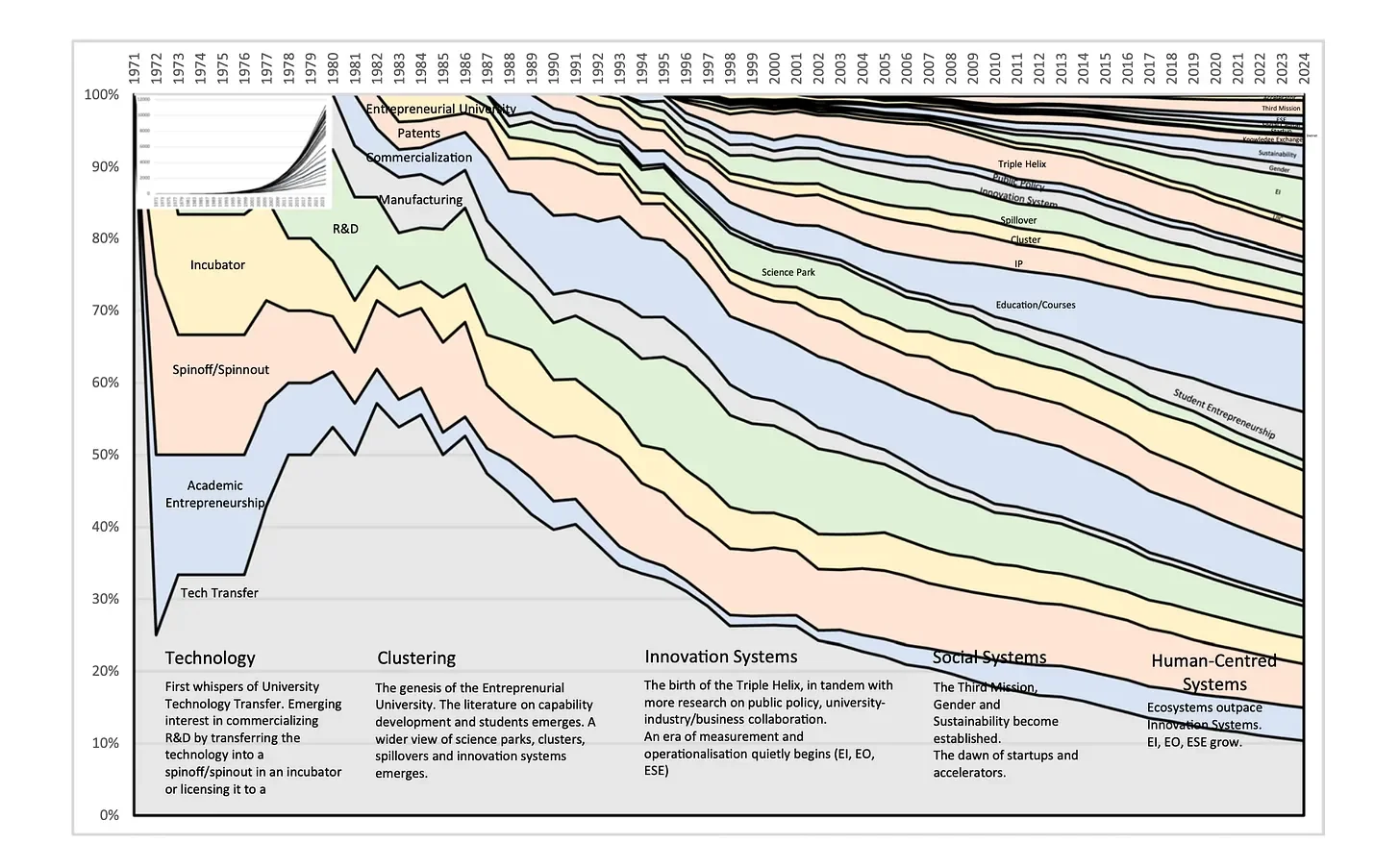
Writing in The Journal of Technology Transfer, Martin Bliemel analyses which keywords appear together across 5,857 articles from 1969 to 2024, finding 240 topics in seven themes. Research on the entrepreneurial university, he finds, has gone through five overlapping eras: technology transfer, clusters, innovation systems, social systems and human-centred systems.
Entrepreneurship education is now the largest area of focus, making up 12% of the literature, while technology transfer is at 11% and shrinking. The language has shifted from “transfer” towards “exchange” and “collaboration.”
Tellingly, the biggest gap in the literature is university administration, leadership and strategy, with no highly cited papers. As Bliemel puts it, this is “arguably the one area that drives (or constrains) the others.” He suspects much of universities’ entrepreneurial activity has emerged organically, or even “by accident,” and has “simply mushroomed in niches within the university on their own.”
From hundreds of conversations with entrepreneurs, universities and ecosystem builders, I’m convinced he is right. Despite some heroic exceptions, entrepreneurship is under-resourced and undervalued in most universities.
The Office for Students’ May 2026 report found 36% of English higher education providers were in deficit in 2024/25, forecast to rise to more than four in ten in 2025/26. Universities need to earn more beyond tuition fees and government grants, yet it is hard to be strategic when money is tight.
But focus, they must. Some researchers want to widen the concept, arguing that the entrepreneurial university needs to be replaced by a so-called “sustainable entrepreneurial university,” putting societal and environmental impact on a par with economic impact. Bliemel argues, convincingly, that the existing concept “remains perfectly adequate.” Its definitions have consistently centred on creating economic value and reducing reliance on government funding. Stretch it to cover sustainability and wellbeing, and the entrepreneurial university loses its distinctiveness.
Universities no longer have the luxury of leaving entrepreneurship to mushroom. They need hard strategic thinking — built on evidence of what works in university administration, leadership and strategy.
🛩️ Mann Virdee, Head of Science and Technology
I spent yesterday at Rolls-Royce in Derby learning how jet engines work and how they’re made.
I was there with this year’s cohort from the Foundation for Science and Technology, and saw the evolution from early piston aero-engines named after birds of prey (Eagle, Hawk, Kestrel, Merlin) to the more familiar gas turbines and jet engines named after rivers (Avon, Trent, Derwent, Nene).
Rolls-Royce began over lunch at Manchester’s Midland Hotel on 4 May 1904, when the electrical engineer Henry Edmunds introduced Charles Rolls to Henry Royce. Rolls soon agreed to sell every car Royce could make.
The two men could hardly have been more different. We were told how Royce sold newspapers at ten, and an aunt paid for his apprenticeship at the Great Northern Railway until her money ran out. By his own account, it gave him some skill as a mechanic but left him lacking commercial experience. By contrast, Rolls was an Eton- and Cambridge-educated aristocrat who ran a London showroom selling imported cars. A third man, the commercial managing director Claude Johnson, became known as ‘the hyphen in Rolls-Royce’.
We were told that developing a new engine used to take about 10,000 engineers three years. Today it takes 1,000, but still about three years. The future of innovation may involve a million ‘virtual engineers’ and just one day. With more founders using AI to go it alone, one might wonder whether a modern Royce would still need a Rolls.
A working paper from Seoul National University suggests it depends how far you want to go. Its authors studied more than 160,000 launches on Product Hunt, a website where founders unveil new apps and users vote for their favourites. After ChatGPT arrived in November 2022, average monthly launches by solo founders more than doubled, from about 1,300 to 2,800, while those by teams rose from about 350 to 540. Almost all solo launches were one-offs, never updated within a year.
But teams strengthened their hold at the top. They made up 53% of each day’s ten most popular launches, up from 50%. Product Hunt is software, not jet engines, and the authors caution against generalising to industries that need heavy investment. Still, they conclude that AI makes it easier to start a venture but not to build one, which depends on several people’s combined knowledge and experience. AI can stand in for a Rolls at the launch stage but it’s far less clear that it can replace the customers, connections and commitment he brought.
That matters most for young people, whose routes into employment have narrowed since 2022. Our new report with Sage, Starting Out and Starting Up (see Ian’s Big Idea below), finds that the share of working 16–24-year-olds who are self-employed has risen from 4.5% to 5.4%. But the Youth Futures Foundation has found that companies set up by young people with an older relative as a co-director survive longer than those they set up alone.
If AI inflates the number of one-off launches, counting how many young people start businesses might tell policymakers less than counting how many go on to build teams. AI may make it easier to be Royce without a Rolls, but that’s no guarantee of the kind of longevity that has made Rolls-Royce an engineering powerhouse.
🌱Ian Ng, Researcher
It has been a perfect storm for young people. Many will have been hoping for a bounce post-Covid, but so far the experience has been a supply-chain shock, a cost-of-living crisis and a weak job market coupled with uncertainties brought by AI. The number of young people not in education, employment or training (NEET) and economically inactive reached its highest level in the 21st century in Britain, and the Government is attempting to fix this, partly in a drive to bring down the welfare bill.
Much has been written about the double whammy of the real-terms increase in the National Living Wage and the rise in employer National Insurance contributions, both increasing the cost of hiring. While we are all for reducing the cost of hiring, we also believe that payroll employment is not the only viable route for young people, which brings us to Starting Out and Starting Up, our latest report on making self-employment a route into work for young people.
One of our policy recommendations is the creation of a £3,000 Youth Enterprise Grant, mirroring previous government schemes that supported self-employment in response to a weak labour market. The Enterprise Allowance Scheme in the 1980s paid unemployed people £40 a week for up to a year to start a business, supporting more than 325,000 people, including Creation Records founder Alan McGee and artist Tracey Emin. The Coalition Government revived the idea in the form of the New Enterprise Allowance (NEA), giving eligible benefit claimants a weekly allowance and business mentoring while they set up. Around 161,000 businesses were supported by the NEA over the decade, until the end of the scheme in 2022.
Annual costs of the NEA varied with uptake of the scheme, from £22.1 million in 2017/18 to £58.8 million in 2013/14. However, the Treasury could make long-term savings — our proposed grant would cost less than the amount paid annually to a Universal Credit claimant. As the Milburn Review found, the longer a young person is out of work, the harder it becomes to help them back. If the £3,000 Youth Jobs Grant paid to employers is worthwhile for getting young people into work, then the same should apply to supporting some young people to start a business and potentially go on to create jobs for others.
Labour pressed the then Conservative Government on the cessation of the NEA when in opposition; indeed, this was led by the current Business Secretary Jonathan Reynolds and Seema Malhotra, now a member of the Treasury Select Committee. Stephen Timms, now Minister for Social Security, spearheaded the Work and Pensions Committee’s call for the then Government to “develop a new self-employment support scheme”, saying that “starting a business could return [many people] to the labour market”.
Having made the case for self-employment support in opposition and on select committees, Labour is now in a position to act on it.