
By The Entrepreneurs Network, in partnership with Sage
Foreword by Steve Hare, CEO of Sage
Every business starts with a person.
Someone with an idea, a skill, or a belief that they can build something for themselves.
At Sage, we work with millions of small businesses around the world, and we see that entrepreneurial spirit every day. It comes from people of all ages and backgrounds. Some spot a gap in the market. Others turn a passion into a profession. Many simply want more control over their future.
This report tells the story of a growing group of those people: young people choosing to work for themselves. A new generation of solopreneurs.
People like Olivia Regan from Solihull. After leaving school without GCSEs, she started a cleaning business. Today, at just 23, she runs a growing company and is creating work for others. Or Christina Aaliyah from Newcastle. After training and working as a doctor, she made the decision to focus full-time on the business she had built helping other entrepreneurs grow online. Today, she works with clients around the world from a business she created herself.
Their stories may be different, but they share something important. They chose to create their own opportunities.
The research in this report shows they are not alone.
Using Sage payroll data, covering 111,700 businesses and 2.2 million payroll records, alongside ONS data, we found that traditional routes into employment have become more challenging for many young people. Yet at the same time, self-employment among 16 to 24-year-olds has reached its highest level in more than a decade.
That's an important shift.
For years, the focus of public policy has rightly been on helping young people find jobs. But this research raises another question; how can we help more young people create opportunities of their own, and, in turn, jobs for others?
Technology has an important role to play.
It is changing what it takes to start and run a business. Tools that once required significant time, money or specialist expertise are becoming more accessible, and AI can help entrepreneurs automate routine tasks, access expertise and reach new customers.
Of course, technology alone is not enough. People need skills, confidence, mentoring, access to finance and trusted tools that help them succeed. But technology and AI can remove barriers that might once have stood in the way.
That matters because the opportunity is significant.
Nearly one million young people in the UK are not currently in employment, education, or training. Cebr analysis suggests that helping even five per cent of those young people move into self-employment could create £4 billion of additional economic value by 2029.
Entrepreneurship will not be the right path for everyone. But for a growing number of young people, it is becoming an increasingly attractive and accessible route into work.
The challenge now is to ensure that more young people have the skills, confidence and support to take that route if they choose to – and to recognise entrepreneurship as an important part of the answer to the UK’s youth employment challenge.

I. Introduction
It has become increasingly difficult for young people to get on the job ladder. In January to March 2026, the number of young people not in education, employment or training (NEET) passed 1 million for the first time since 2013. The number who were NEET and economically inactive reached its highest level since comparable records began in 2001. By April to June 2026 the total was 981,000, or 13.0 per cent of 16–24 year-olds.
Vacancies fell to 702,000 in June to August 2026, below pre-pandemic levels, and the decline in vacancies falls disproportionately on sectors that traditionally provide first jobs, such as hospitality and retail. According to the IFS, hospitality employs 28% of all 18- to 20-year olds, and wholesale and retail 26%.
With starter vacancies falling by 49 per cent in the decade to 2025–26, one for every three young people were NEET by late 2025. Over a third of employers (36 per cent) reduced entry-level jobs for 16–24 year-olds in the past year.
Being economically inactive has a “scarring” impact on NEETs as they become more likely to be inactive in the later stages of their lifetime. The Milburn Review finds that 45 per cent of 24-year-olds who are NEET have never had a job, and that they could lose up to £300,000 in lifetime earnings even if they return to work. It puts the “cumulative annual cost” of almost a million NEET young people at £125 billion.
At the same time, more young people are working for themselves. The self-employment rate among 16–24 year-olds in work rose from 4.5 per cent in 2022/23 to 5.4 per cent in 2025/26, and around 193,000 are now self-employed, the highest level in more than a decade. The rise offsets around a fifth of the fall in young employees.
It coincides with the emergence and spread of generative AI tools, which have cut the cost and complexity of starting and running a business. The Milburn Review's own fieldwork met a young woman in Wrexham who taught herself to build a Shopify site and now runs a nails business from her bedroom. Yet government support for young people out of work is built around employee jobs, apprenticeships and training. The Youth Guarantee has no equivalent for a young person who wants to start a business. There has been no dedicated self-employment route since the New Enterprise Allowance closed in 2022.
The NEETs crisis has been ringing alarm bells in Westminster, with the Prime Minister making it a priority to tackle it. As Alan Milburn put it in his independent review, it’s not only an economic crisis, but also a moral one. The interim report noted that the NEET rate has fallen below 10 per cent only once in 25 years and called for a "whole system reset". While much of the response has focused on getting young people onto payrolls, we believe that a whole of system approach involves self-employment and entrepreneurship sitting alongside apprenticeships and graduate schemes, not merely as a niche or fallback option.
The impact on the Treasury purse could be significant if solopreneurship proves to be a viable route for NEETs. Moving only 5 per cent of NEET young people into self-employment between 2027 and 2029, could add around £4 billion to the economy by 2029, according to Cebr.
This report, produced in partnership with Sage, combines one of the UK’s largest private-sector payroll datasets, from Sage covering around 2.2 million employees and 111,700 UK businesses, alongside official ONS labour market data. The research provides a uniquely detailed picture of how young people’s routes into work are changing and makes three recommendations:
Pilot a Startup Allowance for under-25s, built around mentoring, so young people can test whether self-employment works for them.
Create a £3,000 Youth Enterprise Grant within the Youth Guarantee, matching the Youth Jobs Grant paid to employers, for young people on Universal Credit who start a business.
Launch a youth strand of Help to Grow focused on using AI to start and run a business.
II. Findings
Young people’s route into work has changed in three important and connected ways since 2022. The payroll route has narrowed, even as the wider workforce has grown. More young people are working for themselves, though not enough to replace the payroll jobs lost. At the same time, more are now outside work and education altogether; close to a million young people are currently not in education, employment or training (NEET).
Helping 5 per cent of these young people into self-employment would add an estimated £4 billion to the economy over the three years to 2029.
The findings draw on Cebr’s analysis of firm-level payroll data from Sage, covering up to 111,700 businesses, alongside official statistics. The ONS advises caution when comparing Labour Force Survey estimates over time and for detailed breakdowns. We therefore test survey findings against payroll records wherever we can.
1. The payroll route into work is narrowing
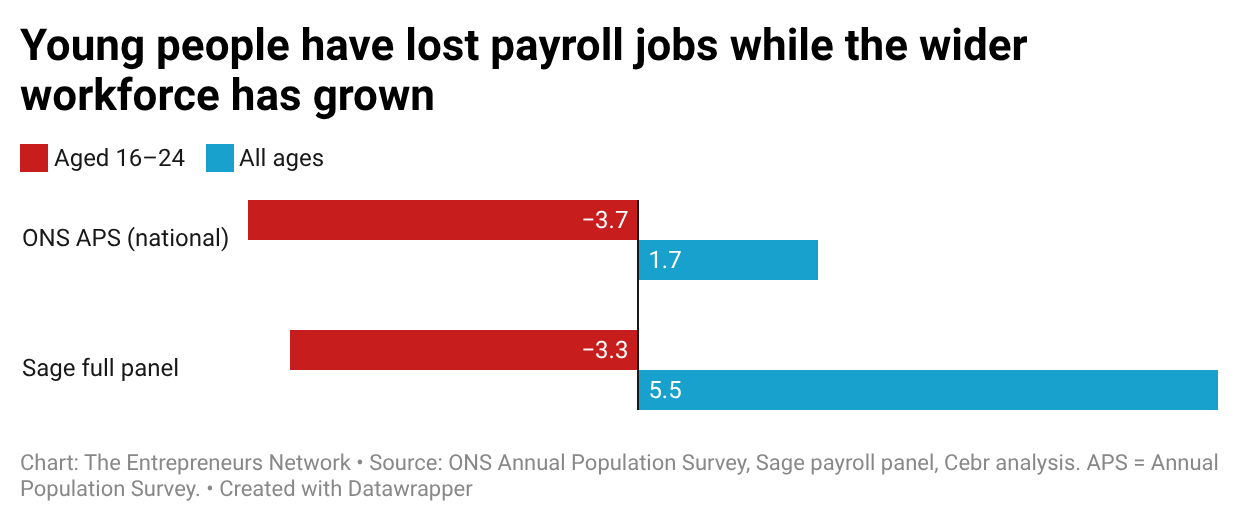
Fewer young people are in payroll jobs, even as the wider workforce has grown (Figure 1). The number of employees aged 16–24 fell by 129,200 between 2022/23 and 2025/26, a drop of 3.7 per cent. Over the same period the number of employees of all ages rose by 1.7 per cent, showing a ‘youth penalty’ of 5.4 percentage points.
Sage’s payroll data tells a similar story. Payroll employment of 16–24 year-olds fell by 3.3 per cent between 2022 and 2025, while all-age payroll employment across the same firms rose by 5.5 per cent.
Figure 1: Percentage change in the number of employees, 2022/23 to 2025/26 (ONS) and 2022 to 2025 (Sage)
HMRC payroll records show 25,000 fewer payrolled employees aged under 25 in June 2026 than a year earlier, while over the same year, the number aged 65 and over rose by 74,000.
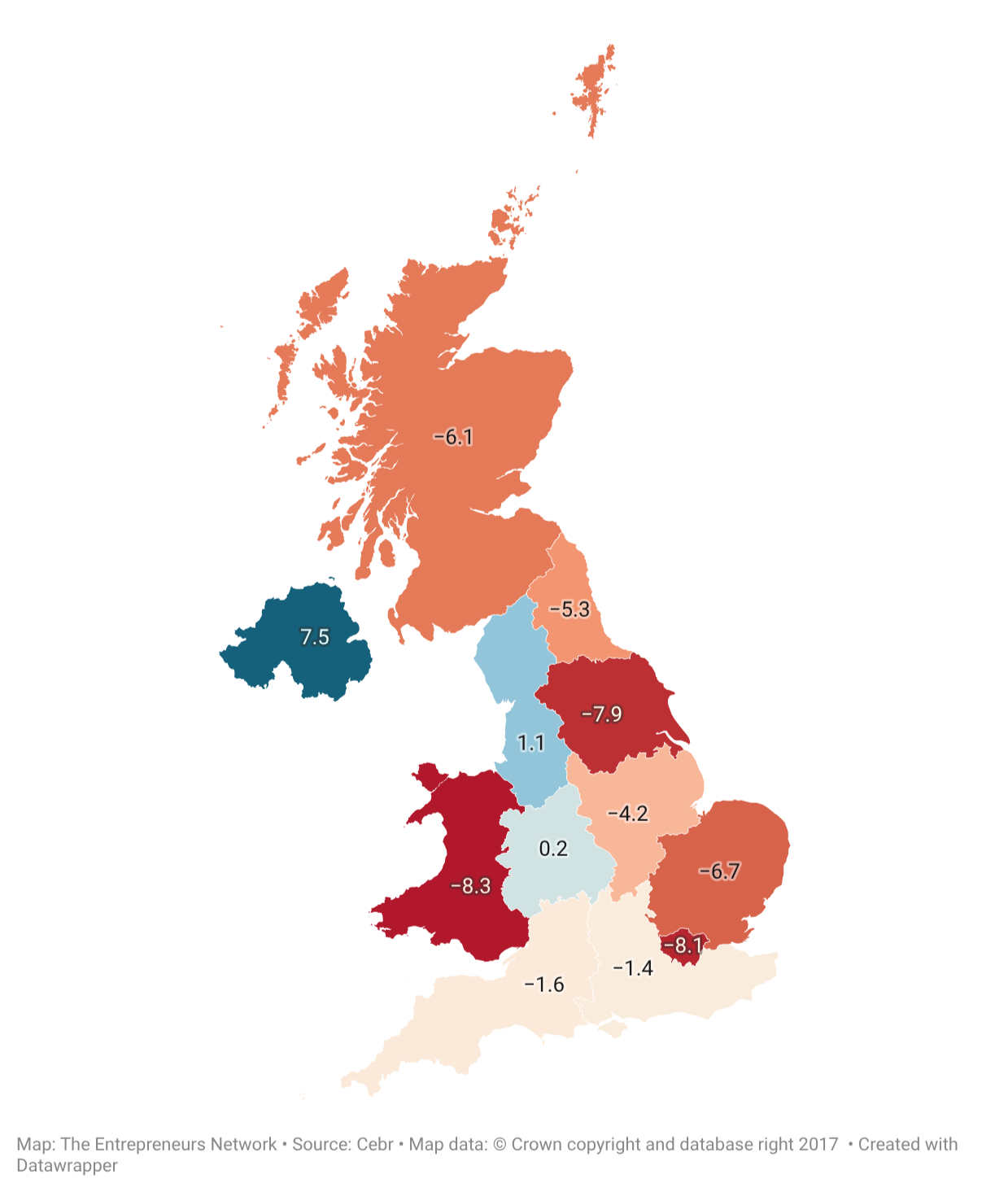
How is this change distributed across the UK? The number of young employees fell in nine of the twelve nations and regions (Figure 2). The steepest falls were in Wales (8.3 per cent), London (8.1 per cent) and Yorkshire and The Humber (7.9 per cent). London alone accounts for around a quarter of the UK’s net fall, while numbers rose in Northern Ireland (7.5 per cent) and the North West (1.1 per cent).
Figure 2: Change in the number of employees aged 16–24 by nation and region, per cent, 2022/23 to 2025/26
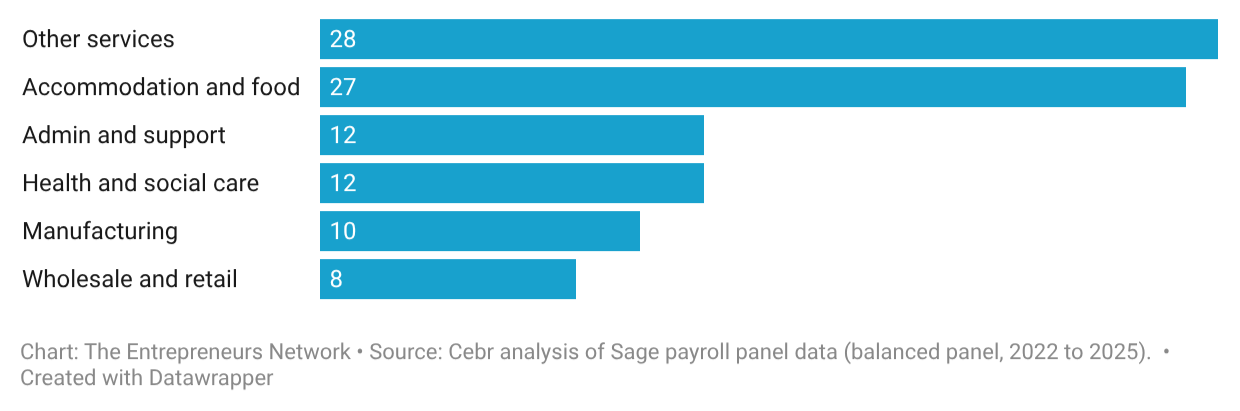
The fall in payrolled employment is concentrated in the sectors that give many young people their first experience of work. In Sage’s data, ‘other services’ and ‘accommodation and food,’ which is typically known as retail and hospitality, together account for 55 per cent of the fall in 16–24 payroll jobs. Six sector categories (Figure 3) account for 97 per cent.
Figure 3: Share of the total fall in 16–24 payroll jobs by sector, per cent, 2022 to 2025
By contrast, education, construction, professional services and arts and recreation all increased the share of their workforce aged 16–24. Cebr notes that these include sectors with formal training routes into work, such as construction and education.
Official payroll data show the same pressure on hospitality across the whole workforce. In the year to June 2026, accommodation and food service lost 79,000 payrolled employees, the largest fall of any sector.
The fall reflects fewer young people getting into work. The chance that an unemployed or economically inactive 16–24 year-old moves into an employee job within a year fell from 30.6 per cent in 2022–23 to 27.1 per cent in 2024–25. Cebr estimates this is equivalent to around 120,000 fewer young people entering payroll employment each year.
Sage’s data suggests the same. The largest effect was growth shifting towards firms that employ fewer young people, and firms also shifted their own workforces away from young people. Cebr links this to higher minimum wages and employer National Insurance contributions, which weigh most on firms that employ many young people.
Weak demand for new staff is also part of the explanation. Vacancies fell to 702,000 in June to August 2026, below pre-pandemic levels. Firms tend to freeze recruitment before they cut staff, meaning that new entrants are hit first.
2. More young people are working for themselves
Set against the backdrop of a fall in payroll jobs is the data showing that more young people are working for themselves. The self-employment rate among 16–24 year-olds in work rose from 4.5 per cent in 2022/23 to 5.4 per cent in 2025/26. The rise is statistically significant at the 95 per cent level.
Figure 4: Self-employment rate, per cent, among 16–24 year-olds between 2022/23 and 2025/26
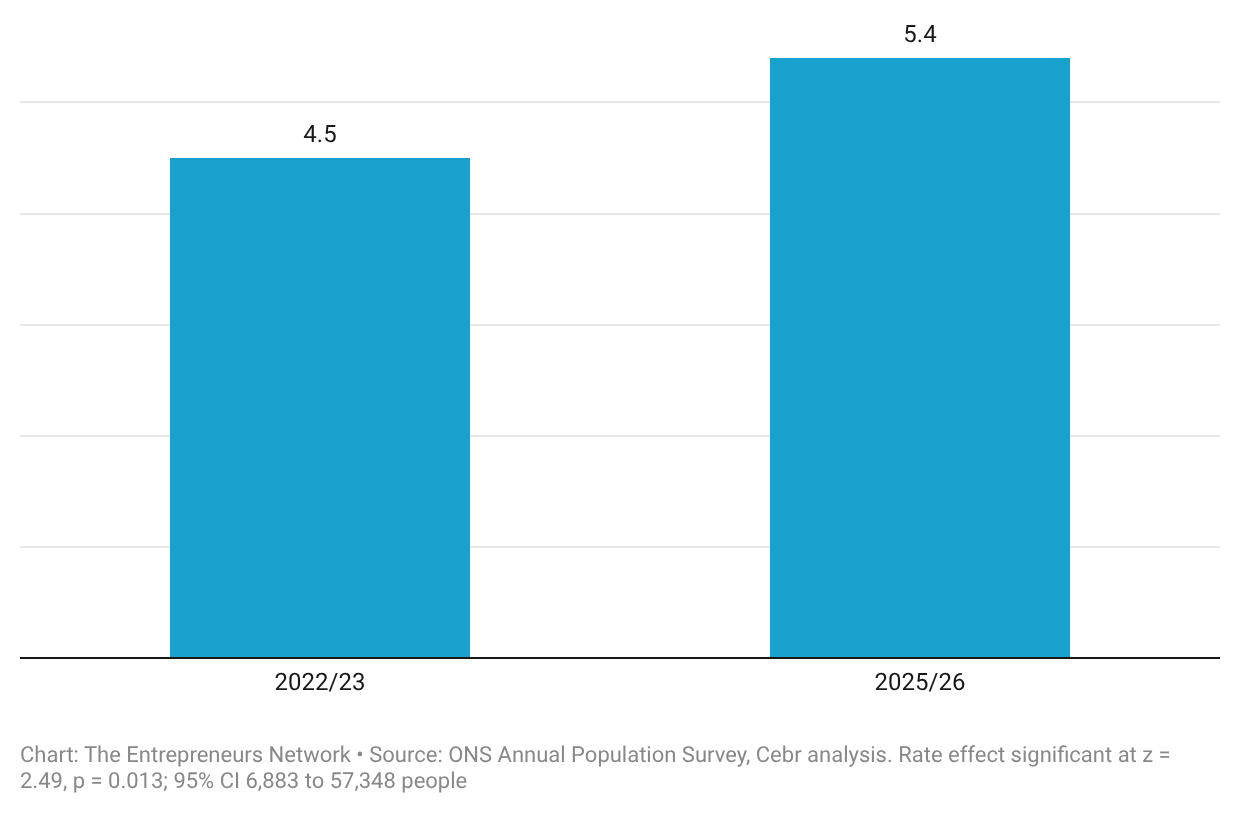
Around 193,000 young people are now self-employed, some 27,500 more than in 2022/23. However, as fewer young people are in work overall, the increase in numbers is smaller than the rise in the rate alone would suggest.
Self-employment has absorbed part, but only part, of the fall in payroll jobs. For every five fewer young employees, there is roughly one more young self-employed person. By our calculation, counting both, the number of young people in work fell by around 100,000.
The shift towards self-employment is spread across the UK. Eleven of the twelve nations and regions saw a move towards self-employment among young people. However, the regional samples are too small for any single region’s change to be statistically significant, so this is best understood as a national trend.
The data cannot say why more young people are becoming self-employed. For some, the shortage of payroll jobs will undoubtedly be a driver towards self-employment. Others, however, will be more drawn to the new opportunities opening up, including AI tools that have cut the cost and complexity of starting a business. Either way, more young people are relying on a route into work that government does little to support.
3. A small shift into self-employment could add £4 billion by 2029
Close to a million young people are NEET. In January to March 2026 the number passed 1 million for the first time since 2013. By April to June 2026 it had eased to 981,000, or 13.0 per cent of all 16–24 year-olds.
The share of young people who are NEET has been rising since 2021 (Figure 5). In January to March 2026, the number who were NEET and economically inactive reached its highest level since comparable records began in 2001. Youth unemployment has risen too: the rate for 16–24 year-olds was 16.4 per cent in May to July 2026, its highest since 2014.
Figure 5: People aged 16 to 24 years who are NEET, as a percentage of all people aged 16 to 24 years, by age, seasonally adjusted, UK, January to March 2019 to January to March 2026
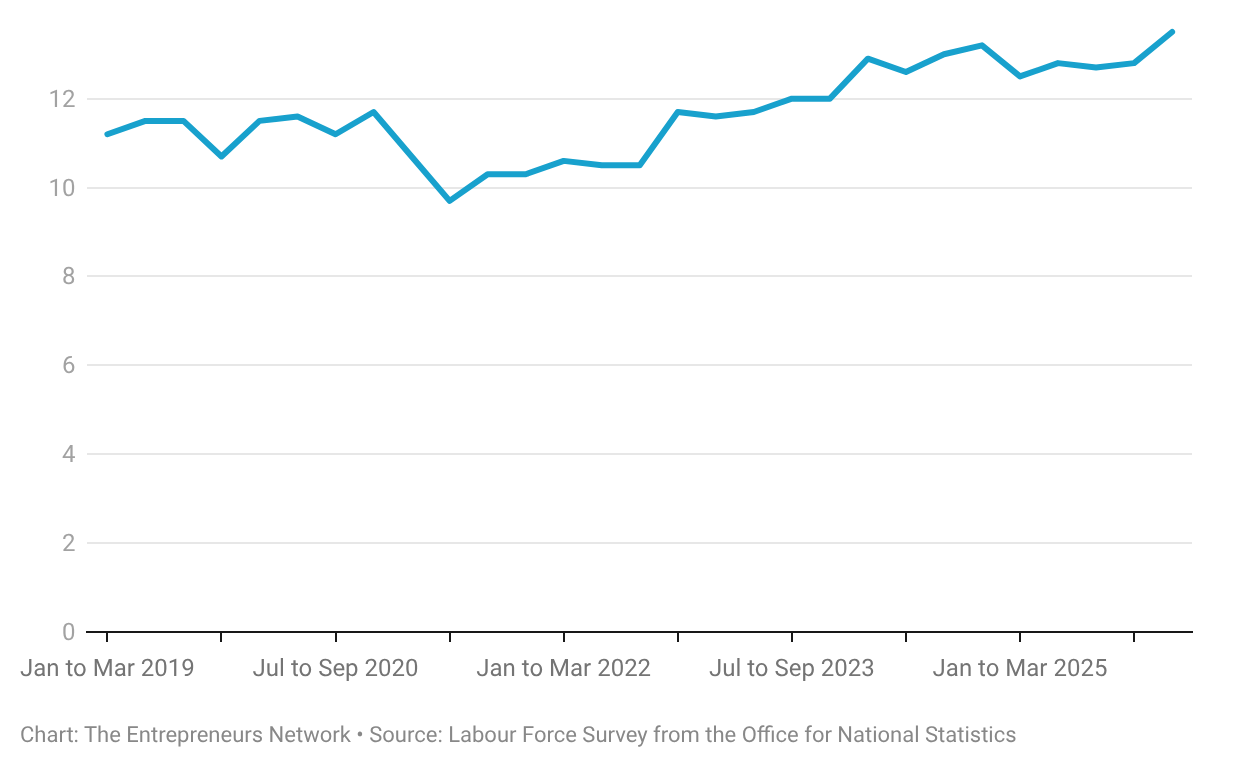
The Milburn Review’s interim report found many young people becoming detached from education and work altogether. Alongside rising risk factors at school and a lack of work experience, it pointed to 'fewer jobs that young people can realistically enter and build from'.
Most NEET young people are not looking for work. Of the 981,000 in April to June 2026, 393,000 were unemployed and 588,000 were economically inactive.
Cebr modelled what would happen if 5 per cent of NEET 16–24 year-olds moved into self-employment, phased evenly over 2027 to 2029. That means around 50,000 young people, or roughly 16,600 a year.
The output is valued using an estimate of gross value added (GVA) per worker built specifically for self-employed 16–24 year-olds. That estimate is £38,700 in 2026, rising to around £40,400 by 2029. On this basis, the scenario would add £4 billion to UK output over the three years to 2029, in 2024 prices.
The value builds quickly because each cohort keeps producing once it has started. The annual contribution triples over the period, from £650 million in 2027 to £2 billion in 2029.
Every nation and region would gain. Nine of the twelve would see more than £250 million, with London and the South East together accounting for around £1.2 billion (Figure 6). The regional split assumes today’s distribution of young self-employed people holds.
Figure 6: Cumulative additional GVA by nation and region, 2027 to 2029, £ million, 2024 prices
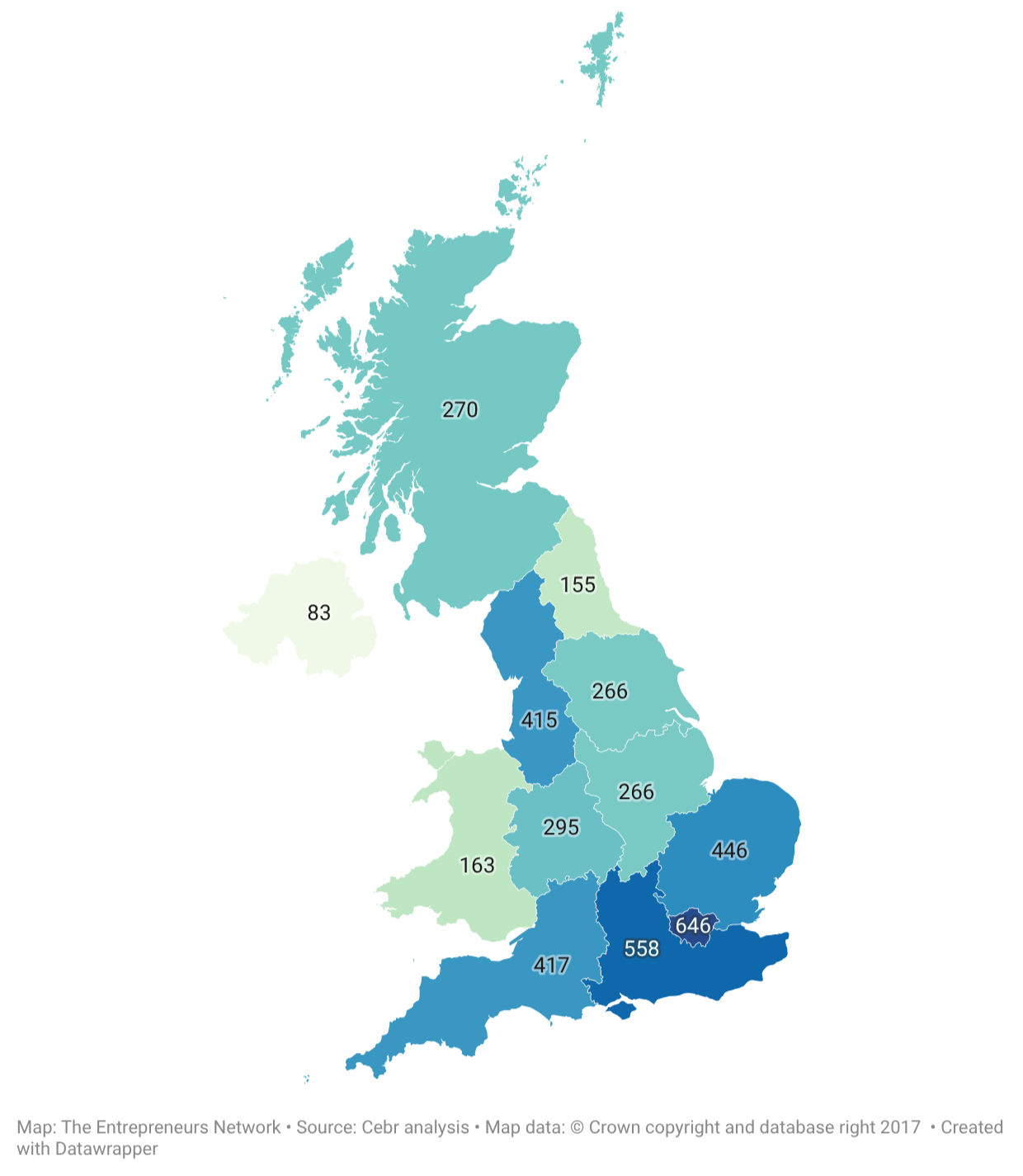
These are gross estimates. They assume each new business produces a full year’s output from its first year and survives the period. They make no allowance for displacement of other activity, so are best read as the size of the prize rather than a forecast.
The scenario is deliberately modest. It could be met entirely from the 393,000 NEET young people who are unemployed and looking for work (around one in eight of them over three years).
However, it would still need support on a larger scale than in the past. The New Enterprise Allowance helped around 157,000 people start businesses in roughly a decade, about 15,000 a year across all ages. Reaching 16,600 young people a year would need a dedicated route into self-employment, which our recommendations set out.
III. Policy Recommendations
As our findings show, the payroll route into work is far from guaranteed. Whether through opportunity or necessity, more young people are turning to self-employment, even though the government does little to support it.
The Youth Guarantee is the government’s main package for young people out of work, but it is built entirely around employee jobs. Under the Youth Jobs Grant, an employer receives £3,000 for taking on an eligible 18- to 24-year-old who has been on Universal Credit and looking for work for six months. The Jobs Guarantee gives those who have been on Universal Credit and looking for work for 18 months a fully funded job for six months, for up to 25 hours a week at the minimum wage for their age. There is no equivalent support for a young person who wants to create their own job through self-employment.
This isn’t the first time government has had to respond to a weak labour market, and it has used self-employment support to do so before. In the early 1980s, with unemployment above 11%, the Enterprise Allowance Scheme paid unemployed people £40 a week for up to a year to start a business, provided they had £1,000 of capital and a basic business plan. It supported more than 325,000 people, including Creation Records founder Alan McGee and the artist Tracey Emin. After the financial crisis, the government revived the idea as the New Enterprise Allowance (NEA), which gave eligible benefit claimants a weekly allowance and business mentoring while they set up. Official figures show around 161,000 businesses were set up through the NEA by December 2021, involving some 157,000 individuals.
With youth unemployment at its highest rate in more than a decade, and more than a million young people NEET earlier this year, it is time for government to offer young people the same kind of support.
Self-employment isn’t for everyone. For those it suits, our three recommendations would create a clear pathway into it, and some of the businesses started this way will go on to grow and employ others. The first recommendation helps young people test whether self-employment can work for them. The second backs their business once it is trading. The third helps both groups use AI tools to start and run their businesses.
Recommendation 1: Pilot a Startup Allowance for under-25s, with mentoring at its core
A young person with entrepreneurial ambitions often doesn’t know where to start. Universal Credit offers some protection: a claimant who starts a business can be given a start-up period of up to 12 months to focus on growing it. But it doesn’t offer advice on whether an idea can work or how to run a business.
Government should pilot a new Startup Allowance for under-25s, built around business mentoring. The mentoring should include practical help with digital and AI tools, linking to Recommendation 3. The pilot should be open to all young people who are NEET, not only those claiming Universal Credit.
The main design question is whether a weekly allowance is needed as well as mentoring. The NEA offered both, but its evaluations can’t show which element made the difference. The pilot should run two versions — mentoring alone, and mentoring with an allowance — to establish whether the allowance offers value for money. It should also test whether requiring an approved business plan before support begins improves outcomes enough to justify the extra hurdle, since that requirement could exclude the young people furthest from work.
If the allowance is kept, it should be time-limited and capped. That would keep it in proportion to existing support and address concerns about the welfare bill and about paying people who aren’t working. It should also be designed alongside Universal Credit’s self-employment rules, so that taking part doesn’t trigger a premature decision that someone is gainfully self-employed.
Recommendation 2: Create a £3,000 Youth Enterprise Grant within the Youth Guarantee
As well as supporting young people while they test an idea, government should back their business once it is ready to trade. A young person who creates their own job should receive the same £3,000 the Youth Jobs Grant gives an employer who creates one.
The grant should use the Youth Jobs Grant’s existing eligibility rules. It would be open to 18- to 24-year-olds who have been on Universal Credit and looking for work for six months, and who choose to start a business rather than take an employee job. Like the Youth Jobs Grant, it should be paid in two stages: £1,800 after six weeks of trading and £1,200 after 18 weeks. Registering as self-employed costs nothing, so each payment should depend on evidence that the business is trading.
Start Up Loans providers, or equivalent specialist organisations, could deliver the grant, so DWP wouldn’t need to build a new network. These providers already assess business plans and cash-flow forecasts. For the grant, they would assess whether the business is viable: is there a plausible customer, a realistic cost base and a route to revenue within six months? The assessment should be proportionate to a £3,000 award. It would also give the young person a relationship with an adviser from the start.
The grant must be kept separate from loan decisions. Receiving it shouldn’t depend on taking out a Start Up Loan or passing a credit and affordability check. Those checks could exclude the long-term Universal Credit claimants the grant is meant to reach.
Recommendation 3: Launch a Help to Grow programme for young founders, focused on AI
AI tools can now handle much of the business planning, admin, marketing and bookkeeping that once required a co-founder or paid support. That makes it far easier for a young person to start a business on their own, but only if they know which tools to use and how to use them well. It also means young people need business support earlier, often before they have a business at all.
Existing programmes don’t meet that need. Help to Grow: Management, the government’s flagship management training programme, is open only to senior decision-makers in businesses that employ between 5 and 249 people and have been trading for at least a year. Its free online version, Help to Grow: Management Essentials, has no eligibility criteria, but it is a short course of videos designed to help leaders of existing businesses think about growth. AI Skills Boost, the government’s partnership with industry, offers free online courses to every UK adult, but it teaches AI for use at work, such as drafting text, creating content and completing administrative tasks, not for starting a business. None of these is built for a young person starting a business from scratch.
Government should create a youth strand of Help to Grow focused on practical AI for starting and running a business: testing an idea, writing a business plan, finding customers, managing cash flow and keeping on top of tax and admin. It should draw on the AI Skills Boost model, bringing in technology companies to provide training and access to tools. The partnership already includes Accenture, Amazon, Barclays, BT, Google, IBM, Intuit, Microsoft, Sage, Salesforce and SAS. The programme should be open to participants in Recommendations 1 and 2, and to any young person thinking about starting a business. Its focus should be on using AI to start and run a business, not on generic AI skills.
IV. Case Studies
Olivia Regan, Managing Director of Crystal Clean

At just 23, Olivia Regan turned her cleaning skills into a fast-growing business after leaving school with no GCSEs. Using digital tools and AI to overcome common entrepreneurial challenges and create opportunities for herself and others. Although pricing, finances and day-to-day administrative tasks used to trip up first time entrepreneurs, the emergence of AI helped Olivia overcome these barriers that typically hold first-time entrepreneurs back.
From no GCSEs to building a growing business
After working in childcare, care work and an estate agency apprenticeship, Olivia became frustrated by a lack of opportunities for progression. Drawing on a skill she already had and genuinely enjoyed, she started Crystal Clean in 2024 — a cleaning business in Solihull, with no business plan and little knowledge of how to run a company.
Within a year, Crystal Clean had grown rapidly, with some months generating around £10,000 in revenue and supporting a team of freelancers. Today, the business is expanding into new commercial contracts.
Like many first-time entrepreneurs, Olivia faced challenges around pricing, managing finances and handling day-to-day admin. Digital tools and AI have played an important role in helping her navigate those challenges, from structuring pricing models by calculating the overall cost of each job to automating routine business tasks and business development.
Her story highlights how entrepreneurship can provide an alternative route to opportunity for young people who may struggle to find traditional employment or feel that conventional educational pathways are not the right fit for them.
Olivia Regan, Managing Director of Crystal Clean said: "I never imagined I'd end up running my own business, but AI has helped me understand the basics and grow with confidence. More young people should know that starting a business can be a real route into work.”
Dr Christina Aaliyah, Founder, Presell Studio

Dr Christina Aaliyah, founder of Presell Studio, left her career practicing medicine to become an AI-enabled solopreneur, using digital tools to build a thriving business with global clients, while helping others explore entrepreneurship as an alternative career path.
From NHS doctor to AI-enabled solopreneur
Like many young people, Christina believed success followed a set path: study hard, go to university, build a professional career. Determined and ambitious from a young age, she achieved her goal of qualifying as a doctor at the age of 23. While she found the work rewarding, the reality of life as a junior doctor proved challenging. Long hours and night shifts made it difficult to balance work with life.
During the Covid-19 pandemic, Christina started a blog as a creative outlet. Her hobby soon grew into a YouTube channel, then a side hustle, and eventually a platform that helped thousands of people. As her audience grew, so did opportunities to work with brands and develop new marketing skills. Recognising that her ability to build engaged online communities could help other businesses grow, Christina began supporting organisations with social media and marketing.
Encouraged by her family to take a chance on a new career, Christina decided to focus full-time on her business, Presell Studio, which helps business owners use YouTube to attract customers, build their profile and grow their business.
The transition was quicker than expected. Within just three months, Christina had matched her salary, giving her confidence that entrepreneurship could provide a sustainable and rewarding career path. Nine months on, she works with clients in the US and has built a business that has surpassed her expectations, supported by AI tools that help her operate efficiently as a solopreneur.
AI has been crucial to her success. Christina uses AI tools throughout her business, from identifying potential clients and conducting research to utilising specific skills to automate lead generation into a Notion dashboard, and employing note-taking devices during in-person meetings and calls. She has even created bespoke AI workflows to automate lead generation and uses virtual assistants, supported by AI, to scale her operations.
Today, Christina is exploring new ways to help others make the leap into entrepreneurship, including educational resources for people considering a move from traditional employment into running their own business.
Dr Christina Aaliyah said: "I qualified as a doctor and followed a traditional career path, but starting my own business opened up opportunities I hadn't considered before. AI gives me access to capabilities that would previously have required a team and has helped me build a business serving clients around the world."
V. Concluding Remarks
The payroll route into work is narrowing for young people. Since 2022/23 the number of employees aged 16–24 has fallen by 129,200, even as the wider workforce has grown. Close to a million young people are now outside work and education altogether, and the Milburn Review warns that, without change, that could pass 1.25 million within five years.
At the same time, more young people are creating their own jobs. Around 193,000 young people are now self-employed, 27,500 more than in 2022/23, and AI tools have made starting a business cheaper and simpler. Yet government support for young people out of work is still built around employee jobs.
A young person who creates their own job should get the same backing as an employer who creates one. Our recommendations would give them a clear route. A Startup Allowance pilot to test an idea, a youth strand of Help to Grow to build practical AI skills and a £3,000 Youth Enterprise Grant once a business is trading.
Self-employment will not suit every young person, and it is no substitute for employers hiring young people. For those it suits, it can be a first step into work, and some of the businesses they start will go on to employ others.
The prize is substantial. Helping 5 per cent of NEET young people into self-employment would add an estimated £4 billion to the economy by 2029. With the Milburn Review’s final report due this autumn and the Budget approaching, government has the chance to act.
An apprenticeship, a graduate scheme and a first job are all recognised routes into work. Starting a business should be one too.
Methodology
This research was conducted by the Centre for Economics and Business Research (Cebr) on behalf of Sage in September 2026. The analysis combines official Office for National Statistics (ONS) data with Sage’s anonymised proprietary payroll data covering 111,700 UK businesses between 2022-2025.
The findings draw on multiple ONS datasets, including the Annual Population Survey, Labour Force Survey and NEET statistics, alongside 2.2 million anonymised Sage payroll records. Sector-level analysis is based on a balanced panel of approximately 111,700 firms with headcounts between 1 and 3,121.
To ensure a like-for-like comparison over time, the analysis tracks the same sample of businesses throughout the study period, removing distortions from firms entering or leaving the dataset and providing a clearer view of changes in youth employment among consistent employers.