



"It Is Serious"

The role of any good think tank or business group is to speak frankly to whoever is in Government. As many of you will already know, we’re asking entrepreneurs to sign a letter to the Chancellor following reports that she is considering hiking Capital Gains Tax (CGT) and further restricting Business Asset Disposal Relief (BADR) in the forthcoming Budget.

If you are a founder, you can read and sign our letter here. Whoever you are, please share it far and wide: email, WhatsApp or Slack groups, social media, carrier pigeon etc. The more, the mightier.

In essence, it argues that restricting BADR or hiking CGT rates would jeopardise the success of Britain’s startup ecosystem by enormously weakening the incentive individuals have to start and build businesses. It would also reduce the incentive for startups to offer employee stock options or shares, making it even harder for startups to attract the talent they need to scale.

Any revenue it might raise in the short term would be more than offset by the damage it does to long-run productivity by stifling the growth of future startups.

Below is the letter in full so you can circulate it among your own networks. Previous letters we have coordinated have garnered a lot of support and made a real difference to policy (see here, here, here, here, here, and here). This one has already been signed by over 200 entrepreneurs, including more than a few household names, but we’d like to get even more signatures.

The stakes are high. According to Evelyn Partners, one in three business owners are fast-tracking sales as capital gains raid looms. This is a response (included anonymously with permission) from a foreign-born founder in our network who started his deep tech business in the UK and has raised millions: "Not gonna lie, in my circles people are not signing letters, they are already moving country. Even *discussing* increasing CGT was enough. I know founders who have left the UK only for this reason since the election. I don’t go on record on this but it is serious."

I respectfully disagree that it’s not worth signing letters. We have shifted policy in the past with your help. But I regretfully agree that it is serious.

If you didn’t get my email about this letter, sign up here. Any journalists who want to get in touch about this should drop me email.

The Letter
Dear Chancellor,

Entrepreneurs represent a uniquely important segment of any country’s economy – but especially our own. Britain can rightly claim to be one of the best countries in the world to start and scale a business, and that reputation has been carefully earned over recent decades.

The risks entrepreneurs take in striking out and starting new and innovative companies are essential to moving the economy forward. From startups developing solutions to the climate crisis to those working to revolutionise healthcare, entrepreneurs not only create businesses that provide good, high-paid jobs, they also generate taxes to pay for public services and help tackle pressing social issues too.

At the last general election, many entrepreneurs put their faith in what they recognised was a changed Labour Party – heartened by statements you made about being the party of wealth creation and your promise to give investors the certainty they need to fuel growth. Reporting in the lead up to the Autumn Budget, however, has given many in Britain’s thriving entrepreneurial community pause for thought.

Chief among our concerns are the rumoured restrictions to Business Asset Disposal Relief (BADR) and rise in the rate of Capital Gains Tax (CGT). According to The Guardian, your officials have modelled the impact of increasing CGT as high as 33% to 39%. Higher CGT or any restrictions on BADR would make this relief less competitive at a time when the rest of the world is making their reliefs more competitive. It would mean the UK has the second-highest CGT rate in Europe, and jeopardise the success of our country’s startup ecosystem by enormously weakening the incentive individuals have to build businesses. Reporting by The Telegraph gives us some hope that the 39% figure may not be on the table – but businesses need clear and definitive reassurances right now.

This applies as much to British entrepreneurs as it does to founders from abroad who currently view Britain as an attractive destination in which to base their company – previous research from The Entrepreneurs Network revealed that four out of ten of Britain’s fastest-growing companies had a foreign-born founder or co-founder.

Many fledgling startups offer employees stock options or shares as part of their compensation package as they cannot compete with the higher salaries of established big corporates. Further restrictions to BADR would reduce this incentive, making it even harder for startups to attract the talent they need to scale while denying workers the chance to own a piece of Britain's growing companies.

Policymakers should also understand that entrepreneurship is an engine for further economic growth. By discouraging entrepreneurs from starting and growing their businesses, HM Treasury could well end up lowering the tax take overall. Indeed, this is what its own previous modelling suggests. Leading economists are also much more likely to agree than disagree that taxing capital income at a permanently lower rate than labour income would result in higher average long-term prosperity.

Given the straitened public finances it is understandable to leave no stone unturned when looking to balance the books. However, any temptation to rapidly and radically hike CGT should be resisted. Any revenue it might raise in the short term would likely be more than offset by the damage it does to long-run productivity by stifling the growth of future startups.

Our hard-fought reputation as a place where entrepreneurs can successfully build a business has been one of Britain’s economic saving graces. We, the undersigned, urge you to ensure our CGT regime remains competitive and encouraging for founders wanting to get Britain growing again.

You can sign it here.

Lunch & Learn
Our good friends at Enterprise Nation have secured the Small Business Minister, Gareth Thomas MP, for their highly recommended Lunch and Learn series. The session will take place online on 13th November from 1pm to 1.30pm. To register for the free event, please click here.

Education, Education, Recommendations
Our other good friends at Youth Business International (YBI) and Global Entrepreneurship Network (GEN) have launched a comprehensive Youth Entrepreneurship Framework. The framework brings a fresh perspective on harnessing the opportunity of youth entrepreneurship. It includes 50 actionable recommendations, with each recommendation tied to a case study in GEN’s Atlas – the world’s largest compendium of entrepreneurship policies.

Three Big Ideas #05

⚡️ Anastasia Bektimirova, Researcher

Ask an investor about the differences between British and US founders, and you’ll likely hear a familiar narrative about the deficit of ambition. They’ll tell you that British startups are not going after big markets, seek an early exit, or are pitching cautious rather than boldly optimistic sales numbers. In a recent World of DaaS podcast interview, when asked what conventional wisdom or advice he thinks is generally bad, Matt Clifford (Entrepreneur First co-founder and ARIA Chair) replied:

“There's a very annoying thing that happens in Europe. A lot of entrepreneurs get advice like ‘that’s a good idea, but do something just a little bit less ambitious because then you're more likely to succeed.’ A lot of people have an intuition that there should be an inverse correlation between odds of success and ambition – if you're trying to do something really hard, you're less likely to succeed. But it is much easier to succeed by being more ambitious, because in the end, it comes down to: can you attract talent and can you attract capital? Guess what? They're attracted to ambition. I think that intuition is just wrong and it gets amplified into very bad advice.”

This has made me wonder why founders don’t know better by default: what mechanisms might be at work here, and where else they might be restraining ambition. While not every founder is university-educated, the academic environment does play a role in shaping the mindset and ambition levels for those who are. From undergraduate to doctoral dissertations, filling a “gap in the literature”, no matter how incremental, is prized; supervisors encourage students to aim at “feasible” research above all, instead of letting their ambition roam while their work is still insulated from the pressure of the market or specific grants. This might be pronounced in some disciplines more than in others, affecting the impact we see from research in different fields and its commercialisation potential. It’s not hard to spot the same logic in education even earlier than university. 

Reflecting on a year spent in the Bay Area, Alice Bentinck (Entrepreneur First co-founder) gives a mindset-rewiring steer which, I believe, applies to science as much as to entrepreneurship:

“The remedy isn’t an over-hyped slide that you don’t believe. The remedy is to ask yourself ‘what’s the most ambitious target we think we could achieve and then what would it take to get there?’. Pitch that.”

📦 Eamonn Ives, Research Director

In American politics, an ‘October Surprise’ refers to an unexpected event that occurs in the month prior to the presidential election, and that threatens to hurt the chances of one of the candidates. On 1 October, a strike called by the International Longshoremen’s Association looked like it could prove to be one for Kamala Harris – if it meant supply chains getting gummed up and inflation taking off again. 

One of the demands made by the striking workers was a ban on automation at US ports. You might imagine this would be a straightforward hammerblow to productivity, but a fascinating post by Brian Potter suggests the impact could well be more nuanced. It also got me wondering, how productive are British ports? 

Data from the World Bank’s Container Port Performance Index don’t make for pretty reading. Of the British ports it considers, only two – London and Southampton – feature in the top quartile, at 76th and 93rd out of 405 respectively. Every other port ranks deep into the triple digits – Felixstowe is 174th, Teesport 224th, Grangemouth 264th, Liverpool 293rd, Greenock 346th and, last of all, Bristol, coming in at a dismal 368th. These lowly figures mean a typical British port on the index would rank 230th – somewhat lower than the global average.

Economists have known for centuries how important international trade is for the economy, and the critical role exporting can play as a way of boosting productivity within individual firms. Previous research we’ve published has highlighted the pains entrepreneurs face when it comes to selling goods abroad. While it might not trigger an economic miracle, it wouldn’t hurt to nudge the performance of our ports up slightly. 

💡 Philip Salter, Founder

My Big Idea for this week comes courtesy of our Adviser Francis Toye, founder of Unilink Software. He shared a Paul Graham's article from September on Founder Mode to get my thoughts.

In the September article, Graham shares the insights of Brian Chesky, CEO of Airbnb:

“As Airbnb grew, well-meaning people advised him that he had to run the company in a certain way for it to scale. Their advice could be optimistically summarized as ‘hire good people and give them room to do their jobs.’ He followed this advice and the results were disastrous.”

Chesky turned to Steve Jobs for inspiration. One thing Graham pulls out is that Jobs used to run an annual retreat for what he considered to be the 100 most important people at Apple. Critically, these weren’t the 100 people highest on the org chart: “It could make a big company feel like a startup,” suggests Graham.

As Graham acknowledges, clearly things need to change as a company scales. And there is a risk that a lot of bad management could be excused as “founder mode”. As Toye wrote to me:

"Extreme Founder Mode has obvious disadvantages: lack of delegation, micromanagement, high staff turnover, reliance on one individual etc., but on the other hand many corporate managers, however well intentioned and experienced, do not have the background to take a founder-led company into a successful growing business."

We still don’t fully understand what defines a great founder or when – and if – a company should transition to being run like a large organisation. Given the rising power of founder-led companies, getting this right (or wrong) could have huge implications for the rate of global innovation and the quality of all our lives.

A Nobel Truth

On Wednesday, Keir Starmer will have his first meeting as Prime Minister with Ursula von der Leyen, the President of the European Commission. Top of the President’s agenda is negotiating a youth mobility scheme between the UK and EU. It’s top, not necessarily because it’s the most important thing, but because it’s an obvious win-win and a test to prod Starmer on his commitment to building a closer relationship.

Immigration has been top of my own mind over the last few weeks too. I spoke on the topic at both the Labour and Conservatives Party Conferences.

As well as my familiar schtick about immigrants being behind 39% of the UK’s fastest-growing businesses and our suite of policy recommendations, I argued that while immigration and upskilling the domestic workforce are two sides of the same coin, they require very different policy levers to get right.

On skills, while the Government is more or less on the correct track in announcing an expert-led review of curriculum and assessment and it’s commitment to replace the apprenticeship levy with a more flexible Growth and Skills Levy (with the caveat that there will be a higher potential for deadweight costs), its reliance on trying to plug skills gaps from the centre through the Migration Advisory Committee (MAC) and Skills England is destined to fail.

The data simply isn’t there to make accurate decisions, nor are any of the functions of the state anywhere near quick enough to respond. This is Hayek’s local knowledge problem writ large, and it’s why free movement – even if limited to the young – beats central planning.

It was Margaret Thatcher who famously grabbed her copy of Hayek’s Constitution of Liberty from her handbag, slammed it down on the table and declared, “This is what we believe.” Those on the other side of politics can learn a thing or two from the Nobel Prize winner without subscribing to everything he believed. After all, Hayek literally wrote a paper called Why I Am Not a Conservative.

It was only four years ago that Keir Starmer said: “We welcome migrants, we don’t scapegoat them. Low wages, poor housing, poor public services, are not the fault of people who come here: they’re political failure. So we have to make the case for the benefits of migration; for the benefits of free movement.”

While times change, economic truths don’t.

SHAPE of Things
Over on our Substack, Anastasia has written up a fascinating interview with ARC Accelerator Co-Founder and Director Chris Fellingham on the commercialisation potential of social sciences, arts and humanities – or what The British Academy calls SHAPE (Social sciences, Humanities and Arts for People and the Economy).

ARC was founded in 2020 and now supports over 45 universities in an ICURe-like commercialisation programme specifically for researchers in social science, arts and humanities. There are lots of great examples cited, but as someone who studied history I’ll point you towards HistoryCity, which was founded by historians from the University of Exeter. They offer immersive trails in European cities and have partnered with organisations like the National Trust and museums to bring the past very much into the present.

For those interested, I would recommend reading the article in full, or at least skimming Anastasia’s X thread. As she says: “Social scientists have deep insights and answers to many pressing issues. If that can’t be translated into solutions, something must be broken or underbuilt.”

Also, in case you missed it, we put out another issue of our weekly Three Big Ideas roundup – on the demise of coal, priorities for growth, and letting a thousand Beatles bloom.

Join Us
As you’ll see, we have a lot coming up. While a fair amount of it is open to anyone – e.g. if you’re an angel investor in Scotland you’ll be accepted onto next week’s Edinburgh roundtable, others will be filled by those who go above and beyond in their support for us.

The more support we get, the more we are able to help entrepreneurs in the UK – including more events that are open for everyone. Now is the time to get on board. Sign up here or book a call with me to find out more.

Interview: SHAPE Shifters

For our latest interview, Anastasia Bektimirova sat down with Chris Fellingham, Co-Founder of ARC Accelerator, to chat about the commercialisation potential of research by academics in social sciences, arts and humanities.

They discussed:

  • How ARC Accelerator came about and what gaps in research commercialisation landscape it fills

  • Challenges of telling the impact story of SHAPE-based ventures

  • The differences between STEM and SHAPE commercialisation

  • SHAPE-based company archetypes, business models, and success stories

  • Commercialisation potential of pure versus computational social science and digital humanities

  • What it would take for SHAPE ventures to become VC-backable, and what high-risk high-reward work looks like in this space

  • How we can get more SHAPE commercialisation, and with greater impact

Three Big Ideas #04

🪨 Eamonn Ives, Research Director

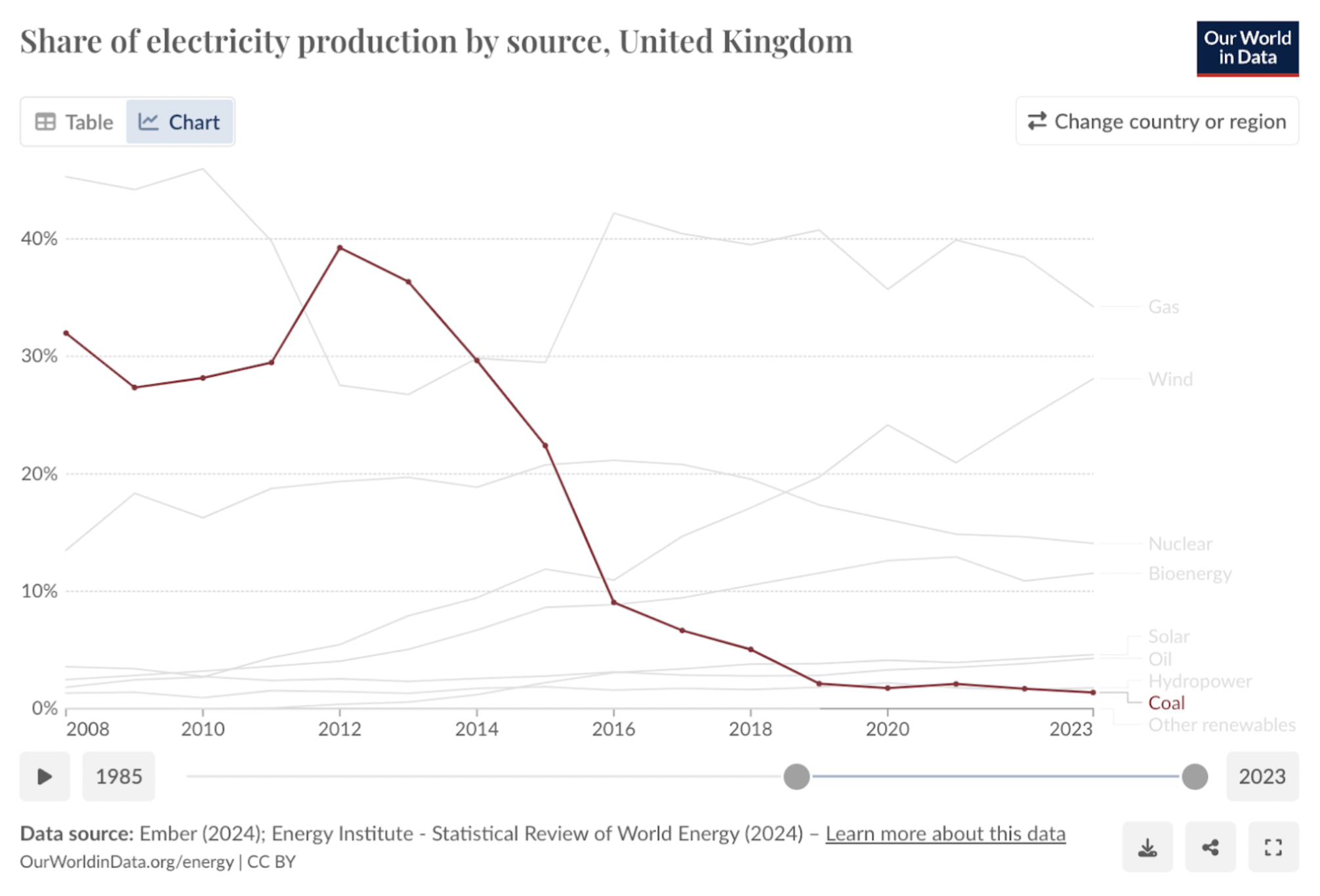
The year is 1882 – Queen Victoria marks her 45th year as reigning monarch, William Gladstone is enjoying his second of four terms in Downing Street, and, at 57 Holborn Viaduct in London, the world’s first coal-fired power station is sputtering into life. One hundred forty-two years – and 4.6 billion tonnes of coal – later, no more electricity will ever be generated from the dirty fossil fuel in Britain again. At 3pm on Monday 30th September, the last remaining coal-fired power station, Ratcliffe-on-Soar, was desynced from the grid.

Different reasons explain the demise of coal in Britain. There was legislative pressure, which placed limits on how polluting power stations could be – limits which coal struggled to comply with. Meanwhile, the rise of renewables ensured there were alternative ways to generate the electricity consumers demanded. But perhaps the killer reason was price. From 2013, a carbon price has been applied to the power sector, which levies a tax per tonne of carbon dioxide generated. Coal-fired power stations became increasingly uneconomical – going from producing 40% of Britain’s electricity in 2012 to just 10% in 2016.

Source: Our World in Data

Economists have long advocated the use of price signals as a way to efficiently and effectively achieve policy objectives. Britain’s rapid transition away from coal seems to vindicate them pretty comprehensively. As we look towards cracking other stubborn issues – from congested roads to decarbonising agriculture – the current government should be minded to learn the lessons of the past, recognise the power of prices to incentivise desired outcomes.

📊 David Lawrence, Co-Director, UK Day One

Keir Starmer says his new government’s ‘number one’ priority is growth. We at UK Day One wanted to take him at his word, so we asked 44 pro-growth economists, think tankers and experts to share their views on what Labour’s priorities should be. 

Far at the top of the list was planning reform. However, respondents largely insisted that the growth impact will depend on building housing and infrastructure in or near existing areas of high productivity, particularly London and the Southeast.

Following this was investment in nuclear energy, to bring down energy costs. These are viewed by some as the main driver of Europe’s economic ills vis à vis the US, and bolstering electricity supply is particularly important given rising demand for electricity arising from heat pumps, electric vehicles and AI data centres. Nuclear is also favoured due to its supply of continuous baseload power, which is essential for industry. Interestingly, respondents were more divided about whether the UK should increase investment in non-nuclear renewable energy – and the UK’s ‘green tech potential’ was generally deemed ‘highly overrated’, despite the current government’s prioritisation of green jobs. 

In what will surprise some, another idea that was viewed as ‘overrated’ was access to capital for startups. Where capital is in short supply, as one respondent put it, is more because of “underlying issues making it difficult to create profitable opportunities here with which to generate returns.” Fixing these could prove to be more effective than tinkering with pensions reforms.  

With the Budget just three weeks away, Rachel Reeves’ first meaningful opportunity to shape Britain’s economy is fast approaching. Our survey findings – which you can read in full here – provide a plan for her to build on. 

💫 Philip Salter, Founder

“[W]e should be taking more chances on quite young people, giving them more authority,” Tyler Cowen declares on the excellent Institute for Progress’ Metascience 101 podcast, the latest episode of which looks at how to better fund scientific innovation. 

Tyler adds, “when you think of young people running things – well, who ran the Beatles? There was George Martin and Brian Epstein, but the Beatles ran the Beatles. Paul McCartney had to figure out the recording studio. We don’t call that science, but that was an extremely difficult scientific project that had never been done before. And this guy, who hadn’t gone to college, at age 23 starts figuring it out and becomes a master.”

It’s not just music. The next generation can bring a fresh approach to tackling the world’s most pressing problems, something we’ve consistently argued for at The Entrepreneurs Network. And, as with musicians, though not everyone will become great, a great entrepreneur can come from anywhere (to misquote Anton Ego in Ratatouille). That’s why we’re supportive of organisations like the Junior Achievement, VIVITA, Young Enterprise and the Prince’s Trust who aim to imbue young people with the skills to lead.

Three Big Ideas #4

Three Big Ideas is our weekly roundup of ideas (and our takes on them) in entrepreneurship, innovation, science and technology, handpicked by the team.

In this week, Eamonn Ives explains how coal-fired power was phased out in Britain, Philip Salter writes about the importance of empowering youth entrepreneurship, and guest contributor David Lawrence discusses the results of a survey on priorities for economic growth run by UK Day One.

Angels Advocate

This week I’m opening with a request. If you’re an angel investor who backs female founders, or you’re actively interested in becoming an angel investor, or a female entrepreneur backed by angels, we have a unique opportunity for you to feed into the Government’s Invest in Women Taskforce, co-chaired by multi-exit entrepreneur Debbie Wosskow and Barclays’ Business CEO Hannah Bernard, and backed by the Chancellor Rachel Reeves.

Over the next few weeks, we’re hosting roundtables with Barclays in Newcastle, Edinburgh, Birmingham, Belfast and London. This really is a chance to have your say on policy, get quoted in the report or feature as a case study (or input off-the-record if you prefer), as well as meet like-minded people in your area.

We want to share this opportunity far and wide so we get the very best and diverse insights. Therefore, before you read any further, sign up for an event or forward this email to anyone in your network who might be interested – the more the merrier. Additionally, you can reshare my LinkedIn post, our tweet, or get it out to the great and good through your channels.

We take this topic very seriously. We were the first organisation in Britain to reveal the equity funding gap; we helped launch the Rose Review; and alongside Barclays have been campaigning for policies to support female entrepreneurship through the Female Founders Forum for over a decade.  

We’re also scoping out doing something in Wales (either in person or virtually), so if you’re interested in that or have any questions about these events, drop us an email.

Pepper Questions
Another week, another three big ideas landed on our Substack. While Eamonn wrote about the lessons of US overregulation of Sichuan Pepper and Anastasia opined on the UN’s AI governance efforts, I pointed people towards what might well be this year’s most influential essay on British politics: Foundations.

It’s worth amplifying the alarm raised in the essay that by making it so hard to build, Britain is sabotaging its leadership in the technologies of the new industrial revolution (sorry, despite claims to the contrary, this will be the second not fourth).

But it’s not just AI and biotech. As Foundations states: “Britain’s strongest industries are creative and intangible, and yet we blocked a £750 million film studio by a dual carriageway, right by the UK’s strongest film cluster. Britain is the most advanced country, per capita, in artificial intelligence, but we blocked a £2.5 billion ‘super hub’ data centre site by the M25. Top talent from around the world flocks to work in biotech in Cambridge, yet we have starved the sector of lab space – under one percent of Cambridge lab space is vacant. Prime city centre office space and labs there are renting for even more than residential property.”

RIO ROI
Adviser to the network Ben Greenstone has co-written an excellent report on how regulation is suffocating startups. Igniting Innovation makes for brutal reading. As Ben’s thread on X explains, the Food Standards Agency has approved just 14% of requests since 2021, the Financial Conduct Authority hit just two-thirds of its targets, while the Civil Aviation Authority has yet to authorise out-of-sight drone flights, even though the US and Japan did so two years ago.

There is a great deal of ruin in our regulatory state: Space Forge, the British aerospace manufacturing company headquartered in Cardiff, had to consult eleven different regulators to launch, while an AI legal startup must navigate at least six different regulators to get approval.

The new Regulatory Innovation Office (RIO) might help with some of the regulatory burden. We’re certainly keeping an eye on it. The report recommends it should be given powers to compel regulators to coordinate on emerging technologies, which would certainly be a step in the right direction. I’d be minded to go a step further, and follow John Fingleton’s suggestion to create an N+1 regulator that could give licences to disruptive entrants across the entire economy.

Well Spent
Labour done. Just the Conservative Party conference to go. If you’re there on Monday, I’ll be on a panel with Karim Fatehi MBE (London Chamber of Commerce and Industry), Shuyeb Muquit (Fragomen), Jonathan Thomas (Social Market Foundation) and Heather Rolfe (British Future). We’ll be chatting about the UK’s current immigration system. I’ll be drawing on much of our recent work, including Eamonn’s latest article on the case for increasing youth mobility.

Three Big Ideas #3

Three Big Ideas is our weekly roundup of ideas (and our takes on them) in entrepreneurship, innovation, science and technology, handpicked by the team.

In this week, Eamonn Ives writes about Sichuan peppercorns and how regulations can shape our economic possibilities in quite unexpected ways, Anastasia Bektimirova discusses the UN’s approach to AI safety, and Philip Salter examines the essay on economic growth that everyone’s talking about.

Three Big Ideas #03

🥡 Eamonn Ives, Research Director

If you’re a fan of spicy food, the New York Times served up a treat last week. In a fascinating article on ‘The Life-Affirming Properties of Sichuan Pepper’ (paywalled), one extract in particular piqued my curiosity. In 1968, the American government banned imports of Sichuan peppercorns, over fears they posed a biological threat to domestic citrus crops. Some of the numbing spice surreptitiously continued to make its way into the US, but it was generally low-quality and often only sold to Chinese-speaking customers under the counter to minimise detection from inspectors. In 2005, the import rules were relaxed, but the peppercorns still had to be heated to 140°F for ten minutes to kill any potentially harmful bacteria – which dulled its potency. Only years later, when this requirement too was dropped, could the unique ingredient properly showcase its magical qualities. 

New businesses sprang up, now able to freely sell unmeddled Sichuan peppercorns, while existing corporations – including the likes of McDonald’s and Panda Express – got in on the action too. Americans’ appetite for the distinctive properties of Sichuan peppercorns no doubt partly explains why Sichuan restaurants are increasingly muscling in on Cantonese restaurants’ monopoly on the broader ‘Chinese’ food scene in the US.

What this all very tangibly brings home is how regulations can shape our economic possibilities in quite unexpected ways. It can only make one wonder about what other pleasures existing rules may be preventing us from experiencing. In a recent interview with The Telegraph (paywall), Science Secretary Peter Kyle gestures towards one contender – lab-grown meat. Though British regulators have taken some progressive steps forward, startups in the sector remain highly regulated. As with the Sichuan peppercorn, who knows what culinary delights might be in store for us if we gave lab-grown meat more space to flourish?

🇺🇳 Anastasia Bektimirova, Researcher

Liverpool was not the only destination du jour last weekend. So too was New York, as foreign policy delegates descended on the United Nations (UN) headquarters for the Summit of the Future ahead of the General Assembly this week. The tech policy community had expected the long-anticipated announcement of the new UN AI Office, as recommended in the report from the High-level Advisory Body on AI. But that failed to materialise yet. The closest we get to it in the Global Digital Compact, which was supposed to lay down the plans, is “an international scientific panel on AI and a global AI policy dialogue.” 

The game play change might be a reason. In a shift from the Advisory Body’s interim report, which attempted to craft a UN-led superstructure for global AI governance, the new report calls for a “light touch mechanism,” and says that “the case for an agency with reporting, monitoring, verification, and enforcement powers is not yet made.” The purpose of the proposed AI Office would be to “ensure information sharing across the UN system,” and fill any gaps in the flurry of national, multilateral and global initiatives so that the excluded parts of the Global South could have a say in AI governance. Instead of falling into the trap of directing resources at governing every shiny new thing, the report is a reality check. This course-correction, however, is a far cry from the initial power play.

So, what does the adopted Global Digital Compact leave us with? The international scientific panel on AI is expected to produce an annual report surveying AI opportunities and risks. But the AI Safety Institute (AISI) -led International Scientific Report on the Safety of Advanced AI is doing just that. The global AI policy dialogue, another adopted recommendation, is already what the AI Safety Summit, and its sequels, are tasked with. Rather than pooling resources as intended, the UN’s efforts risk adding more layers to an already complex AI governance landscape.

As several reports argued this year (e.g. Onward, The Tony Blair Institute), the international network of AISIs, which have already built impressive capacity, should take the lead in setting standards, including for safety evaluations, and collaborative research efforts on advancing scientific understanding of AI opportunities and risks. And as the first and best-funded one in this network, the UK’s AISI should lead the way in this work.

🧱 Philip Salter, Founder

What do Britain’s recent political leaders have in common with the elites of the Austro-Hungarian Empire, Qing Dynasty China and the Polish Commonwealth? Answer – they all tinkered ineffectually while their metaphorical ‘Romes’ burned. That’s according to Foundations, a new essay from our Adviser Sam Bowman, and friends of the network Ben Southwood and Samuel Hughes, which is setting British policy discussions ablaze.

The thesis is easy to explain: our economy has stagnated because we have denied it the foundations on which to grow. Investment has been all but banned in housing, transport and energy, effectively prohibiting many of the most valuable investments that could be made in the UK. As such, instead of devising intricate schemes to try to stimulate and crowd in investment, we should focus on simply giving the private sector the platform and permission to build. It’s what we’ve done historically, and it’s what many other countries around the world are still doing.

While the diagnosis is simple, the solutions are less so. Whether it’s unpicking the Town and Country Planning Act (TCPA), removing the second staircase requirement, reforming nutrient neutrality rules, or disincentivising lengthy judicial reviews, there is plenty to build on. And yet, while some of this won’t be easy, as the paper concludes, “the hardest things to create are ours already. No government can legislate into being a respect for the rule of law, appetite for scientific discovery and entrepreneurship, or tolerance of eccentricity and debate.”

Join us for a Female Angel Investor Roundtable in your city

Together with Barclays, we are currently undertaking research for our next Female Founders Forum report. In this year’s report, we are exploring the opportunities and challenges for female angel investors in the UK. The report and its policy recommendations will contribute to the Government-backed Invest in Women Taskforce.

This research will be informed by a series of roundtables across the UK. There will be opportunities for attendees to be quoted in the report and featured as a case study.

We’ll cover:

  • Regional challenges in angel investing

  • The impact of angel syndicates, groups, and co-investment funds in supporting female entrepreneurs and investors across different regions.

  • Strategies to increase women's participation in angel investing through improved support programs and policy changes

  • Bridging the gap between entrepreneurs and investors

The roundtables are open to both male and female angel investors, female entrepreneurs who have been backed by angels, and those actively interested in becoming angel investors.

You are invited to join us, and feel free to share with your network!

Newcastle
Monday, 7 October 2024
1.30pm to 3.30pm
Maybrook House, Newcastle upon Tyne
Request a place

Edinburgh
Tuesday, 8 October 2024
1.30pm to 3.30pm
CodeBase, Edinburgh
Request a place

Birmingham
Tuesday, 15 October 2024
1.30pm to 3.30pm
6 Brindley Pl, Birmingham
Request a place

London
Tuesday, 22 October 2024
1.30pm to 3.30pm
1 Churchill Place, London
Request a place

Belfast
Tuesday, 29 October 2024
1.30pm to 3.30pm
Ormeau Baths, Belfast
Request a place

Up and Atom

Ensuring the UK has cheap, clean energy is critical for any entrepreneur looking to build – or power – anything. When energy prices soar, businesses suffer or go bust. That’s why, in Small Wonders, we argue that Small Modular Reactors (SMRs) – developers of which include a host of innovative startups – should play a role in meeting this challenge.

For those unfamiliar with SMRs, these reactors have capacities of around 300 megawatts or less and are modular by design, meaning they are manufactured off-site and then assembled at their intended location. “The potential of SMRs is huge,” explains Will Murray in CapX. “Their modular nature allows for iterative learning and improvement, which means less risk of cost overruns. There is also export potential for SMRs made in the UK.”

As I discussed on Substack, energy is the cornerstone of progress: “Artificial intelligence will demand vast amounts of energy. The International Energy Agency forecasts that by 2026, electricity consumption will exceed 1,000 TWh. Just this week it was announced that Oracle is scoping out using three small nuclear reactors to power a new 1 GW AI data centre. That’s why our report advocates for the co-location of data centres with SMRs, aligning with two of the new Government’s core missions: stimulating economic growth and positioning Britain as a clean energy leader.”

The report, kindly supported by Bradshaw Advisory, is written by our Research Director Eamonn Ives, an expert on energy and environment matters, and who was a Special Adviser to a Cabinet Minister on energy and climate policy prior to joining us. Among other things, we call for the Government to open up more sites for SMR development, allow local authorities approving new nuclear power stations to retain a greater share of the business rates developers would pay, and for Britain to recognise the work of nuclear regulators in allied countries. Eamonn has a cracking thread on X that explains this better than I can.

Some people reading this might have concerns about the mere mention of the word “nuclear.” I won’t waste your time busting every myth about it, but I will point you in the direction of the remarkable work of Dr Hannah Ritchie – specifically this article on Our World in Data, but also more broadly her Sustainability by Numbers Substack.

Mission Possible
This week, my colleague Anastasia Bektimirova interviewed former DSIT policy adviser Ben Johnson on how bridging government and innovation networks can enhance the UK’s competitive edge in science and technology. The interview has made waves across Westminster and is a must-read for anyone invested in these areas. You can read it here.

Reach for the Stars
With party conference season in full swing, if you’re in Liverpool for Labour’s, head to the Main ACC, Auditorium 1C at 9am on Tuesday to hear my thoughts on how Labour should think about aligning policies for work with its skills agenda.

I’ll be speaking alongside a stellar panel, including Seema Malhotra MP, Parliamentary Under-Secretary at Home Office, as well as representatives from British Future, London Chamber of Commerce and Industry, the National Federation of Builders, and the Social Market Foundation.

If you’re based in or near London and can’t wait until Tuesday, feel free to attend our event on Monday morning.

Time to Join
On 24 October Rathbones is hosting us for a private dinner for our Patrons and Advisers. This will be a valuable opportunity to learn about our policy initiatives and to share your thoughts on the issues entrepreneurs face in relation to government policy. If you’re interested in becoming an Adviser, don’t hesitate to get in touch.

Three Big Ideas #2

Three Big Ideas is our weekly roundup of ideas (and our takes on them) in entrepreneurship, innovation, science and technology, handpicked by the team.

In this week, Philip Salter digs into our latest report on nuclear reactors, Anastasia Bektimirova reports back on the need for bilingual science, and Eamonn Ives looks at new evidence on the sharing economy.

Three Big Ideas #02

⚛️ Philip Salter, Founder

Energy is the cornerstone of progress. A strong correlation exists between per capita energy consumption and economic output, but this growth has historically come at the cost of increased carbon emissions. Small Wonders, which we released this week, argues that Small Modular Reactors (SMRs) should be part of the solution. These reactors, with a capacity of 300 MW or less, are modular by design — manufactured off-site and assembled on location.

Artificial intelligence will demand vast amounts of energy. The International Energy Agency forecasts that by 2026, electricity consumption will exceed 1,000 TWh. Just this week it was announced that Oracle is scoping out using three small nuclear reactors to power a new 1 GW AI data centre. That’s why our report advocates for the co-location of data centres with SMRs, aligning with two of the new Government’s core missions: stimulating economic growth and positioning Britain as a clean energy leader.

Looking back, the true marvel of nuclear power isn’t its potential but the decades-long delay in realising that potential. In 1956, the UK made history at Calder Hall in Cumbria by launching the world’s first full-scale nuclear power station to supply electricity to a civilian grid. As the report highlights, 18 additional nuclear power stations followed, but the most recent one – Sizewell B in Suffolk – was connected to the grid nearly 30 years ago in 1995. Since then, eight Prime Ministers have come and gone, while South Korea has brought 18 new nuclear stations online.

The report also recommends that the UK recognise nuclear regulatory approvals from allied nations. Similar precedents exist in other sectors, such as pharmaceuticals between Australia and Switzerland, food and drug regulation between Canada and the European Union, and automotive standards between the EU and the US. This can even be done unilaterally – as seen in Singapore’s recognition of pharmaceuticals from the US, EU, and UK – and wouldn’t cost the government a penny. Something for the Chancellor to keep in mind with the Budget just around the corner.

👩‍🔬 Anastasia Bektimirova, Researcher

Last week, I got a spot for a fireside chat between Matt Clifford (Entrepreneur First co-founder and ARIA Chair) and Tom Kalil (Renaissance Philanthropy CEO and former Deputy Director for Policy at the White House Office for Science and Technology under Presidents Clinton and Obama), organised by UKDayOne and TxP. 

The dialogue ranged from institutional innovation and research funding to industrial strategy and technological diffusion. But if I were to highlight just one point, it would be Tom’s answer about a skill gap between the UK and the US: 

“Many US universities are really significantly increasing the number of courses in AI, machine learning and data science. And not only people who would just focus on that, but people who are genuinely bilingual, that is, they have both deep domain expertise and this sort of computational skills as well. And it would be important for UK universities to benchmark how they are doing in this area vis-à-vis world-class peers.”

In a field like engineering biology, for example, this means that having the best biologists alone won’t cut it – we also need more people who know how to combine biology with engineering expertise (and there is evidence that the UK struggles here). Having already secured an early edge – built on a scientific pedigree and exciting companies spanning from new materials to novel foods – we can’t afford to let it slip.

Bilingualism is likely to develop fairly naturally in many disciplines, where there is a strong computational precedent. Computing principles have already been part of biological workflows for decades. Chip design is also a computational playground. In the social sciences, a shift into advanced computational methods has made economists valuable hires for tech companies. But this won’t be the case for many other fields. Especially with AI tools lowering the skill barrier, there is no excuse for not being more intentional in preventing gaps from forming. 

So, what could a game plan for a comprehensive computational shift involve? One part of it is a curriculum catch-up. This means degree programmes, starting from the undergraduate level, with training in applied computational methods and writing software for research, done in a way that is tailored to each field.

At a more advanced level, there is room for translational postdoc programmes, which, as Tom noted, some US universities are experimenting with. This, essentially, means that a PhD graduate enters a programme specifically designed to help them bring research from the lab to the marketplace. By extension, this could create a ripple effect back through the academic pipeline – for example, PhD programmes developed with this postdoc route in mind too.

Another part of it is physical social infrastructure: more cross-disciplinary research centres, institutes, and other spaces, such as co-working hubs envisioned as part of the EU’s AI Factories, which will allow startups, scientists and students “to meet and work on common ideas and projects,” creating “an environment that can attract the necessary talented human capital and build vibrant, attractive, and dynamic communities of practice.” The beauty of such spaces lies in their ability to blur traditional boundaries between the fields, with computational thinking as a common language.

💼 Eamonn Ives, Research Director

As well as providing us with cheaper takeaways and convenient rides home, one of the other key benefits that the sharing economy has given rise to is an extra way for people to earn a living. A new paper from Tucker Omberg from Jacksonville University, which analyses the impact of ridesharing on the labour market, caught my eye this week. His headline finding is that “Uber’s arrival to a city resulted in [a] decline in the unemployment rate by between a fifth and a half of a percentage point.” The good news doesn’t stop there either – Omberg also finds evidence that Uber has a positive effect on wages at the lower end of the wage distribution, which he suggests may be due to changes in how workers search for jobs or shifts in bargaining power.

Omberg’s research is one more datapoint proving the importance of the sharing economy, and the tangible consequences it has for consumers and workers alike. It gives us further reason to ensure that the rules that govern it – from worker’s rights to matters of taxation – are fit for purpose. And with the Labour Party about to descend on Liverpool for their annual conference, chatter about the future direction of travel on these issues is gearing up.

Prior to the election, Labour published their ‘Plan to Make Work Pay’. Among many other things, it contained a promise to end the three-tier system for employment status, which classifies people as either employees, self-employed or ‘workers.’ Removing the worker definition, however, could pose significant challenges – as platforms would then likely be on the hook for offering things like statutory sick pay or redundancy rights, while workers using them would be subject to National Insurance Contributions on their earnings. Indeed, according to the Financial Times (paywall), there are fears even from worker unions themselves that an unintended consequence of Labour’s plan could be businesses simply hiring staff as contractors or casual workers.

As was previously noted in research by the APPG for Entrepreneurship, the sharing economy is a unique segment of the overall economy and one deserving of bespoke policy attention. Though the Labour high command promised to table an Employment Bill within their first 100 days in office, it’s critical that enough time is taken to work out the specifics. Even the best intentioned legislation can end up causing trouble if it’s rushed through.

Interview: Mission Possible

For our first interview in a new series, Anastasia Bektimirova sat down with Ben Johnson, former Adviser to the Science, Innovation and Technology Secretary, to chat about bridging government and innovation networks to seize the UK’s edge in science and technology.

They discussed:

  • What the new Government’s five missions mean for DSIT and its interaction with the sector

  • How to better deploy expertise and evidence into government

  • What needs to happen to make UK Research and Innovation (UKRI) as effective a delivery partner as possible

  • Stakeholder engagement beyond public consultations and roundtables

  • How the science and technology community can get the Government excited and compelled to invest resources

  • Moving from being comparatively good to objectively good at research commercialisation

  • Strategic advantage in science and technology beyond economic growth

United We Stand

This week we launched our United Growth report in partnership with Sumer. Based on a survey of entrepreneurs across every region of the UK, we got into the nitty-gritty of the challenges they face, their expectations about the future and their views on different policies that could make their lives easier.

As many of you will be acutely aware, it’s tough out there. By a ratio of more than six to one, business owners agree that economic inequality between the regions of the UK is a problem. And more agree than disagree that they’ve come close to closing in the previous six months. Nearly two in five are currently considering closing up.

With the Budget just around the corner, the Government will no doubt be interested to know that entrepreneurs feel that the tax burden is the single biggest obstacle holding back growth. Things could get worse.

On this, we know that the thousands of entrepreneurs in our network are worried about mooted changes to Capital Gains Tax (CGT). As our Research Director Eamonn Ives argues for CapX: “Though there is a logic to bringing rates of CGT and income tax closer together, nobody doubts that this would have harmful economic consequences – not least lowering the expected return to investment or company growth. If CGT is to rise, we urge the Chancellor to accompany such a move with paring measures such as base reform and targeted carve outs to ensure that genuine entrepreneurship does not get overly penalised in the process.”

The report was launched in our home away from home: the Cholmondeley Room in the House of Lords. After last week’s Labour-led launch, with Jonathan Reynolds and Lord McNicol, this week we crossed the floor of the House to host the Business Secretary’s opposite number, Kevin Hollinrake MP, and the Liberal Democrat MP Victoria Collins, a new Member who, like Kevin, used to be an entrepreneur. As I wrote for Forbes, concern over tax changes were echoed by Kevin, while Victoria expressed particular support for the calls in the report around extending devolution, which called for the granting ‘London-style’ powers to all metro mayors.

Victoria also backed the report’s call for business rates reform – suggesting a commercial landowner levy as an alternative – which aligns with the report’s recommendation for the adoption to tax in proportion to the value of the underlying land that premises sit on. This is an idea inspired by Andrew Dixon, one of our Advisers, who in 2018 commissioned a team to draw up a land value tax to reform business rates and support the struggling high street.

I expect you’ll be hearing a lot more from Sumer as they scale in their efforts to support small businesses. Read City A.M. recent profile of its founder Warren Mead to find out more.

What the Big Idea?
If you’re not already doing so, do give us a follow on Substack. This week we published our first Three Big Ideas, a new series where Eamonn, Anastasia and I share our thoughts on ideas that have captured our attention. The first covers self-driving cars, AI art, and measuring immigrant entrepreneurship. On the topic of visas, Eamonn has written the second deepdive into our Job Creators 2024 report, which is also on our Substack.

More Immigration?
There are few policy areas with as much chopping and changing as visa rules. Consultation after consultation, tweak after tweak, it’s beyond the wit of any business owner to keep on top of it.

I’m no expert, but I can’t tell you how many times I’ve given an overview of the visa routes open to perplexed entrepreneurs and their (wannabee) employees – before passing on to someone qualified to give legal advice. In a few weeks, we’ll be hosting an actual expert: Dr Madeleine Sumption, Director of the Migration Observatory at the University of Oxford and Member of the influential Migration Advisory Committee.

If you want to see things nudged in the right direction – come along to support us.

Three Big Ideas #01

🚗 Eamonn Ives, Research Director

Everything’s bigger in America, so the saying goes, and that certainly applies to their cars. An obvious problem with all that extra weight, as a recent article in The Economist explains, is that while supersized vehicles are safer for those inside them, they can pose lethal consequences for anyone else who isn’t. After analysing ten year’s worth of US crash data, they conclude that for every life saved by the heaviest 1% of SUVs and trucks, there are more than a dozen lost in other vehicles. 

People don’t buy bulky cars to deliberately jeopardise their fellow motorists though. Bigger models are roomier and thus more pleasant to sit in. Part of the extra weight that modern cars have gained is due to modcons like climate control, electric windows and sunroofs. An inconvenient truth about electric vehicles is that they can often be heavier than their gasoline-powered equivalents because of their hefty battery packs. So calls to simply ‘mandate lightness’ would come at a cost to consumer welfare and possibly delay progress towards environmental objectives. 

Fortunately, a technological solution is (safely) hurtling down the road – autonomous vehicles (AVs). Driverless cars promise to eliminate the vast majority of crashes – after all, just 2% of collisions in the UK are due to vehicle defects. The computers that control them don’t get aggressive, tired or drunk – but they are able to talk to each other remotely and have much faster reaction times than humans ever could. An enormous productivity boost could ensue if AVs enable more efficient transportation of both goods and workers. (Say goodbye to the commute as you know it.)  

Earlier this year, the Autonomous Vehicles Act received Royal Assent, which means AVs could be driving on Britain’s roads by 2026. At the end of last month, British AV-startup Wayve announced a partnership with Uber, in which they will integrate their AI into vehicles using the ride-hailing firm’s platform. 

Good news like this should encourage us that a safer, more prosperous future is possible – but let’s not take it for granted. Writing for the Greater London Project, Shakeel Hashim does a great job of sketching out some of the Cheems (for the uninitiated, read this) reasons why AVs might find themselves stuck at a metaphorical red light in Britain. He argues that, despite the AV Act being passed in May, there are still legislative hoops to be jumped through before we can expect driverless cars to be whisking us around. Given the gains that stand to be made, the responsible civil servants must have their feet firmly on the accelerator.

Subscribe

🎨 Anastasia Bektimirova, Researcher

Sci-fi author Ted Chiang penned an essay for The New Yorker arguing that “AI isn’t going to make art”, really ever. He writes that “art is something that results from making a lot of choices” and that AI “is a fundamentally dehumanizing technology because it treats us as less than what we are: creators and apprehenders of meaning.” In response, the commentary on social media got so loud it bordered the HR territory for some.

Unlike the caricature that Chiang’s piece sketches, the reality of AI art is more nuanced than typing a prompt into a machine. Like cameras or brushes, AI tools are instruments shaped and put to use by humans to assist in the creative process. It still requires artistic direction and iteration–that is, a lot of choices–and the initial output is rarely the final product. Such works can take days, weeks or longer to refine. The creative core remains human: people shape the message and use AI to express their vision. We don’t think of photos taken with digital cameras, where computer interfaces unlock hundreds of sophisticated and increasingly automated manipulations, as lesser creations than film photos. The medium isn’t the message here, and its choice is neither a yardstick for a work’s artistic merit nor a boundary of what it means to be creative. So is the case with AI – it is simply an evolution of the artist’s toolkit.

AI introduces a new dimension to creativity. And this dimension is an innovative space for human-machine collaboration and hybrid work. Refik Anadol, whose AI-generated art was on display at London’s Serpentine North Gallery this February, described AI as “a thinking brush that doesn’t forget, that can remember anything and everything,” and said he would “invite that AI to my studio, and host and cocreate” with it. Over at the Sydney Opera House, AI-generated choreography instructions keep dancers on their toes, creating a unique performance each night. From Pollock's drip paintings and Arp’s gravity-led collages to Cage's chance operations, there is something about chance that has long fascinated artists, and AI offers a new way to embrace it.

Beyond the “what counts as art” debate lie hard policy questions. No one is under the illusion that permission from every single artist whose work feeds into an AI tool lands in developers’ inboxes. Policymakers will have to grapple with what to do about this. Judging by recent copyright infringement court cases, this won’t be an easy fix. AI-assisted output is usually sufficiently transformed, but using this as a basis for policy is unlikely to satisfy many. One way forward might be infrastructure for detecting content ownership and providing compensation. But this is likely to be hard to implement in practice, especially at scale. As O’Reilly founder and CEO puts it, we need “a virtuous circle of ongoing value creation, an ecosystem in which everyone benefits.” There is a possibility that, when the dust settles, norms might end up shifting. On aesthetic grounds, there is still a long way to go before most AI art is worthy of the name. But the excitement of a new medium in its early days is an opportunity space to be leveraged not binned.

For the road, I’m leaving you with this piece by Vera Molnár, who is considered to have paved the way for generative art. Back in the 1960s, she was one of the first artists to produce computer-assisted drawings.

Vera Molnár, (Dés)ordres ((Dis)orders), 1973. Plotter drawing, ink on paper. Photo: Galerie Oniris, Rennes. Courtesy of Vera Molnár/Galerie Oniris

🌎 Philip Salter, Founder

Our latest report,  Job Creators 2024, reveals that 39% of Britain’s fastest-growing companies have at least one foreign-born founder, with ​​32% of all founders across these companies coming from overseas. Given the UK’s immigrant population is less than half of this, we can confidently conclude – and we do – that immigrant founders are a critical component of Britain’s flourishing entrepreneurial ecosystem.

Debates around immigration can become emotional. But facts matter, and they really don’t care about your feelings. That so many of the UK’s most innovative companies are started by immigrants reveals that we are reliant on them for innovation, jobs and economic growth. It also suggests a path to more growth, if we can attract and retain more immigrants like them. The report has eight policy recommendations aimed to target them.

You can measure immigrant entrepreneurship in all sorts of ways. Before our work, the most common approach was to look at the percentage of those born outside the UK who are registered as directors of companies. The claim here was that the higher percentage proves immigrants are more entrepreneurial.

However, Governments understandably care about jobs and productivity and this measure doesn’t account for the economic impact of these businesses. Also, some of this could be ‘necessity entrepreneurship’, which might include immigrants who are excluded from employment due to discrimination. This certainly wouldn’t be something to celebrate.

The methodology we used was inspired by another report in which SyndicateRoom partnered with Beauhurst to track the 100 startups that have seen the greatest growth in valuation. In other words, a list of companies which private markets have taken the biggest bet on. Critically, unlike many lists of top companies that are put together with additional motives, e.g. PR,business development, it passed the smell test, including the likes of Darktrace, Deliveroo and Monzo.

Statistics can have a memetic quality – Rishi Sunak regularly quoted our finding that in 2019 that half of fastest-growing companies had an immigrant founder. That’s now dropped to 39%. Luckily, we know how to get it back up where it belongs and what that would mean for economic growth.