





Group Think

We’re so back. Or more accurately, the All-Party Parliamentary Group (APPG) for Entrepreneurship is, of which we’re the Secretariat. We’ve got big plans for the year ahead, but are always open to new ideas, and very open to working in collaboration with others – more on this later.

We’ve been Secretariat of the APPG for Entrepreneurship since 2018, but APPGs have a far longer history, dating back, at least in a more formal structure, to 1937 when two backbench Members of Parliament set up an all-party American committee to extend the knowledge of the United States within the British Parliament and elsewhere. The British-American Parliamentary Group (BAPG) is still around and certainly has its work cut out!

APPGs offer MPs and Peers a way to collaborate outside the rigid structures of party whips. Over time, the number of APPGs boomed, with everything from Advertising to Zoos represented. As the number grew, so did the need for stricter regulation. As a consequence, there are now fewer APPGs overall, and fewer focused on those not-so-inconsequential topics of business and wealth creation. That’s why we think the APPG we run is one of the most important.

So how can you get involved? First, sign up for the APPG’s monthly newsletter. This will give you an insider’s view of what’s going on and coming up in Parliament that is relevant to entrepreneurs and those who support them. Second, let us know if you want to host an Officer or Member of the APPG for an event. And finally, we are looking for between three and five keystone sponsors to support the work of the APPG, so just let me know if this is something you’d be interested in.

We’re very excited about the APPG. Our Officers include Tris Osborne MP (Labour), Victoria Collins MP (Liberal Democrat), Lord Leigh of Hurley (Conservative) and Lord Bilimoria of Chelsea (Crossbench) – all representing different political traditions, but all united in their determination to do their bit in making the UK the best place in the world to start and grow a business.

We also have some exceptional Members, including serial entrepreneur Angus MacDonald MP, who founded eFinancialCareers among many other businesses, the Rt Hon the Baroness Neville-Jones DCMG (to give her full title), who sits on the Lords Science and Technology Committee, and rising star Callum Anderson MP who is the Parliamentary Private Secretary to Peter Kyle. The list goes on.

Truro to Tallinn

As we have argued ever since Britain voted to leave the European Union, it’s in each side’s interest to negotiate a UK-EU youth mobility scheme, replicating those we have with several other nations already. That’s why we welcome news that no fewer than 62 MPs have signed a letter calling for time-limited visas for 18- to 30-year-olds from Europe to travel and work freely in Britain, and vice versa. Briefings suggest that the Home Secretary, Yvette Cooper, is warming up the idea, albeit only if we insist on a ‘one-in, one-out’ approach to limit its contribution to net migration figures.

While I would like to see open travel, given the political constraints around immigration I’ve made this exact pragmatic case – after all, limited liberalisation is better than none at all. As regular readers may remember, I wrote:

“[J]ust 23,000 people came to the UK on Youth Mobility Visas in 2023, with as many young Brits going the other way (particularly to Australia). Also, most of these schemes are capped – Uruguay at 500 people, Canada at 8,000, and Australia at 45,000. We could negotiate for a capped EU Youth Mobility Visa scheme to offset the political risk associated with unexpectedly large numbers.”

Our country needs young blood. As our Research Director, Eamonn Ives, argued here last year:

“Like many countries, Britain’s population is steadily ageing. In 2022, around a fifth of the population were aged 65 years or older. Fifty years prior, the figure stood at 13%. Projections from the Office for National Statistics suggest that, 50 years hence, 27% of the population will be.

“While there are reasons to celebrate this trend – people living healthier, longer lives is surely a good thing – there’s no getting away from the fact that it also creates problems in need of solutions. A population which skews old means those of working age have to toil all the harder to cover the costs of pensions and other benefits.

“Allowing young, aspirational individuals to come into the country and contribute towards the economy is a surefire way to address this demographic dilemma. And if our analysis is anything to go by, it proves that immigrants play an outsized role right where it matters most – founding the fast-growing and innovative businesses that haul an economy into the future.”

On the subject of immigration, we’re on the lookout for a sponsor for Job Creators 2025. If you want to back one of our most impactful reports, get in touch.

Purposeful Profit

Britain’s Enterprise Management Incentive (EMI) is a tax-advantaged way to reward employees and boost the growth of smaller companies. But while the economy has changed since it was first introduced, EMI hasn’t always kept up – with some now saying that it’s no longer fit for purpose.

We’re keen to test ideas for how it could be improved to ensure it is delivering for the companies it’s trying to support. If you have thoughts on EMI – either as a business owner who has offered it, an employee who’s made use of it, or other outside expertise – let us know and we’ll be in touch.
Three Big Ideas #30

🎥 Eamonn Ives, Research Director

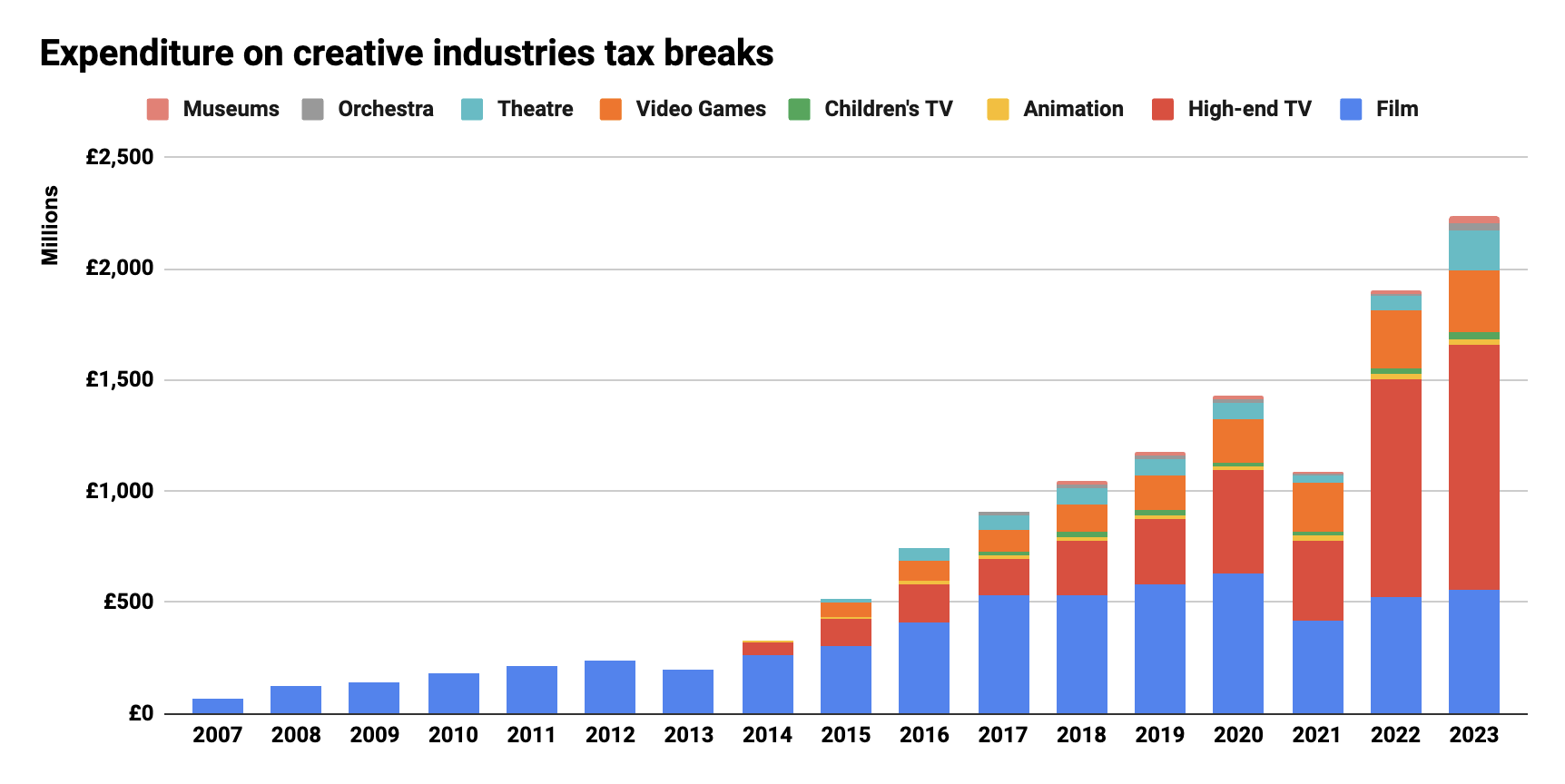
Taxes are what we pay for a civilised society, so the saying goes. But you hardly have to be a diehard libertarian to think that not everything funded by the public purse is strictly necessary for upholding a functional state. One such example, recently documented by The Observer, is how the 2022 film Jurassic World: Dominion was subsidised by the taxpayer to the tune of £89.1 million through Film Tax Relief. And it wasn’t alone – for the year 2022-23, more than half a billion quid was dished out via this tax break, taking its total to nearly £6 billion since it was created in 2006-07. (Film studios aren’t the only beneficiaries of these schemes, as similar ones exist for other ‘creative industries’, such as High-end TV production, theatre and video games.)

Source: HM Revenue and Customs (2024). Creative industries statistics – contents, August 2024.

Now, the obvious argument in favour of this scheme is that it drives companies to produce films in the UK rather than elsewhere. This generates benefits like employment, increased local spending, and, yes, new tax revenues that flow back to the Treasury eventually. Indeed, analysis from the film lobby claims that for each £1 the industry receives in support, £8.30 is returned to society.

Quite the return on investment – assuming it’s true. Unfortunately, I can’t help but be sceptical. As Adviser to The Entrepreneurs Network Sam Dumitriu pointed out, the wider evidence base on similar film tax reliefs around the world suggests a far lower multiplier. While I don’t doubt they help the industry – as any reasonable person should expect a subsidy to – the real question is how cost effective that help is. Each pound that gets ploughed into reliefs has to be raised by taxing other businesses more sharply, thereby destroying value elsewhere in the economy. Or an alternative way of looking at things is that money spent on enticing more film production in the UK is money not spent on funding the NHS, schools or some other part of the state.

Moreover, sectoral reliefs like this create a cottage industry of lobbyists whose sole purpose is to defend their fiefdom rather than being genuinely productive. A more neutral approach to tax (and reliefs from it) would eradicate the need for these jobs to exist, and their hard work and effort could be deployed for more worthwhile ends.

As it happens, Film Tax Relief is closing in 2027, but only because the Audio-Visual Expenditure Credit is taking its place. At a time of straitened finances and an increasingly heavy tax burden weighing down on the economy, the Chancellor should think about whether it’s time to call ‘cut!’ on reliefs for film production.

🍺 Philip Salter, Founder

According to Anton Howes’s latest Age of Invention essay, the road to mass-produced pale ale was much longer, more winding, and more interesting than expected. It’s another of his essential long reads which, taken together, tell the story of Britain’s Industrial Revolution.

Drying malt was once a difficult endeavour, as smoky fuels like wood and coal tainted the malt and harmed its quality. Anton tells the story of how inventors attempted to solve this by developing smokeless kilns – devices that separated fire from malt, allowing the use of cheap, smoky coal without tainting the product.

A series of proposed and patented designs emerged in the early 1600s, including Hugh Plat’s lead-heated floor, John Shotbolt’s iron-conducted heat system, and Cornelis Drebbel’s thermostatic stove, which automatically regulated temperature using early thermostat technology.

There are numerous parallels to draw with industry today, including an attempt by Shotbolt to centralise and monopolise the malt trade under a corporate charter, despite Drebbel’s invention being technically superior. Alongside others, Shotbolt proposed creating a Society of Maltsters, a new official guild, which claimed to represent all maltsters in England. But really, it was an attempt to create a monopoly disguised as professional regulation.

While we’ve greatly improved at brewing beer without needing a monopoly, we remain burdened by ‘furious monopolists’ – those whose claims to act in the public interest are dubious at best, even as they profit handsomely from regulation.

🛣️ Anastasia Bektimirova, Head of Science and Technology

“Growth” has become Westminster’s favourite promise, with every other new policy proposal claiming to deliver it. But few seem to articulate what kind of growth, and towards what ultimate purpose. As Jeegar Kakkad of the Tony Blair Institute recently tweeted:

“One cannot just say ‘here is a policy to deliver growth’. Not all growth is equal. One needs a theory of the type of growth (therefore economy) you want. One can then judge policies on whether they are aligned to that type of growth or not.”

Economic growth is often viewed as a destination when it really is a mode of transportation. A sports car and a bus both move forward but at different speeds. Both are important, but they serve different purposes, carry different passengers and a different number of them, arriving at different destinations. Each vehicle is engineered differently, has different fuel requirements and a different impact on the landscape it traverses. In last weekend’s piece on abundance, Janan Ganesh wrote “you can’t buy moderation... you can’t build or grow your way to civic sanity”, noting that “the biggest head-scratcher in the modern world is the lack of correlation between abundance and voter happiness.” Just as not all vehicles are suitable for every journey, not all forms of growth address every societal challenge.

Before debating how to accelerate, we should first figure out where we’re trying to go. Ian Hogarth’s analysis of Europe’s technology sector illustrates this well. When Ian argues for building trillion-dollar companies, “this isn’t just about growing the tech industry for those that work in it: it’s about creating a more prosperous and resilient society with more wealth to pay for Europe’s public services.” Pro-business policy asks often miss this point. Companies are part of a national ecosystem, not the endgame.

When Bank of England economist Andy Haldane travelled the country after the 2008 financial crisis, armed with economic recovery data, the public often asked him: “Whose recovery?” So, alongside asking “will it deliver growth?”, it’s worth asking “what kind of society would this growth create?” Growth of what? For whom? At what cost? For what purpose? The vehicles we choose reflect what we believe is worth growing, who benefits, and which trade-offs we accept. Articulate a society you wish to create and align your wealth engines to get there.

Three Big Ideas #30

Three Big Ideas is our weekly roundup of ideas (and our takes on them) in entrepreneurship, innovation, science and technology, handpicked by the team.

In this week, Eamonn Ives urges the Chancellor to call ‘cut!’ on tenuous taxbreaks for film studios, Philip Salter discusses the parallels between 17th Century brewing and our modern economy today, and Anastasia Bektimirova implores us to think of growth as a mode of transport, not a destination.

Guarding Golden Geese

Few policy issues hit as hard as tax. While entrepreneurs care about a lot – from access to talent and finance, to regulation and infrastructure, to making British culture more entrepreneurial – it’s only when changes to taxes are mooted that my inbox starts overflowing.

This is to be expected. While some think the art of taxation consists of plucking the goose so as to get the most feathers with the least hissing, entrepreneurs know full well that the real damage isn’t the hissing, but stopping them from creating the wealth that pays for everything else.

This week, the Tony Blair Institute released A Pro-Growth Roadmap for Business-Tax Reform. One recommendation I’m particularly keen on is allowing businesses to deduct the full cost of all plant and machinery expenditure (including on vehicles and, crucially for a lot of Britain’s startups, intangibles) and introducing ‘neutral’ cost recovery for buildings so that allowances keep pace with inflation and the time value of money.

All the way back in June 2018, my former colleague Sam Dumitriu wrote a report for the All-Party Parliamentary Group (APPG) for Entrepreneurship making one of the first cases for full expensing in the UK. For those with an interest in how policy change really happens, read this article from The Economist.

Another recommendation I’m pleased to see is the idea to swap the existing business rates system for a commercial‑landowner tax that only taxes unimproved land value, shifting formal liability to landlords and removing penalties on developing or upgrading property.

Our Adviser Andrew Dixon OBE deserves full credit for this policy idea, which the TBI report gives by pointing people towards his brilliant Taxing Land, Not Investment report. As I wrote at the time: “Business rates are a tax on investment, adding to Britain’s productivity woes. Introducing a Commercial Landowner Levy would remove a key disincentive to investment and reduce administration costs for thousands of business owners. This is exactly the sort of policy entrepreneurs need to thrive.”

But it’s not all roses. The TBI report also calls for Business Asset Disposal Relief (BADR), formerly Entrepreneurs’ Relief, to be scrapped. As entrepreneurs know only too well – particularly the thousands who have moved or are moving their business abroad – the relief has already been slashed, with the maximum amount of gains that are subject to the lower rate reduced from £10 million to £1 million in 2020, and the last Budget increased the tax rate on disposals from 10% to 18%.

While the report is right to point to the lack of evidence across the whole business population, we know from speaking to many of the world’s most successful founders that it has acted as a massive incentive for them to start and keep their businesses in Britain.

We’re keen to build the evidence base to prove this beyond doubt, and make the case that the Treasury should retarget the relief at founders who are scaling businesses to incentivise the world’s best entrepreneurs to start, grow and sell multiple businesses in Britain.

When the geese do need to hiss, we’re the megaphone (as we were when rumours swirled that Capital Gains Tax was going to be hiked significantly). All of which is to say, let me know if you think BADR is worth hissing about.

Protecting the Ecosystem

We’re launching a new meetup group for entrepreneurship ecosystem builders. As Natalia Loza, who is partnering with us on this, explains:

This gathering is for those working behind the scenes to make entrepreneurship thrive. Whether you’re leading or sponsoring an accelerator, venture builder, corporate innovation team, policymaking body, university innovation office, innovation agency, or any other venture support organisation – your work is vital in helping founders and businesses launch, grow, and succeed.

What’s in it for you?

  • Meaningful connections with like-minded ecosystem builders

  • Fresh insights from others navigating similar challenges and opportunities

  • And yes – coffee, croissants, and great conversation in good company

Say WhatsApp?

After a bit of experimenting, phase one of our WhatsApp Community is working. Anyone can join our Community – just tap here. While you can’t post yet, you can respond to our announcements, which we try to keep to a couple per week.

We’ve also got our Adviser group up and running (request to join here) and the APPG for Entrepreneurship Advisory Board group (request to join here).

Next week, we’ll roll out our Supporters group and we’ll also launch our Entrepreneurship Ecosystem Builders (see above). Phase two will be opening up more groups through a comprehensive application form.

Three Big Ideas #29

🎨 Eamonn Ives, Research Director

Last week, I hopped on a Eurostar to Brussels to attend the Lisbon Council’s Scaling Europe Summit. The headline act was Stripe’s President and Co-Founder John Collison, who, as an Irishman who’s done a pretty decent job of growing a company, is better placed than most to give his view on what countries this side of the Atlantic should be doing to close the scaleup gap with America.

During a panel session, he invoked a possibly apocryphal but definitely apt Pablo Picasso saying: “When art critics get together, they talk about form and structure and meaning. When artists get together, they talk about where you can buy cheap turpentine.” Rather than getting into the intricacies of paint thinner, however, Collison was making the point that founders should do more to ensure they’re heard when policymakers are trying to improve the business environment.

As someone who certainly falls more into the ‘art critic’ side of the equation in this extended metaphor, but who nonetheless wants to help ‘artists’ as much as possible, I wholeheartedly agree. When it comes to trying to boost the economy, too often people who are detached from the fundamental, nuts and bolts realities of running businesses wield the most influence. Too often, vague platitudes are confidently trotted out as solutions to knotty problems.

When I think of some of the best policy influencing we’ve done over the years, it has often come from founders talking us through exactly what banal rule or specific regulatory quirk is holding their business back. While it’s our job to devise the policy workaround, we won’t always know what needs to be worked around without founders telling us first. Put another way, if you think your turpentine can be made cheaper, don’t hesitate to get in touch.

🚆 Philip Salter, Founder

Like many Londoners, I’ve become a little too obsessed with a Live Tube Map built by Ben James. Its beauty lies, mostly, in its simplicity: showing exactly where every tube train is at any given time.

As Time Out reports: “Hover over the moving trains and a little information box pops up telling you the exact model of the train, where it’s going to and from, the percentage of its journey that it’s completed and the exact times (to the second) that it is expected at its next two or three stops.”

I’m old enough to remember printing off maps from the Transport for London (TfL) website to navigate around the city. Nowadays, the data underlying what was once a basic platform now powers a range of applications, including Citymapper, Moovit, Santander Cycle, and many others.

As much as I love the Live Tube Map – and as much as we should celebrate the success of TfL’s open data – it’s also a stark reminder of how much of our public data remains underutilised. The Head of Data for London, Greater London Authority sums it up well: “Unfortunately, some great projects still fail because we cannot share the data needed to solve the problem. Whether we are hampered by technical infrastructure, legal barriers, capability, capacity, or resourcing, that is still a wasted opportunity to improve the city and benefit Londoners.”

If we don’t act quickly we’ll fall further behind. Even Germany is moving towards the ‘public money, public data’ principle, potentially legislating to ensure all data collected with public funding should be made available for public use and benefit.

Unshackling public data will free public-spirited technologists and entrepreneurs to build services we didn’t even know we needed. If you have an idea for what you would like to build with government data let us know.

🌍 Jessie May Green, Events and APPG for Entrepreneurship Coordinator

Carbon credits were introduced with the Kyoto Protocol in 1997, inspired by the ‘cap-and-trade’ system for sulfur dioxide emissions that successfully tackled the US and Europe’s acid rain problem. In a carbon market, total greenhouse gas emissions are capped, and any party that comes in below their individual cap receives a ‘carbon credit’, which they are free to trade to a higher-emitting party that is exceeding their own cap.

The UN intended carbon credits to be a meaningful way for countries to voluntarily meet their climate targets, but new research by Carbon Market Watch has found that only one in 27 international carbon credits will likely represent a real emissions reduction. So, what’s going wrong here?

While in theory this presents an elegant and economically efficient way to decarbonise, a couple of problems crop up in practice. First, some parties are inappropriately granted credits based on questionable supporting evidence, and, second, others are guilty of ‘double counting’ – when both the credit-seller and the credit-buyer logs the emissions reduction, which misrepresents the overall change that has taken place.

Not only do Carbon Market Watch point out that historic carbon credits lack efficacy, they also warn that familiar flaws are set to persist in the new and improved framework. With the European Commission currently considering counting international carbon credits towards its 2040 climate goal, and with nearly two thirds (63%) of large UK businesses planning to use carbon credits to meet their own sustainability targets, this is important to know – and to fix.

Three Big Ideas #29

Three Big Ideas is our weekly roundup of ideas (and our takes on them) in entrepreneurship, innovation, science and technology, handpicked by the team.

In this week, Eamonn Ives urges founders to heed Pablo Picasso, Philip Salter makes the case for unshackling more public data, and Jessie May Green delves into why carbon credit markets could be falling short of their true potential.

No Uncertain Terms

In this week’s issue of Perennial Gale, I explore how political uncertainty weighs on entrepreneurship, investment and innovation. Drawing on recent research and real-world examples – from the fallout of Brexit to the policy whiplash after Trump’s first term – I show how unpredictable policy environments can stall new business formation, shrink investor appetite and slow productivity growth. Even whispers of tax changes have recently prompted founders to rush exits ahead of possible reforms.

But it’s not all doom and gloom. There’s evidence that some firms respond to uncertainty by doubling down on R&D, treating turbulence as a strategic window to out-innovate competitors. While uncertainty depresses aggregate activity, the entrepreneurial instinct to adapt and push forward remains a vital counterforce. As we await the next Budget and possible further shifts in policy, the question isn’t whether uncertainty will persist – it’s how the most ambitious firms will navigate through it.

In addition, we want to hear from entrepreneurs. We’re responding to a government consultation on e-invoicing, and we’re looking into accelerators and incubators. Get in touch with Eamonn or Anastasia respectively to feed your views in.

Three Big Ideas #28

Three Big Ideas is our weekly roundup of ideas (and our takes on them) in entrepreneurship, innovation, science and technology, handpicked by the team.

In this week, Philip Salter takes stock of how to boost European scaleups, Eamonn Ives ponders a new way to think about GDP per capita, and Anastasia Bektimirova explains what she’s excited about as ARIA announces its second cohort of Programme Directors.

Three Big Ideas #28

🇪🇺 Philip Salter, Founder

My colleague Eamonn was in Brussels yesterday for the launch of When Europe Scales, a very timely report offering practical policy recommendations to grow the European startup and scaleup ecosystem.

Today, I’ll touch on one of the 16 headline policy recommendations – to take a harmonised and competitive approach to stock option taxation:

“Retaining talent also requires a competitive tax environment, particularly in terms of the uniform treatment of stock options across member states. Harmonised taxation criteria across the EU are needed, and this should focus on taxing stock options at the time the stock is sold, not when the option is exercised. EU-Inc could provide the right framework to deliver this coordinated effort at EU level.”

This is a huge deal for startups. As last year’s EU Startup Nations Standards report set out, recognising stock options as capital rather than income, as well as avoiding double taxation are significant challenges. It’s also important to see harmonisation around the ability of startups to offer no voting rights, without which too many people can become involved in decision-making.

These ideas are downstream of work undertaken years ago when founders banded together to make the case for better stock option policies. But this is all taking too long. If anything good is going to come of Trump’s tariffs and broader turn against America’s long-term allies, it needs Europe to break down the regulatory barriers preventing a truly single market. Tear down these walls!

💷 Eamonn Ives, Research Director

For anyone invested in Britain’s economic future, last month’s growth forecasts made for sobering reading. Worse still, some were quick to note that our already modest projections for economic output will be spread across a growing population, due to continued immigration. That sounds like a double blow – low growth, diluted further by more people. 

But this framing deserves closer scrutiny. Yes, higher GDP per capita is generally better than lower GDP per capita – but it’s a crude proxy for changes in individual welfare. It’s influenced not just by how productive we are, but by who we count. When immigration increases the denominator, it’s easy to miss the effects on the overall composition, productivity, and dynamism of the economy.

Consider this: when someone moves to the UK to work as a cleaner or delivery driver, they don’t necessarily compete with the British-born lawyer or doctor – rather, they often complement them. By enabling higher-productivity people to work longer or more efficiently, lower-wage workers can boost total output. That’s comparative advantage at work, even if on the face of it GDP per capita goes down.

With this in mind, there’s a case for looking beyond GDP per capita to something like GDP per ‘native’ capita. I’ll be the first to admit, the phrasing makes me feel a little squeamish. But if immigration increases total output without dragging down natives’ earnings, that seems worth noting. After all, if what’s really driving the lower average is compositional change, not declining prosperity for existing residents, then some of the gloom may be misplaced.

It won’t resolve every debate, but it might just help us distinguish between real economic problems and statistical artifice.

🚀 Anastasia Bektimirova, Head of Science and Technology

How can we design aircraft that can reliably find thermals and wind shear, harvest energy from them, and interlace these into long, unpowered flight paths? As we explore the ocean as a new frontier, what high-value foods and materials could we sustainably cultivate? This is the flavour of questions that will be explored by the newly announced second cohort of Programme Directors at the Advanced Research and Invention Agency (ARIA). What makes this cohort different is that ARIA deliberately sought out entrepreneurial scientists who have successfully built ventures, communities and technologies that have left a mark on society. I enjoyed reading about the selection process here.

Each Programme Director is joining ARIA with one or two early areas of exploration, that they will shape before narrowing down and defining programmes more precisely. There is a lot to be excited about – from engineering biological energy to sculpting innate immunity. But I’ll be watching two of the emerging programmes particularly closely.

First, the Collective Intelligence Engine that could revolutionise how scientists navigate the research landscape. Discoveries often emerge from identifying new connections between studies across different disciplines. What if AI could map every scientific argument, instantly revealing valuable connections, contradictions, and gaps? This is what the programme aims to do by building a living knowledge engine. But beyond this, it leaves room for ARIA-shaped metascience questions. For example, how might AI restructure scientific disciplines, and what institutional changes would be needed once this happens? The answers to such questions could be as transformative as the technology itself, reshaping how we organise, fund, and evaluate scientific work in the age of AI-assisted discovery.

Second, the Extending Our Perception programme that focuses on computational systems that can simultaneously process multiple streams of data from advanced sensors far beyond what humans can perceive. This could transform healthcare by detecting diseases before symptoms appear, enable more precise environmental monitoring, or advance sustainable food production. Regular readers will remember that I wrote about this direction earlier, noting how multi-sensor integration would create strategic advantages by gaining a fundamentally different understanding of the world around us. This direction is one of those that could serve as a backbone for many more new ones – just imagine AI systems capable of processing multiple sensory and more conventional data streams simultaneously, revealing patterns and relationships that remain invisible to traditional analysis methods.

Anyone…?

Whatever mistakes you’ve made this week, take solace in the fact that you didn’t wipe $2.5 trillion of value off Wall Street and drive your country towards recession. And that’s ignoring the damage inflicted across the globe. No, that was Donald John Trump, the 47th President of the United States.

While on the face of it we got off relatively lightly, make no mistake: this is bad news for Britain’s entrepreneurs. While we ‘only’ got hit with 10% tariffs, our economy does not exist in isolation. When markets around the rest of the world stutter, so too will our own. These tariffs will destroy trading relationships for millions of individual firms, which may take years to adjust to – if at all. Positive-sum gains accrued from specialisation and exposure to international competition will evaporate.

As I’ve argued on these pages before, the government should be unstinting in its promotion of free trade around the world: “Free trade might be a little passé these days, but we shouldn’t forget the lessons of our forebears like Adam Smith who demolished the mercantilist worldview in the Wealth of Nations, and Richard Cobden, who tirelessly campaigned for free trade for the good of the poorest and to broker peace between nations.”

The methodology Trump’s team has used to impose tariffs is nothing short of madness. Despite claims to the contrary, they didn’t calculate tariff rates and non-tariff barriers. Instead, they just took the US trade deficit for each country and divided it by the country’s exports.

The tiny island of St Pierre et Miquelon got slammed with a 99% tariff because somebody bought $3.4 million worth of crustaceans in July 2024, but your deepest sympathies should go out to the entrepreneurs of Vietnam and Thailand and their populations, who will suffer deeply from these tariffs, both through direct exposure to US imports, but also indirectly via exports to the US through other countries.

There’s simply no escaping Econ 101. Trump needn’t have even pulled himself away from his TV addiction to learn this. Ferris Bueller’s Day Off does a good enough job of explaining why the Hawley-Smoot Tariff Act of 1930 – legislation that raised tariffs on imports in an attempt to protect American industries and generate more revenue for the government – worsened the Great Depression by stifling international trade rather than helping the economy recover. Anyone…? Anyone…?

Mark my words. Trump’s tariffs will fail. Perhaps we can take solace in The Economist’s Mike Bird’s insight that aggressive protectionism is often followed by a long backlash: “The Corn Laws, Smoot-Hawley, and interwar European trade restrictions sparked the resurgence of free-trade liberalism in the generations that followed them.”

Jolly Good Fellows

Defeating Trump’s mercantilism and equivalents in the UK will require a lot of people to put up a strong fight. To that end, it’s great to see our good friends at UK Day One expanding to create the much-needed Centre for British Progress. I’m delighted that Anastasia Bektimirova, our Head of Science and Technology, has joined as one of their Fellows. I strongly recommend reading their long read Rediscovering British Progress.

Party Time

The All-Party Parliamentary Group (APPG) for Entrepreneurship will soon be back, with Tris Osborne MP (Labour), Victoria Collins MP (Liberal Democrats), Lord Leigh of Hurley (Conservative) and Lord Bilimoria of Chelsea (Crossbench). As the Secretariat we’ve got big plans, so how can you get involved?

First, if you’re an MP or Peer, you can still become a Member. Get in touch with our APPG Coordinator, Jessie, to let her know.

Second, if you or your company supports entrepreneurs you may want to support the APPG. We are looking for up to four supporters for 2025/26. Drop me an email so I can send through more information.

Third, if you represent entrepreneurs, you may be able to join our Advisory Board. We catch up every month to discuss policy issues, research and events relating to all things entrepreneurship. Drop Eamonn Ives an email to find out more.

Fresh Thinking

Another week, another new Adviser. This week, I’m pleased to announce that James Callander, Managing Director of Freshminds is joining our growing ranks. As he says:

“I have always been super enthusiastic about the world of business and entrepreneurs – while it can be hugely risky and not for everyone, I think that running your own company is a wonderful privilege and something we (as a society) should encourage as an engine of job and wealth creation.”

If you’re keen to join James as an Adviser, get in touch.

Three Big Ideas #27

Three Big Ideas is our weekly roundup of ideas (and our takes on them) in entrepreneurship, innovation, science and technology, handpicked by the team.

In this week, Eamonn Ives draws attention to ways to reform the Office for Budget Responsibility in a pro-growth fashion, Anastasia Bektimirova asks whether tokenisation of the economy may require us to rethink institutions, and Jessie May Green looks at how smart siting could boost the rollout of renewable power.

Three Big Ideas #27

🧮 Eamonn Ives, Research Director

Some norms in British politics – like elections always falling on a Thursday – have been around for generations. Others sometimes feel like they have been, but are actually very recent phenomena. The sacrosanct involvement of the Office for Budget Responsibility in Treasury decision-making is one such example. Despite only being set up in 2010, the OBR enjoys an extraordinarily privileged position, and wields immense power over the government of the day.

We saw that on full display last week when Rachel Reeves delivered her Spring Statement, and made painstakingly exact spending promises in order to meet her fiscal rules. After all was said and done, the Chancellor maintained precisely the same headroom – £9.93 billion, down to two decimal places – as she enjoyed after her October Budget last year.

A defender of the OBR would argue that its scrutiny keeps chancellors honest and Britain’s reputation in the markets sound (or at least, more sound than the case would be otherwise). But an interesting challenge from economists Pedro Serôdio and Rohan Shah which recently caught my eye argued that the OBR is falling short in certain respects, especially when it comes to forecasting the impact of medium- and long-term policy changes.

This is enormously important for the future of our economy. Some of the things that matter most for increasing growth are reforms that the OBR, in their analysis, is not well set up to model. Think here of changes to planning frameworks that could deepen labour markets by allowing more people to live in the most productive parts of the country.

As well as convincingly diagnosing the issue, Serôdio and Shah prescribe a solution. For very little investment in the grand scheme of things, they outline how to bolster the OBR’s talent pipeline and enable it to do a better job of forecasting policy changes, and thus strengthen the scope policymakers have to make meaningful reforms. I won’t try to forecast the benefit of doing so myself, but I’d bet the answer would be net positive.

🧩 Anastasia Bektimirova, Head of Science and Technology

Think about how we’ve traditionally organised our economy. We group similar activities into industries, divide work into job categories, and create companies around related products and services. These divisions make intuitive sense to us as humans. But AI systems don’t share our intuitions.

AI systems divide information into ‘tokens’ – discrete units based on statistical patterns, rather than human meaning. Unlike human categories based on meaning and function, tokenisation creates divisions based on what works computationally rather than what makes intuitive sense. As Nicklas Lundblad, DeepMind’s Senior Director of Policy and Strategic Advisor, writes in his blog, the tokenisation process is already reshaping major industries:

“Consider how digital platforms have restructured industries by tokenizing previously continuous experiences. Uber tokenized transportation into discrete, algorithmic units; Airbnb did the same for accommodation; TikTok for entertainment. Each platform succeeded by reconceptualizing an industry in terms that could be discretized, quantified, and optimized according to computational logic. I think this comes close to what Andreesen meant when he noted that software will ‘eat’ everything – but in order to do that it first needs to digest the world, into tokens.”

As tokenisation spreads, our traditional industry boundaries might blur in unpredictable ways. We can already see this in how companies like Amazon and Apple operate across what were once distinct sectors, following patterns that transcend standard categories.

What I find most interesting about this line of thought is implications for institutions. Our institutions are organised around human-meaningful categories that emerged in specific historical contexts. If tokenisation fundamentally reorganises economic activities, then institutions – which are “the humanly devised constraints that shape human interaction” – may misalign with economic reality.

New technologies have often demanded new institutional forms – for example, the industrial revolution created corporations and regulatory agencies. Similarly, institutions will likely need to be designed around the actual patterns of a tokenised economy – potentially cutting across traditional domains like healthcare, finance, and education to address newly visible patterns of risk and opportunity. The greatest challenge ahead may not be the technology itself, but reimagining our institutions for a world where the organisation of economic activity no longer follows the patterns we’ve built our social structures around.

🛰️ Jessie May Green, Events and APPG for Entrepreneurship Coordinator

You may have heard a lot about the clean energy transition, but have you ever wondered what it looks like? With the Global Renewables Watch – a partnership between The Nature Conservancy, Planet Labs and Microsoft’s AI for Good Lab – you need wonder no more. Together, they have mapped the spread of onshore wind and large-scale solar over time using advanced AI and high-resolution satellite imagery.

In this interactive article by The New York Times, you can visually explore how renewable energy capacity has grown over the last eight years. For instance, the US’ solar and wind capacity has nearly tripled, China has built more than 120,000 wind turbines – almost a third of the world’s total, and emerging economies like Turkey are beginning to fulfil their solar potential.

Despite this progress, still around three quarters of global greenhouse gas emissions are generated by energy use, and so cleaner energy infrastructure must continue to be rapidly scaled to mitigate further global warming. This will require a lot of land. If not done thoughtfully, the expansion of renewables could – ironically – cause a lot of environmental damage, not to mention human conflict.

That’s where ‘smart siting’ can come in – choosing wind and solar sites based on where they’ll have the fewest negative impacts. The Global Renewables Watch dataset is unique in that it captures trends over a period of time, not just snapshot moments, and tracks underlying development patterns, not just development. Thus, it can predict where renewables siting may cause tensions to flare up, and assist in producing alternative plans. Considering how conflict can impede action on climate change, this is no small matter.

With Microsoft providing the AI and platform technology, Planet Labs on the satellite imagery, and The Nature Conservancy bringing the expertise needed to analyse the trends, this is a stellar example of the importance of cross-sector collaboration on climate action. With all the doom and gloom reports about AI threatening the environment, it’s nice to remember the positives too.

Real Dynamo

For too long, there has been a chasm between rhetoric and reality – between the way that too many politicians talk and think about growth, and the realities of productivity. It’s time to bridge this gap. It’s time to focus on business dynamism.

To butcher a Paul Krugman quote, business dynamism isn’t everything, but, in the long run, it is almost everything. As the ERC’s State of Small Business Britain Report 2024, which was released this week, clearly states: “The link between business dynamism and productivity growth at the national level is an empirically established fact.”

Business dynamism is the pace at which businesses start up, expand, shrink, or close down. It matters because high dynamism usually goes hand-in-hand with greater innovation, stronger productivity growth, and more job opportunities. When new businesses emerge, and existing firms grow or adapt quickly, it tends to promote competition, fresh ideas, and economic vitality. Conversely, if dynamism wanes – reflected in fewer startups and lower rates of growth – innovation can slow, job creation can stall, and overall economic progress may suffer.

In the UK, Professor Mark Hart has been leading this research for many years. He finds that, on average, about a quarter of UK jobs are either created or destroyed each year. However, the overall job reallocation rate has declined over time, suggesting lower levels of business dynamism. Notably, only 3-5% of existing jobs are created by newly launched businesses (startups), and that proportion has been falling in recent years.

One of the implications for policymakers is the need to think about policies to support wider categories of businesses – whether that’s startups reaching £1 million turnover within three years; established firms growing from £1-2 million turnover to over £3 million; or so-called “productivity heroes” that are increasing revenue per employee while also creating new jobs.

There are debates to be had about how to slice and dice the categories. And there are full-on arguments to be had about the policies needed to support them – where they overlap and where they differ. But there can be no arguing at all about the importance of business dynamism.

We’re planning to do more on this issue. Drop me an email if you’re keen to be involved.

Spring Lose

In case you missed it, we gave our reaction to the Chancellor’s Spring Statement. We covered everything from revised growth forecasts, additional investment pledged for defence capabilities, Making Tax Digital and the consultation on R&D tax relief.

As many of you will know only too well, R&D tax relief is an ongoing debacle. It was a major point of contention at a roundtable we held the day after. In fact, our Research Director Eamonn Ives wants to hear from you if you’ve been stung by recent changes to R&D tax credits.

Two other ongoing bones of contention also cropped up – the impending hike to Employer’s National Insurance Contributions, and forthcoming regulations contained in the Employment Rights Bill.

Group Focus

We are collaborating with Enterprise Nation to deliver a joint response to the Government’s call for evidence on e-invoicing, with a view to understanding how to further promote its use among Britain’s small businesses. We’re looking for views from all sides. If you want to have your say, join our focus group from 12pm to 1pm on 9 April to share your thoughts.

Esprit de Cork

The latest Adviser to join our growing ranks is Julian Cork, COO and Board Member of Landbay, a leading UK prime buy-to-let mortgage lender which he has helped scale the platform to a loan book of over £3.3 billion. As he says:

“Entrepreneurship matters. It is one of the most powerful engines of innovation, job creation, and societal progress. Founders and startups don’t just build businesses, they solve real-world problems, challenge conventions, and drive economic dynamism. For the UK to remain globally competitive, it must continue to be a place where entrepreneurs can thrive – where ambition is supported, innovation is celebrated, and barriers to growth are removed.”

We couldn’t agree more. Find out how you can join Julian as our next Adviser here.

Real Dynamo

In this week’s issue of Perennial Gale, I argue that if we’re serious about fixing Britain’s sluggish productivity, we need to stop speaking in vague platitudes about growth and start focusing on business dynamism. As the latest State of Small Business Britain Report makes clear, the link between dynamism and productivity is no longer up for debate. When businesses start, scale, adapt, or even exit at a healthy clip, the result is more innovation, more competition, and a more vibrant economy.

Yet Britain’s dynamism is faltering. Fewer startups are breaking through, and job churn – a key indicator of economic vitality – is declining. The challenge for policymakers is to support not just more startups, but a wider range of firms at different stages of growth. That means targeted policies for everything from high-growth early-stage businesses to mid-sized firms boosting productivity and creating new jobs. However we frame the debate, one thing is clear – business dynamism is not a nice-to-have, it’s the engine of progress.

In addition, we gave our reaction to the Chancellor’s Spring Statement, issued a call for entrepreneurs to speak their minds at our event on e-invoicing with Enterprise Nation, and said hello to Julian Cork as our latest new Adviser.

Spring Statement 2025

This afternoon, Chancellor of the Exchequer Rachel Reeves gave her Spring Statement. Read below for our team’s snap reaction to some of the main points concerning economic growth, innovation and entrepreneurship.


On the revised growth forecasts
Eamonn Ives, Research Director at The Entrepreneurs Network, said:

“For a Government which regards growth as its central mission, today’s forecasts are the epitome of a mixed bag. Supporters of the Chancellor will point to the upward revisions to growth figures from 2027. These are fuelled by the Office for Budget Responsibility deciding it can now evaluate the estimated impact of Labour’s planning reforms – which it thinks could single-handedly raise growth by 0.5%.

“Detractors, however, will note that growth projections for 2026 were slashed in half – to an abysmal 1%. What’s more, even if subsequent years do see higher output than previously anticipated, Britain will nonetheless fail to break 2% annual GDP growth by the end of this Parliament. Contrary to the cheers of Labour backbenchers, that should be no cause for celebration from anyone. Furthermore, while the OBR has factored in the positive growth effects of planning reforms, it has not done the same for the forthcoming regulations promised in the Employment Rights Bill. Should this legislation slow down hiring or impose additional burdens on employers, we should only expect yet more changes to the forecasts – and not in a welcome direction.” 

On the additional investment pledged for defence capabilities
Anastasia Bektimirova, Head of Science and Technology at The Entrepreneurs Network, said:

“Today’s announcements signal recognition that our security landscape demands not just greater investment, but a fundamental transformation in how we deliver military capability. The £2.2 billion uplift for the Ministry of Defence, including investment towards technologies such as autonomous systems and AI-enabled capabilities, is welcome. The focus on bringing these innovative technologies to the frontline faster through UK Defence Innovation supported with £400 million ringfenced budget, scaling over time, is promising, as is the segmented procurement approach which could finally address the notoriously slow acquisition processes that have hampered our defence capabilities.

“But as always, the true test will be implementation. The new Defence Growth Board must include frontier expertise from the defence tech ecosystem, especially given the Government’s commitment to make it easier for startups to bring innovative technologies to the frontline at speed. Success will be measured not by announcements or budgets, but by whether our frontline forces can rapidly deploy cutting-edge capabilities that replace the dated systems they’ve been relying on for far too long.”

On the announcement on tax reliefs for entrepreneurs and investors
Eamonn Ives, Research Director at The Entrepreneurs Network, said:

“Britain is Europe’s leading entrepreneurial ecosystem but it didn’t get that mantle by chance. It took years of careful policy making to incubate an environment where founders, investors and alike can take bets on launching dynamic startups and growing them to scale. Longstanding and globally revered tax reliefs like the Enterprise Management Incentives Scheme, the Enterprise Investment Scheme and the Venture Capital Trust Scheme all fall firmly into this category – supporting not only home-grown entrepreneurs but also enticing foreign talent from around the world to choose Britain as their place to build. 

“The Government’s announcement to convene a series of roundtables to examine these reliefs is therefore encouraging. Though they have proven successful to date, aspects of some now require inspection – not least around limits and thresholds for qualifying companies which have stayed static since their inception. With minor tweaks, we can ensure they continue to deliver for our precious entrepreneurial ecosystem, and by extension, the whole of the British economy.”

On the consultation on R&D tax relief
Philip Salter, Founder of The Entrepreneurs Network, said:

“For many founders of the UK’s most innovative companies, delays and uncertainty around the UK’s R&D tax credits regime have hit them hard. While the Government has made efforts to improve the system, more work is needed, with the announced consultation offering an opportunity to improve the system.

“However, the consultation is too focused on widening the use of advance assurance. While this can provide certainty to businesses, it’s not without an administrative burden – both for businesses and the government – and fails to address the more serious problems in the system: delays, errors, and a lack of avenues to reach HMRC.”

On the continuation of Making Tax Digital
Philip Salter, Founder of The Entrepreneurs Network, said:

“Continuing the rollout of Making Tax Digital is the correct decision from the Government. This will nudge Britain’s businesses towards increasing their productivity, as it reduces the time entrepreneurs devote to dealing with tax, while minimising inaccuracies. As a next step, the Government now needs a solid plan to present at the next Budget for the four million taxpayers who have income below the £20,000 threshold.”

Three Big Ideas #26

Three Big Ideas is our weekly roundup of ideas (and our takes on them) in entrepreneurship, innovation, science and technology, handpicked by the team.

In this week, Eamonn Ives calls for the Digital Services Tax to be scrapped, Anastasia Bektimirova examines what ‘Everythingism’ is and how it impedes good policymaking, and Jessie May Green looks into the innovators trying to solve water scarcity.

Three Big Ideas #26

💸 Eamonn Ives, Research Director

While being interviewed by Laura Kuenssberg on Sunday, Rachel Reeves was asked whether there was any truth to the rumour that the Treasury is looking at junking the Digital Services Tax (DST). Her inability to deny it spoke volumes and raises the possibility of a not insignificant tax change being on the cards.

Introduced in 2020, the DST slaps a 2% tax on the revenues of large tech companies – like search engines, online platforms and marketplaces – and currently raises around £800 million a year. In order to be in scope for the DST, companies must make over £500 million a year from ‘digital activities’ and £25 million of that has to accrue from British users. In effect, this means that those who bear the (direct) brunt of the DST are invariably household American names like Amazon, Meta and Alphabet.

As implied by the Chancellor’s response when questioned, the Government sees this as an opportunity to barter with President Trump and potentially avoid being the victim of any new tariffs. We should absolutely use the prospect of scrapping the DST as a bargaining chip to not only dodge tariffs but also pave the way for a long-awaited trade deal between the UK and the US.

As the DST goes, it is an example par excellence of terrible tax policymaking in theory and in practice. By the way it effectively cherrypicks which firms it impacts, it violates the principle of neutrality. By the way in which it taxes revenues and not profits, it unfairly penalises low-margin or loss-making firms, potentially hampering productive investment which we desperately need more of. Meanwhile, the empirical evidence we have of the DST shows that those who do pay it simply pass on higher costs to users – such as advertisers on Google or small third-party sellers on Amazon.

Even if the motor of world trade was humming along nicely, canning the DST would still be in our own self-interest. This fact is only rendered more true if it could help us to negotiate closer economic ties with the world’s biggest economy at a time of heightened global tensions. In a strange way, simply having the ability to shelve the DST might be the best thing it achieves in its short life to date.

🤹‍♂️ Anastasia Bektimirova, Head of Science and Technology

A new essay by Joe Hill, Policy Director at Reform think tank, identifies ‘Everythingism’ as a pathology undermining effective policymaking. Joe writes:

“Governments try to advance their objectives through many different instruments – policies, legislation, economic measures, national infrastructure and public services. Not only do they struggle to prioritise between the objectives, but also to identify which instruments are best used to deliver those objectives.”

This creates a system that struggles to learn. When every policy is expected to optimise for growth, sustainability, social inclusion, regional balance, and other objectives simultaneously, it’s hard to isolate variables to determine which approaches work for which purposes.

I see a parallel with the scientific method here. Imagine running an experiment where you’re not allowed to control variables to establish correlations or causality. The same happens when every policy must serve every goal. Science advances through testing hypotheses and isolating variables; our policy approach assumes that the answers are known in advance. One system is designed to learn, the other pretends to already know.

The institutional culture that sustains Everythingism makes it difficult to overcome. Joe’s essay quotes Dame Angela McLean, the Government Chief Scientific Adviser, who contrasts the civil service’s aversion to disagreement with academic standards of challenge:

“It is very frequent in a civil service meeting that as somebody stands up the very first thing they will say is ‘I agree with everything that has been said’, and you are sat there thinking ‘well you can't have been listening then’.”

While I had previously noted Dame Angela’s observation on academia’s culture of disagreement at the expense of action, Joe points out how the civil service itself could benefit from the academic tradition of robust challenge. Everythingism thrives in conflict-averse environments – where policies can accumulate objectives because no one feels incentivised or empowered to question their compatibility or trade-offs.

The scientific community understands that progress often comes from focusing resources on specific questions rather than diffusing attention across every possible line of inquiry. We need a similar discipline in policymaking – recognising that when everything is a priority, nothing truly is. Joe’s diagnosis points to a clear prescription: we must recover the courage to prioritise, to match specific instruments to specific purposes, and to build institutions where honest, evidence-based disagreement is the expectation.

💧 Jessie May Green, Events and APPG for Entrepreneurship Coordinator

World Water Day last Friday shone the spotlight on innovators working to improve water security globally – from solar-powered desalination in Egypt, to mangrove forest restoration in India, to desertification reversal in Saudi Arabia. Looking at these arid landscapes, it seems absurd that we – in perpetually drizzly Britain – also face challenges when it comes to managing our water supplies.

You’d be forgiven for thinking this country is wet enough – our green fields and grey summers are all too convincing. But the truth is that we waste a lot of the water that falls on these lands, causing shortages in populous areas such as the South East of England, with huge economic impacts. As Public First’s Bertie Wnek comments on their recent report on the subject:

“Water availability is becoming a very serious issue, already constraining new commercial and housing development in parts of the country. Our research suggested 60,000 new homes could be blocked in the East and South East of England alone over the next five years. Worse still, the problem is most severe in some of our highest productivity areas, like the Oxford-Cambridge Arc, which recent Public First analysis - referenced by the Chancellor in February - suggests has the potential to contribute £78bn to our economy by 2035.”

Thus, there is plenty of need for innovation in this country, too. Some projects to watch that are currently in R&D include: Pipebots – tiny autonomous robots that inspect underground water pipes and repair damage; FreeOx – a hydrogen-based formula for water treatment; and ‘lightning in a jar’ – Anamad’s low-energy, lightning-inspired alternative to chlorination. Budding entrepreneurs in this area, let this be your inspiration!

Winds of Change

Welcome to Perennial Gale – the new home for our Friday newsletter. Its name isn’t a reference to this weekend’s inclement weather forecast, but a quote from Joseph Schumpeter’s description of capitalism as “the perennial gale of creative destruction.” His observation in 1942 was that capitalism is neither stable nor static, but constantly shaped by innovation, entrepreneurship and change. Entrepreneurs are central to this, driving forward economic progress by disrupting existing systems – what he termed “creative destruction.”

Schumpeter was one of the first economists to take entrepreneurship seriously. It was his work, along with that of many others, which inspired us to start The Entrepreneurs Network over a decade ago. While there were, and still are, lots of people lobbying on behalf of the more static parts of the economy – whether large incumbents or small businesses – there was the need for an organisation focused on ensuring that ambitious entrepreneurs across all sectors of the economy have a voice in Westminster. We are that voice.

The wider movement that we are part of is starting to win the battle of ideas. Just this week, the Prime Minister penned an unequivocal piece for City A.M.:

“To deliver economic growth – the number one mission of this government – we need to unleash the power of the private sector. Entrepreneurs who work day and night to build a business from scratch. Family companies that have passed know-how across the generations. Iconic British companies employing thousands of people across all sectors. Investors who provide the capital and expertise that fuels growth and innovation.”

But winning the battle of ideas is only half the challenge. We also need to see change – and the right sort of change. The Government’s New Approach to Ensure Regulators and Regulation Support Growth has a lot going for it in identifying the complex, duplicative and uncertain state of regulation in Britain. It also correctly highlights the excessive risk aversion from regulators, and the high administrative costs regulations impose on businesses (potentially up to 3-4% of GDP). But action is needed.

To support us in helping the government make that change, we need the support of the thousands of entrepreneurs who read this: first, to tell us what your challenges are; second, to speak directly to policymakers and policy influencers at our events; and third, to continue to back and spread the word about our work and campaigns.

On point one, we will now be asking you every week to tell us what your business challenges are (more on this below). These can be any sort of challenge. If it’s a policy challenge, we’ll pass it on directly to policymakers. If it’s a business challenge, we’ll let you know if we know someone who can help. But even your most practical challenge will still be useful for policymakers. After all, the government is already spending billions on trying – and too often failing – to help with these too.

On point two, we have two upcoming events that might be of interest. On Thursday morning we will be at OakNorth reflecting on the Chancellor’s Spring Statement (request a place here). Your insights will directly inform our reaction. Then, on the morning of 1 April, we will be with Steve Rigby at Blick Rothenberg to discuss the serious matter of the impact of inheritance tax changes on entrepreneurs and family businesses (request a place here). Beyond being one of our Patrons, Steve has become a mega-influencer (for want of a better word) in policy circles. See what three things he thinks can steer the country in the right direction (paywall – The Times) and don’t miss his sterling performance on Sunday with Laura Kuenssberg.

Go Forth

Friend of the Network and Co-Founder of The Data City, Tom Forth, has been busy reading no fewer than 14 things published about the National Data Library (NDL), and has penned a blog on what he finds good, what he finds weak, and what he thinks the NDL should be (and, most importantly, where in the country it should be located). It’s a thorough piece which I recommend to anyone following the NDL’s progress (or seeming lack thereof).

And if you work with data in academia or the private sector and want to make sure the NDL is developed in a way that serves your needs, you can do your part by filling out the survey we’re running together with the Tony Blair Institute.

Words of Advice

For over a decade, we have been the voice for entrepreneurs in Britain – conducting original research, campaigning for change and building an extensive network of ambitious founders, innovators and other key players in the wider entrepreneurial ecosystem.

Drawing on this expertise, we’ve decided to establish The Entrepreneurs Network Advisory to help shape policy landscapes and support businesses navigate complex regulatory environments. This formalises work that we’ve already been doing, including policy consultancy for entrepreneurs, public affairs and stakeholder engagement, polling and focus groups, media advocacy for entrepreneurial impact, and government advisory. Find out more here.

Three Big Ideas #25

Three Big Ideas is our weekly roundup of ideas (and our takes on them) in entrepreneurship, innovation, science and technology, handpicked by the team.

In this week, Eamonn Ives argues the case for technological solutions over behavioural adaptations, Anastasia Bektimirova weighs in on a debate about entreprenerial scholars, and Philip Salter explains why the path of liberalism is the one he’d prefer to take.