

By Sophya Mashkoor and Ian Ng, with support from Jennifer Sieg (case studies) and Kajal Sanghrajka (roundtable chair)
foreword
We founded the Jessica Vollman Foundation (JVF) nearly six years ago to honour the legacy of CEO and founder Jessica Vollman. JVF was built out of Jessica’s personal mission to empower women in entrepreneurship through access to education, closing the skills gap and job flexibility. Our community spans four partners across the US and UK: General Assembly, the Kendra Scott Women’s Entrepreneurial Leadership Institute at the University of Texas at Austin, London School of Economics Generate and The Entrepreneurs Network.
Alumni of these programmes join the larger JVF peer mentorship community, which will scale to nearly 100 women by the end of 2026. Jessica’s decade-long career in ed-tech saw her open offices in the UK as Director of New Market Expansion for General Assembly, mentor at LSE Generate’s Accelerator and eventually run her consultancy, The Vollman Group, for startups scaling internationally. It was in this venture that she met her friend and former business partner Kajal Sanghrajka, now an Adviser to The Entrepreneurs Network. The relationship and peer mentorship between these two women over the years is what led us to sponsor this report from The Entrepreneurs Network.
The JVF Female Founder Ambition Series’ three roundtables, divided into early-stage, high-growth and internationally expanding founders, reflected the types of conversations Kajal and Jessica might have as fellow founders and CEOs. It’s through these candid conversations and fostered connections that we hoped to highlight not only what needs to be improved in the female founder ecosystem in the UK, but the many wins the women featured here can point to as well. We are grateful to The Entrepreneurs Network for its work and dedication, and hope the findings in this report can effect tangible change that helps more female founders in the UK find success in their entrepreneurial journey.
Sarah and Mike Vollman
Jessica Vollman Foundation


Introduction
Female founders in Britain build some of the country’s most successful businesses. Yet they frequently start and scale them against a set of challenges that are invisible to those who have ready networks or easier access to capital. Female-led businesses still receive a fraction of UK venture capital, and many structures remain built for founders who only have the business to think about.
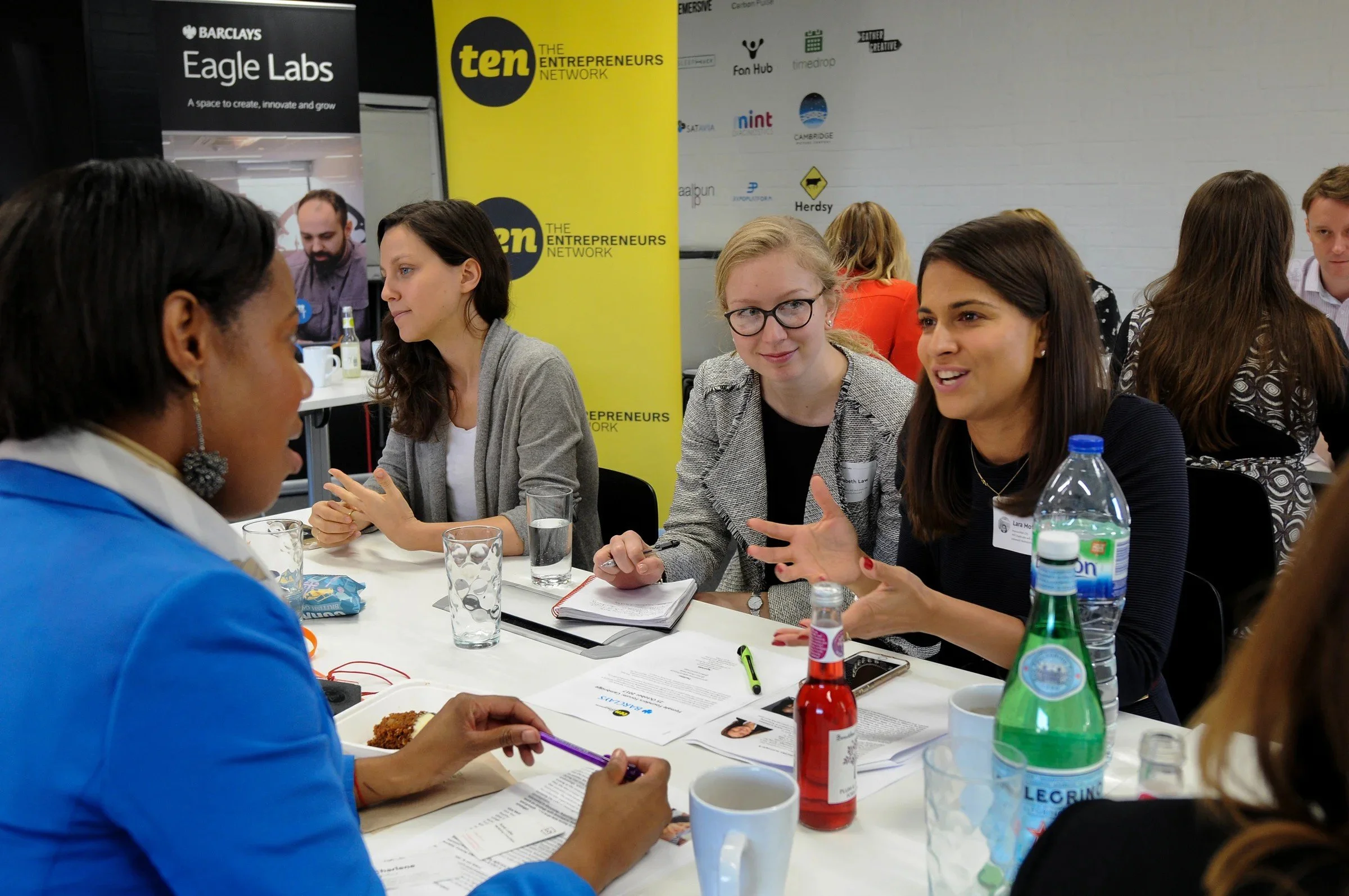
This report is based on three roundtables and a series of interviews with founders building businesses across a variety of industries, and at every stage of funding. We asked founders to describe what gets in their way and where guidance would have made a difference.
Change has been partial. Policy has moved, but without founders’ specific circumstances in view, leaving many self-employed and early-stage business owners less able to access support. Where founders themselves disagree on policy alternatives, we have set out both sides rather than resolving the disagreement for them.
From these roundtables and interviews, five themes emerged: capital access, bias and the funding gap; childcare; networks, mentorship and ecosystem; finance and procurement; and international market expansion.
1) Capital access, bias and the funding gap
When asked what the biggest obstacle to growth is, female founders often cite the same statistic: all-female founding teams receive only around 2% of UK equity investment. However, through the roundtables we convened and the interviews we conducted, another, equally challenging, obstacle emerged: getting someone to listen to the pitch in the first place. Long before a deck gets picked apart on its numbers, it has to survive a much earlier filter — whether the investor already knows the founder, or knows someone who does.
1.1. Warm introductions are a gatekeeper
Early-stage funding is still heavily reliant on personal networks, with warm introductions going a long way with investors. The UK Business Angels Association has told Parliament that existing investors are frequently a source of warm referrals. The result is that the same small pool of contacts tends to recycle deal flow among people who already know each other, and investors favour founders who have already accumulated the right contacts. The problem with this is that plenty of founders haven’t had time to build up that kind of network, or moved to the UK too recently to have one.
Case study: Ahana Banerjee — Founder, Clear
With a physics degree from Imperial College London and a run of software-engineering internships behind her, Ahana Banerjee looked like someone who wouldn’t struggle to raise money. Yet when she began looking for funding, her credentials did little to help open doors.
Out of 200 applications she sent out, she received only one response that wasn’t a rejection: Y Combinator (YC). Ahana is upfront about the fact that YC didn’t suddenly make her a better founder, and that its value was partly reputational. After gaining credibility by association, investors who had ignored her for two years suddenly wanted to take the call, simply because someone else had gone first. Since then, she has built Clear — a skin-health platform — which is now used by over 70,000 people.
After closing her first round, Ahana went back through her Customer Relationship Management (CRM) system and tagged roughly 300 investor meetings by gender to better understand her fundraising numbers. Male investors made up the large majority of those meetings, reflecting the market as a whole. But when she traced where the money she had raised had come from, “over 90% of the dollars [...] raised were led by female investment decisions”. Had she known this before approaching investors, she says she would have approached fundraising differently.
Ahana Banerjee
Source: Clear
1.2. Capital needed to scale
A similar bottleneck exists further along. Even when founders can prove customers want their product and that it can generate revenue, they still struggle to find investors who understand the market for female-oriented products and services, or are prepared to move at the speed required for the business to flourish.
Case study: Tara Chandra — Co-founder, Here We Flo
Tara Chandra co-founded Here We Flo, an organic period-care brand now generating around £15 million a year. Their products are now stocked in Boots, Tesco and Whole Foods, among others. The business had already overcome the early-stage funding gap described above, but Tara had a second gap waiting further along.
British consumer-sector funds are typically generalist rather than sector specific. The handful of specialist funds that do exist often set revenue thresholds beyond where Here We Flo stood in its early days and even in its high-growth scaling years. As Tara puts it, “funding high growth one £10k EIS (Enterprise Investment Scheme) cheque at a time is extremely challenging”. Competing for the same pool of institutional capital as consumer businesses like pub chains and fashion brands was also prohibitive, both for growth and for developing sector expertise. No UK working-capital lender she approached was willing to back an unprofitable-on-paper but fast-growing business, so Tara had to issue costly equity just to finance inventory, until the company finally obtained a line of credit. Nor was there any tax relief to bridge the gap: R&D tax relief is open to any company doing qualifying R&D, but most consumer product development does not meet the definition.

Tara Chandra (left) and Susan Allen (right)
Source: Here We Flo
1.3. Bias shapes who gets funded
Founders described changing both branding and pitches to fit a mould they believed VCs would be more responsive to — often at odds with what their business really was.
One founder in our roundtables, who started a PR agency working with female founders and many of the UK’s leading venture capital firms, explained how this can play out in practice: a breastfeeding startup was advised to change its name after roughly twenty investors, all of them male, declined to open the pitch deck. This had nothing to do with the viability of the investment: it was the word “booby” in the name that made clear what the business did. That raised the question of whether rebranding something core to the product was a sacrifice worth making to win meetings.
A related pattern came up independently across two roundtables: participants said female founders tend to build what one called “needs-based” businesses, funded from revenue rather than the opportunity-led, fast-growth model most venture capital is built to back. One founder gave an example of founding a juice-fasting business years before the wellness trend caught on. She pitched it to a potential investor who, mid-meeting, called his wife to ask whether they made juice at home. His wife said yes, so he turned the pitch down. The investor didn’t view juice as an investable category because he had no frame of reference for judging a business built around an everyday need rather than a novel, scalable opportunity.
Unable to raise money, founders building this kind of business are left to fund it themselves. One founder described this as “the bootstrapping bargain” — bootstrapping from profit because early institutional capital simply isn’t available to them. The cost isn’t just slower growth. Under the Seed Enterprise Investment Scheme (SEIS), qualifying investment must be raised within three years of a company starting to trade. A founder who bootstraps for a few years can see the window close before approaching an investor, costing them access to one of the most generous early-stage tax reliefs in Europe. The rule assumes a fast growth curve, backed by investors from day one.
Policy landscape: closing the funding gap
In response to the Rose Review of Female Entrepreneurship, many financial institutions signed the Investing in Women Code and committed to supporting equality in access to finance and improving the outlook for female entrepreneurs. The Code deserves credit as the UK had no systematic picture of the gender gap in funding for entrepreneurs prior to it. Since then, it has grown from 12 founding signatories to over 330, including most major retail banks.
The Code’s 2026 annual report found that 32% of VC investment from signatories in 2025 was directed to teams with at least one female founder, up from 27% the year before, compared with 15% of total equity investment across the UK market. All-female founding teams fared better among signatories too, receiving 6% of signatory investment value, three times the 2% they received across the market as a whole in 2025. The Code keeps growing, and its signatories are ahead of the wider market. But they chose to sign up, so part of that gap may reflect who joins rather than what the Code achieves, and it does not bind firms that stay out. Some question whether a voluntary scheme can stand in for rules that apply to everyone.
Debbie Wosskow CBE, Co-chair of the Invest in Women Taskforce, suggested recipients of British Business Bank funding could be required to commit to the Investing in Women Code. The Women and Equalities Committee’s October 2025 report recommended a Female Enterprise Investment Scheme offering SEIS-level relief on investments up to £2 million in female-led businesses, and a requirement for VC firms to report their gender funding gap to the Financial Conduct Authority (FCA). The previous Government rejected the former on subsidy control grounds and because differential rates for particular groups would be complex to design, and the latter as a disproportionate administrative burden while the FCA is streamlining data requests to VC firms.
When SEIS was introduced in 2012, relief was limited to companies that had been trading for fewer than two years. This was extended to three years in 2023, alongside an increase in the company investment limit from £150,000 to £250,000 and in the gross assets test from £200,000 to £350,000. The Committee also proposed removing entirely the seven-year age limit on EIS, a suggestion the previous Government rejected on the grounds that doing so risked displacing investment towards “larger, more mature companies”. However, EIS already limits company size (gross assets of no more than £30 million before investment since April 2026, and fewer than 250 full-time equivalent employees), so a company eight years into trading that sits well inside those limits is hardly a larger, more mature company. By measuring maturity in trading years rather than in size, EIS penalises founders who reach the same stage more slowly, having funded growth through revenue rather than early investment.
2) Childcare
For many female founders, the working day was never built around them in the first place. Those juggling children alongside growing a business say the work day rarely ends at 5pm. This requires careful planning and management to overcome, but that often sits outside the scope of a business cost.
2.1. Childcare isn’t a business cost
The tax system doesn’t recognise care costs as business expenditure, and statutory leave frames paternity as time taken to support a partner rather than as something that sustains a business.
Case study: Jade Bentwood — Founder, TALO
Jade Bentwood founded TALO, a peer-to-peer mentoring platform for women navigating career transitions with others who have walked a similar path, after finding her own return from maternity leave professionally isolating. She’d spent years supporting other women through major life transitions, but nothing prepared her for how disconnected she would feel from her own business once she was off it — “I felt quite isolated, quite detached from the business I’d grown and built”, she says.
Jade’s policy argument centres on fathers: those who take meaningful time out, she argues, come back as sharper and more strategic leaders as they better understand first-hand what their female co-founders and colleagues navigate day to day. The problem is that, beyond two weeks of statutory paternity leave (a day-one right since April 2026), any further paid leave depends on the mother giving up part of hers through shared parental leave, which keeps it positioned as an act of support rather than a right in itself. “We need to reframe it so men see the value in that for themselves, rather than feeling they’re just helping out their partner”, Jade says, proposing fathers receive their own individual, non-transferable paternity leave rather than a share borrowed from hers.

Jade Bentwood
Source: TALO
2.2. What counts as a business cost, and what doesn’t
Founders in two of our roundtables described networking events running from 7.30pm until 10pm, attended largely by the same people: those with no childcare responsibilities. The structural exclusion is clearest at these events, where informal deal-making takes place over drinks at a pub or a round at the golf course. One founder in our first roundtable pointed out a telling asymmetry in how business costs are viewed: a client round of golf is accepted as a normal cost of winning business, yet childcare that makes meetings possible in the first place isn’t treated in the same way.
Case study: Maria Kardakova — Founder, iCook
Maria Kardakova built iCook, an AI nutrition platform now used by 250,000 people across 176 countries, after a lockdown spent managing two children and a husband recovering from cancer. She’s blunt about the difference between her and the “30-year-old guys with no families”: last-minute pitch invitations and evening events that run past dinner leave her scrambling for external caretaking options that founders without kids don’t have to worry about. What makes it even harder is that it is exactly these people who she competes with for the same rooms. She’s sceptical of the gestures that are typically offered, arguing that measures such as lactation rooms solve a problem she doesn’t really have while ignoring the one she does. “We don’t need female-friendliness. We’re fine with just having the same opportunities”. She points instead to kids’ rooms at conferences, a free companion or nanny ticket and Sweden’s model of shared, well-funded childcare as the kind of change that would work.

Maria Kardakova
Source: iCook
Box 1. Sweden’s childcare model
Sweden guarantees every child a subsidised place in förskola (preschool) from age 1, a system built up since the 1975 Preschool Act. Parent fees are capped under a national maximum-fee scheme, adopted by every municipality, as a percentage of household income — a maximum of 3% for the first child, 2% for the second, 1% for the third, up to a monthly ceiling, with a fourth child free — meaning families pay a fraction of the actual care cost. Parent fees cover under a fifth of the total, with the rest funded publicly. Sweden also reserves 90 of the 480 days of paid parental leave for each parent on a use-it-or-lose-it basis, an incentive for fathers to take leave.
2.3. Existing childcare policy wasn’t designed with founders in mind
Existing childcare support is designed around employment, not founding a company. This leaves self-employed and early-stage founders at a structural disadvantage when they apply.
Case study: Amber Vodegel — Founder, 28X
Amber Vodegel bootstrapped Pregnancy+ from launch through to its acquisition by Philips. Under her leadership, the app continued to scale after the acquisition, ultimately reaching more than 150 million users worldwide. She is now building 28X, a free women’s health platform. Her policy ask is narrower: exempting care costs from benefit-in-kind tax, but only for companies that meet a clear, tiered revenue growth bar. This is a way of directing the relief at businesses that are already bringing money into the country, rather than opening it up without limit. “There must be something we can do, especially for women, around childcare”, she says, framing it less as a concession to founders and more as a return on the growth they’re already generating.

Amber Vodegel
Source: Pregnancy+
Policy landscape: childcare and parental leave
Funded childcare begins only at nine months, so the first stretch is carried by maternity leave and pay. Statutory maternity pay (SMP) requires earnings of at least £129 a week, and dividends do not count towards this threshold. A sole-director company cannot claim the Employment Allowance, which pushes many to take their salary at £5,000 before Employers’ National Insurance comes in, making their salary equivalent to about £96 a week, below the £129 threshold. Founders in this position claim Maternity Allowance instead, which pays the same 90% of earnings that SMP would at that salary: roughly £87 a week for 39 weeks, or about £3,400 in all. The shortfall comes from the low salary itself, not from the switch. By comparison, a founder paid £12,570 would receive roughly £7,700 (2026/27 rates).
From September 2025, working parents in England have been entitled to 30 hours of government-funded childcare a week, for 38 weeks a year, from the age of nine months. Each parent must also expect to earn at least 16 hours a week at the National Minimum or Living Wage over the next three months (about £2,640 at £12.71 an hour), and dividends do not count towards this. A founder paying themselves a £5,000 salary (about £1,250 a quarter) therefore fails the test, even though dividends do count towards the adjusted net income limit described below. Newly self-employed parents are exempt from the minimum for 12 months, but on HMRC’s guidance a company director counts as employed and must meet the test through salary.
The scheme is also designed around regular monthly income and this works against founders. Applicants have to estimate their expected earnings for the upcoming quarter and reconfirm every three months. Self-employed applicants who do not expect to earn enough in the next three months can instead use their expected average over the current tax year, but that option is for the self-employed, not for directors paid through payroll. Separately, where either parent’s adjusted net income exceeds £100,000, they lose the entitlement to free childcare outright. This hits founders especially hard, since a single large dividend can take them over the line in a year even when their average earnings are unremarkable.
The Women and Equalities Committee has also raised the idea of making childcare a deductible business expense, recommending that the Government examine its merits “if only for an initial period”. The previous Government’s response did not take up the idea, pointing instead to a Department for Education-led review of childcare provision and to Tax-Free Childcare. Any such exemption would also run into the “wholly and exclusively” rule. Workplace nurseries are exempt from income tax and National Insurance as a benefit in kind only where the employer is wholly or partly responsible for financing and managing the provision of the care, and where it is available to all employees. It is not realistic for a startup to finance and manage a childcare facility, and even if it could, the responsibility for childcare would still fall disproportionately on female founders.
The Women and Equalities Committee also echoed Jade’s argument that men should share the responsibility of childcare. It called for reform of the shared parental leave scheme by improving paternity leave and pay, arguing it could “directly benefit female entrepreneurs”. The Committee has separately recommended raising paternity pay to match maternity pay’s rate for the first six weeks. The previous Government launched a review of parental leave and pay in July 2025, which is expected to conclude in early 2027. Since April 2026, paternity leave has been a day-one right and can be taken after shared parental leave.
3) Networks, mentorship and ecosystem
Founders described networks as running underneath almost every stage of building a business, deciding who gets a chance and who doesn’t long before anyone looks closely at the work itself. Having one makes that easier, and not having one leaves founders searching for a way in that doesn’t obviously exist.
3.1. The value of a network
Founders stressed that a network matters beyond getting a meeting with an investor. It shaped who trusted them enough to become an early customer, and who was willing to work with them before they had a finished product to show.
One founder in our first roundtable described how her professional network, built over years of working in financial services, became what let her business exist at all before raising a penny. Without a co-founder or an early team, she leaned on informal advisers she already knew for feedback, and then persuaded one of her own contacts to become an early client before her product was fully ready, which was a risk the contact was only willing to take because they already knew and trusted her. She explained how many female founders fall into a “perfection trap” where they wait until something feels completely ready before putting it in front of anyone, which delays the first revenue a business needs to survive. Her advice is for founders to find the circle of people willing to back them before they feel ready and ask them directly for help, rather than waiting until asking feels comfortable.
3.2. Stigmatisation of programmes aimed at women
Our roundtables saw significant debate over one specific issue: whether female-specific programmes helped or hindered female-led businesses. Some view these schemes as a helpful way to build a network from nothing. Others argue that they can entrench the perception that women-led businesses are a higher-risk category.
Jade Bentwood, whose case study appears in the Childcare section, warns that a room made up entirely of women can inadvertently narrow a founder’s options, even though her own platform, TALO, exists specifically to connect women through shared transition. She says “sometimes they can just be a bit of an echo chamber.” She instead makes the case for mixed-seniority, mixed-gender networks that reach investment routes and introductions that an all-female room may not have.
Box 2. US Springboard Enterprises
A more encouraging model surfaced in our third roundtable: Springboard Enterprises, a US accelerator built for women. Instead of offering community alone, Springboard actively makes introductions on founders’ behalf and books them speaking slots at industry events. This develops access by creating a programme built to open doors, rather than providing a space that mainly gives founders somewhere to compare notes.
Case study: Grace Almendras-Castillo — Founder, Gifftid
Grace Almendras-Castillo provides a different analysis of the same problem. She previously built and exited Self Care Catalysts, a healthtech company acquired by the US-based Alira Health, largely on the strength of US capital. She took a risk and moved to the UK in her fifties, knowing only one person.
Her experience building her first company is what inspired her argument: investors make decisions by looking backward at a track record, and women have only been building companies at scale for a few decades, which means there isn’t yet enough historical data for investors to point to when deciding who to back. In her view, that’s a different problem to bias, and she therefore proposes a different solution.
Gifftid, the company she has since built to address this, is an AI platform designed to surface “invisible” SMEs, including women-led, immigrant-led and mission-driven businesses, to investors, banks and corporates using forward-looking operational signals rather than backward-looking financials. She also rates Springboard Enterprises (Box 2) highly because, alongside creating community, it builds the evidence and introductions that get founders in front of the people who can fund them.

Grace Almendras-Castillo
Source: Gifftid
Policy landscape: networks and ecosystem support
While the Government may not run the networks founders described, it has funded initiatives that help build them. Women in Innovation by Innovate UK was launched in 2016 to encourage female founders to apply for Innovate UK funding opportunities. The share of successful female-led applications increased from one in seven to one in three, with the success rate now equivalent for men and women.
At a local level, the Growth Hub network has been brokering introductions and running local accelerators for founders. However, the UK Shared Prosperity Fund (UKSPF), which helped fund the Growth Hubs, has been replaced by the Local Growth Fund. The Local Growth Fund is allocated a £902 million budget that now has to be spread across four years, against England’s £570 million UKSPF allocation in 2025/26 alone. It goes only to mayoral strategic authorities in the North and Midlands with below-average GDP per head, leaving the rest of England (including London and Cornwall) with no direct successor to UKSPF. The capital-to-revenue split also limits the budget for business advice and accelerator delivery as capital spending increases to 58% by 2028/29.
Beyond mentoring and networking, female founders need to connect with investors who ultimately decide who gets funded. The coalition Let’s Fund More Women called for government-funded programmes to include a sponsorship condition, requiring investors who receive public money to actively vouch for and introduce female-led businesses to other decision-makers. Given the venture capital sector is male-dominated, they argue this could create structured pathways for women to gain the introduction needed and counteract the bias they face.
There are, however, limits to how far financial institutions can go in vouching for a particular demographic on grounds other than commercial merit. The Women and Equalities Committee noted that pension funds must remain mindful of their fiduciary duties when deciding where to direct capital, while female founders we interviewed mentioned the risk of female-specific programmes reinforcing stigma around female founders.
4) Finance and procurement
Another barrier faced by female founders is built into the machinery of Government itself. It covers how tax relief claims are assessed and which businesses a public contract reaches. These hurdles concern process rather than perception, and recurred across our roundtables often enough to warrant a section of their own.
4.1. R&D tax relief difficulties
Across two of our roundtables, female founders described R&D tax credits and rising employment costs as a difficult combination to manage. Since 2023, HMRC has significantly tightened the R&D claims process to crack down on fraudulent and erroneous claims: all claims must now include a mandatory Additional Information Form detailing each project’s technical uncertainty and progress, and the proportion of claims selected for a compliance enquiry has risen from around 1% to between 17 and 20% in recent years.
At the same time, Employers’ National Insurance rose from 13.8 to 15% in April 2025, alongside a lower threshold at which it starts being charged — both changes increasing the cost of hiring technical staff and of growing R&D-heavy businesses. This is a common problem for small businesses, but participants said it lands especially hard on female founders.
4.2. Grant assessment tilted towards academic backgrounds
Grant assessors that are drawn largely from academic and research backgrounds default to rewarding long feasibility studies. They treat founders who say a problem can be solved quickly with suspicion rather than confidence. This isn’t a problem unique to female founders as it’s a structural feature of how these panels are staffed. But it lands hard on founders building the kind of fast, needs-based businesses this report has already described as more common among the women we spoke to.
Amber, whose founder journey we introduced in the Childcare section, has now been on both sides of the grant process. First, she bootstrapped Pregnancy+ through to its acquisition by Philips, without grant funding or external investment. Under her leadership, the app subsequently continued to scale, ultimately reaching more than 150 million users worldwide. Later, she navigated UK-style panels while building 28X. She discovered that the people judging these applications were almost always drawn from research backgrounds, where a career depends on finishing one study only to secure funding for the next. This background shapes their perspective on entrepreneurial attitudes, and the kinds of businesses they tend to support. A founder who says a problem can be solved quickly reads as naive to this demographic. “They hate it when you say it’s easy,” she says.
When it comes to proposing a change, Amber’s suggestion focuses on the structure of these panels: put an entrepreneur on every assessment board to supplement the researcher and the policy specialist, so the vote reflects more than one way of judging risk.
A related complaint surfaced independently in our second roundtable, where female founders pointed to the same assessment criteria that rewarded institutional and academic credentials over commercial traction. Often the traction is the stronger evidence of viability, and yet it counts for less in the eyes of assessors than a research qualification does.
4.3. Procurement bypasses early-stage and SME suppliers
Public procurement rarely reaches early-stage or SME suppliers, and where the Government does buy software or services in this space, contracts have gone to overseas providers even when a UK-founded alternative exists.
Jade, whose case study appears in the Childcare section, argues that public sector contracts can transform an early-stage business by giving it stable revenue, reducing the pressure to raise external funding before it is ready to scale. She says that shifting more government procurement towards SMEs “would help smaller businesses,” which would in turn lift female-founded businesses without needing a gender-specific mechanism.
Amber reinforces this point, citing NHS procurement of AI scribe software that lets GPs focus on the patient rather than typing throughout the consultation. Her point is that when the Government procures technology, the question should be who owns it and where the resulting profits end up. Amber’s proposed fix is a minimum proportion of government spend directed towards UK-based suppliers, to increase the incentive for UK entrepreneurship. She argues that framing the requirement as a single narrow quota would invite backlash, and so it should be designed as a small set of qualifying pillars (UK-based or female-founded) so that a supplier need only meet one to qualify.
This touches on a question raised in our second roundtable: whether government contracts should carry a minimum proportion for female founders specifically. It is worth weighing against the opposite critique. Critics have argued that UK procurement suffers from ”everythingism” — the tendency to load every contract with competing secondary objectives (net zero, social value, regional growth, diversity) until the primary goal of getting good value for money becomes impossible to deliver well. In August 2026, the new Government under Andy Burnham published a revised social value model, taking effect in January 2027, that strips back net zero and other requirements to simplify the process and refocus it on job creation. Amber’s own proposal is arguably designed with this tension in mind — her “qualifying pillars” model asks a supplier to meet just one flexible condition rather than piling on multiple mandatory ones, which is a different proposition to the kind of multi-objective procurement rules that “everythingism” critiques.
Policy landscape: navigating government bureaucracy
Navigation of government bureaucracy came up repeatedly in our interviews and roundtables, and most of the criticisms are not gender specific. From R&D tax relief to government procurement deterring SMEs, and from grant assessment to Employers’ National Insurance, many barriers our founders named are faced by small businesses generally. Women-led businesses are also a shrinking share of SME employers: the Longitudinal Small Business Survey 2024 found that around 14% were women-led, down from 19% in 2021.
The Government may not have placed an entrepreneur on every assessment panel, but Innovate UK’s Pledge for Progress (April 2025) committed to gender-equitable assessment panels, with a goal of 50% women assessors and equality guidance embedded in assessor onboarding. Innovate UK has also introduced a new system to match assessors to applications, which classifies assessors holistically — taking into consideration technical, sector and application-area knowledge. Since September 2025 it has also run an assessor recruitment drive a modest but concrete step towards that 50% target.
Some countries take a more direct approach to supporting female founders through public procurement. In the US, the federal government runs a formal set-aside programme aiming for 5% of contracts to go to women-owned small businesses specifically. The Women and Equalities Committee cited this example and formally recommended that the UK Government set a target of at least 10% of public contracts going to female-led businesses by the end of the Parliament. The previous Government declined this recommendation in its January 2026 response, arguing that existing SME measures (set out below) would “benefit SME female-led businesses” without a female-specific mechanism. This mirrors its response to the Committee’s other headline asks: rather than adopting a Female Enterprise Investment Scheme, mandatory FCA reporting or a dedicated Female Entrepreneurship Strategy led by its own minister, the previous Government opted to back voluntary, industry-led and existing public routes, most visibly the Invest in Women Taskforce’s £635 million funding pool, of which over £115 million had been deployed by 15 July 2026, and the British Business Bank’s £400 million Investor Pathways Capital programme, at least half of which is aimed at female fund managers.
Box 3. Canada’s approach to procurement and women-owned businesses
Since 2009, WBE Canada, a non-profit, has run a formal certification system for women-owned businesses, verifying that a company is at least 51% owned, managed and controlled by women. Certification gives businesses a dedicated portal of government and corporate procurement opportunities, alongside training on how to bid for large contracts. In 2018, the federal government committed to raising the share of its SME suppliers that are majority women-owned from 10% to 15%. Progress has been made, but it remains incomplete, and WBE Canada has said “more is needed” to hit the Government’s target.
Around £385 billion a year is spent through UK public procurement, and for the last decade it has been directed towards competing objectives, from social value and environmental standards to, more recently, support for small suppliers. Respondents to the 2025 procurement consultation said that these complex conditions favour big corporations with dedicated bid teams and disadvantage the SMEs the policy is meant to help.
The Procurement Act 2023 came into force in February 2025, creating a duty on contracting authorities to have regard to the barriers facing SMEs. Meanwhile, the National Procurement Policy Statement requires every department and agency to set three-year direct SME spend targets from April 2025. The most ambitious was 40%, set by the Department for Science, Innovation and Technology (DSIT), which was abolished in July 2026 and merged into the new Department for Business, Innovation, Science and Trade. While direct public sector spending with SMEs reached a six-year high of 21% in 2025, driven by local government, central government departments were on average 8.4 percentage points below their own targets: DSIT, with a 40% target, achieved only 12%.
Even with the steer from ministers, the onerous procurement process still deters spending with SMEs, which makes it harder for female founders to win contracts. The new Government recognised this and, from January 2027, will apply social value requirements only to contracts above £1 million, exempting the smaller tenders where most SMEs compete. The measurement of social value will also be limited to job creation, skills and local opportunity.
5) International market expansion
For female founders who’ve built something that works in the UK, the US market is often the obvious next step. For several, this was also the point where they hit complications, typically because the scale and structure of the US market, which differ from the UK’s, caught them out. Government support has also been historically skewed towards larger, more established exporters, leaving SMEs to find their own resources.
5.1. The US retail system adds layers of cost and complexity the UK doesn’t have
Tara’s experience with Here We Flo, introduced in section 1, captures the differences between the US and UK retail systems, and why a brand cannot scale in the US the way it can in the UK.
In Britain, she built traction by walking into independent Hackney retailers and emailing buyers directly. This differed from the US system, which added many intermediaries: brokers, distributors and wholesalers, each of which added cost between her product and the shelf. The cost of entry follows a similar pattern, requiring a dedicated account manager to manage the relationship, and an added cost of compliance checks to avoid the fines-and-fees culture of large retailers. She says that the amount of funds needed for an entire three-year plan in the UK would only launch a brand to a single retailer in the US, citing costs of around $25,000 just to make sure stores are stocking and displaying correctly.
After realising that a full national rollout with a mass-market retailer required a far greater operational and financial commitment, Tara built up Here We Flo’s US business in natural and independent retailers, where the brand had strong consumer fit, for a few years before considering expanding further. The trade-off allowed her to keep her team managing the business remotely from the UK.
5.2. UK export and trade support exists, but isn’t signposted well enough to reach female founders
Founders described the problem less as an absence of support and more as not knowing where to find the right door.
Even when support exists, it is ”not signposted well enough”, as one participant put it. The complaint came up most often in our third roundtable, where founders said UK government export and trade support hadn’t made navigating expansion to the US any easier. The same founder described turning to a US firm’s pro bono network to find guidance on US tariffs — help that should have come from home, and which she noted was only available to her because of the firm’s pro bono criteria, not something every founder can count on.
That complaint echoes longstanding scrutiny of UK Export Finance (see the policy landscape below).
5.3. Founders disagree on whether a UK-branded landing pad in the US would help
Whether there should be a dedicated UK landing pad in the US was a point of contention among female founders. Some argued that a local mentor network would facilitate launch, while others warned that national cohorts tend to insulate founders from the market.
One participant in our third roundtable argued that a UK-specific landing pad (co-working space and a list of local mentors) would give female founders a starting point before they could build on their own. Another pushed back, pointing to an experience with Spain’s national cohort in Silicon Valley, which meant newly arrived businesses weren’t forced to integrate with the wider ecosystem and instead clustered in networks of their own country. Her proposed alternative was to embed new firms directly in a US accelerator rather than build a parallel UK-only structure, to avoid this problem.
Policy landscape: supporting international growth
Many of the obstacles raised by female founders concern the barriers to entering international markets, which existing policies were not designed to tackle. For example, UK Export Finance (UKEF) provides businesses with export insurance, working capital guarantees and buyer credit. However, it doesn’t shoulder the risk and cost facing founders looking at international expansion.
A 2021 cross-party inquiry found that much of UKEF’s support goes to a relatively small number of large-scale manufacturing, energy and infrastructure deals which leaves SMEs underserved relative to their numbers. A more recent analysis of the £14.5 billion of new business UKEF issued in 2024/25 found that direct financing to SMEs made up under 5% of the total by value, even though small and medium-sized firms made up the majority of its individual customers. UKEF has responded, committing to support 1,000 SMEs a year by the end of the decade alongside new working-capital products and an automatic credit-limit escalator for smaller exporters, but the scale of change so far remains modest. UKEF could publish annual progress against its 1,000-SME-a-year target by value as well as by number of customers, in order to track whether smaller exporters are gaining a meaningfully larger share of UKEF’s actual lending, not just a larger share of its customer count.
There has been more targeted movement specifically for female founders. In December 2024, UKEF agreed a two-way referral partnership with Female Founder Finance, and in January 2026 it began the first cohort of the Female Founder Export Accelerator with Lifted Ventures. The four-month accelerator offers workshops and mentoring to female founders who are already exporting or preparing to expand into global markets within 12 to 24 months. The first cohort has graduated and a second programme is due to launch later this year.
Instead of building a standalone UK landing pad, Innovate UK’s Global Incubator Programme takes small cohorts of up to eight UK SMEs and embeds them for four to six months inside an existing foreign incubator, with Innovate UK covering flights and accommodation for one senior representative per company. The Urban Future Lab at NYU’s Tandon School of Engineering has hosted UK cohorts since 2020. However, the scale is limited to six to eight companies per cohort in a narrow band of sectors, specifically climate tech and ocean tech. Nevertheless, it serves as a proof of concept for the embedded model.
Our own 2024 report, Towards A More Special Relationship, found that a well-developed ecosystem already exists for VC-backed startups expanding into the US, but that ordinary businesses outside that world are left to navigate the process alone. The report also found that insurance costs can double the moment a UK business anticipates US revenue, and that the exploratory phase of expansion is poorly served by visa routes designed for founders who have already committed to a US presence rather than those still testing the market.
Conclusion
None of the five barriers outlined in this report exists in isolation. A founder who can’t get a warm introduction is also the founder least likely to have a peer network to fall back on. A founder who can’t expense childcare is the one most often absent from the after-hours events where deals get made. A grant panel that penalises speed often reflects the same institutional thinking that shapes how public procurement is allocated. Many of these obstacles are faced by all small businesses, but they compound for female founders.
What struck us most was that founders did not frame any of this as a grievance. They were pointing out how the system wasn’t designed with them in mind, and describing the ingenuity and resourcefulness it took to build successful businesses regardless.
What made this report possible to write with any precision was that female founders described what would have helped them. That specificity let us hold existing policy up against a clear standard and point to where it falls short, and where a modest, workable change inside the current framework would close the gap.
The UK has made progress, but the evidence gathered here suggests that progress should be measured by whether female founders can actually navigate the system more easily, rather than by the number of initiatives introduced. The experiences in this report provide a practical basis for making that shift.